Municipal Solid Waste to Hydrogen: Yield, Purity, Cost
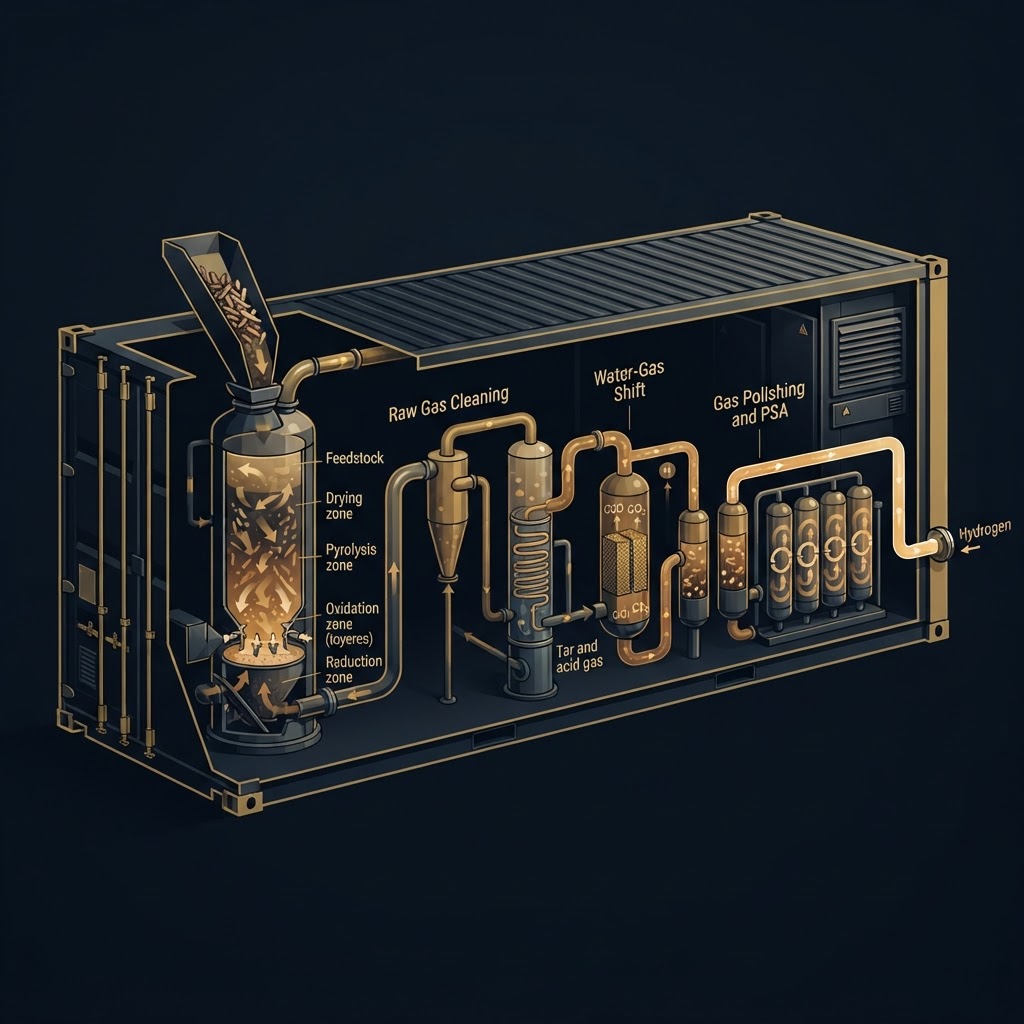
Search municipal solid waste to hydrogen and you get review papers and Aspen Plus models. They report yields in grams per kilogram, gas quality in volume percent, and cost in pounds, dollars and renminbi, and none of them tells a waste authority the three things it needs: how many kilograms of hydrogen a tonne of mixed waste gives, how far the raw gas is from something a fuel cell will accept, and which variables actually move the price per kilogram.
This article puts those three numbers in one place. Every laboratory figure is labelled as a laboratory figure. The one continuous-operation figure comes from a machine we run.
Why municipal solid waste is the hardest hydrogen feedstock
Mixed municipal waste is food, paper, textiles, plastic, inerts and water in proportions that change by district and by season. The world generated 2.01 billion tonnes of it in 2019, and only about a quarter of municipal waste was collected and recycled. The same review names what stops a plant: ash, sulfur, alkali metals, particulates and above all tar, the condensable organics that settle in filters and downstream equipment and cause interruptions.
A 2026 review from King Fahd University of Petroleum and Minerals reaches the same conclusion from the commercial side. It lists feedstock standardisation, contaminant management, gas cleaning, hydrogen purification and reactor scale-up as the open items between the laboratory and a plant. In other words, the chemistry is settled. The engineering of a dirty, variable feed is not.
If you want the full chain before the numbers, start with the four stages of a waste to hydrogen chain. For the gas cleaning problem specifically, see tar removal from syngas.
The pathways from mixed waste to hydrogen
Gasification: the mature route
Gasification is sub-stoichiometric thermal conversion: enough oxidant to break the waste into gas, not enough to burn it. The KFUPM review calls it the most mature thermochemical route for municipal waste, typically operating at 800 to 1100 C and producing raw syngas with 39 to 51 percent hydrogen by volume.
The oxidant decides the gas. A comparative model of air, oxygen, steam and sorbent gasification concludes that air gasification shows little merit for hydrogen: the nitrogen ballast dilutes the gas and the heating value is low. Oxygen avoids the nitrogen but needs an air separation unit. Steam gives the highest hydrogen fraction, about 33 percent more hydrogen per tonne than air or oxyfuel in that model, but the reactions are endothermic and the steam has to be raised somewhere. Sorbent beds such as calcium oxide or portlandite shift the gas toward hydrogen and capture CO2 in the bed at the same time.
That is why serious hydrogen projects run on oxygen, steam or both, and why Jenja campaign described below ran in oxy-steam mode with no nitrogen in the gas.
Pyrolysis, plasma and digestion
Pyrolysis runs without oxidant and splits the waste into char, oil and gas; it is better suited to plastics than to mixed waste, and we cover it in plastic waste gasification. Plasma gasification reaches higher temperatures and vitrifies the inerts at the cost of a large electrical load. Anaerobic digestion followed by biogas reforming works for the wet organic fraction and yields far less hydrogen per tonne. We compare all three families on real project data in six waste to hydrogen plants normalised to kg per tonne.
How much hydrogen per tonne of municipal waste
The honest answer is a range, and the range is wide because feedstock, oxidant and catalyst all move it. Across municipal waste, tyres and plastics, the 2024 survey in the journal Hydrogen reports yields from 15 to 300 grams of hydrogen per kilogram of feedstock. The municipal waste rows in its table are narrower:
| Condition | H2 in gas | Yield | Scale |
|---|---|---|---|
| Air-steam, 757.7 C, optimised by response surface | 41.36 mol% | about 32 g/kg (32 kg/t) | bench |
| Steam with dolomite catalyst, 900 C, steam to MSW 1.04 | 53.2 mol% | 86 g/kg measured, 140.4 g/kg potential | bench |
| Glasgow distributed gasification cost model | not stated | 71 kg/t | model |
Two cautions. First, the survey itself states that most municipal waste experiments were bench-scale, from micro to batch fixed-bed reactors, with only a few continuous fluidised beds and pilot plants at a feed capacity of 100 kilograms per hour. Second, the Glasgow figure of 71 kilograms of hydrogen per tonne of municipal waste is a model input used for a cost calculation, against 242 kilograms per tonne of natural gas in the steam methane reforming reference. A tonne of mixed waste carries less hydrogen than a tonne of methane, which is why gate fees matter so much to the economics below.
Purity: from 39 percent raw gas to fuel-cell grade
The raw gas leaving a municipal waste gasifier is 39 to 51 percent hydrogen by volume. The rest is carbon monoxide, carbon dioxide, methane, water and, if air was used, nitrogen. Sorption-enhanced catalytic gasification has reached 80.76 percent hydrogen under optimised laboratory conditions, which the KFUPM authors are careful to describe as an experimental result rather than a plant result.
Getting from there to a product takes two more unit operations. Water-gas shift converts carbon monoxide and steam into more hydrogen and CO2. Pressure swing adsorption then separates the hydrogen. In the reference steam methane reforming chain used by the Glasgow study, the shift stage converts 94 percent of the carbon monoxide and the adsorption stage delivers hydrogen at 99.99 percent purity. The same chain applies to waste-derived gas, with one difference: the gas must be tar-free and sulfur-free before it reaches the shift catalyst, or the catalyst dies.
This purification train is not a footnote on the budget. In a greenfield techno-economic model published in Green Chemistry, the water-gas shift section alone accounted for 37 percent of capital cost, dominated by the compressor, with the gasifier and syngas preparation together at 31 percent. The 2024 Hydrogen review says the same thing in plainer words: upgrading raw gas from waste gasification to hydrogen is rather costly and adds significantly to plant investment and operating cost.
On Jenja we attack this at the source. The COMETHA campaign measured 99.98 percent tar conversion inside the reactor, and the SyngaPure cleaning stage downstream removes 99 percent of remaining tar compounds while maintaining energy efficiency. SyngaPure, which monitors tar, hydrogen sulfide, ammonia and particulates in real time, was selected for German federal BMWK go-inno support in December 2025. What the shift catalyst sees is the point; the composition of the gas before cleaning is covered in syngas composition.
What actually drives the cost per kilogram
The KFUPM review's most useful finding for a buyer is that hydrogen production cost from municipal waste is governed primarily by electricity price, plant capacity factor, gate fees and carbon pricing, rather than by the conversion technology itself. The published models put magnitudes on each.
Gate fees and feedstock price
Municipal waste is the only hydrogen feedstock someone pays you to take. The Green Chemistry model shows how much that is worth: hydrogen from purchased mixed plastic at 0.60 dollars per kilogram carried a minimum selling price of 3.41 dollars per kilogram against 1.15 for fossil hydrogen, and that price falls to 1.35 dollars at zero feedstock cost. The model's municipal waste case had annual operating cost of 12 million dollars against 60 million for the plastic case, almost entirely because the waste was not purchased. The idea is old. A 1990s Lawrence Livermore and Texaco programme already treated the tipping fee as a credit against the cost of hydrogen, with United States fees then ranging from 20 to over 100 dollars per ton. The contractual question for a municipality is whether the gate fee stays with the project or disappears into the waste contract.
Capacity factor and continuous operation
The Glasgow study found that for thermochemical routes capital cost had the largest effect on the levelized cost, and its 2.22 pounds per kilogram for municipal waste gasification assumes a 90 percent capacity factor, which is 7,884 hours a year. Every hour a gasifier is down for tar fouling or slag is an hour of capital earning nothing. This is why continuous-run hours on real waste are the first thing to ask any supplier, and why we publish ours.
Electricity price and carbon pricing
Oxygen production, compression for the shift and adsorption stages, and any plasma or electric heating all draw power, so the electricity tariff feeds straight into the cost per kilogram. Carbon pricing cuts the other way: the KFUPM life-cycle results show lower greenhouse gas emissions than steam methane reforming in every study reviewed, but carbon-negative performance only under specific assumptions, namely carbon capture and storage, avoided landfill emissions, renewable electricity and biogenic carbon accounting. A project that claims carbon-negative hydrogen without naming those four assumptions is quoting someone else's model.
Syngas yield
The Green Chemistry sensitivity analysis found that cutting syngas yield to 1 kilogram of dry gas per kilogram of feed raised the hydrogen selling price by 32 percent, because unconverted solids are paid for twice: once as lost gas and once as residue disposal at the 59 dollars per tonne United States average tipping fee. Carbon conversion in the reactor is an economic variable, not just a process one.
For comparison across regions, a 2025 model for a 500 tonne per day wet municipal waste plant in China using drying, torrefaction and entrained-flow gasification put total investment at 523 million renminbi, equipment at 42 percent of it, and hydrogen cost at 15.38 renminbi per kilogram, which the authors state is well below electrolysis in the same market. It also found that raising torrefaction temperature from 220 to 300 C cut hydrogen yield by 7.8 percent, a reminder that pretreatment is part of the yield equation. Where public money closes the capital gap, see grants for waste-to-energy projects.
What has run on real municipal waste
The literature stops at 100 kilograms per hour of feed and at batch runs measured in hours. Our reference point is different in kind. The first Zero-X waste-to-hydrogen reactor became operational in Paris in May 2024 within the COMETHA project, fed by household waste and sewage sludge.
The campaign that followed ran Jenja for 1,939 continuous hours, 80 consecutive days, processing 16,382 kilograms of digestate pellets with 33 percent hydrogen in the syngas, 99.98 percent tar conversion and a hydrogen to carbon monoxide ratio of 1.95 to 1 in oxy-steam mode with zero nitrogen ballast. Read that against the table above: 33 percent hydrogen in an uncleaned gas from a difficult real feedstock, at the low end of the 39 to 51 percent laboratory band, sustained for eleven weeks rather than for one afternoon. We report gas composition rather than kilograms per tonne for that run because the campaign was configured for syngas quality, not hydrogen separation, and we would rather give you the number we measured.
The platform is a containerized 150 kilogram per hour fixed-bed downdraft gasifier, independently validated at COMETHA in Paris, at Verkoso with Fraunhofer IKTS and at Hochschule Zittau/Goerlitz, on high-ash sewage sludge, municipal solid waste and digestate, the feedstocks that clean-wood gasifiers cannot handle. The sludge route has its own article in hydrogen from sewage sludge.
Before you commission a feasibility study
Five questions settle most municipal waste to hydrogen proposals before a consultant is paid.
- Continuous hours on waste like yours. Not on wood pellets, not on refuse-derived fuel someone else sorted. Ask for the longest unbroken run and the feedstock analysis for it.
- Oxidant and nitrogen. If the gasifier is air-blown, the gas is not a hydrogen feed. Ask for the oxidant mode and the nitrogen fraction of the raw gas.
- Where the purification capital sits. Shift, compression and adsorption can be a third or more of the plant. Ask whether the quoted capital cost includes them.
- Who keeps the gate fee. The economics above only work if the project captures it.
- The carbon accounting basis. Ask which of the four KFUPM assumptions the carbon claim depends on.
Suppliers who answer all five with numbers are rare. We list the ones we know of in waste to hydrogen companies. Two sibling articles are in preparation on the cleaner single-stream feeds, food waste to hydrogen and plastic waste to hydrogen fuel.
FAQ
How much hydrogen can you get from one tonne of municipal solid waste? Published municipal waste gasification data runs from about 32 kilograms per tonne in air-steam bench tests to 86 kilograms per tonne measured with a dolomite catalyst, and a Glasgow cost model uses 71 kilograms per tonne. All of these are laboratory or model figures; treat any supplier number above them with care.
What temperature does municipal solid waste gasification run at? Typically 800 to 1100 C. In that range the raw syngas carries 39 to 51 percent hydrogen by volume before any shift or purification step.
Is hydrogen from municipal waste cheaper than green hydrogen? In the published models, yes, provided the project keeps the gate fee: 2.22 pounds per kilogram in a Glasgow municipal waste gasification scenario and 15.38 renminbi per kilogram in a 500 tonne per day Chinese model, both below electrolysis in those studies. Neither model is a quotation.
Is municipal solid waste to hydrogen carbon negative? Only under specific assumptions: carbon capture and storage, avoided landfill emissions, renewable electricity and biogenic carbon accounting. Without them it is lower-carbon than steam methane reforming, not negative.
Why can't you gasify municipal waste with air if you want hydrogen? Air adds nitrogen ballast and yields a low-value gas. Oxygen or steam is required, and steam gasification gives about 33 percent more hydrogen per tonne than air or oxyfuel in a comparative model.
We use cookies to improve your experience on this site. By continuing, you agree to our Privacy Notice.