Food Waste to Hydrogen: Which Routes Work for Wet Feedstock
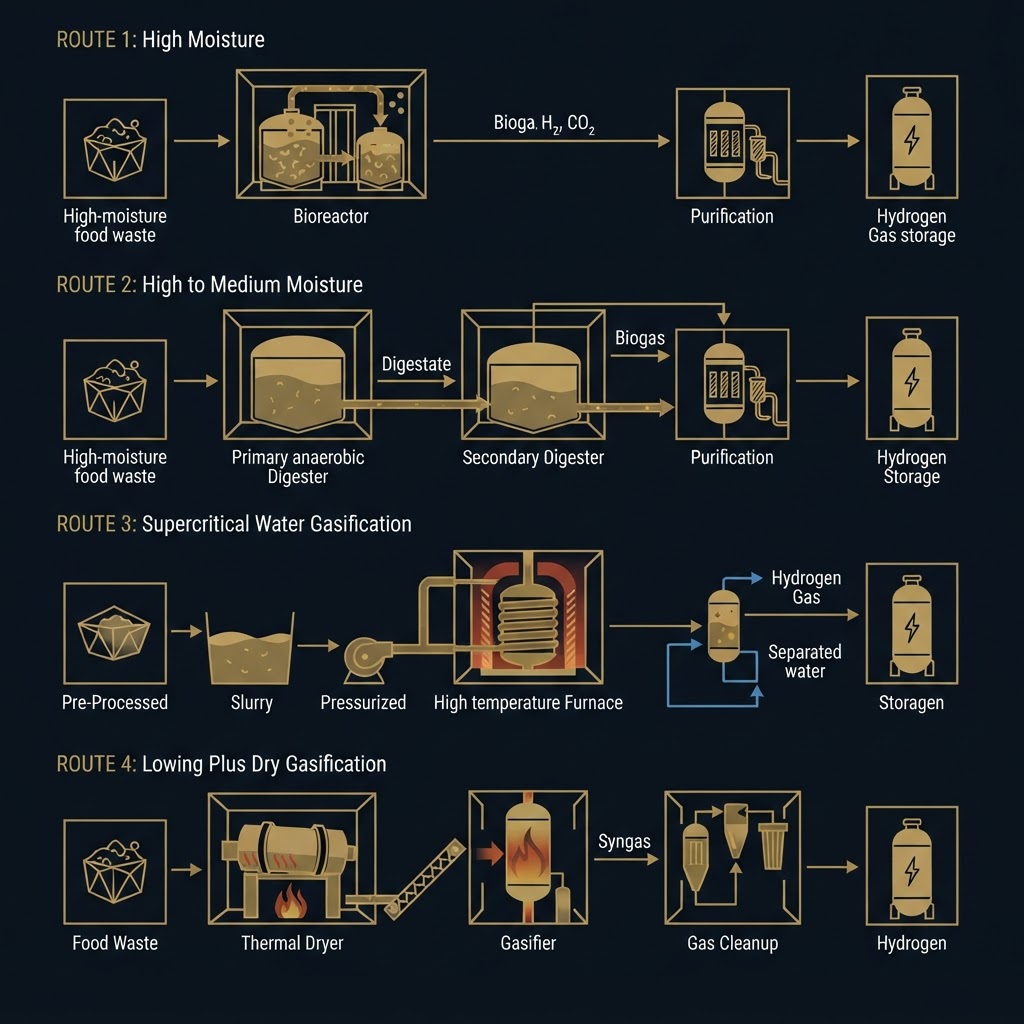
Food waste to hydrogen sounds like a single technology. It is four, and the thing that separates them is water. Food waste arrives at 60 to 90 percent moisture according to a 2024 review of dark fermentation feedstocks, and every route is really a decision about what to do with that water: ferment it, pressurise it, digest it first, or dry it out.
Search the phrase and you get biology papers that rank routes by laboratory yield. This article sorts them by the question an operator asks: what feed does it take as delivered, what gas comes out, and whether anyone has run it for longer than an afternoon. Every number is tied to its source and labelled for what it is.
The short answer: four routes, sorted by what they do with the water
- Dark fermentation uses the water. Bacteria convert sugars to hydrogen and carbon dioxide at near-ambient conditions. Best studied, lowest energy input, lowest yield.
- Two-stage digestion uses the water and takes hydrogen as a side product before the methane stage. Mature equipment, but hydrogen is the minor gas.
- Supercritical water gasification uses the water as the reaction medium above its critical point. Accepts the wettest feed, pays for it in pressure.
- Dry gasification removes the water first, then converts the dried solid thermochemically to a hydrogen-rich syngas. The only route on this page with field hours, and the honest caveat is that those hours were on digestate pellets, not raw food waste.
Why food waste is a wet-feedstock problem first
The composition table in the same dark fermentation review is the reason the routes diverge. Kitchen food waste is about 81.5 percent moisture and 18.5 percent total solids. Volatile solids sit between 10 and 180 grams per litre, and degradable carbohydrates make up 41 to 62 percent of the organic fraction. Those carbohydrates are what makes fermentation attractive. The moisture is what makes a fixed-bed gasifier refuse the material as delivered.
For comparison, the digestate pellets that fed the Zero-X Paris campaign were a dried, densified product. Nothing on this page turns a wet bin into syngas in one step, and any vendor who says otherwise is describing a dryer they have not mentioned.
Route 1: dark fermentation, the route the papers love
What the yields actually are
The ceiling is set by chemistry. The acetate pathway yields at most 4 moles of hydrogen per mole of hexose sugar, per Sahota, Kumar and Lombardi's 2024 review of biogas, biohydrogen and biohythane from food waste. Real reactors get a fraction of that. The same review cites a batch result of 148.7 millilitres of hydrogen per gram of volatile solids from cafeteria waste pretreated at 90 degrees Celsius, which is near the top of the published range.
A more typical result comes from Florio and colleagues, who ran mesophilic batch fermentation at 37 degrees Celsius on food waste with 63.5 percent moisture. After acclimating the inoculum they reached about 35 millilitres of hydrogen per gram of volatile solids in three days, with hydrogen making up 55 percent of the gas. They put the theoretical energy recovery at about 34 kilowatt hours per tonne of food waste. That is a lab figure in 100 millilitre bottles, and it is the right order of magnitude to plan around.
Why it stalls at industrial scale
The obstacle is not the bacteria. Sahota's review lists hydrogen-consuming organisms such as homoacetogens and methanogens that eat the product unless pH is held around 5, and it states plainly that stand-alone acidogenic processes are not economically viable for industrial-scale food waste treatment because they recover too little energy on their own. Fermentation makes hydrogen cheaply but leaves most of the energy in the liquid effluent. That is why every serious proposal pairs it with a second stage.
Route 2: two-stage digestion, hydrogen as the minor product
Pairing a fermentation stage with a methane digester is the configuration with the most operating experience. In a long-term recirculated two-phase digestion trial on food waste mixed with up to 50 percent paper waste, the first stage produced 50 to 79 normal litres of hydrogen per kilogram of volatile solids fed, while the second produced 329 to 426 normal litres of methane. Adding paper raised hydrogen and lowered methane.
Read those numbers as a ratio. Hydrogen is a few percent of the energy leaving a digester. If the goal is hydrogen specifically, the digester is not the hydrogen plant. What it does produce in quantity is digestate, a wet solid that still carries carbon, and that is the feed that leads into the fourth route.
Route 3: supercritical water gasification, built for wet feed
Supercritical water gasification was designed for exactly this material. Work on sludge-class feed shows it accepts feedstock above 50 percent moisture with no drying step, because water above 220 bar and 374 degrees Celsius becomes the solvent and the reactant at once, and the product gas is hydrogen-rich with carbon dioxide as the main carbon compound.
The price is the pressure. The published work is batch reactors with minutes of residence time, and the authors flag corrosion and plugging from salts and ash as open problems. For food waste, which carries salt from kitchens, that is not a footnote. No continuous supercritical plant on food waste has published run hours that we could cite, so this route sits at the research stage for now.
Route 4: dry gasification of digestate, the only route with field hours
What the COMETHA campaign measured
Fixed-bed gasification is the thermochemical route with real operating data, with the condition that the feed arrives dry. A review of municipal solid waste gasification puts the operating window at 800 to 1100 degrees Celsius and the hydrogen content of the syngas at 39 to 51 percent by volume depending on gasifying agent and feed.
Zero-X's Jenja, a containerised 150 kilogram per hour downdraft gasifier, ran a 1,939-hour continuous campaign at the COMETHA site in Paris, 80 consecutive days, processing 16,382 kilograms of digestate pellets. In oxy-steam mode with no nitrogen ballast the syngas held 33 percent hydrogen at a hydrogen to carbon monoxide ratio of 1.95 to 1, with 99.98 percent tar conversion. The reactor had been operational since May 2024, fed by household waste and sewage sludge within the same project.
Tar is the figure that matters for hydrogen. Fermentation makes a clean gas and little of it. Gasification makes a lot of gas and dirties it. SyngaPure, the modular cleaning train behind those numbers, removes 99 percent of tar compounds with real-time tar, hydrogen sulphide, ammonia and particulate sensing, and was selected for the German BMWK go-inno programme in December 2025. Without a cleaning step of that grade, syngas hydrogen stays in the engine and never reaches a separation unit.
What this does and does not prove for food waste
It proves that the dried, digested fraction of organic waste can run continuously for months at a hydrogen content that fits the published thermochemical window, on a feed that clean-wood gasifiers do not handle. The platform has been validated independently at COMETHA, at Fraunhofer IKTS and at Hochschule Zittau/Goerlitz on high-ash sludge, municipal waste and digestate.
It does not prove that raw food waste at 80 percent moisture goes straight into the hopper. The honest process chain is digestion first, then dewatering and pelletising, then gasification of the digestate for hydrogen-rich syngas. The digester takes the water out of the problem and the gasifier takes the carbon that the digester left behind. We describe it that way because a food waste to hydrogen plan that skips the drying step is a plan that will not commission.
Choosing a route for your stream
| Your situation | Route that fits | What to check first |
|---|---|---|
| Wet stream, small volume, research budget | Dark fermentation | Energy recovery per tonne, effluent handling |
| Wet stream, existing or planned digester | Two-stage digestion, then gasify the digestate | Digestate drying energy and pellet quality |
| Very wet, salty, no drying possible | Supercritical water gasification | Continuous run data, corrosion, pressure rating |
| Dried or pelletised organics available | Dry gasification with gas cleaning | Tar removal performance, validated hours |
Two numbers decide most projects. The first is drying energy, which no fermentation paper reports because fermentation does not need it. The second is public funding: in Zero-X Wave 1 markets governments cover 56 to 70 percent of project CAPEX, validated in Cadiz, Alentejo and Patras, and that changes which route a municipality can afford to build rather than study.
If your organic stream is sludge rather than kitchen waste, the route comparison is similar but the numbers differ; see our breakdown of hydrogen from sewage sludge. For the chemistry between gasifier and hydrogen outlet, read how waste to hydrogen works. The wider market picture is in our waste to hydrogen overview, and the dry-fraction counterpart to this article is municipal solid waste to hydrogen.
FAQ
Can you make hydrogen directly from raw food waste?
Yes, by dark fermentation or supercritical water gasification, both of which accept feed at the 60 to 90 percent moisture that food waste typically carries. Dry gasification needs the material dewatered and pelletised first, which in practice means digesting it and gasifying the digestate.
How much hydrogen does dark fermentation of food waste produce?
Published batch results range from about 35 to 148.7 millilitres of hydrogen per gram of volatile solids, against a theoretical ceiling of 4 moles of hydrogen per mole of hexose sugar. Hydrogen content of the gas is around 55 percent, the rest being mostly carbon dioxide.
Is food waste to hydrogen commercially viable?
Not as a stand-alone fermentation process: a 2024 review concludes acidogenic processes recover too little energy to be economically viable at industrial scale on their own. Viability improves when fermentation is paired with digestion, and when the dried digestate is gasified with grant support covering most of the CAPEX.
What hydrogen content does gasified digestate give?
In the Zero-X COMETHA campaign, digestate pellets gasified in oxy-steam mode gave 33 percent hydrogen in the syngas over 1,939 continuous hours, inside the 39 to 51 percent window reported for municipal waste gasification once nitrogen-free operation and feed differences are accounted for.
We use cookies to improve your experience on this site. By continuing, you agree to our Privacy Notice.