Hydrogen From Sewage Sludge: 4 Routes, Real Numbers
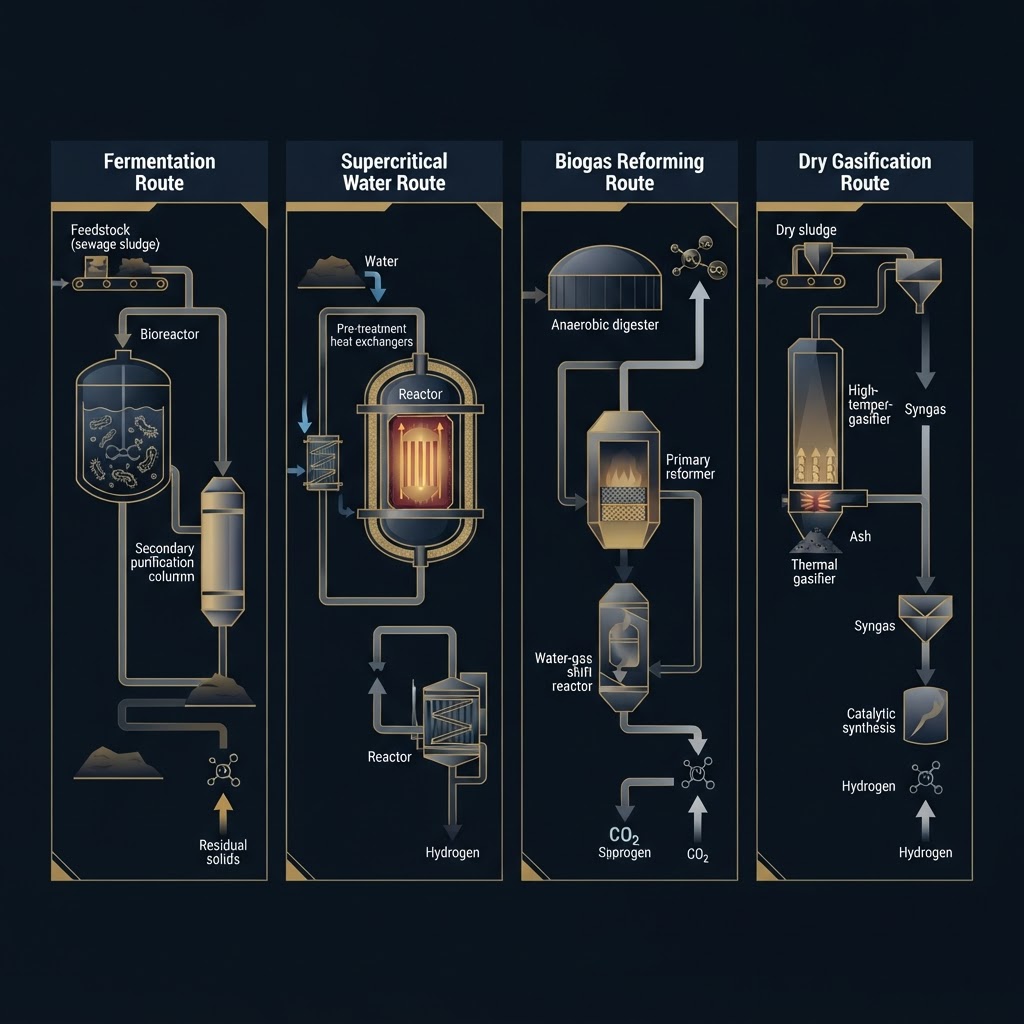
Hydrogen from sewage sludge can be made four ways: bacteria, supercritical water, reforming the biogas a digester already produces, or dry thermochemical gasification. Search the phrase and you get review papers that rank those routes by laboratory yield. What they rarely tell a utility engineer is which of them has run for longer than an afternoon, and what the gas looks like when it comes out.
This article compares all four on the questions an operator actually asks. Every number is tied to its source and labelled for what it is: a lab result, a model, or a measured plant figure.
The short answer: four routes, one running at commercial scale
The most cited review of the field, by Liu and colleagues, covers photo fermentation, dark fermentation, sequential dark and photo fermentation, pyrolysis, gasification and supercritical water gasification, and its conclusion is blunt: none of these techniques can be regarded as mature. Biological pathways remain at laboratory stage. Supercritical water gasification is still developing. Gasification and pyrolysis are the relatively mature pair, but lack commercial applications and standardised production.
The clearest commercial-scale sludge hydrogen plant we could find does not use any of the direct routes. Hyundai's HTWO Energy Cheongju in South Korea digests the sludge first, upgrades the biogas to biomethane and then steam reforms it. That distinction matters, and we come back to it below.
Why the yields in the papers do not compare
Before looking at any number, know the trap. The same Liu review notes there is no unified standard for measuring sludge hydrogen output: biological yields are reported as material efficiency, while thermochemical yields are reported as the hydrogen share of the syngas. A fermentation paper quoting moles of hydrogen per mole of substrate and a gasification paper quoting a volume percentage are not on the same axis.
So the useful comparison is not "which number is biggest". It is feed, readiness, what leaves the site, and what goes wrong.
Route 1: dark and photo fermentation
What the bacteria need
Dark fermentation uses acidogenic bacteria to break sugars into organic acids and hydrogen. When the acetate and butyrate pathways run together, the theoretical ceiling is 2.5 mol of hydrogen, per the Liu review. Sludge brings its own problem: mixed cultures contain hydrogen-consuming bacteria, so pretreatment is necessary before the process produces anything useful.
Operating conditions are still contested. Some groups find pH 5.5 to 6.5 optimal because hydrogen forms in the acidogenic stage; others hold pH near 10 to suppress propionic acid and the hydrogen consumers. When researchers disagree about the pH window, the process is not ready for a municipal tender.
Where it stands
Biological routes win on cost and lose on speed. The review is clear that their reaction rates trail thermochemical methods, and that sequential dark plus photo fermentation delivers the best biological yield at a slower rate than dark fermentation alone.
A newer lab variant deserves a mention because it tops many searches. Researchers at NTU Singapore built a solar-driven electroreforming process that recovers 91.4 percent of the organic carbon in sludge and generates up to 13 litres of hydrogen per hour at 10 percent energy efficiency. The team itself flags that scale-up, electrochemical cost and plant integration are unproven. For planning purposes, this is a research result, not an option.
Route 2: supercritical water gasification
Why wet sludge suits it
Above 374.15 degrees C and 220.64 bar, water stops behaving like water. It dissolves organic matter, acts as both reactant and catalyst, and gasifies the sludge with sharply reduced tar and char. The decisive advantage for sludge is that feed with more than 50 percent moisture can go in directly, with no drying step. Sludge is mostly water, so that is not a small point.
The numbers
The lab results are genuinely strong:
- A batch study reached a hydrogen fraction of 55.72 percent and a yield of 19.86 mol per kg at 27 MPa after 6 minutes, with a phosphorus release rate of 98.74 percent under oxidising conditions.
- Chen and co-workers reported 20.66 mol per kg and 73.49 percent gasification efficiency at 750 degrees C and 30 minutes, without catalyst.
- With alkali catalysts at 550 degrees C, another group reached 41 mol per kg, with a gas of 58 percent hydrogen, 26 percent CO2, 11.7 percent methane and 4 percent CO.
The phosphorus result is worth underlining for German operators, who face a recovery obligation. We cover the regulatory side in phosphorus recovery from sewage sludge.
What stops it
Liu and colleagues list three barriers: corrosion, plugging and high running investment. Salts precipitate when water goes supercritical, and the reactor runs at pressures that make every fitting expensive. The economic case is conditional. The assessment they cite puts SCWG on par with natural gas reforming at 6.82 EUR per GJ only when sludge treatment revenue reaches 211 EUR per tonne of dry matter.
A 2024 techno-economic model built on plant data from a Norwegian treatment works puts the trade-off in plain terms. At 7 wt percent sludge, SCWG converted energy at 46.6 percent against 25.8 percent for anaerobic digestion, rising to 73.2 percent at 15 wt percent. It also cost 6.83 million USD against 4.08 million for digestion, and under the study's assumptions neither plant returned a positive net present value.
Route 3: biogas reforming and methane splitting
This is the route that is actually producing. Cheongju sits on a 7,500 square metre public wastewater site and chains a biogas upgrader, a steam methane reformer and a liquefied CO2 unit. It produces about 500 kg of hydrogen per day, enough for about 100 Nexo cars or 30 buses, with a target of 2 tonnes per day by 2030.
In Manchester, United Utilities is trialling Levidian's LOOP device at Davyhulme, which splits biogas methane into hydrogen and solid graphene. The two firms estimate UK sewage biogas could support up to 75,000 tonnes of hydrogen a year. That is their projection, not a measured output.
The limit is structural. These plants only turn the fraction of sludge that digestion converts into methane into hydrogen, so their ceiling is set by how much biogas sewage sludge actually yields. Digestate is left over, and it still needs a destination.
Route 4: dry thermochemical gasification
Where the hydrogen comes from
Conventional gasification runs sludge at 800 to 1500 degrees C with a limited oxidant. Adding steam raises the hydrogen share, and the carbon monoxide in the syngas can be shifted into more hydrogen, with CO2 as the only by-product. The chemistry is well known. For the full stage by stage walk through, see how waste to hydrogen works; for what the sludge itself does to a reactor, see our piece on sewage sludge gasification.
The problem is the gas, not the reactor
Sludge is high in ash, and dirty syngas is where hydrogen projects die. Tar, H2S, ammonia and particulates all have to come out before the hydrogen can be separated and used, which is why tar removal from syngas gets its own engineering budget. A route that makes hydrogen but cannot deliver clean gas has not made usable hydrogen. This is why we break down what the gas actually contains before any talk of yield, and why the syngas composition matters more than the peak hydrogen figure.
What our reactor measured
This is where we can add something the reviews cannot. Zero-X's first waste-to-hydrogen reactor went operational in Paris in May 2024 within the COMETHA project, fed by household waste and sewage sludge.
The long campaign that followed ran the X-150, a 150 kg per hour fixed-bed downdraft unit, for 1,939 continuous hours. To be precise about the feed: that campaign processed 16,382 kg of digestate pellets, not raw sludge. The measured results:
- 33 percent hydrogen in the syngas
- 99.98 percent tar conversion
- an H2 to CO ratio of 1.95 in oxy-steam mode, with zero nitrogen ballast
Gas cleaning is handled by SyngaPure, which removes 99 percent of tar compounds and monitors tar, H2S, NH3 and particulates in real time. It was selected for Germany's BMWK go-inno programme in December 2025. The platform has been validated at COMETHA, Fraunhofer IKTS and Hochschule Zittau/Goerlitz on high-ash sludge, MSW and digestate, the feedstocks that clean-wood gasifiers cannot handle.
Compare that 33 percent with the 55 to 58 percent from supercritical water and the lab route looks better on paper. The difference is that one figure came from a batch vessel over minutes, the other from 80 days of continuous operation with the tar problem solved.
Which route fits which plant
| Route | Feed | Readiness | What leaves the site | Main risk |
|---|---|---|---|---|
| Dark and photo fermentation | Wet sludge, pretreated | Laboratory | Hydrogen plus organic acids | Slow rates, unstable cultures |
| Supercritical water gasification | Wet sludge, no drying | Developing | Hydrogen-rich gas, phosphorus in solution | Corrosion, plugging, capital cost |
| Biogas reforming or splitting | Digester biogas | Commercial | Hydrogen, plus digestate still to dispose of | Ceiling set by methane yield |
| Dry gasification | Dewatered or pelletised sludge | Continuous field campaigns | Syngas for hydrogen, mineral char | Gas cleaning |
If you already run digesters and need hydrogen soon, reforming is proven. If you want the whole sludge mass converted and can accept drying, dry gasification with serious gas cleaning is the route with operating hours behind it. SCWG is the one to watch, and fermentation is the one to fund as research.
FAQ
Can you make hydrogen from sewage sludge without drying it?
Yes. That is supercritical water gasification's main advantage: it accepts feed above 50 percent moisture. The price is operating above 220 bar, with corrosion and plugging risk. Dry gasification needs dewatered or pelletised feed.
Is hydrogen from sewage sludge cheaper than hydrogen from natural gas?
Only under specific conditions. The SCWG assessment cited by Liu and colleagues reaches parity with natural gas reforming at 6.82 EUR per GJ only when sludge treatment revenue reaches 211 EUR per tonne of dry matter. The gate fee, not the gas, decides the economics.
Can phosphorus be recovered at the same time as hydrogen?
In supercritical water lab work, yes: one batch study released 98.74 percent of the phosphorus while producing a hydrogen-rich gas. Dry gasification leaves phosphorus in a mineral char, which is a different recovery path.
How much hydrogen does a sewage sludge plant produce?
The commercial reference is Hyundai's Cheongju plant, at about 500 kg per day via biogas reforming, enough for about 100 fuel cell cars. Its target is 2 tonnes per day by 2030.
Available for advisory work, board seats and media appearances.
Julien Uhlig advises boards and funds and briefs newsrooms across Europe and North America. Enquiries are read personally.
We use cookies to improve your experience on this site. By continuing, you agree to our Privacy Notice.