Tar Removal From Syngas: What 99.98% Conversion Takes
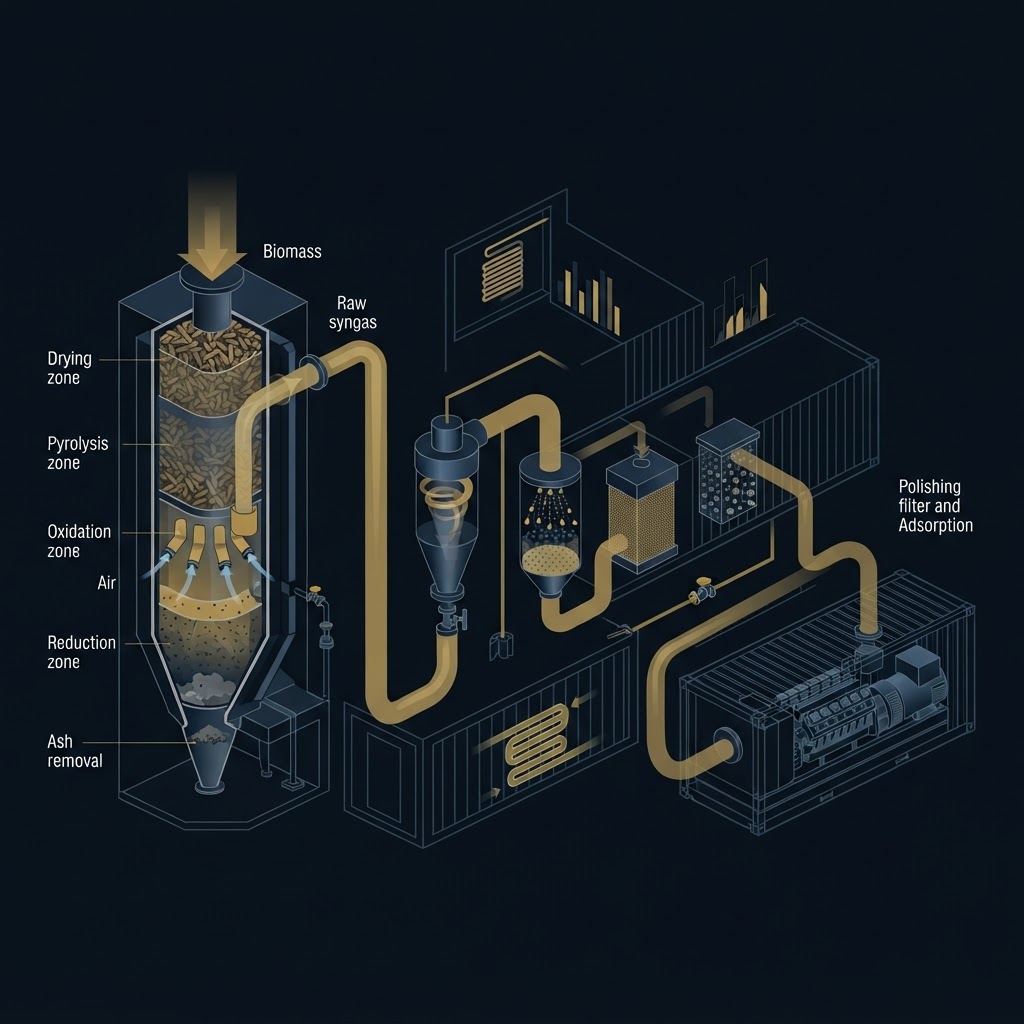
Gasification projects rarely fail because the gasifier does not gasify. They fail because tar removal from syngas was specified as a percentage instead of as an outlet concentration, and the plant that hit its conversion target on the commissioning report still gummed the engine in month three.
Here is the gap the cleaning train has to close. Raw producer gas carries anywhere from 0.1 g/m3 out of a co-current fixed-bed reactor to 150 g/m3 out of a counter-current one, while an internal combustion engine running combined heat and power tolerates a maximum of 0.01 g/m3. That is up to four orders of magnitude. Everything below is about how each family of methods behaves against that spec, and it is why tar removal, not the reactor, is the cost barrier for small-scale gasification-to-power.
What tar actually is, and why it only becomes a problem downstream
Tar is not one compound. It is a mixture of condensable hydrocarbons running from single-ring to five-ring aromatics plus oxygen-containing organics, and of all the contaminants in the gas stream it is the most difficult one to remove.
Condensation is the mechanism, not combustion
The gas leaving a hot reactor is fine. Tar becomes a problem when the gas cools below the tar dew point and condenses, at which point it blocks fuel lines, filters, engines and turbines. Downstream you get pipeline fouling, corrosion, deactivated catalysts and a measurable drop in cold gas efficiency and heating value.
This is why the failure is always delayed. The gas passes its analysis at the sample point and destroys equipment 20 metres later.
The tolerance is set by the offtake, not by the gasifier
Most syngas applications need 0.05 g/m3 or less, and an air-blown circulating fluidized bed typically produces around 10 g/m3 raw, with the range across gasifier types running from 0.5 to 100 g/m3. The offtake sets the ceiling: an engine is stricter than a burner, and a hydrogen or chemical-grade route is stricter than an engine. Choose the end use first and the number falls out of it. Which geometry you started from matters too, and that is a separate question about the gasifier geometries.
Primary methods inside the reactor, secondary methods after it
Every serious treatment of the subject splits the field the same way, into primary and secondary methods.
Primary methods act in situ, inside the reactor: tuning operating conditions such as temperature, equivalence ratio and steam-to-biomass ratio, improving reactor design, or putting catalyst in the bed so tar cracks where it forms. Secondary methods act ex situ, downstream: either physically separating tar from the gas or destroying it in a thermal or catalytic step.
The honest finding from that same review is the one vendors skip: primary methods may not be efficient enough to remove tar completely, and real plants combine both families. Fixed-bed downdraft geometry is the low-tar starting point rather than the solution, which is why the Zero-X X-150 is a containerized fixed-bed downdraft platform with a dedicated cleaning stage behind it rather than a clever reactor sold as a complete answer.
Scrubbing works, and it costs you the gas
Wet cleaning is mature, cheap and genuinely effective at capturing particulate. On tar it is weaker than its reputation. Venturi scrubbers remove up to 99% of particulate matter but only 50% to 90% of tar, and swapping the working fluid buys single-digit gains: an acetone venturi reached an optimum 89% tar collection, while an emulsified oil absorbent at 7.5% water by volume managed 89.3% against 75.0% for pure canola oil. Measured on a countercurrent rice husk gasifier, venturi tar separation efficiency ranged from 51% to 91%.
Across all the mechanical options, scrubbers, cyclones, electrostatic precipitators and rotational particle separators, you can reduce 40% to 99% of the tar. But the same source names the penalty plainly: the energy in the tar is lost. Physical capture does not convert anything. It moves the problem.
That leaves three structural costs, all of them named in the literature rather than inferred:
- Energy. Wet methods need significant heating and cooling steps, and you pay for both.
- A liquid stream. You now own contaminated water that must be treated or recycled, and tar emulsified in water is difficult to separate.
- Lost chemical energy. The tar's calorific value leaves in the waste stream instead of staying in the gas you sell.
For a small plant, that third item is the one that decides the business case. Tar is fuel. Throwing it away is a choice, and at the 150 kg/h scale where small-scale waste-to-energy systems live, it is an expensive one.
Cracking and reforming: converting tar instead of collecting it
The alternative is to destroy the tar and keep its energy in the gas as hydrogen and carbon monoxide. This is why catalytic reforming is judged the most cost-effective pathway to removing tar, and why catalytic treatment is considered the best option for tar elimination despite its cost.
Thermal cracking alone underperforms
Heat the raw gas hard enough and tar molecules break into lighter gases. In practice biomass tar is refractory and hard to crack by thermal treatment alone, and the numbers show it: secondary thermal cracking topped out around 74% in a direct comparison against a venturi scrubber's 89%. Thermal cracking is a supporting stage, not a cleaning system.
Catalytic reforming, and what kills the catalyst
Catalysts have to work at 600 C to 900 C in a stream loaded with hydrogen, carbon monoxide, carbon dioxide and steam, which narrows the field fast.
Dolomite is the popular cheap answer. It is abundant, inexpensive and can deliver 95% or more tar conversion. Its failure modes are mechanical and thermal: attrition, elutriation and coke formation. Nickel is the reference catalyst, roughly 8 to 10 times more active than dolomite for tar reforming, and transition-metal catalysts can remove tar completely within 900 C. But complete conversion over nickel needs temperatures above 800 C in the first place, and nickel dies of coke deposition, metal sintering and sulfur or chloride poisoning. On a sludge or mixed-waste feed, sulfur is not hypothetical.
The direction the reviews converge on is integration: catalytic cracking combined with physical removal, not one or the other. Which is a polite way of saying that no single stage gets you to 0.01 g/m3.
Why bench percentages mislead buyers
Now do the arithmetic that vendor decks leave out.
Take 95% conversion, the dolomite headline number, on a raw gas at 30 g/m3, comfortably inside the observed range. You exit at 1.5 g/m3. Against an engine ceiling of 0.01 g/m3 you are still 150 times over spec. Against the 0.05 g/m3 that most applications need, you are 30 times over. A 95% number is not a passing grade, it is one stage of several, and a conversion percentage quoted without an inlet concentration is not a specification at all.
Then there is duration. The best-documented catalytic result on this topic is a genuinely good one: a Pt-promoted Ni-Fe-Cr catalyst on a ceramic fibre filter held 93% naphthalene conversion for at least 100 hours with no observed deactivation, with a pelletized version above 80% for 70 and 110 hours. As catalyst science that is a real result. As a plant specification, 100 hours is roughly four days.
This is the gap that produces the industry's demonstration graveyard, and it explains why practitioners end up on forums openly doubting whether tar cracking works at all. They are not confused about the chemistry. They have been sold hour-one numbers and lived with month-three results.
The question to ask a vendor is therefore not what conversion rate the system achieves. It is: what outlet concentration, held for how many continuous hours, on which feedstock.
What sustained tar conversion looks like in a running plant
Zero-X answers that question with an 80-day continuous campaign rather than a test-bench figure. In the COMETHA project in Paris, an X-150 ran 1,939 consecutive hours and processed 16,382 kg of digestate pellets at 99.98% tar conversion, producing 33% hydrogen in the syngas at an H2/CO ratio of 1.95:1 in oxy-steam mode with zero nitrogen ballast. Digestate is not clean wood. It is a high-ash, awkward feed, which is the point of running the campaign on it.
Set the numbers side by side. Ninety-nine point nine eight percent against ninety-five leaves 4,000 times less tar in the gas at the same inlet loading. Nineteen hundred hours against one hundred is the difference between a catalyst result and an operating record.
SyngaPure: measuring the contaminant instead of assuming it
The cleaning stage behind that number is SyngaPure, which removes 99% of tar compounds while maintaining energy efficiency, which is what makes waste-to-hydrogen and chemical-grade syngas routes reachable rather than aspirational. Related routes for the cleaned gas are covered separately under hydrogen from waste and what actually sits in the syngas.
The mechanism worth borrowing, whoever you buy from, is the instrumentation. SyngaPure is a modular AI-supported cleaning system with real-time sensing of tar, H2S, NH3 and particulates feeding closed-loop control, and it was selected for support under the German BMWK go-inno programme in December 2025 on that basis.
That is not a marketing distinction. A catalyst bed rated at commissioning and then left alone will drift as it cokes, and nobody finds out until the engine does. A system that measures tar continuously can respond to the drift while it is still a control problem. Most plants do not measure tar continuously. That is the actual difference between a cleaning stage and a cleaning system.
The platform has been independently validated at Paris COMETHA, at Verkoso with Fraunhofer IKTS and at Hochschule Zittau/Goerlitz, on high-ash sludge, municipal solid waste and digestate, feedstocks that clean-wood gasifiers cannot handle.
The gas cleaning spec to write before you buy anything
None of the above requires you to take a vendor's word for anything. Take these five questions into the conversation instead.
- State the end use, then derive the ceiling. Engine in CHP service means 0.01 g/m3. Most other applications mean 0.05 g/m3 or less. Write the number down before anyone quotes you a percentage.
- Demand outlet concentration, not conversion rate. A percentage is meaningless without the inlet loading it was measured against. Ask for g/m3 at the outlet.
- Ask over what continuous duration it was held. Hours, not a single test point. If the answer is around 100 hours, you are being shown catalyst research, and there is nothing wrong with that as long as you know it.
- Ask which feedstock. Clean wood proves very little. High-ash sludge, mixed municipal waste and digestate are where fixed-grate systems and nickel beds fall over.
- Ask where the tar's energy goes. Reformed into hydrogen and carbon monoxide that stay in your gas, or condensed into a wastewater stream you now have to treat. That single answer moves the operating economics more than the headline efficiency does.
Tar removal is the part of a gasification project that decides whether the rest of it runs. It is also the part most often specified in a way that cannot be verified. If you are still weighing thermal routes against each other, the same discipline applies to gasification versus incineration: ask what was measured, for how long, on what.
FAQ
How much tar is in raw syngas?
Reactor geometry decides it more than feedstock does. Raw gas runs from 0.1 g/m3 for a co-current fixed-bed reactor up to 150 g/m3 for a counter-current one, with an air-blown circulating fluidized bed sitting around 10 g/m3.
What tar level does a gas engine tolerate?
For an internal combustion engine producing combined heat and power the limit is a maximum of 0.01 g/m3. That is the number the entire cleaning train has to be sized against, and most syngas applications more broadly need 0.05 g/m3 or less.
Is a water scrubber enough to clean syngas?
It is enough for particulate and not for tar. Wet scrubbers reach 50% to 90% tar removal, they need significant heating and cooling energy, and what they do capture leaves as a contaminated liquid carrying the tar's calorific value with it.
Why do nickel tar catalysts stop working?
Coke deposition, metal sintering, and sulfur or chloride poisoning. Complete conversion over nickel also requires temperatures above 800 C, so the operating window is narrow before deactivation is even considered.
Can tar removal add energy to the gas rather than taking it away?
Yes, but only via the destructive routes. Physical capture strips 40% to 99% of the tar and the chemical energy leaves with it, while catalytic reforming converts the same tar into hydrogen and carbon monoxide that remain in the product gas.
What should I ask a vendor to prove tar performance?
Outlet concentration in g/m3 rather than a conversion percentage, the number of continuous hours it was held for, and the feedstock it was held on. A percentage without an inlet loading and a duration is not a specification.
Available for advisory work, board seats and media appearances.
Julien Uhlig advises boards and funds and briefs newsrooms across Europe and North America. Enquiries are read personally.
We use cookies to improve your experience on this site. By continuing, you agree to our Privacy Notice.