How Does Waste to Hydrogen Work? The Four Stages
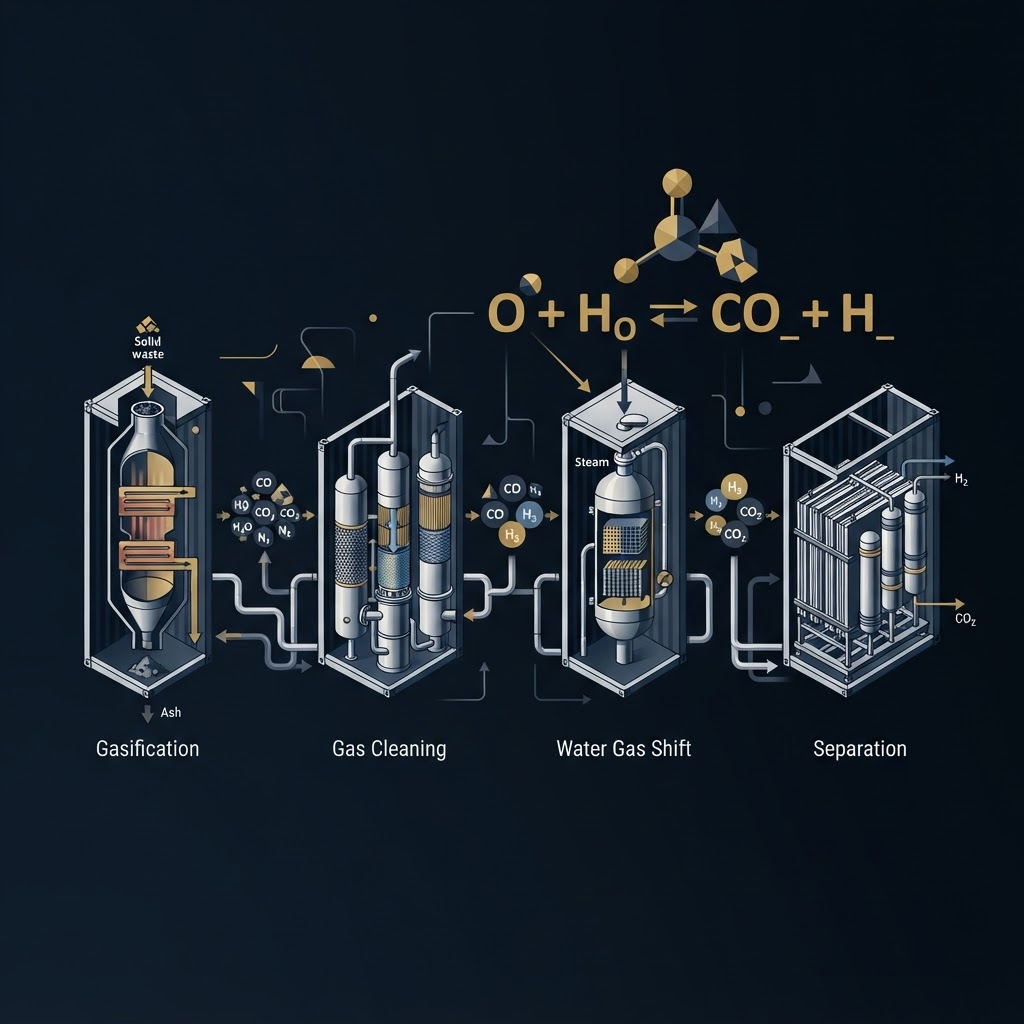
How does waste to hydrogen work in practice? Not as one machine. It is four processes bolted together, and the reason the answer is hard to find is that most pages describe the first one and stop.
Waste goes into a gasifier and becomes a dirty synthesis gas. That gas gets cleaned. Steam is injected to convert the carbon monoxide in it into more hydrogen. Then the hydrogen is separated out to whatever purity the customer will accept. Four stages, four capital items, four distinct ways for a project to fail.
This page walks the whole line. For the buyer's read of the same technology, yields against cost, we have written what the gas actually contains and what a kilogram costs separately. What follows is the mechanism.
Stage one: gasification cracks the waste into syngas
What happens above 700 degrees C
Gasification is not burning. The US Department of Energy defines it as a process that converts carbonaceous material at high temperatures above 700 degrees C, without combustion, with a controlled amount of oxygen and/or steam, into carbon monoxide, hydrogen and carbon dioxide. Starve the reaction of oxygen and the long hydrocarbon chains in the waste crack apart instead of oxidising to CO2 and water.
The threshold matters. Below it you are pyrolysing, which is a different product slate. Above it, with the right residence time, you get synthesis gas: mostly hydrogen and carbon monoxide, with carbon dioxide, methane, water vapour, tar and contaminants riding along.
Nobody sells that gas as hydrogen. It is an intermediate, and three more stages stand between it and a product. If you want the reactor itself in detail, geometry, residence time and feed handling, that is how waste gasification works inside the reactor.
The gasifying agent decides how much hydrogen you get
Here is the variable that vendor pages skip. What you blow into the reactor changes what comes out of it.
Air is cheap and mostly nitrogen. That nitrogen does not react. It passes straight through and dilutes the product gas, so a hydrogen percentage measured on an air-blown gas is a percentage of a largely inert stream. Substitute oxygen and steam and the ballast disappears.
In the COMETHA project in Paris, a Zero-X X-150 ran in oxy-steam mode with zero nitrogen ballast and delivered 33 percent hydrogen in the syngas at an H2/CO ratio of 1.95:1 across 1,939 consecutive hours, processing 16,382 kg of digestate pellets. The ratio near 2:1 is not decoration: it is the window that downstream chemical synthesis routes want, and it is set here, at stage one, by the agent choice.
Stage two: gas cleaning is where waste to hydrogen projects fail
Ask an operator where these plants die and nobody says the reactor.
The gas leaving a waste gasifier carries tar, sulphur compounds, chlorides, ammonia and particulates. Tar condenses on cold surfaces and fouls them. Sulphur and chlorides poison catalysts. Every expensive item in a hydrogen train, the shift catalysts and the separation media, sits downstream of the dirtiest gas in the plant. A gas engine will tolerate contamination that destroys a shift catalyst in weeks, which is why a hydrogen route carries a materially stricter cleaning specification than a power route on identical feedstock.
What a real cleaning section contains is instructive. The 4.4 MWth waste gasification plant at Swindon in the UK puts its gas through plasma tar reforming, then dry filters, then a combination of acid and alkaline scrubbers, then ZnO guard beds before anything reaches a shift reactor. Four cleaning technologies in series, for one gas.
Our own answer to that stage is SyngaPure, which removes 99 percent of tar compounds while maintaining energy efficiency, and measured 99.98 percent tar conversion over the 1,939-hour campaign above. It is modular and instrumented rather than passive, sensing tar, H2S, NH3 and particulates in real time, and it was selected for German federal BMWK go-inno support in December 2025 on the strength of that instrumentation.
Two words in those claims do the work: measured, and for how long. A tar conversion percentage with no inlet loading and no duration behind it is a marketing number, and we have written out why under tar removal from syngas.
Stage three: the water gas shift makes hydrogen out of steam
This is the stage that surprises people, and it is the real answer to how the process gets more hydrogen than the waste appears to contain.
Once the gas is clean, steam is injected and the water gas shift reaction runs:
CO + H2O gives CO2 + H2
The DOE states it plainly: the carbon monoxide reacts with water to form carbon dioxide and more hydrogen, releasing a small amount of heat as it goes. Read the equation from the left and the point lands. The hydrogen atoms on the right came out of the water molecule. The waste supplied the carbon monoxide that made the reaction thermodynamically willing to go.
That is why a plant can report a hydrogen yield above the hydrogen chemically bound in its feedstock, and why the phrase "hydrogen from waste" is a slight misnomer. It is hydrogen from steam, unlocked by waste.
Industrially the reaction is split across two reactors. Swindon runs a series of catalytic high temperature and low temperature shift reactors, then a methanation step to remove trace carbon monoxide before separation. High temperature gets the bulk of the conversion quickly; low temperature pushes the equilibrium further; methanation cleans up what is left, because trace CO is a poison for fuel cells at the far end of the chain.
Stage four: separation sets the purity your offtake will accept
The shifted gas is still a mixture. Splitting it is the last stage, and it decides what you can actually sell.
Adsorbers or membranes are the two routes, separating hydrogen from the gas stream and leaving a concentrated carbon dioxide stream behind. In practice one route dominates: pressure swing adsorption, which a 2025 review names the dominant separation technology on efficiency, scalability and industrial maturity, operating at adsorption pressures of roughly 8 to 9 bar.
The number to interrogate here is not purity. It is recovery. A sorption-enhanced shift pilot installed on the Swindon plant reached 99.5 percent hydrogen purity and 99.9 percent CO2 purity at 88.6 percent hydrogen recovery, and was still judged inadequate for fuel-cell grade hydrogen because of its steam consumption.
Sit with that for a second. Purity of 99.5 percent sounds finished. It is not fuel-cell grade, and 11.4 percent of the hydrogen never made it into the product at all. A vendor quoting purity without recovery has told you half the story, and it is the cheaper half.
What the four stages look like on a plant that exists
Swindon is the clearest public worked example of the full chain: roughly 850 kg/h of RDF or waste wood into that two-stage steam-oxygen gasifier, then the cleaning train, then high and low temperature shift, then methanation, CO2 capture and PSA. Four stages, in that order, at 4.4 MWth.
The same four stages run at a fraction of that scale. The first Zero-X waste-to-hydrogen reactor became operational in Paris in May 2024, fed by household waste and sewage sludge, in a containerized 150 kg/h format. The platform has been independently validated at COMETHA, at Verkoso with Fraunhofer IKTS and at Hochschule Zittau/Goerlitz on high-ash sludge, MSW and digestate, which are precisely the feeds that clinker a clean-wood gasifier. The sludge case has enough of its own chemistry to deserve separate treatment under hydrogen from sewage sludge.
Not every architecture splits the stages the same way. Boson Energy compresses drying, slow pyrolysis, gasification and plasma vitrification into one integrated gravity-driven reactor, using plasma as a heat source only so that less carbon is combusted and hydrogen yield rises. That is a genuinely different design, and worth understanding. What its public description does not give you is throughput, hours or a measured gas composition, and the full breakdown of what those figures mean sits under syngas composition.
Three questions that tell you whether a chain actually works
Which feedstock, and what was its ash content? Clean wood proves almost nothing. High-ash sewage sludge, mixed municipal waste and digestate are where fixed-grate systems clinker and stop, and they are the only feeds worth citing as evidence.
Held for how many continuous hours? A commissioning day and 1,939 hours describe different machines. If a duration is missing from a claim, you have been shown a test result rather than a plant.
Where does the carbon dioxide go? Stage four hands you a concentrated CO2 stream whether you planned for it or not. Captured, used or vented is a project decision with a cost line attached either way, and it decides the carbon intensity of every kilogram you produce.
FAQ
What temperature does waste to hydrogen gasification run at?
Above 700 degrees C, with a controlled amount of oxygen and/or steam and without combustion. The threshold is what separates gasification from pyrolysis, and it is why preheating and thermal integration matter as much as the reactor itself.
Is waste to hydrogen the same as pyrolysis?
No. The DOE defines pyrolysis as gasification in the absence of oxygen. It leaves more hydrocarbon compounds in the exit gas, so a catalytic reforming step has to be added to convert them before the shift stage can do its job.
Why is steam added if the hydrogen is supposed to come from the waste?
Because a large share of the product hydrogen is stripped out of the steam by the water gas shift reaction, with carbon monoxide from the waste acting as the reducing partner. The feedstock supplies the carbon monoxide at least as much as it supplies hydrogen.
Can any waste be fed into the process?
No, and the industry's failures cluster here. Many gasification projects collapsed because the technology demanded extensive pre-processing to adapt the waste to the reactor rather than the reverse. Validation on high-ash and mixed feeds is the claim worth checking.
Does the plant produce anything besides hydrogen?
Yes. Separation leaves a concentrated carbon dioxide stream, and the reactor leaves a solid carbon fraction: the X-150 platform is specified to produce syngas, hydrogen and biochar from the same run. Whether those are products or disposal costs depends on the site.
Available for advisory work, board seats and media appearances.
Julien Uhlig advises boards and funds and briefs newsrooms across Europe and North America. Enquiries are read personally.
We use cookies to improve your experience on this site. By continuing, you agree to our Privacy Notice.