Plastic Waste to Hydrogen Fuel: Yields, Cost, Reality
Plastic waste to hydrogen fuel is a chemistry problem with a business problem bolted on. Polyethylene and polypropylene carry about 14% hydrogen by mass, more than any biomass, so on paper a bale of film is a hydrogen reservoir. In a reactor, that same bale melts, sticks, and makes tar. This article gives the measured numbers: how much H2 a kilogram of plastic yields, what it costs per kilogram against fossil hydrogen, why the process needs two stages, and what Zero-X saw in 1,939 hours of continuous oxy-steam operation. If you are a waste operator or developer deciding whether plastic-to-hydrogen belongs in a project, this is the data you need before the vendor deck.
What plastic waste to hydrogen fuel actually means
The world uses over 90 million tonnes of hydrogen a year, and more than 95% of it comes from steam methane reforming at roughly 11 tonnes of CO2 per tonne of H2, according to a 2023 Advanced Materials paper from Rice University. That is the baseline every waste route competes against.
Turning plastic into hydrogen means breaking long polymer chains into small molecules, then rearranging those molecules so the hydrogen ends up as H2 rather than locked in hydrocarbons. The Chemical Society Reviews state of the art sets out the temperature windows. Pyrolysis decomposes plastic at 400 to 700 C with no oxygen. Catalytic reforming of the resulting gas runs at 700 to 900 C. Gasification proper needs more than 800 C plus a gasifying agent, usually steam or oxygen, and steam gasification runs anywhere from 800 to 1500 C. The review describes the conventional industrial layout as a tandem two-stage reactor: one vessel to break the polymer, a second to reform the vapour into hydrogen and carbon oxides.
The output of either route is syngas, a mix of H2, CO, CO2 and methane. Hydrogen fuel only exists after a water-gas shift step converts CO and steam into more H2, and a separation unit pulls the H2 out. The full chain is covered in our waste to hydrogen explainer; this article focuses on what plastic does differently.
Why polyolefins are the best feedstock and PET is the worst
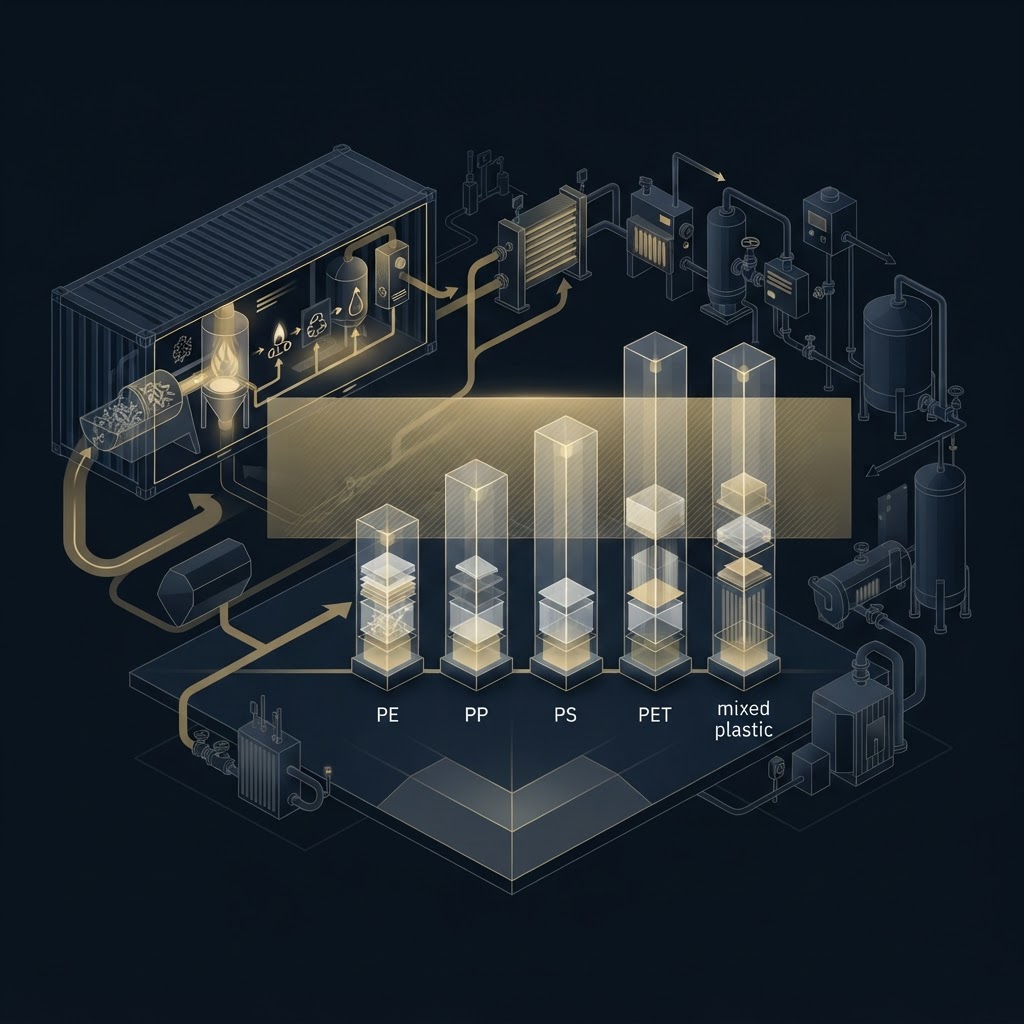
Not all plastic is equal. The most cited feasibility study, Lan and Yao in Nature Communications Earth and Environment, modelled steam gasification of five waste streams and found that PP and PE deliver the highest yields at 0.15 to 0.29 kg of H2 per kg of feedstock. PET comes last at 0.10 to 0.14 kg per kg, because it is only 62.5% carbon and 4.2% hydrogen by mass with a lower heating value of 22.1 MJ per kg. The oxygen in PET's ester bonds is dead weight for hydrogen production.
Across the wider literature the range is even broader. A Karlsruhe Institute of Technology review reports hydrogen yields of 15 to 300 g per kg of feedstock depending on waste type, reactor and conditions, a twenty-fold spread. Any vendor quoting a single yield for "plastic" without naming the polymer mix is quoting the top of the range.
The practical rule for a sorter: polyolefin film, crates and caps are what you want. Bottles, textiles and PVC are what you divert. A mixed residual stream from a materials recovery facility sits in the middle, and its yield depends on how much PET and PVC the sorting line left behind.
Two stages, not one: how reforming and shift lift hydrogen above 75%
Stage one: break the polymer
A 2026 process simulation in MDPI Hydrogen models pyrolysis of mixed plastics at 350 to 500 C, producing a vapour of hydrocarbons, hydrogen and light gases plus solid char. Standalone pyrolysis gives a gas that is only 30 to 45 mol% hydrogen. The rest is methane, ethane, propylene and heavier hydrocarbons that still hold most of the hydrogen atoms.
Stage two: reform and shift
Steam reforming at around 700 C cracks those hydrocarbons against steam, and a water-gas shift reactor converts the CO. The same paper reports hydrogen concentrations rising above 75 mol% once both steps are included. A University of Central Lancashire study quantified the lever: raising reforming temperature from 500 to 1000 C increases hydrogen yield by 83.53%, but almost all of that gain is captured by 700 C, so pushing hotter mostly burns fuel. Their modelled train, with two shift reactors and pressure swing adsorption, produced 64.21 kg per hour of hydrogen from 300 kg per hour of plastic, roughly 0.21 kg per kg.
An alternative is direct steam gasification at 900 C, which a Polymers journal simulation found gives an H2 to CO ratio of 1.86 straight from the gasifier. Integrating heat recovery in that design lowered hydrogen production cost by 29%, a reminder that the economics live in the heat balance, not the reactor alone.
Separation
Pressure swing adsorption or membranes deliver fuel-cell-grade hydrogen. This is standard equipment, but it is sized by gas volume, and nitrogen in the syngas doubles the volume for nothing. That is why air-blown gasifiers struggle to make hydrogen economically and why oxygen or oxy-steam operation matters, a point we return to below.
What it costs per kilogram and what it competes with
Here the reviews are more honest than the press releases. Lan and Yao put the minimum hydrogen selling price for mixed plastic waste gasification with carbon capture at $2.26 to $2.94 per kg, against $1.21 to $2.62 per kg for fossil hydrogen with CCS. The two ranges overlap only at the edges. A Green Chemistry techno-economic analysis of a larger plant landed at a minimum selling price of $3.41 per kg of hydrogen, and concluded that cost parity with fossil pathways needs waste plastic feedstock priced below $0.02 per kg. The same study gives the environmental ledger: supply-chain energy use falls 56% versus fossil hydrogen, but greenhouse gas emissions rise 36% unless the CO2 is captured. The syngas yield that underpins those figures is 2.1 Nm3 per kg of plastic.
Two conclusions follow for a project developer. First, plastic-to-hydrogen does not close on the hydrogen price. It closes on the gate fee: if a municipality or MRF pays you to take residual plastic, your feedstock cost is negative and the $0.02 threshold is crossed with room to spare. Second, the carbon story depends entirely on what you do with the CO2 stream. The US Department of Energy's target of $1 per kg of hydrogen, cited in the Rice paper, is not in reach for any waste route today, and nobody serious claims otherwise.
The problems the reviews mention and operators live with
Sticky feed and melt
Plastic does not behave like wood chips. It softens before it decomposes, bridges in hoppers, and fuses into a mass that blocks gas flow. The Energy Advances 2025 review names plastic stickiness and feeding issues as persistent barriers, and its proposed fix is co-gasification: blending plastic with biomass or coal waste enhances the reforming reactions, lowers tar and solves the feeding problem at once. We documented the blend shares a fixed-bed downdraft tolerates in plastic waste gasification feedstock limits.
Tar
Plastic vapour is rich in aromatics, which condense as tar downstream and foul everything from heat exchangers to engine valves. Any hydrogen train with a catalyst or a membrane is far less tolerant of tar than a gas engine. The engineering of tar removal from syngas is where most small gasification projects have historically failed, not in the gasifier itself.
The blend answer
The pattern across the literature is consistent. Pure plastic is a laboratory feedstock. Plastic as a 10 to 30% energy-dense share of a biomass, sludge or digestate stream is an operating feedstock. It raises the hydrogen content of the gas, lifts the heating value, and arrives at a tipping fee instead of a purchase price.
What a real reactor measured: the Zero-X benchmark
Simulations end at a mass balance. Operation ends at a maintenance log. Zero-X ran its Jenja fixed-bed downdraft gasifier for 1,939 consecutive hours in Paris within the COMETHA project, processing 16,382 kg of digestate pellets. In oxy-steam mode with zero nitrogen ballast, the raw syngas held 33% hydrogen at an H2 to CO ratio of 1.95 to 1, with 99.98% tar conversion inside the reactor. That ratio is close to what the Polymers simulation predicts for plastic at 900 C, and it is the number a downstream shift and separation train is designed around.
Two caveats so nobody misreads the data. The 80-day run was on digestate, not plastic; Jenja is validated on high-ash sludge, MSW, digestate, straw, palm fruit bunches and plastics as listed on the Zero-X partner page, with independent test campaigns at Paris COMETHA, Fraunhofer IKTS and Hochschule Zittau/Goerlitz. Plastic enters a Jenja unit as a blend share, for exactly the melt and tar reasons above. And 33% is raw gas before shift; the hydrogen-fuel number is what leaves the separation unit.
The gas cleaning that makes the hydrogen route possible is SyngaPure, Zero-X's modular AI-monitored cleaning stage that removes 99% of tar compounds while holding energy efficiency, with real-time sensing of tar, H2S, ammonia and particulates. For a plastic-rich feed that sensor loop is not optional, because the tar load swings with every change in the bale.
When plastic to hydrogen makes sense for a site
Four conditions, all of them necessary:
- Feedstock cost at or below zero. A gate fee for residual plastic is the whole margin. Buying sorted polyolefin flake to make hydrogen does not pay.
- A polyolefin-rich stream. Film, crates, caps and agricultural plastic. PET and PVC lower yield and raise corrosion.
- A co-feed on site. Sludge, digestate, straw or wood that lets the plastic run as a blend, which is how every documented long run has been achieved.
- A hydrogen or syngas offtaker within reach. Hydrogen does not travel cheaply at the 150 kg per hour scale. Refuelling, a nearby industrial user or chemical-grade syngas for synthesis is the realistic market; compare the eight projects in waste to hydrogen plants compared.
Where those conditions hold, the chemistry is not the risk. The feeding system, the gas cleaning and the grant application are. Zero-X partners get all three with the machine, including the playbook that has secured 56 to 70% CAPEX funding in its first markets. Where the conditions do not hold, a mixed residual stream is usually a better project than a plastic-only one, and our guide to municipal solid waste to hydrogen covers that case. Organic streams have their own pathway, which we cover in food waste to hydrogen.
FAQ
How much hydrogen can you get from 1 kg of plastic waste?
Under steam gasification modelling, PE and PP yield 0.15 to 0.29 kg of hydrogen per kg of plastic and PET yields 0.10 to 0.14 kg per kg. Across all waste gasification studies the measured range is 15 to 300 g per kg, so the polymer mix and the reactor decide the answer.
Is hydrogen from plastic waste cheaper than grey hydrogen?
Not on the hydrogen price alone. Modelled minimum selling prices run from $2.26 to $3.41 per kg, against $1.21 to $2.62 per kg for fossil hydrogen with carbon capture. Parity requires plastic feedstock below $0.02 per kg, which in practice means being paid a gate fee to take it.
Is plastic to hydrogen low carbon?
Partly. Supply-chain energy use is about 56% lower than fossil hydrogen, but greenhouse gas emissions are around 36% higher unless the CO2 from the process is captured. With capture the route competes; without it the climate case rests on avoided landfill and incineration.
Can a small gasifier run on pure plastic?
Not for long. Plastic softens and bridges in the feeder, fuses in the bed and produces heavy tar. Every documented continuous run uses plastic as a blend share with biomass, sludge or digestate, which also fixes the feeding problem.
What temperature does plastic gasification need?
Pyrolysis runs at 400 to 700 C, catalytic reforming at 700 to 900 C and gasification above 800 C. Most of the hydrogen gain from hotter reforming is captured by 700 C; going further mainly costs fuel.
We use cookies to improve your experience on this site. By continuing, you agree to our Privacy Notice.