Plastic Waste Gasification: The Feedstock Limits
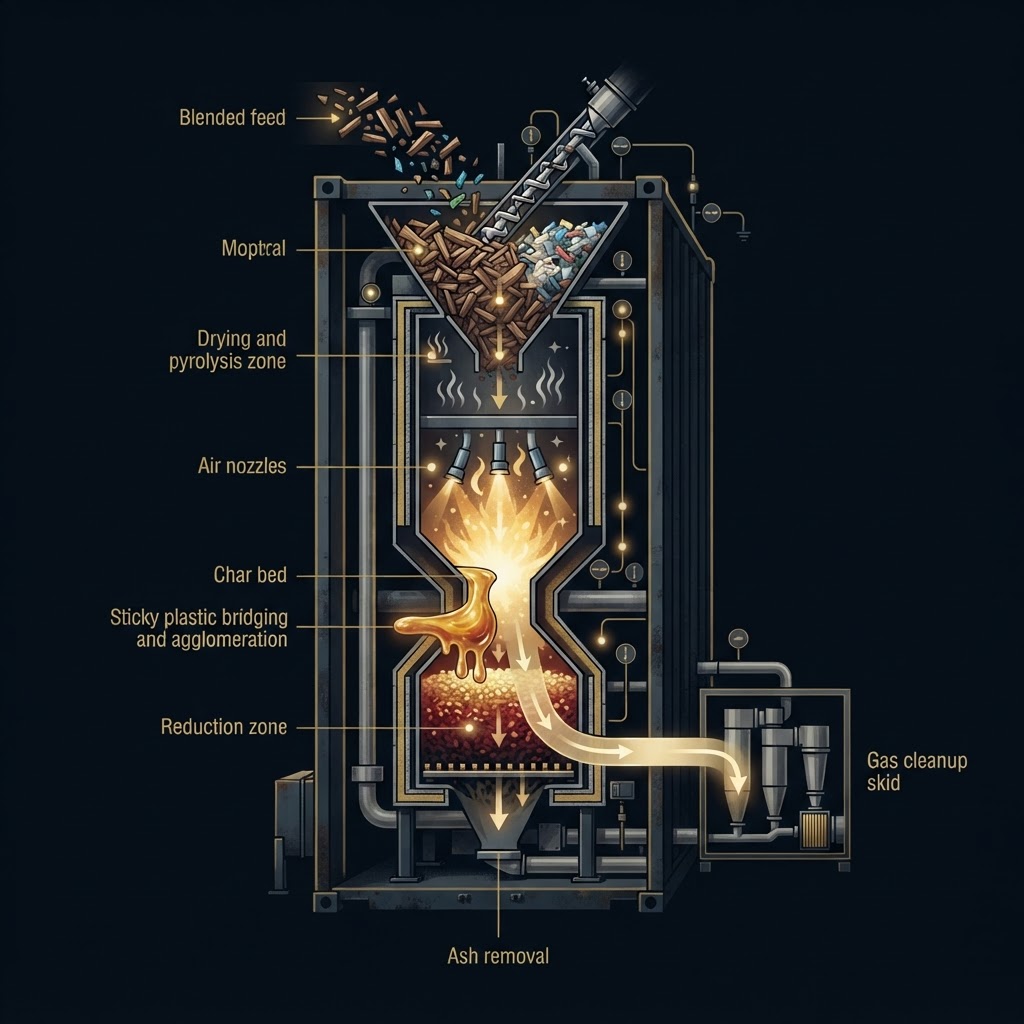
Plastic waste gasification works. The question nobody on page one answers is in which reactor, and at what share of the feed. Gasification converts carbon-rich solids into a hydrogen and carbon monoxide gas at 800 to 1100 °C, and plastic is carbon-rich. But in a fixed-bed downdraft unit, the class most small waste-to-energy plants use, plastic behaves as a blend partner, not a feedstock on its own. Push the share too high and the bed melts, tar climbs and gas quality falls.
This is the operator's version: the physics, the blend limits the published downdraft trials actually measured, and what to do with a plastic-heavy waste stream.
Can you gasify plastic waste?
Yes, with two caveats.
- Pure plastic runs happen mostly in fluidized beds with steam, at lab and bench scale. That is where the literature lives.
- In fixed-bed downdraft reactors, plastic is co-gasified with a char-forming feedstock such as wood, garden waste, palm fronds or sludge.
If you are new to the process itself, start with how waste gasification works. The rest of this article assumes the basics and focuses on what makes plastic different.
Why plastic behaves differently from biomass in a gasifier
Almost all volatiles, almost no char
A downdraft gasifier depends on a hot, porous char bed. Air and pyrolysis vapours pass through it, and the char both reduces CO2 to CO and cracks tar. Plastic barely makes any. In a downdraft modelling study, polyethylene was characterised as 99.9 percent volatiles with 0.1 percent ash, and a tar fraction in its pyrolysis products of 0.9 against 0.2 for wood. The same study flags that the more plastic in the mix, the more likely the bed agglomerates, so some calculated optimum regimes cannot actually be reached.
Translated: plastic turns almost entirely into vapour, and a large share of that vapour is tar.
It melts before it gasifies
Wood chars. Plastic melts, flows and sticks. An open-access review of plastic gasification lists the high volatility, sticky, viscous and adhesive nature and exceptional tar production of plastic wastes as the properties that obstruct processing in traditional gasifiers. It also notes that heating value of the gas usually lands between 3 and 12 MJ/Nm3 depending on the gasifying agent.
In a fixed bed, molten plastic fills the voids the gas needs to pass through. That shows up as pressure drop, channelling and bridging above the throat.
Chlorine from PVC
Mixed plastic waste rarely arrives clean. A 2026 review of plastic gasification names feedstock heterogeneity, HCl release from PVC, tar formation, catalyst deactivation and the high cost of syngas purification as the major barriers to industrial implementation. HCl corrodes downstream equipment and poisons catalysts, so PVC is the fraction to sort out before the hopper, not after.
How much plastic a fixed-bed downdraft gasifier tolerates
What the downdraft trials show
Two experimental downdraft studies give the numbers operators actually need.
High-ash garden waste plus LDPE. Raising plastic from 0 to 25 wt percent lifted the gas LHV from 3.5 to 4.7 MJ/Nm3, raised cold gas efficiency from 43.8 to 61.8 percent, cut clinker from 3 to 0.65 wt percent and lowered tar from 8.1 to 5.7 g/Nm3. Plastic raised temperatures across all zones, which helped a difficult, high-ash biomass.
Oil palm fronds plus HDPE, PP or PS. Across 0 to 30 wt percent plastic at 750 to 950 °C, HHV with polypropylene rose from 6.3 to 12.2 MJ/Nm3, driven by methane. The authors put the optimum at 10 to 20 wt percent plastic, with hydrogen peaking around 10 percent blending. Beyond 30 wt percent, gas quality declined, which they attribute to reduced char reactivity and increased tar formation.
Where it breaks
| Plastic share in feed | What the trials report | Operator reading |
|---|---|---|
| 0 to 10 wt % | H2 peaks for HDPE and PP blends | Safe, mild energy gain |
| 10 to 25 wt % | Higher heating value and cold gas efficiency, less clinker on high-ash biomass | The useful band |
| Around 30 wt % | Heating value still rising, H2 falling | Edge of stable operation |
| Above 30 wt % | Gas quality declines, tar formation increases | Outside what these studies support |
Two cautions. These are small experimental units, not continuous commercial campaigns. And the limit depends on the partner feedstock: a high-ash fuel that clinkers on its own can benefit from plastic in ways clean wood will not. A separate review makes the same point from the other side, noting that co-feeding biomass reduces tar and resolves feeding issues caused by plastic stickiness.
Steam, oxygen or air: what the gasifying agent does to plastic syngas
Plastic is hydrogen-rich (about 14 percent H on a dry ash-free basis in the modelling study above), so the agent decides whether that hydrogen ends up in the product gas. A review compiling over 100 experimental trials summarises it: steam or oxygen gasification yields hydrogen-rich syngas suitable for synthesis, while air gasification mainly produces gas for energy. The same review names high tar content as one of the principal limitations.
The best recent bench result shows what steam can do. In a fluidized bed at 850 °C with a steam-to-plastic ratio of 1.5, mixed plastic waste gave 2.4 Nm3/kg of nitrogen-free gas with over 50 vol percent hydrogen; a nickel catalyst cut tar by 70 percent and pushed hydrogen to about 56 vol percent.
We see the same principle on our own machine with a different feedstock. In a 1,939-hour continuous X-150 campaign in Paris, oxy-steam mode on digestate pellets delivered 33 percent hydrogen at an H2/CO ratio of 1.95:1 with zero nitrogen ballast. Removing nitrogen from the agent is what makes a waste-derived gas useful for waste to hydrogen rather than just combustion. To be clear: that campaign ran on digestate, not plastic, and we do not quote a plastic figure we have not measured. For how the gas splits by agent, see our planned guide to syngas composition.
Tar is the real cost of plastic gasification
Every source above lands in the same place. Plastic makes more tar, and tar is what shuts plants down. A Waste Management paper on chemical recycling of complex plastic wastes reports tar formation as one of the major challenges in fluidized-bed gasification of plastics. It also covers supercritical water gasification, which yields little tar but whose cost and complexity have so far prevented large-scale use.
So plan the gas cleaning before you plan the plastic share. Our SyngaPure system removes 99 percent of tar compounds while keeping energy efficiency, and the full set of options is in our guide to tar removal from syngas.
Plastic waste gasification vs pyrolysis vs incineration
- Pyrolysis heats plastic without oxygen and keeps the oil. It suits clean, sorted polyolefins when the product is liquid.
- Gasification adds a limited amount of oxidant (air, oxygen or steam) and pushes the vapours and char on to a permanent gas. In practice, gasification is pyrolysis followed by partial oxidation of the tar and char.
- Incineration burns everything completely and recovers heat only.
Gasification is the route when you want a gas you can clean and use for power, heat, hydrogen or synthesis, and when the plastic is mixed or dirty. The wider trade-offs are in gasification versus incineration.
What this means if you are planning a small plant
- Characterise the plastic fraction first. Polyolefins, PET and PS behave differently, and the downdraft trials above show different gas outcomes for each.
- Keep PVC out. Sort it upstream. Chlorine is a corrosion and catalyst problem you do not want to solve in the gas train.
- Blend with a char-forming feedstock. Stay in the roughly 10 to 25 wt percent band the trials support, and validate on your own mix before going higher.
- Pick the agent for the product. Air for heat and power. Oxy-steam if hydrogen or synthesis gas is the goal.
- Budget for gas cleaning from day one. Tar is not an afterthought with plastic in the feed.
- Match the reactor to the stream. Pure or near-pure plastic belongs in a fluidized bed. Mixed residual waste with some plastic is fixed-bed territory. Our planned overview of types of gasifiers will cover the full field.
Our X-150 platform has been independently validated at the Paris COMETHA project, at Verkoso with Fraunhofer IKTS and at Hochschule Zittau/Görlitz on high-ash sludge, MSW and digestate, feedstocks that clean-wood gasifiers cannot handle. Municipal solid waste always carries plastic. The honest rule from the data: treat plastic as an energy-dense additive to a real waste stream, not as the stream itself.
FAQ
Can a small gasifier run on 100 percent plastic?
Not a fixed-bed downdraft unit, in practice. Plastic is almost all volatiles, leaves little char to hold the bed together and pushes it towards agglomeration. Pure-plastic work is done mostly in steam-fed fluidized beds.
Does adding plastic to biomass improve the gas?
Up to a point. Heating value and cold gas efficiency rise, and in one high-ash trial clinker and tar fell too. Past about 30 wt percent plastic, reported gas quality declines.
Which plastics are worst for gasification?
PVC. Its chlorine is released as HCl, which corrodes equipment and deactivates catalysts. Recent reviews list it among the main barriers to industrial plastic gasification.
Can plastic waste gasification make hydrogen?
Yes. Steam gasification of mixed plastic has produced over 50 vol percent hydrogen at bench scale, and about 56 percent with a nickel catalyst.
Available for advisory work, board seats and media appearances.
Julien Uhlig advises boards and funds and briefs newsrooms across Europe and North America. Enquiries are read personally.
We use cookies to improve your experience on this site. By continuing, you agree to our Privacy Notice.