Food Waste Gasification: The Water Problem, Solved Honestly
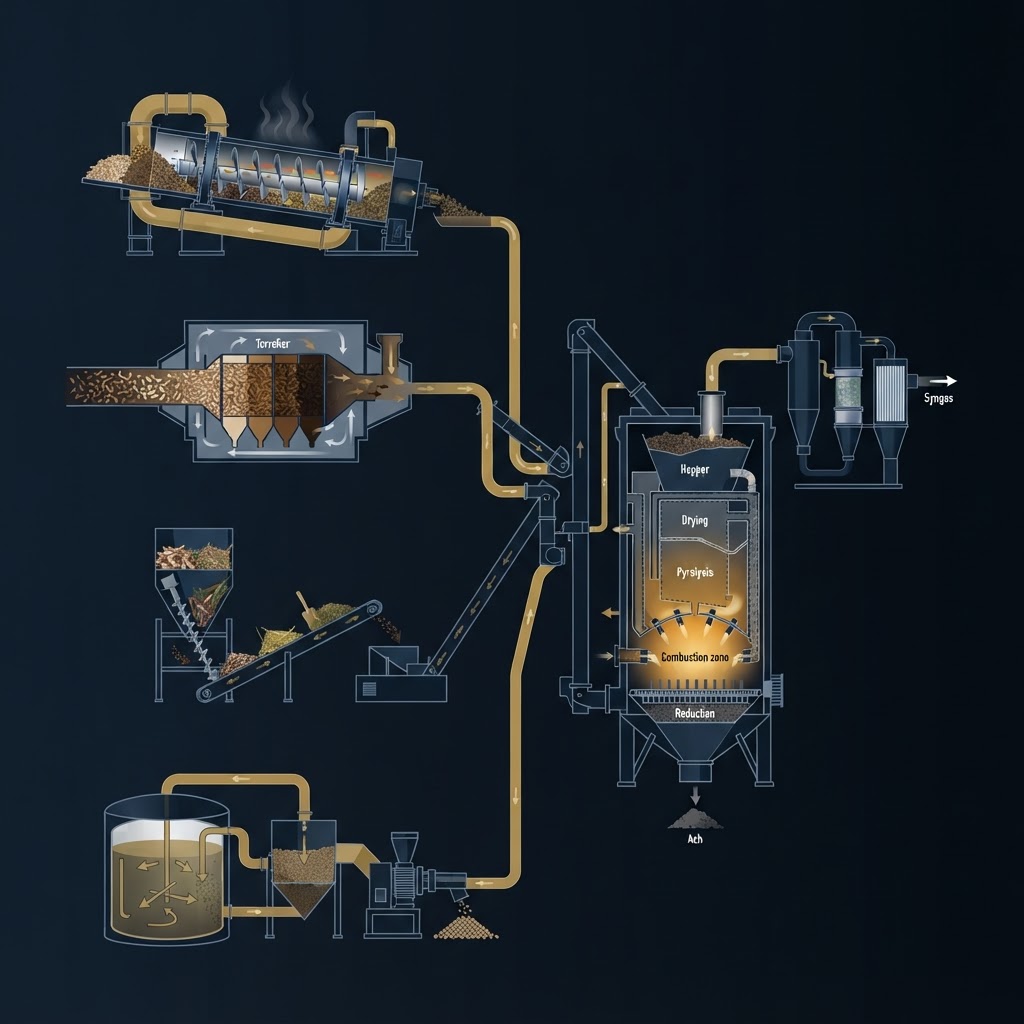
Food waste gasification has a reputation problem. The chemistry works and the dry fraction is decent fuel. The trouble is that a bin of kitchen waste is mostly water, between 72 and 85 percent by weight according to a 2025 review in Sustainable Energy & Fuels. A gasifier cannot convert water into syngas. It can only boil it off, and it pays for that with the heat it was supposed to sell.
Search the phrase and you get Aspen models and laboratory reactors. They are useful, and we cite them below, but almost none of them answer the question an operator actually asks: what has to happen to this waste before a gasifier will take it, and what does that cost? That is what this page covers. Every number links to its source and is labelled as a model, a lab result or field data.
The short answer
Food waste gasifies well once it is dry. So the design decision is not which gasifier to buy. It is how you get the water out. There are four realistic options:
- Dry it thermally with the gasifier's own waste heat. This is simple, but it can consume most of the heat you produce.
- Torrefy it at 230 to 290 °C into a char-like solid, then gasify that solid.
- Blend it with a dry feedstock such as wood so the mixture stays inside the gasifier's moisture window.
- Digest it first in an anaerobic digester, then dry and pelletise the digestate and gasify the pellets.
The fifth route, supercritical water gasification, uses the water as the reaction medium instead of removing it. It belongs to the hydrogen conversation, and we compare it with fermentation in our guide to food waste to hydrogen.
What food waste looks like to a gasifier
Moisture is the whole story
Gasification happens at 700 to 1200 °C in four stages: drying, pyrolysis, oxidation and reduction. That breakdown comes from Murugesan and colleagues' 2022 review of food waste gasification, which examined 162 publications. Drying comes first and does not negotiate. The same review concludes that direct gasification of food waste "requires high energy input owing to its high moisture content, low bulk density, low homogeneity", and that this is what has kept the technology off commercial scale.
An open-access 2025 modelling study states the physics plainly: if moisture is too high, the enthalpy needed to vaporise the water can match or exceed the energy released by combustion. At that point the reactor stops making gas and works as a very expensive kettle.
The dry fraction is actually good fuel
Remove the water and the picture changes. Murugesan's review puts food waste at roughly 80 percent volatiles, 15 percent fixed carbon and 5 percent ash. That is a low ash content compared with the sewage sludge and municipal waste that gasifiers usually struggle with.
A Nigerian downdraft modelling study of cooked rice, eba, orange, yam and potato peels found food waste gave syngas with a higher heating value than hardwood. It also found a lower cold gas efficiency: 49.3 to 57 percent for food waste against 55.6 to 74.95 percent for hardwood. Treat both figures as simulations. The gap between them is the moisture penalty showing up in the numbers.
The drying bill: how much heat the water costs
The most useful single figure on this topic comes from Ulster University's work on small-scale gasification CHP. The team analysed 40 biowaste samples with an equilibrium model calibrated against lab results to within 15 percent error. Drying a feedstock down to 10 percent moisture may require up to 60 percent of the heat produced. Across the biowastes they studied, syngas lower heating value ranged from 3.1 to 5.4 MJ/Nm³ on a dry basis.
Read that as a budget. If the gasifier is CHP, the drying load comes out of the heat you would otherwise sell or use. A site with no heat customer can afford it. A site whose business case depends on selling heat may not be able to.
The 2025 PMC model is more optimistic. Even with a drying stage included, food waste held 60 to 80 percent energy efficiency at around 800 °C. However, the authors note that real systems will differ, because the model simplifies carbon conversion. In practice, the moisture limit of your specific reactor sets the rule, which we cover in gasifier feedstock moisture content.
Four ways to get the water out
1. Dry it with the gasifier's own heat
This is the default option, and it is the one the Ulster figure prices. It suits sites with surplus low-grade heat and no heat buyer. Use a belt or drum dryer fed by engine exhaust or the syngas cooler, aim for a stable moisture target, and feed the dried material in a consistent particle size. Its weakness is seasonal and compositional swing: a week of melon rind and soup does not dry like a week of bread and rice.
2. Torrefy it first
Yadav and Singh (2023) torrefied food waste at 230 to 290 °C, then steam-gasified the resulting char in a downdraft fixed-bed reactor. Torrefaction raised fixed carbon to 47.2 percent and cut volatiles to 37.4 percent. The best char gave 3.75 m³ of syngas per kilogram, with about 65 percent hydrogen.
Those are strong numbers, but they come from lab scale, and the paper does not account for the energy that torrefaction itself uses. The value of torrefaction is that it turns a sticky, rotting, variable feed into a stable, grindable solid you can store. That matters as much as the gas yield.
3. Blend it with a dry feedstock
Co-gasification is the most practical route for small plants. Nagy and Dobó (2020) gasified oak and food waste blended 2:1 in a fixed-bed reactor. At 900 °C with steam they measured 99.7 percent carbon conversion, a gas yield of 888.7 litres per kilogram and an H2/CO ratio of 2.03. The best lower heating value they recorded was 11.03 MJ/m³.
A 2015 trial in a 10 kW downdraft gasifier fed food waste mixed with wood chips continuously at 10 kg/h, with combustion and reduction zones at 900 and 850 °C. Gas composition shifted with the waste type and blend ratio, which is the operational lesson: if the blend is not controlled, the gas is not controlled either.
The catch is that you need a reliable dry co-feed, such as wood, straw or a dry fraction of municipal waste, and the food waste stays a minority of the mix.
4. Digest it first, gasify the digestate
This is the route that uses the strengths of both technologies. Anaerobic digestion is very good at wet, easily degradable organics. What it leaves behind is digestate, which still carries energy and still needs disposal. Dewater it, pelletise it and you have a dry, dense, uniform gasifier feed.
This is also where the only long-run field data on this page comes from. Zero-X ran its X-150 fixed-bed gasifier for 1,939 continuous hours in Paris under the COMETHA project, processing 16,382 kg of digestate pellets. To be clear about what that proves: those pellets were a dried, densified product of digestion, not raw kitchen waste. Nobody should sell you a gasifier that turns a wet bin into syngas in one step. Zero-X's platform has been validated on high-ash sludge, MSW and digestate at COMETHA, Fraunhofer IKTS and Hochschule Zittau/Görlitz, which is the feedstock family food waste joins once the water is managed. The same logic drives sewage sludge gasification.
Air, steam or oxygen: what the gas looks like
The gasifying agent decides what the syngas is good for. In the PMC model, air gasification of food waste gave 23 to 27 percent hydrogen, while steam gasification pushed it to 54 percent at a steam-to-biomass ratio near 0.5 to 0.6. The same paper notes that air-blown systems usually produce gas of around 4 to 7 MJ/m³, against 10 to 18 MJ/m³ for oxygen-enriched modes, because air brings nitrogen ballast.
Field data points the same way. In oxy-steam mode, the COMETHA campaign produced 33 percent hydrogen at an H2/CO ratio of 1.95:1 with zero nitrogen ballast, which is close to the 2:1 that methanol and Fischer-Tropsch synthesis want. See oxy-steam gasification for how that mode works. For engine CHP, air-blown gas is fine. For hydrogen or fuels, use steam or oxygen.
Does it beat incineration and landfill?
Food waste in an incinerator is a poor fuel: wet, low in energy and harsh on the furnace. You and colleagues (2016) compared decentralised co-gasification of sewage sludge and food waste with Singapore's incineration-based system. They found food waste was the more favourable co-feed, giving more energy and less residue than sludge. In a Monte Carlo cost-benefit analysis, the gasification schemes beat incineration on net present value, benefit-cost ratio and internal rate of return.
That result belongs to Singapore's costs, not yours. But the direction is consistent with the wider gasification vs incineration comparison: at small, decentralised scale, gasification avoids the haulage and the large central furnace.
What a small gasifier operator should actually plan for
If you are scoping food waste gasification for a hotel cluster, a food processor or a small municipality, work through this list before you look at reactor brochures.
- Moisture target first. Decide how the feed will reach your gasifier's moisture window: dryer, torrefier, dry co-feed or digester upstream. Then cost that step. It is often the biggest line in the energy balance.
- Feed consistency. Food waste varies with the season, the menu and the day of the week. Pellets or a controlled blend protect a fixed-bed downdraft gasifier from bridging and channelling.
- Tar. Lower-temperature, variable feeds make more tar. Plan the gas cleaning before the reactor, not after the first engine rebuild. Our guide to tar formation in gasification covers the mechanisms. Zero-X's SyngaPure cleaning system removes 99 percent of tar compounds, and the COMETHA run reached 99.98 percent tar conversion.
- The baseline you are replacing. The COMETHA post cites a hotel paying $338K a year to truck its waste away. That cost, not the electricity price, is usually what makes a small food waste project pay. More on that case in waste to energy for hotels and resorts.
- Start small. The X-5 prototype, precursor to the X-150, was reported operational at Thrive Hotel in Canggu, Bali in 2024. Hotels and resorts are where food waste volume, a disposal bill and an energy demand all sit on one site.
FAQ
Can you gasify wet food waste directly?
Not in a fixed-bed or fluidised-bed gasifier. The water has to be removed or diluted with a dry co-feed first, or the drying stage consumes the energy the process produces. The exception is supercritical water gasification, which uses water as the reaction medium at very high pressure. It is a hydrogen-focused route with its own cost profile.
Is food waste gasification better than anaerobic digestion?
They are not competitors. Digestion handles wet organics cheaply and produces biogas, but it leaves digestate behind. Gasification handles dry solids quickly and at high temperature. The strongest design for a mixed site often runs both in sequence: digest the food waste, then dry and gasify the digestate.
How much syngas does food waste produce?
It depends on preparation and gasifying agent. Published lab results range from 888.7 litres per kilogram for a 2:1 wood and food waste blend to 3.75 m³ per kilogram for torrefied food waste char under steam. Expect plant-scale figures to be lower, and ask any vendor for continuous-run data on your own feed.
What is left after gasification?
A mineral-rich char or ash fraction. With about 5 percent ash in dry food waste, the solid residue is small, and under the right conditions it can be recovered as biochar rather than landfilled.
We use cookies to improve your experience on this site. By continuing, you agree to our Privacy Notice.