Gasification vs Incineration: What the Data Actually Says
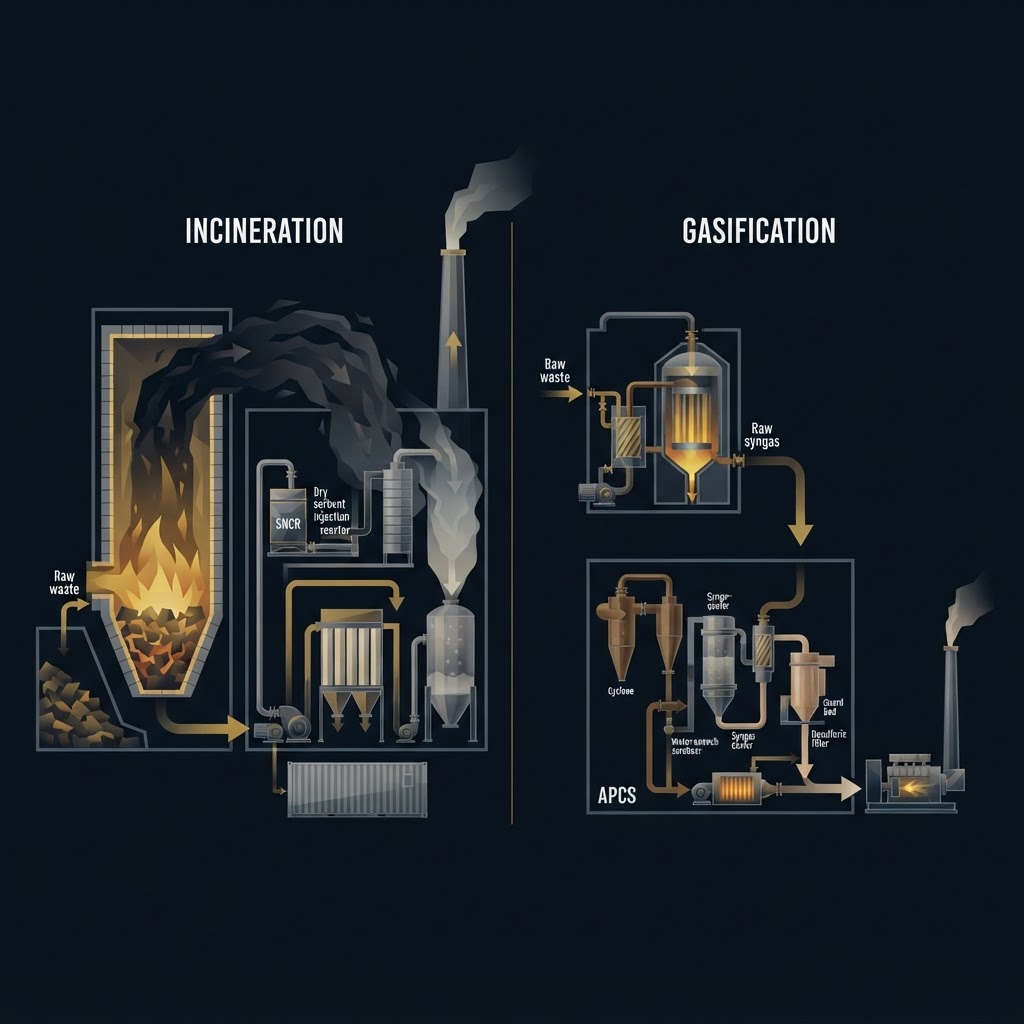
We build gasifiers. So take this seriously: on gasification vs incineration, the published evidence does not say gasification wins. It says the answer splits, and it splits in a way that is predictable once you understand one structural difference between the two processes.
Every page ranking for this comparison picks a side. Vendor pages say gasification is cleaner and more efficient. Academic life cycle assessments hedge into unreadability. Neither tells a municipal buyer what they need, which is the rule for deciding.
Here is the rule, and then the evidence behind it.
The one architectural difference that explains all the others
Incineration is the complete, rapid, exothermic oxidation of the organic fraction of waste in the presence of an adequate excess of oxygen. Gasification is a thermochemical decomposition that generates a combustible gas, syngas, which is burned afterwards. The literature calls this indirect combustion, or two-step oxidation (Bianco et al., Sustainability).
That sounds like a chemistry footnote. It is not. It has one consequence that drives everything else on this page:
An incinerator cleans a large flue gas stream after combustion. A gasifier cleans a small fuel gas stream before it.
Flue gas is mostly nitrogen and excess air, at low pressure, at high volume, already carrying whatever formed in the furnace. Syngas is a concentrated fuel that you can cool, filter and scrub while it is still a product rather than an emission. Every advantage gasification has traces back to that. So does its failure rate.
If you want the reactor-level picture first, start with how waste gasification actually works and which gasifier types survive real waste.
Efficiency: what the operating fleets actually deliver
Start with the incineration baseline, measured across a real fleet rather than a datasheet.
The European waste-to-energy fleet averages 15% net electricity export and 32% net heat export, or 0.4 and 0.9 MWh per tonne of waste. Those are yearly averages including shutdowns and maintenance stops, which is why they sit below any nameplate figure (CEWEP Climate Roadmap Technical Annex). Across 314 European plants, the R1 efficiency factor averages 0.69, ranging from 0.21 to 1.37, and plants generating electricity only reach 21.6% electricity with a total used energy recovery rate of 26.1% (CEWEP Energy Report III).
Now the head-to-head, from a study that compared four commercial plants rather than models.
The Lahti II plant in Finland, a circulating fluidised bed gasifier running solid recovered fuel at 250,000 tonnes a year, cools its syngas to 400 degrees C to strip heavy metals and particulates. The cleaned gas then feeds a boiler at 121 bar and 540 degrees C, and the plant reaches 27% net electrical efficiency with 61% heat efficiency. The reference incinerator, Silla 2 in Milan, runs its boiler at 40 bar and 400 degrees C and delivers 24% electricity with 6% heat (Dong et al.).
Read the steam conditions, not the efficiency numbers. The gasifier is not a better heat engine. It gets to run hotter, higher-pressure steam because the corrosive species were removed while the energy was still in a fuel gas. Burn raw waste and the chlorine in it caps your superheater temperature, and that cap costs you electrical efficiency.
The counterpart study makes the same causal point from the other direction: gasification's environmental advantage was attributed to the intermediate syngas purification step, which both reduces stack emissions and raises energy efficiency. That same analysis modelled a best-available-technology incinerator at 600 kWh per tonne, equal to 23% net efficiency, and found it superior to gasification on global warming (Dong et al., J. Clean. Prod.).
So on electricity, the honest gap is roughly 24% against 27%. Three points. Not a revolution.
The gap only becomes large when you stop making electricity. On an exergy basis, municipal waste to hydrogen reaches 46.7% and waste to synthetic natural gas 43.7%, against 28.6% for integrated gasification combined cycle and 18.9% for incineration to energy (Wang et al.). That is the real efficiency argument for gasification, and it only applies if your product is a molecule.
Dioxins: the reducing-atmosphere argument, stated honestly
This is where vendor pages overreach, so here is both halves.
The mechanism is real. Dioxin formation needs oxygen and chlorine. In a laboratory comparison, PCDD/F production during incineration was 7 to 20 times greater than during pyrolysis, because a hydrogen-rich, oxygen-deficient atmosphere inhibits the Deacon reaction and carbon-chlorine bond formation. Incineration plants consume large quantities of absorbents such as activated carbon to manage dioxins in the flue gas, an ongoing environmental and economic burden (Tang et al., Environmental Pollution).
Now the other half, from the commercial plant comparison already cited. Actual measured emissions from the reference incineration and gasification plants were quite similar, because modern fabric filters, desulphurisation, NOx abatement and activated carbon injection do their job. Every one of those plants comfortably met its emission limits.
Put those together and the conclusion is unglamorous but defensible. The reducing atmosphere genuinely suppresses dioxin formation at source. Against a modern, well-run incinerator, that shows up as smaller abatement equipment and lower consumable spend, not as a different permit outcome. Anyone selling you gasification on stack numbers alone is comparing against a badly run incinerator.
Where incineration is the right answer
The section our competitors do not write.
On identical unsorted residual municipal waste, an attributional life cycle assessment of a moving grate combustor against a vertical shaft gasifier with direct melting found the combustion unit better for almost all impact categories. The same paper gives the maturity gap in one line: more than 1,400 combustion plants in operation worldwide at 50 to 1,400 kt/y, against more than 100 waste gasifiers at 10 to 250 kt/y (Arena et al.).
The commercial verdict is harsher still. A UK government technology review of advanced gasification technologies found that none of the technologies reviewed were in commercial operation, with technology readiness levels of 6 to 8, and noted that most UK gasification projects aimed at producing electricity with limited success (BEIS / AECOM / Fichtner).
Parasitic load is the other quiet killer. The gasification-melting plant in the four-plant comparison showed internal energy demand reaching 24% of total energy production, largely from using oxygen-rich air to melt ash. Plasma gasifiers are worse: they consume 40 to 50% of the energy they produce (Sierra Energy). Both are gasification. Both lose to a grate.
So say it plainly. For city-scale mixed unsorted waste with a district heating customer, a modern grate incinerator is the defensible engineering choice. It is proven, it is financeable, and the efficiency penalty is a few points. We are not going to pretend otherwise to sell a gasifier.
The LCA warning nobody quotes
One more finding, from the MDPI study that opened this article, because it should change how you read every other page on this topic.
Switching from economic allocation to system expansion changed the global warming result by 35%. Including the benefit of avoided landfill sometimes turned results negative. For some impact categories, the two approaches led to opposite conclusions. Under one approach, the combustor's global warming impact came out 23% lower than the gasifier's.
The authors' own recommendation is that comparisons in this field be made with caution, because in the absence of harmonised category rules the accounting choices drive the answer.
Which means any page telling you one technology wins outright is telling you which accounting rules it picked. Including, to be fair, the ones that favour us.
Where gasification is the right answer
Three specific places. Not a general claim.
When the product is a molecule, not a megawatt
If you want electricity, gasification buys you three efficiency points and a lot of complexity. If you want hydrogen, synthetic natural gas, methanol or Fischer-Tropsch fuels, incineration cannot do it at all: a flame does not produce a chemical feedstock. The exergy spread above is the whole argument. A related structural advantage: a proportion of the CO2 from gasification leaves as a relatively pure stream, which the BEIS review flags as significant for adding carbon capture. Diluted CO2 in flue gas is far more expensive to capture.
When the plant is too small to earn R1
Under Annex II of the EU Waste Framework Directive, a municipal waste incinerator counts as recovery only if its energy efficiency factor reaches 0.60, or 0.65 for plants permitted after 2008. Electricity is weighted 2.6 and heat 1.1. Fall below the threshold and the plant is classed D10 disposal, sitting alongside landfill in the waste hierarchy (European Commission R1 guidelines).
That formula rewards scale and a heat market. A small incinerator with no district heating offtake is structurally exposed to it, which is precisely why the sub-megawatt class is dominated by gasification: the output can be sold as gas, power, char and hydrogen rather than as bulk heat nobody local wants to buy. We covered that economics in detail for small scale waste to energy systems.
When the feedstock is the problem
This is where most gasifiers fail and where the real engineering lives. The BEIS design basis for municipal solid waste is 17.86% ash, 34.65% moisture and 0.96% chlorine at a net calorific value of 9.70 MJ/kg. Set that against a conventional downdraft gasifier, which cannot handle more than 20% moisture. Real waste is roughly twice as wet as the machine most vendors quote.
Our answer is the number we publish rather than the one we model. The X-150 ran a 1,939-hour continuous campaign in Paris under the COMETHA project, processing 16,382 kg of digestate pellets at 33% hydrogen in the syngas and 99.98% tar conversion, with an H2/CO ratio of 1.95:1 in oxy-steam mode with no nitrogen ballast (Zero-X). The platform has been independently validated at Paris COMETHA, at Verkoso with Fraunhofer IKTS and at Hochschule Zittau/Goerlitz, on high-ash sludge, municipal waste and digestate that clean-wood gasifiers cannot handle (Zero-X). The hardest version of that problem, sewage sludge gasification, is where the ash content stops being a specification and starts being the whole design.
Tar is the honest reason gasification projects fail
Syngas does not leave the reactor clean. It carries tars, particulates, alkali metals, chloride and sulphide, and multicomponent clean-up systems are required before anything downstream will reliably accept it. Both the LCA literature and the BEIS review say this in the same terms.
So here is the thing the industry underprices, repeatedly. The gas cleaning is the project. It is not an accessory bolted onto a reactor. Price it as an accessory and the plant either never reaches its guarantees or spends its life shut down for cleaning, which is how a technology with a genuine thermodynamic advantage ends up with a worse commercial record than the thing it beats on paper.
Our gas cleaning system, SyngaPure, uses real-time sensing of tar, H2S, NH3 and particulates with AI-supported control, and was selected for German federal BMWK go-inno support in December 2025 (Zero-X). We treat it as a product in its own right for the reason above. The full mechanism, and what 99.98% tar conversion actually takes, is a longer story.
How to actually decide
Five questions, in order. They resolve most cases without reading a single LCA.
- How many tonnes a year? Above roughly 100,000, incineration's supply chain and financing depth are hard to beat. Below the sub-megawatt line, incineration was never designed for you.
- Is there a real heat customer within pipe distance? If yes, that favours incineration heavily, because heat is where the European fleet earns most of its efficiency. If no, you are pushing an incinerator toward the R1 threshold from the wrong side.
- Does your output need to be a molecule? Hydrogen, syngas, fuels or char means gasification. There is no second option.
- What are the actual ash, moisture and chlorine numbers of your waste? Not the national average. Yours. This decides which gasifiers are even candidates.
- Can the vendor show a continuous-hours figure on your feedstock? One unbroken run, feedstock named. Annual availability figures on clean wood tell you nothing about March.
The technology argument is mostly settled and mostly boring. The feedstock argument is where projects are actually won and lost.
FAQ
Is gasification legally different from incineration in the EU? Not in the way people hope. Thermal treatment of waste falls under the same regulatory regime whichever route you take, and the R1 energy efficiency test that separates recovery from disposal is applied to the facility and its energy output, not to the reactor type. A gasification plant that fails the threshold is D10 disposal, exactly like an inefficient incinerator.
Which is cheaper to build and run? Incineration, at municipal scale, and it is not close. It is mature, the supply chain is competitive and lenders understand it. Gasification's cost case never comes from a cheaper reactor. It comes from a different product, from a site too small to justify an incinerator, or from grant-funded capital expenditure.
Is pyrolysis the same as gasification? No. Pyrolysis decomposes waste with essentially no oxidant and yields gas, liquid and char; gasification adds a controlled sub-stoichiometric oxidant to push conversion toward a combustible gas. They diverge commercially too: pyrolysis systems actually in operation are small modular plants of roughly 7,000 to 10,000 tonnes a year, suited to niche waste streams rather than large-scale production.
Does gasification produce less ash and residue? It produces a different residue rather than simply less of it. Gasification yields a carbon-bearing char with potential value, while European incineration routinely recycles its bottom ash, at 77% into road works and 7% metal recovery in the French case. Melting routes cut residue volume further, and pay for it in the parasitic load noted above.
If gasification is better, why is almost every waste plant an incinerator? Because proven beats optimal when a municipality signs a twenty-year contract. The plant counts, 1,400 against roughly 100, and the finding that no reviewed advanced gasification technology was in commercial operation are the honest answer. That gap is closing fastest at small scale, where incineration was never a good fit in the first place.
Available for advisory work, board seats and media appearances.
Julien Uhlig advises boards and funds and briefs newsrooms across Europe and North America. Enquiries are read personally.
We use cookies to improve your experience on this site. By continuing, you agree to our Privacy Notice.