Tar Formation in Gasification: Where It Comes From
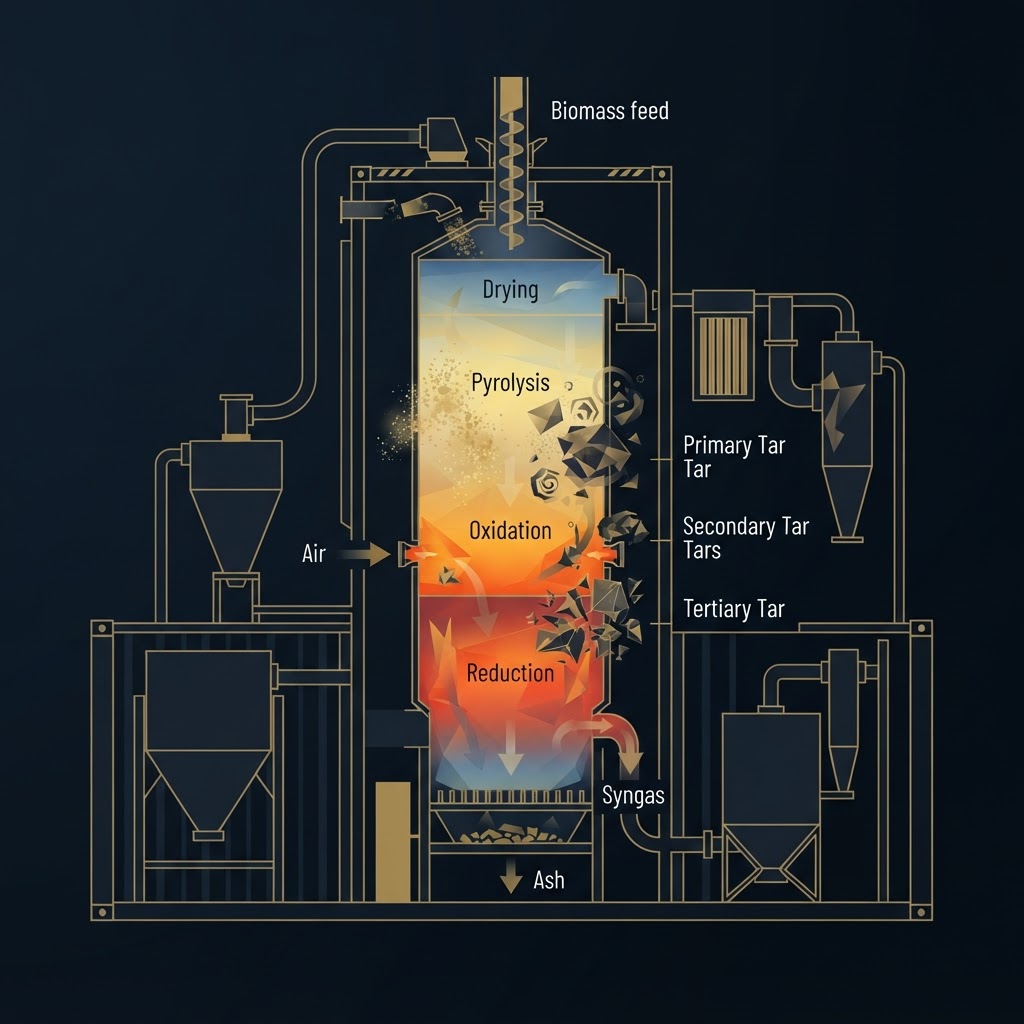
Every gasifier makes tar. Tar formation in gasification is not a malfunction you can engineer out; it is part of the thermochemistry, and a 2024 ACS Omega review states it plainly: the presence of tar in syngas is inevitable. What you control is how much forms, what kind of molecules it is, and at what temperature it will condense inside your pipework.
That distinction matters because most failed small gasification projects did not die from a lack of gas. They died from gas carrying a contaminant nobody had sized for. This article explains where tar comes from, then ranks the levers that set your tar load, from the one that matters most (reactor geometry) to the ones that fine tune it. How to clean the gas afterwards is a separate question, covered in our guide to tar removal from syngas.
Tar is made in the pyrolysis zone, then matured by heat
Tar is a family of condensable organic compounds, mostly aromatic and heavier than benzene. It is born in one zone of the gasifier and changes character as it travels through the others.
Primary tar: what pyrolysis releases
When biomass or waste heats up, the first thing it does after drying is pyrolyse. According to a 2025 review in Sustainability, between about 400 and 600 °C the cellulose, hemicellulose and lignin depolymerise into oxygenated condensable compounds: acids, aldehydes, ketones, alcohols. Lignin contributes phenolic fragments such as guaiacol and syringol. This is primary tar, and the ACS Omega review links lignin content directly to tar yield.
The quantities are not small. The foundational NREL report by Milne, Evans and Abatzoglou notes that fast pyrolysis can turn up to 60% of the original feed weight into primary tar liquid. Gasification exists precisely to push past that point: taken to 700 to 900 °C, primary tars break down into much more gas and a residual 1 to 5% of secondary tar.
Secondary and tertiary tar: what heat turns it into
Above roughly 600 °C, primary tar loses its oxygen through dehydration and decarbonylation and rearranges into secondary tar: phenolics and olefins, then single-ring aromatics like benzene, toluene, xylene and styrene. The Sustainability review places this between 600 and 850 °C.
Push past 800 °C and the surviving molecules condense into tertiary tar. First come alkylated aromatics such as methylnaphthalene, peaking between 850 and 900 °C. Then come the unsubstituted polycyclic aromatic hydrocarbons (PAHs): naphthalene, phenanthrene, anthracene, pyrene. These are the most thermally stable compounds in the mix, the hardest to eliminate, and precursors to soot.
One finding from the NREL work explains a lot about field behaviour: primary and tertiary products are mutually exclusive. Primary tar is destroyed before tertiary tar appears. So the tar coming out of your gasifier is a fingerprint of the hottest zone the gas passed through on its way out.
The five tar classes, and why the dew point matters more than the total
Researchers also group tar by how it behaves rather than where it came from. The ACS Omega review sets out the five-class scheme:
| Class | Name | Examples | Practical behaviour |
|---|---|---|---|
| 1 | GC-undetectable | very heavy tars | measured only by weighing |
| 2 | Heterocyclic aromatics | phenol, cresols, pyridine | highly water soluble |
| 3 | Light aromatics (1 ring) | toluene, xylene, styrene | rarely condense |
| 4 | Light PAH (2 to 3 rings) | naphthalene, fluorene, anthracene | condense even at low concentration |
| 5 | Heavy PAH (4 to 7 rings) | pyrene, chrysene, coronene | condense at high temperature at low concentration |
In a typical gasifier tar, benzene alone makes up 37.9% by weight, toluene 14.3% and naphthalene 9.6%, per the same review. Benzene is usually not counted as tar at all, which is one reason reported tar figures from different labs rarely agree.
The more useful number for an operator is the dew point, and it depends on concentration. A class 2 compound at about 1 mg/Nm3 condenses near 50 °C; the same class at 10,000 mg/Nm3 starts condensing above 100 °C. That is why a gas with less total tar can still foul a heat exchanger faster than a dirtier gas: what matters is which classes are present and how close the dew point sits to your coldest surface.
Reactor geometry sets the tar load before anything else
If you remember one thing from this article: the choice of reactor decides your tar load by orders of magnitude, and every other parameter adjusts within that range. The ACS Omega review summarises typical raw tar levels by gasifier type:
| Gasifier type | Typical tar (g/m3) | Dominant tar character |
|---|---|---|
| Fixed bed, updraft | 10 to 150 | mostly primary |
| Fluidised bed | 5 to 40 | secondary and tertiary mix |
| Fixed bed, downdraft | 0.01 to 0.5 | almost entirely tertiary |
| Entrained flow | no significant tar | none |
NREL's cruder rule of thumb lands in the same place: about 100 g/Nm3 for updraft, 10 for fluidised beds, 1 for downdraft. The character column also comes from NREL, which found well-run updraft units produce largely primary tar while downdraft units produce an almost exclusively tertiary tar.
The reason is the gas path. In an updraft unit the gas leaves through the drying and pyrolysis zones at the top, collecting fresh tar on the way out. In a downdraft gasifier the gas must pass through the hot oxidation zone and the char bed before it exits, so most tar is cracked inside the reactor. Fluidised beds mix everything together, which is why a TNO study of fluidised-bed tar formation reports around 10 g/Nm3 as typical. Entrained flow reactors run at 1,300 to 1,500 °C and produce no significant tar, but they need finely prepared feed and large scale.
The trade-off is size. The ACS Omega review puts the practical ceiling for downdraft units at around 10 MWth, which is why large plants accept fluidised beds and their tar. For small, distributed plants the geometry choice is easier. Our overview of the main gasifier types walks through the rest of the comparison.
Hotter is not simply cleaner
Raising temperature cuts total tar, and the measured effect is steep. In steam gasification of sawdust in a spouted bed, researchers reporting at AIChE measured tar falling from 49.2 g/Nm3 at 800 °C to 6.7 g/Nm3 at 900 °C. The ACS Omega review cites a fluidised bed where moving from 1,023 K to 1,053 K with steam cut tar from 180 to 40 g/Nm3.
But heat changes what remains. In the same AIChE runs, naphthalene became the major compound at 850 and 900 °C. The TNO work is sharper still: as temperature rose from 750 to 900 °C, class 2 tars were almost gone by 850 °C, while class 4 and class 5 PAHs kept climbing the whole way. The tar dew point rose from 145 °C to 203 °C.
Read that again from an operator's side. You can lower total tar and raise the temperature at which what is left condenses. More heat buys a cleaner number on the analysis sheet and a stickier deposit in the cooler. The ACS Omega review flags the same risk: above about 1,123 K, class 4 and 5 compounds dominate, and stretching residence time for more cracking compromises the gas heating value and accelerates three and four ring PAH formation.
Pressure shifts this picture too. A University of Glasgow study notes that while tertiary tar generally increases with temperature at atmospheric pressure, naphthalene drops significantly with temperature in pressurised gasification. The same paper names throughput, the feed rate per unit of reactor cross-section, as one of the dominant factors in tar production alongside temperature and catalyst.
Oxidant, steam and residence time
The gasifying medium is the next lever. The ACS Omega review summarises it this way:
- Oxygen availability stops primary tars from maturing, reducing tar content. A higher equivalence ratio, though, increases four and five ring PAHs, especially at very high temperatures, and lowers the gas heating value.
- Steam delivers a similar tar reduction, provided the steam to biomass ratio is chosen so it does not dilute the gas.
- Oxygen plus steam gives the lowest tar yield of all the media compared.
- Longer residence time lowers primary and secondary tar and slightly raises the PAH fraction.
Oxygen plus steam also removes the nitrogen that air brings in, which matters if the gas is headed for hydrogen rather than an engine. We cover that mode in detail in oxy-steam gasification.
Why waste makes more tar than wood
Most of the tar literature, and most gasifier datasheets, are built on clean wood. Waste behaves differently. In the ACS Omega review's compiled data for air gasification, median tar concentration is higher for waste (RDF and municipal solid waste) than for wood or agricultural residue within each gasifier type, and higher in fluidised beds than in downdraft units for the same waste.
The obvious fix, more heat, is often not available. Agricultural fuels and RDF are restricted to gasification temperatures below about 1,173 K to avoid ash sintering. High-ash feedstocks such as sewage sludge gasification bring the same constraint: the temperature you would like for cracking is the temperature at which the ash starts to fuse.
So on waste you have fewer degrees to spend and a heavier tar load to begin with. Feed preparation, especially feedstock moisture content, and reactor geometry carry more of the burden. This is the core of why gasification plants fail when a unit proven on wood chips is moved onto a real municipal stream.
What the X-150 data shows about controlling formation
Zero-X builds around the levers above rather than against them. The X-150 is a containerised 150 kg/h fixed-bed downdraft gasifier, chosen for the gas path that cracks most tar inside the reactor, and it has been validated at the COMETHA site in Paris, at Fraunhofer IKTS (Verkoso) and at Hochschule Zittau/Goerlitz on high-ash sludge, MSW and digestate.
On the medium, the unit runs in oxy-steam mode. In a 1,939-hour continuous campaign at COMETHA, about 80 days, it processed 16,382 kg of digestate pellets and held 99.98% tar conversion, with 33% hydrogen in the syngas and an H2/CO ratio of 1.95:1 with no nitrogen ballast.
The formation lesson from that run is about measurement as much as chemistry. Tar character shifts with every change in feed and temperature, so a single lab analysis tells you little about month two. Zero-X's SyngaPure gas cleaning system measures tar, H2S, NH3 and particulates in real time under AI control, and was selected for German BMWK go-inno support in December 2025. If tar formation responds to conditions, the plant has to see it respond.
The practical checklist for anyone specifying a gasifier on waste follows directly:
- Pick the geometry first. It sets your tar load by up to four orders of magnitude.
- Ask for tar by class, not just total. A low total made of heavy PAHs can foul faster than a higher total of light aromatics.
- Ask for the dew point. It tells you where in your plant the tar will land.
- Ask what feedstock the data came from. Wood numbers do not transfer to waste.
- Ask for continuous hours. Formation drifts; a percentage without a duration is not a specification.
FAQ
At what temperature does tar form in gasification?
Primary tar forms during pyrolysis at about 400 to 600 °C. It matures into secondary tar between roughly 600 and 850 °C and into tertiary PAH tar above about 800 °C, so the temperature profile of the reactor decides which type leaves it.
Is benzene counted as tar?
Usually not. Tar is normally defined as organic compounds heavier than benzene, yet benzene is routinely measured and reported alongside it, at around 38% of typical tar by weight. Always check whether a vendor's tar figure includes it.
Why does tar from a downdraft gasifier still cause problems?
Because what survives is almost entirely tertiary tar: low in quantity but made of stable PAHs such as naphthalene, which resist further cracking and condense on cool surfaces even at low concentrations.
Can you design a gasifier that makes no tar at all?
Entrained flow gasifiers running at 1,300 to 1,500 °C produce no significant tar, but they need finely milled feed and large scale. Every fixed-bed and fluidised-bed design forms some tar and relies on downstream cleaning for the remainder.
We use cookies to improve your experience on this site. By continuing, you agree to our Privacy Notice.