Waste to Energy for Hotels and Resorts: What Actually Works
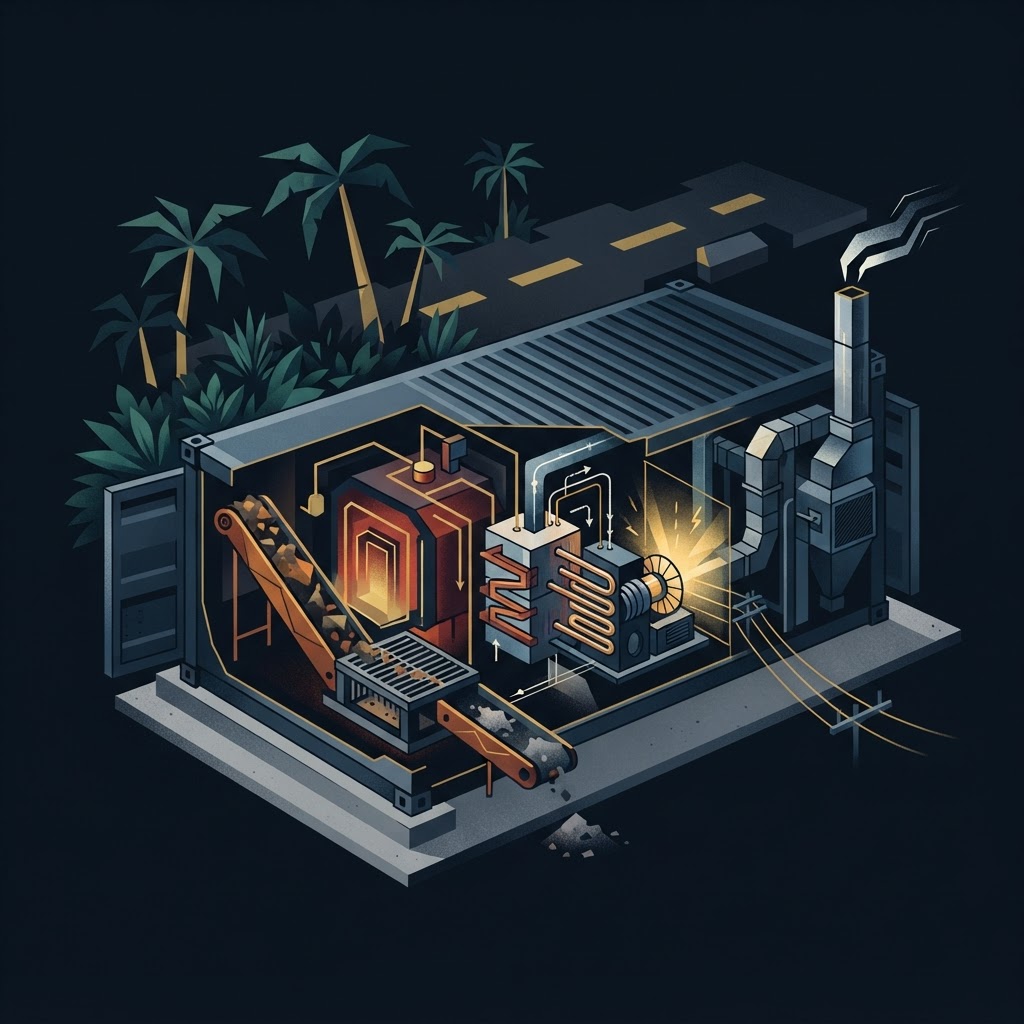
Search waste to energy for hotels and resorts and you will be sold a food waste biodigester. It is a good machine. It is also aimed at roughly a third of what your property throws away, and most of the units on that first page generate no energy at all. That gap between the query and the answer is worth understanding before you sign anything, because the fraction the brochures skip is the fraction that sets your haulage schedule and your disposal bill.
This is a technology comparison written from the feedstock backwards: what is actually in a hotel's bins, which machines can eat which parts of it, and which of them produce power you can use on the property.
What a hotel actually throws away, by weight
The working industry number is that a hotel creates around 1 kg of waste per guest per night, with a benchmark band for a European luxury property of 0.6 to 1.2 kg. Audited results scatter widely around that. A survey of 36 two- to four-star hotels in Germany and Austria averaged 1.98 kg per guest-night, against a median of 1.05 kg across a mid-range European chain. A study of 120 hotels in Hoi An, Vietnam found a mean of 2.28 kg per guest per day, rising with capacity, room price, garden area and restaurant service. Size from your own audit, not from an average.
Composition is where the decision actually lives. An audit across 30 Irish hotels put food waste at 30.3 percent of waste per guest night, recycling at 19.1 percent and general waste at 50.5 percent. The same study estimates a 100-room hotel at 70 percent occupancy generates roughly 25 to 38 tonnes a year.
Read those two lines together. Half the stream is general residual waste. The machine that ranks for this keyword eats the 30 percent.
The three things people mean by waste to energy at a hotel
Three quite different technologies get filed under one phrase. Only one of them puts electricity on your property from your whole stream.
Aerobic digesters: disposal, not energy
The LFC class of biodigester uses bacteria and oxygen to break food waste down into a liquid. Vomo Island Fiji, a 36-room resort, runs an LFC-300 that processes up to 4,400 kg of food waste a month and diverts 18.4 tonnes of CO2e; before it, waste was shipped off the island three times a week. The output is a liquid that feeds the septic system.
That is a real operational win and a real carbon win. It is not energy recovery. If your goal is to stop paying to move rotting kitchen waste, this class of machine does exactly that and nothing more should be expected of it.
Anaerobic digestion: real energy, organic feedstock only
Take the oxygen away and the same organic fraction produces methane. At the Cayo Levantado Resort in the Dominican Republic, 219 rooms and villas, a microdigester rated for 263 tonnes a year produces just over 42,000 Nm3 of biogas annually for thermal and electrical self-consumption. At the Half Moon Hotel in Jamaica, ten small units convert 20 kg of food waste a day into 7,300 m3 of biogas and 41,450 litres of organic fertiliser a year, saving around $20,000.
This is genuine on-site energy. Its ceiling is its feedstock: kitchen waste, garden greens, sludge. Packaging, textiles, mixed residual and most of what leaves the guest rooms are not on the menu.
Thermal conversion: the residual half and the power
High-temperature conversion is the only route that takes the dry, mixed, awkward fraction. Even Zero-X's competitors make the claim for hospitality: WOIMA markets a modular plant fed by all waste fractions, municipal, industrial, commercial and institutional, producing the thermal and electrical power to run a resort. The claim is right. What that page does not give a buyer is a capacity class, a feedstock limit or an operating hour.
Zero-X's platform in this class is the X-150, a containerized 150 kg/h fixed-bed downdraft gasifier independently validated at Paris COMETHA, Verkoso (Fraunhofer IKTS) and Hochschule Zittau/Goerlitz on high-ash sludge, MSW and digestate. It is worth reading how gasification works and why gasification and incineration are not the same process before comparing vendors, because the two get conflated constantly and they have very different permitting profiles.
One warning while you are reading case studies. A Birmingham hotel and conference centre of close to 800 rooms processed 249 tonnes of food waste, cut waste transport by 75 percent, and sent 81 tonnes of residue off site where it was repurposed into electricity described as powering 36 homes for a year. Excellent volume reduction. The electricity was generated somewhere else. Ask every vendor where the generator physically sits.
Why the residual stream is the one that costs money
Food waste is heavy, but it is also the fraction with the most alternatives: composting, donation, portion control, a digester. The residual mixed fraction has none of those, and it is what sets the collection schedule.
On an island it sets the barge. Cayo Levantado's kitchen waste, pruning waste and treatment plant sludge were all barged to Hispaniola before the project. Vomo shipped three times a week. Those logistics do not appear on an energy line item, they appear as a disposal contract, and in hospitality that contract gets large: Zero-X benchmarks hotel waste hauling at $338,000 a year in its own deployment market.
Scale it the boring way instead and the number still moves. At about 1 kg of unsorted waste per guest-night, the ITP and WRAP figures cited in the EU best-practice reference work out to roughly 66 tonnes per hotel per year in the UK. Every tonne of that is a tonne someone is paid to take. If you want the general engineering picture across capacity classes before narrowing to hospitality, our guide to small scale waste to energy systems covers what each class actually eats.
The second bill: what the energy is worth
Here is where hospitality diverges sharply from municipal waste to energy, and where most vendor maths goes wrong. A municipal plant values its output at a grid tariff. A remote resort does not buy power at a grid tariff.
The Asian Development Bank puts Maldives generation costs at $0.30 to $0.70 per kWh, with the most efficient diesel sets producing at $0.23 to $0.33, and notes that resort islands hold 144 MW of diesel capacity of their own on top of the 290 MW installed across inhabited islands. The Climate Investment Funds report electricity costs reaching $0.40 per kWh in the outer islands. A fully loaded genset model that adds operations, maintenance and reserves to fuel lands at about $0.46 per kWh. Zero-X uses $0.40 per kWh as its island benchmark.
So a remote property is paying twice for the same tonne: once to remove it, and again for the diesel that would not have been needed if that tonne had been converted. A machine that closes both lines is not competing against a $0.10 grid tariff. That is the arithmetic that makes hospitality one of the few sectors where a small unit clears its own cost.
Do not oversell it to yourself either. At one to two kilograms per guest-night, waste displaces a slice of diesel. It does not make a resort energy independent, and any vendor promising that is selling you an arithmetic problem.
Sizing: what 150 kg an hour means for a property
Turn the capacity class into rooms. Take a 200-room property at 70 percent occupancy with two guests per occupied room: about 280 guest-nights a day. At the 1 kg per guest-night industry figure that is roughly 280 kg of waste a day. At the 1.98 kg average from the German and Austrian survey it is around 550 kg, and at Hoi An's 2.28 kg it is closer to 640 kg.
A 150 kg/h class unit running a single shift covers the low end of that band and a longer duty cycle covers the high end. This is arithmetic from the published generation rates above, not a throughput claim for any specific project. Your own audit replaces every number in that paragraph.
The practical questions a general manager asks next are all answerable:
- Footprint. Containerized units arrive as a unit and sit in the back of house area you already use for waste, not in a new building.
- Guest proximity. Gasification is a closed, negative-pressure process rather than an open burn, which is why the siting conversation is about noise and truck movements more than about plume.
- Moisture and separation. Thermal conversion wants the dry fraction dry. This is a housekeeping and kitchen discipline question, and it is the single most common reason a unit underperforms its spec sheet.
- Staffing. Someone has to be trained and accountable. Certified operations and maintenance is part of the technology package, not an afterthought.
Hospitality is not a theoretical market for this platform. The X-5 prototype, introduced in 2021 as the precursor to the X-150, is operational at Thrive Hotel in Canggu, Bali.
The failure mode nobody in hospitality brochures mentions: tar
If you take one technical question to a vendor call, make it this one. Small gasification projects rarely fail at gasification. They fail at gas cleaning. Tar condenses in the downstream equipment, fouls the engine, and turns a plant into a maintenance liability within months. The industry is littered with demonstrators that never got past that.
The number to ask for is continuous operating hours on your feedstock, not on clean wood. Zero-X's public figure comes from the COMETHA campaign in Paris: 1,939 hours, 80 consecutive days, 16,382 kg of digestate pellets processed, 99.98 percent tar conversion and 33 percent hydrogen in the syngas in oxy-steam mode. The cleaning stage behind that is SyngaPure, a modular system with real-time tar, H2S, NH3 and particulate sensing, which was selected for German federal BMWK go-inno support in December 2025.
We have written the full technical version of this in tar is what actually kills gasification projects. For a buying decision, the short form is enough: no gas cleaning spec, no deal.
Who pays for it
Waste to energy at property scale is a capital decision, and in most target markets it is not a decision you fund alone. Zero-X's programme is built on the observation that governments fund 56 to 70 percent of project CAPEX in its target markets, with validated routes in Spain at 70 percent under IER in Cadiz and Andalusia, Portugal at 60 to 72 percent under SICE in Alentejo, and Greece at 56 percent in Patras.
Two structures follow from that. A property that wants the asset applies for the grant and owns the plant. A property that wants the outcome without the balance sheet entry hosts a build-own-operate project, where a regional developer funds and runs the unit and the hotel contributes the feedstock and buys the output. Which one fits depends on how you already treat your energy contracts.
The grant application is the work. Our breakdown of government grants for waste to energy covers the routes, and the capital side is set out in what a waste to energy plant costs to build.
A short buying checklist before you sign anything
Take these to the vendor call:
- What percentage of my audited stream, by weight, does this machine accept? Ask for the answer against your composition, not against a generic pie chart.
- Where does the generator physically sit? On my property, or at a facility that receives my residue?
- How many continuous hours has this unit run on a feedstock like mine? Clean wood hours do not count.
- What is the gas cleaning specification and what is measured in real time?
- What comes out the other end, in what quantity, and who takes it?
- What is the separation discipline my staff have to maintain for the spec sheet to hold?
- Who writes the grant application, and what is the fee if it fails?
- What does the operations and maintenance contract cover in year three, not year one?
A vendor who answers all eight in numbers is worth a site visit. A vendor who answers in adjectives is selling a brochure.
FAQ
How much waste does a hotel produce per guest per night? Roughly 1 kg is the working industry figure, but audited results range from a 1.05 kg median across a mid-range European chain, to 1.98 kg across 36 German and Austrian hotels, to 2.28 kg per guest per day in Hoi An, Vietnam. Generation rises with capacity, room price, garden area and the completeness of food and beverage service, so a resort sits at the top of that range and a limited-service city hotel near the bottom. Use your own twelve months of contractor invoices divided by guest-nights.
Is a food waste biodigester the same as waste to energy? Only if it is anaerobic. Aerobic biodigesters, the widely marketed LFC class, convert food waste into a liquid that goes to drain or septic. That is disposal and carbon avoidance, and it is genuinely valuable, but no energy is recovered. Anaerobic digestion produces biogas you can burn. Ask which process is in the box.
Can a hotel gasifier take sewage sludge from the property's own treatment plant? High-ash-tolerant fixed-bed downdraft designs can, and Zero-X's validation covers high-ash sludge, MSW and digestate specifically because most gasifiers cannot. This matters more than it sounds: island resorts routinely barge treatment plant sludge off site on the same schedule and the same contract as the kitchen waste, so it is the same cost line.
What is the smallest property size that justifies an on-site system? The threshold is tonnage, not stars or room count. The question is whether the property generates enough consistent daily feedstock to keep a unit inside its operating band year round, which depends on guest-nights, food and beverage volume and how seasonal your occupancy is. A 40-room resort with three restaurants and heavy garden waste can out-produce a 150-room limited-service hotel.
Does an on-site system reduce our waste contractor bill or eliminate it? Reduce. Glass, metals, hazardous waste and anything the technology does not accept still leaves the property, so the contract shrinks rather than disappears. The saving comes from the collection frequency dropping, which is why the operational numbers to model are truck or barge movements per week, not just tonnes per year.
We use cookies to improve your experience on this site. By continuing, you agree to our Privacy Notice.