Oxy-Steam Gasification: Hydrogen Without Nitrogen Ballast
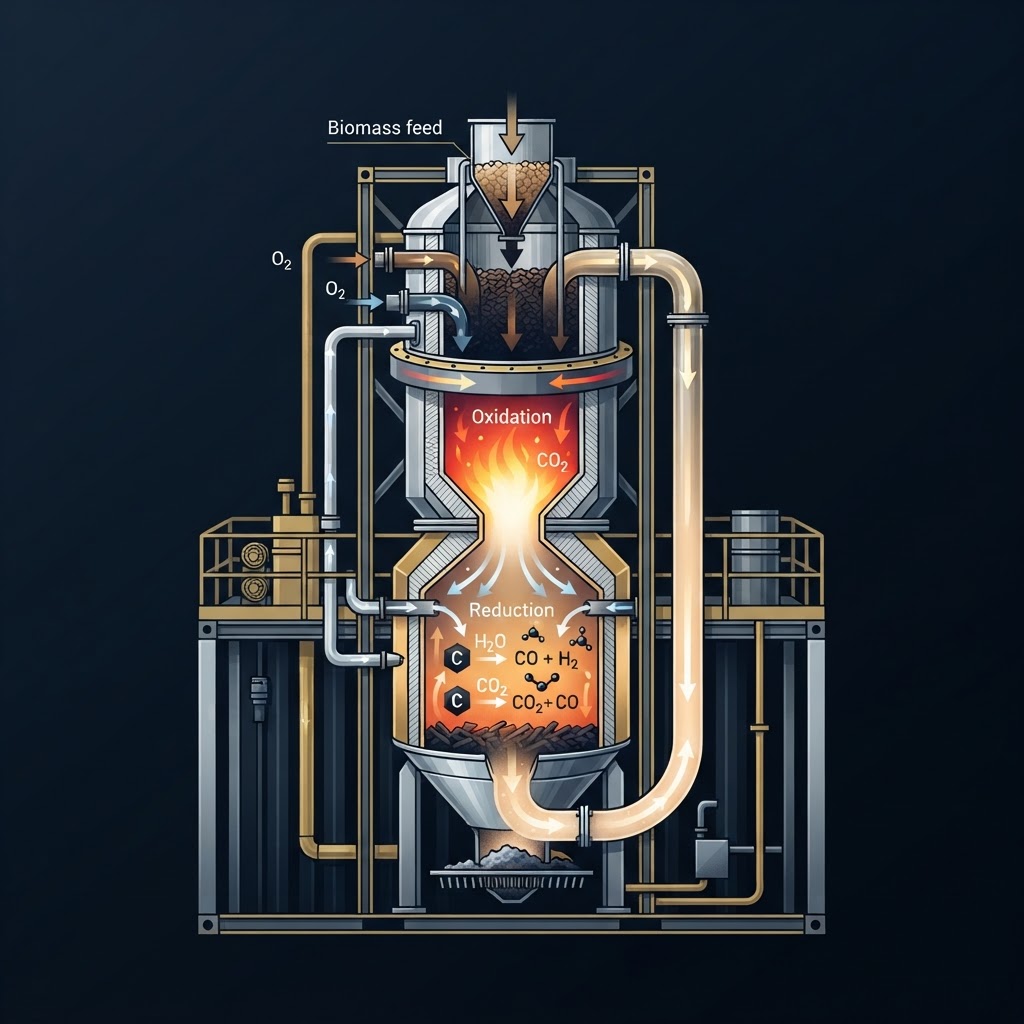
Air is 78% nitrogen, and a gasifier blown with air spends its whole life heating that nitrogen up and pushing it out the stack with the fuel gas. Oxy steam gasification removes it. Oxygen replaces air as the oxidant, steam is added as a second agent, and the gas that leaves the reactor is mostly hydrogen and carbon monoxide instead of mostly nitrogen.
That one change decides what the gas can become. Diluted producer gas is fine for an engine. Nitrogen-free, hydrogen-rich syngas can go to hydrogen separation, methanol or Fischer-Tropsch. The price is an oxygen supply and a reactor that is harder to keep in balance.
This guide covers how the process works, the two ratios that control it, what the steam and oxygen really cost you, and what happened when we ran it for 1,939 hours on waste.
What oxy-steam gasification is
Every gasifier partially oxidises its feedstock. A share of the carbon burns to supply heat, and that heat drives the endothermic reactions that turn the rest into combustible gas. The gasifying agent is what you blow in to make that happen.
In oxy-steam mode, the two agents split the work:
- Oxygen is the heat source. It burns part of the char and volatiles inside the bed, so the process stays autothermal without a heat exchanger or a second reactor.
- Steam is the hydrogen source. It raises the water partial pressure and pushes the water-gas reaction (C + H2O to CO + H2) and the water-gas shift (CO + H2O to CO2 + H2) toward more hydrogen.
Pure steam gasification gives an even richer gas but needs heat delivered from outside, which is why it usually runs in dual fluidised beds or allothermal reactors. Oxy-steam keeps the simplicity of a single directly heated reactor. It works in downdraft, updraft and fluidised beds; our overview of types of gasifiers covers how those differ. For the full breakdown of the gas itself by agent, see our guide to syngas composition. This page is about running the process.
Why remove the nitrogen: air vs oxygen vs oxy-steam
The cleanest comparison in the literature comes from one 200 kWth updraft pilot plant at ENEA that gasified the same residues with all four agent combinations. The hydrogen content measured by Cerone and Zimbardi was:
| Gasifying agent | H2 in syngas (vol%) |
|---|---|
| Air | 9.7 to 11.4 |
| Air plus steam | 15.8 to 21.6 |
| Oxygen | 26.4 to 28.9 |
| Oxygen plus steam (oxy-steam) | 31.6 to 39.2 |
Swapping air for oxygen nearly triples the hydrogen share, mostly because the nitrogen diluent is gone. Adding steam on top lifts it again, because now the chemistry itself makes more hydrogen. The same study reports the H2/CO molar ratio rising from 0.34 to 0.66 with air to 0.80 to 2.08 once steam is added, with the top value of 2.08 reached in oxy-steam gasification of lignin-rich residues.
You do not have to go all the way to pure oxygen to see the effect. On a pressurised bubbling fluidised bed, enriching the air to 40% oxygen raised hydrogen by up to 70%, carbon monoxide by up to 34% and the gas heating value by up to 43%. The same work flags a cost: ammonia and NOx in the syngas rose as enrichment increased, and the benefit was largest for feedstocks low in nitrogen and moisture.
The two dials: oxygen ER and steam-to-biomass ratio
An oxy-steam gasifier has two main control inputs. Most of what goes right or wrong comes down to how they are set against each other.
Oxygen equivalence ratio: the heat source
The equivalence ratio (ER) is the oxygen supplied as a fraction of what full combustion would need. Raise it and the bed gets hotter and conversion improves, but more of the fuel burns to CO2 and water instead of becoming gas. Lower it and you keep more chemical energy in the syngas, until the reactor can no longer hold its temperature.
Steam-to-biomass ratio: the hydrogen source
The steam-to-biomass ratio (SBR) is kilograms of steam per kilogram of feed. In a downdraft oxy-steam study at the Indian Institute of Science, Sandeep and Dasappa varied SBR from 0.75 to 2.7 and ER from 0.18 to 0.3. Hydrogen fraction rose with SBR, peaking at a yield of 104 g of H2 per kg of biomass at SBR 2.7. But higher SBR forced a higher ER to keep the reactor hot, and the energy trade-off was clear: gasification efficiency was 85.8% with an LHV of 8.9 MJ/Nm3 at SBR 0.75, against 69.5% at SBR 2.5 and an LHV of 7.4 MJ/Nm3 at SBR 2.7.
That is the core tension of the process. Steam buys hydrogen, oxygen pays for the steam, and every unit of oxygen you add burns fuel that would otherwise have been gas.
Where the sweet spot sits
The answer depends on the reactor and the feed, but the published points are useful anchors:
- On the ENEA updraft plant, oxy-steam gasification of torrefied wood gave the best cold gas efficiency and heating value with both ERs (oxygen and steam) in the 0.23 to 0.27 range. Cold gas efficiency rose from 0.57 to 0.69 as the steam ER went from 0 to 0.25, then fell back to 0.64 at 0.28. More steam stopped helping.
- In a bubbling fluidised bed at Université de Lorraine, Badu and co-authors reached 45 vol% hydrogen from construction waste wood at ER 0.2 and SBR 1.3, and 36% from wood chips at ER 0.31 and SBR 0.97. They note that very low ER is possible in electrically heated pilot rigs but hard to hold in autothermal gasifiers.
- A 100 kWt downdraft unit studied at the University of Pisa produced syngas above 40 vol% hydrogen with cold gas efficiency above 80%, and modelling showed roughly 5% hydrogen by mass of the biomass after purification.
Read together: the best results sit at moderate oxygen and moderate steam, and the record hydrogen numbers come from conditions a self-heated commercial reactor cannot always sustain.
The steam penalty: temperature, tar and efficiency
Steam does not arrive at reactor temperature. On the ENEA plant it was fed at 160 C into a bed running near 1,000 C at the grate, and too much of it cooled the whole reactor. In eucalyptus tests, raising the steam ER from 0.19 to 0.24 dropped the average bed temperature from 688 C to 642 C and pushed tar from 29.53 to 45.48 g/kg. More steam also meant more gas, a shorter residence time and less time for tar to crack. Making the steam itself took about 3.9% of the heating value of the biomass fed.
So why use it at all? Because steam is also the best temperature control you have. At steam ERs above 0.2 the lower bed on that plant held between 850 C and 950 C, and steam prevented the local hot spots and ash melting near the grate that end campaigns early. For high-ash waste, that matters more than the last point of efficiency.
Oxygen helps on the tar side. Using oxygen instead of air lengthens gas residence time in the bed, which gave more thermal cracking of tar in the ENEA data. Even so, oxy-steam syngas still needs cleaning before an engine, a shift reactor or a synthesis catalyst; our guide to tar removal from syngas covers the options.
Where the oxygen comes from, and what it costs
Every paper above uses bottled or laboratory oxygen. A plant has to make its own, and at small scale this is the question that decides whether oxy-steam pays.
How much oxygen. A scoping study for oxygen-blown biomass gasification puts the need at, conservatively, about 1/3 kg of oxygen per kg of dry biomass.
Which technology. Large plants use cryogenic air separation. Below about 500 tonnes per day, the capital cost and energy penalty of cryogenic separation become too high to compete with pressure swing adsorption (PSA) or vacuum PSA. For PSA plants making 10 to 50 tonnes per day, that DOE abstract gives a total oxygen cost of about $200 per tonne and 300 to 500 kWh of electricity per tonne. PSA delivers 90 to 95% oxygen, not pure oxygen, at roughly half the production cost of cryogenic plant according to the scoping study. The few percent of residual nitrogen and argon end up in your syngas.
Why it matters. At large gasification plants, the air separation unit consumes over 5% of plant power and makes up about 15% of plant cost. Small plants do not get better economics than that.
A simple back-of-envelope check, using only the figures above and not a measured value: a unit gasifying 150 kg/h of dry feed would need roughly 50 kg of oxygen per hour, about 1.2 tonnes per day. At 300 to 500 kWh per tonne, that is 15 to 25 kW of continuous electrical load for oxygen alone. Treat it as a floor, since the cited PSA figures are for plants 10 to 40 times larger and specific consumption rises as units shrink.
The practical conclusion: oxy-steam earns its oxygen bill when the product is worth more than electricity. If the gas goes straight to an engine, nitrogen is just ballast you can live with. If the gas goes to hydrogen or liquid fuels, nitrogen is a contaminant you would have to pay far more to remove downstream.
Oxy-steam on real waste: 1,939 hours at COMETHA
Almost every published oxy-steam dataset is clean wood, a few hours long. Waste behaves differently: more ash, more moisture variation, more clinker risk. So this is what our X-150, a containerised 150 kg/h fixed-bed downdraft gasifier, did in the COMETHA campaign in Paris:
- 1,939 hours of continuous operation, 80 consecutive days
- 16,382 kg of digestate pellets processed
- 33% hydrogen in the syngas
- H2/CO ratio of 1.95:1, in oxy-steam mode with zero nitrogen ballast
- 99.98% tar conversion
Our 33% hydrogen sits inside the 31.6 to 39.2% oxy-steam band from the ENEA plant, below the 40% plus figures from clean-wood downdraft and fluidised bed rigs. That is the expected cost of running digestate instead of wood chips, and the trade we would make every time: a number held for 80 days on a feedstock that fixed-grate systems clinker on beats a peak held for an afternoon on ideal feed. The roller grate in the X-150 is what keeps high-ash feeds moving.
The 1.95 ratio matters more than the hydrogen share. A ratio near 2 is what Fischer-Tropsch and methanol synthesis want, which means the gas leaves the reactor close to synthesis-ready without a large shift step. Gas cleaning is handled by SyngaPure, our AI-supported cleaning system with real-time sensing of tar, H2S, NH3 and particulates, which was selected for German BMWK go-inno support in December 2025. The platform has been validated at Paris COMETHA, Verkoso (Fraunhofer IKTS) and Hochschule Zittau/Görlitz on high-ash sludge, MSW and digestate.
When oxy-steam is worth it
Use this as a first filter:
- Power or heat only (CHP). Air gasification is usually the better answer. Nitrogen costs you heating value, but an engine runs on producer gas, and you avoid the oxygen plant entirely.
- Hydrogen. Oxy-steam is the natural route. You start with a third or more hydrogen and no nitrogen to separate out. Our explainer on how waste-to-hydrogen works follows the gas from reactor to purified hydrogen, and we cover the downstream step in syngas to hydrogen.
- Methanol, Fischer-Tropsch or SAF. Oxy-steam is close to mandatory. Synthesis needs nitrogen-free gas and a ratio near 2, which steam lets you tune. See our guide to the syngas H2/CO ratio.
- Wet or high-ash waste. Steam's temperature control helps against clinker, but moisture already in the feed is not a substitute for dosed steam; the IISc study found dry wood with steam outperformed wet wood on both hydrogen and efficiency.
The deciding number is rarely in the reactor. It is the value of the product per kg of oxygen you have to make.
FAQ
What is the difference between steam gasification and oxy-steam gasification?
Pure steam gasification is endothermic, so it needs heat from outside, typically through a second reactor or heat exchanger. Oxy-steam adds oxygen to burn part of the feed inside the bed, which keeps the process self-heated in a single reactor at the cost of some hydrogen and the need for an oxygen supply.
Can oxygen-enriched air replace pure oxygen?
Yes, partially. Enrichment to 40% oxygen already lifts hydrogen and heating value sharply, and PSA units deliver 90 to 95% oxygen. The remaining nitrogen dilutes the gas, and higher enrichment can raise ammonia and NOx in the syngas.
Does more steam always mean more hydrogen?
No. Past a point, extra steam cools the bed, shortens residence time and raises tar. On the ENEA plant, cold gas efficiency peaked at a steam ER of about 0.25 and then fell.
Is oxy-steam gasification used commercially at small scale?
Rarely, because the oxygen plant adds cost and electrical load that a power-only unit cannot justify. Published oxy-steam data is mostly short tests on clean wood, which is why the 1,939-hour COMETHA run on digestate stands out.
We use cookies to improve your experience on this site. By continuing, you agree to our Privacy Notice.