Sewage Sludge Gasification: What Actually Works
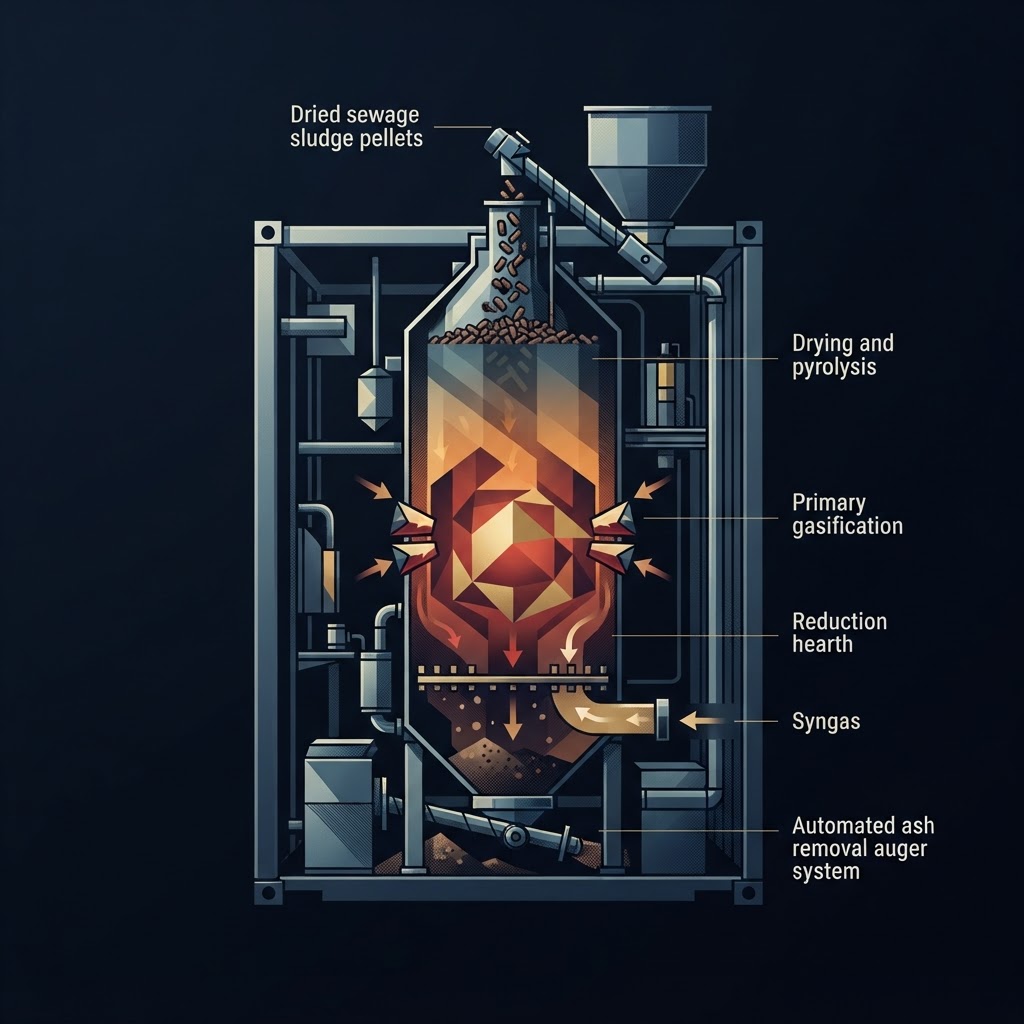
Search sewage sludge gasification and you get review papers. Fluidized bed parameter studies, thermochemical conversion overviews, a lot of laboratory hours reported as if they were operating hours. What you do not get is the thing a plant manager actually needs before 2029: which failure mode will stop the machine, what the syngas is worth once it is clean, and which installations have genuinely run.
This article is that version. Every number below is either a measured plant figure or a published dataset, and each one says which.
What sewage sludge gasification actually is
Gasification runs the sludge sub-stoichiometric. You supply less oxidant than complete combustion needs, typically at 800 to 900 degrees C, and instead of flue gas and ash you get a combustible gas (hydrogen, carbon monoxide, methane, carbon dioxide) plus a carbon and mineral residue. Incineration oxidises everything and leaves ash. Pyrolysis uses no oxidant at all and leaves char plus oil. Gasification sits between them, and that position is legally load bearing in Germany: the federal environment agency's sludge report lists sub-stoichiometric processes such as pyrolysis and gasification alongside mono-incineration and co-incineration as accepted thermal pre-treatment routes.
If you want the mechanism in full, we covered how waste gasification works and the gasification versus incineration comparison separately. Here the interest is narrower: what sludge specifically does to the machine.
Why sludge is the hardest feedstock in the business
Wood gasifiers are a solved problem. Sludge gasifiers are not, and there are three physical reasons.
Ash is close to half the dry mass
Across 185 published datasets, sewage sludge ash averages 32.4 plus or minus 11.8 percent of total solids, and phosphorus makes up about 6.7 percent of that ash, per a review of 208 sludge datasets from 162 papers. Real samples run higher. A fixed bed study on two Polish sludges measured 36.5 and 44.2 percent ash with lower heating values of 12.96 and 10.75 MJ/kg dry. In a steam-oxygen fluidized bed campaign the ash summed to almost half the fuel's dry mass.
Compare that to clean wood at a few percent. Every kilogram you feed is half mineral that has to move through the reactor, be discharged, and not fuse on the way.
Sintering starts 300 degrees below the melting point
This is the trap. Sewage sludge ash melts at around 1200 degrees C, which sounds like enormous headroom. It begins sintering at about 900 degrees C, which is not headroom at all. Bed temperature has to stay under the sintering onset or the bed agglomerates and the plant stops. Tar cracking, meanwhile, wants temperature as high as you can get it. The practical window that falls out of that trade-off is 850 to 900 degrees C, and it is narrow.
Half the volatiles of wood
Sludge carries roughly 49 to 51 percent volatile matter on a dry basis against about 70 percent for conventional biomass. Less volatile matter means less gas per kilogram fed and a slower, more char-dominated conversion. A gasifier designed on wood numbers will be undersized on gas output and oversized on residue handling.
The drying energy nobody puts in the business case
Mechanically dewatered sludge averages 21.0 plus or minus 6.7 percent total solids. Gasifiers do not accept that. Depending on reactor type you need 45 to 50 percent dry matter for a fluidized bed and more than 80 to 85 percent for a fixed bed, with water content ideally between 10 and 20 percent, according to a comparative analysis of sludge thermal treatment routes. The published route to get there is centrifuge to about 0.25 kg/kg dry matter, then solar and low-temperature thermal drying up to about 0.9 kg/kg.
That drying is not free, and here is the honest consequence the vendor brochures skip: the same analysis found that a sludge gasification plant runs roughly energy neutral. It covers its own drying and parasitic load, with little or nothing left to export. Any business case that shows a sludge gasifier as a net power station, without saying where the drying heat comes from, has moved a cost off the page.
Tar, and why sludge tar is worse than wood tar
Tar is the reason the global count of sewage sludge mono-gasification plants is small. The literature attributes that scarcity to a technically demanding process with high downtimes, and the mechanism behind the downtime is condensing tar fouling coolers, filters and engines.
Sludge tar is also chemically nastier than wood tar. Gravimetric tar sampled from sludge syngas carries significant sulfur, nitrogen and chlorine, and comes out as ammonium salts as much as polyaromatics, with a heating value around 25 MJ/kg, roughly 40 percent below naphthalene. A cleaning train sized on wood tar chemistry will be sized wrong.
This is the specific problem SyngaPure was built for. Zero-X's modular gas cleaning system removes 99 percent of tar compounds while holding energy efficiency, and its real-time sensing of tar, H2S, NH3 and particulates was selected for German federal BMWK go-inno support in December 2025. For the numbers behind gas cleaning generally, see our piece on tar removal from syngas.
The regulation that makes this unavoidable
Germany's amended sewage sludge ordinance (AbfKlaerV) entered into force on 3 October 2017 and put a clock on every large wastewater plant in the country. Phosphorus recovery becomes obligatory on 1 January 2029 for plants above 100,000 population equivalents and on 1 January 2032 for plants above 50,000 PE. The obligation triggers when sludge contains 20 g phosphorus or more per kg of total solids. Recovery must extract at least 50 percent of the phosphorus from the sludge itself, or at least 80 percent from the ash or carbonaceous residue after thermal treatment. Below 50,000 PE, soil application stays possible. The ordinance names no specific technology, which is what leaves the door open.
Two words in that framework matter for gasification: carbonaceous residue. Gasification does not produce an incineration ash, it produces a carbon-bearing solid, and the ordinance addresses that category explicitly.
The scale of the problem is already visible. More than 65 percent of German municipal sewage sludge, about 1.1 million tonnes, already goes to incineration, and around 34 new mono-incineration projects are in planning with no settled phosphorus recovery solution attached. Europe produces over 10 million tonnes of dry sewage sludge a year. This is not a niche waiting for demand.
If your project needs public co-funding to clear its capital hurdle, our guide to grants for waste-to-energy projects covers the routes, and the machine-output side of the mandate is treated in phosphorus recovery from sewage sludge.
What actually runs
Two datasets are worth more than the entire review literature, because they are hours rather than experiments.
Balingen, since 2002. The oldest sewage sludge gasification plant of its kind was built for about 1,000 t/a dry solids, then expanded in 2010 to about 2,000 t/a dry solids when neighbouring municipalities joined the disposal association. It gasifies with air at 850 degrees C, 720 kW installed, feeding a belt dryer. Note where the syngas ends up: originally blended with digester gas into a CHP, now converted purely to heat to cover the dryer's own demand. Twenty years of operation, and the energy went back into drying. That is the realistic base case, and it confirms the energy balance above rather than contradicting it.
COMETHA, 1,939 continuous hours. Zero-X ran its X-150 platform for 1,939 hours, 80 consecutive days without interruption, processing 16,382 kg of digestate pellets in Paris. Measured over that campaign: 33 percent hydrogen in the syngas, 99.98 percent tar conversion, and an H2/CO ratio of 1.95 to 1 in oxy-steam mode with zero nitrogen ballast. The first reactor in that project went operational in Paris in May 2024, fed by household waste and sewage sludge.
The X-150 is a 150 kg/h containerized fixed-bed downdraft platform, and it has been independently validated at COMETHA, at Verkoso with Fraunhofer IKTS and at Hochschule Zittau/Goerlitz specifically on high-ash sludge, MSW and digestate, the feedstocks that clean-wood gasifiers cannot handle. On the small end of the scale, this is the class covered in small-scale waste-to-energy systems.
What the syngas is actually worth
The gasification agent decides the product.
Air gasification gives a nitrogen-diluted gas fit for heat and, with cleaning, for engines. The published optimum air ratio for maximum syngas heating value is 0.18. Push higher and the process slides toward combustion.
Steam-oxygen removes the nitrogen ballast, and the gas becomes a chemical feedstock. Fluidized bed work measured hydrogen up to 0.37 and carbon monoxide up to 0.18 as volume fractions, and showed that the H2/CO ratio can be steered by the water gas shift toward roughly 3 for synthetic natural gas or 2 for Fischer-Tropsch products. Zero-X's measured 1.95 to 1 lands on the Fischer-Tropsch number. That is the reason to run oxy-steam rather than air: it converts a heat product into a fuels and chemicals product.
Two further findings help the residue case. Cadmium, mercury and thallium evaporate during gasification, leaving the bed ash lean in them, which matters if the phosphorus-bearing residue is headed for fertiliser production. And the calcium already present in sludge ash binds most of the sulfur into that residue, an effect that limestone addition improves while lowering H2S and COS in the gas.
How to evaluate a vendor
Six questions, in the order that separates a machine from a slide deck.
- What is the longest continuous run, in hours, on sludge like mine? Not on wood, not summed across campaigns, not laboratory hours. Hours are a different unit from experiments and most published claims are experiments.
- What tar conversion was measured, and by which sampling method? A percentage with no method behind it is not a number.
- What does my specific ash do at your bed temperature? Sintering onset for their reference ash is not sintering onset for yours.
- Where does the drying heat come from, and is it inside your energy balance? If the answer is vague, the business case is short by the largest single load.
- What happens to the phosphorus, and does the residue route satisfy the 80 percent requirement? The recovery obligation does not disappear because the plant is small.
- Who validated it, by name? An institute that will be quoted is worth more than an internal report.
Ask those six and most of the market answers itself.
FAQ
Is sewage sludge gasification the same as incineration? No. Gasification runs sub-stoichiometric and produces a combustible gas plus a carbonaceous residue instead of flue gas and ash. German waste law treats it as its own thermal pre-treatment route, distinct from mono-incineration and co-incineration.
How dry does sewage sludge have to be before gasification? It depends on the reactor. Fluidized beds need 45 to 50 percent dry matter, fixed beds more than 80 to 85 percent, ideally with water content between 10 and 20 percent. Mechanically dewatered sludge arrives at around 21 percent, so a drying stage is mandatory, not optional.
Does gasification satisfy the German phosphorus recovery obligation? It counts as thermal pre-treatment, so the obligation is discharged downstream on the ash or carbonaceous residue, which must yield at least 80 percent phosphorus recovery. Verify the residue route with the authority before committing, because the obligation stays with the wastewater plant operator even when the recovery happens elsewhere.
What temperature does sewage sludge gasification run at? Practically 850 to 900 degrees C. High enough to crack tar, low enough to stay below the roughly 900 degrees C sintering onset of sewage sludge ash. Balingen runs at 850.
Are there any sewage sludge gasification plants actually operating? Yes, but few. Balingen has run since 2002 at about 2,000 t/a dry solids. The worldwide count of mono-gasification plants remains small, which the literature attributes to process complexity and downtime, and which is exactly why continuous-hour data should be the first thing you ask any vendor for.
Available for advisory work, board seats and media appearances.
Julien Uhlig advises boards and funds and briefs newsrooms across Europe and North America. Enquiries are read personally.
We use cookies to improve your experience on this site. By continuing, you agree to our Privacy Notice.