Waste Gasification Companies in 2026: Who Builds What
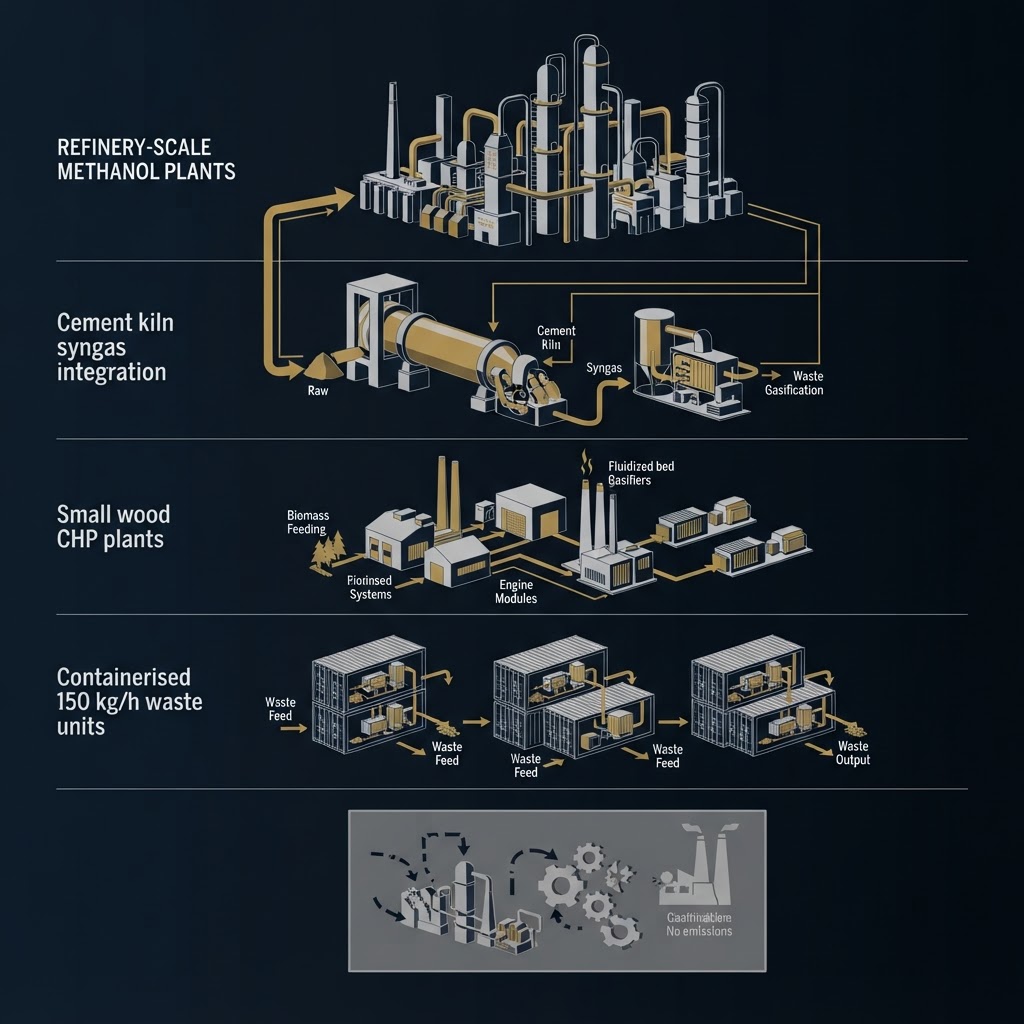
Search for waste gasification companies and you get a pile of press releases, directory listings and roundups that rank on one thing: the size of the announcement. Tonnes per year, grant euros, target start dates. What they rarely tell a buyer is the part that decides whether a project gets built: which scale class the company actually plays in, what it sells (a plant, a licence or a project), and how many hours its reactor has run on real waste.
This guide sorts the field on those three questions. We build gasifiers ourselves, so we are on the list too, in our own bracket, with our own number.
First, take the incinerators off the list
Half the companies that surface for this query do not gasify anything. Take enfinium's new Skelton Grange plant in Leeds: it processes up to 410,000 tonnes of unrecyclable waste to generate up to 49 MW, built by Kanadevia Inova on advanced moving grate technology. That is a serious modern energy-from-waste plant. It is also combustion: waste burns on a grate with excess air and the heat raises steam.
Gasification runs with too little oxygen to burn the feed and makes a fuel gas, syngas, that can go to an engine, a kiln, a catalyst or a hydrogen train. Different chemistry, different emissions profile, different permit. The full comparison is in gasification vs incineration. For shortlisting, the rule is simple: if the company's reference plants all have grates and steam turbines, it is an incineration company, however the directory files it.
Refinery-scale: waste to methanol and hydrogen
At the top of the size range, gasification is a feedstock play for the chemical industry. Two projects define it in Europe.
Enerkem with Repsol, Ecoplanta, Spain
Repsol's board has approved the final investment decision for Ecoplanta in El Morell, which will use Enerkem's gasification technology to divert around 400,000 tonnes of non-recyclable municipal waste a year into 240,000 tonnes of methanol, with start-up scheduled for 2029. Note the roles: Enerkem licenses the technology, Repsol owns and develops the plant, and an engineering contractor builds it. That is the normal shape at this scale.
NEXTCHEM with Eni and Iren, Italy
MAIRE's technology unit NEXTCHEM is the licensor for a plant at Eni's Sannazzaro refinery that would convert about 200,000 tonnes a year of non-recyclable waste into up to 110,000 tonnes of methanol and up to 1,500 tonnes of hydrogen. The date on that announcement is the start of permitting, not construction.
Both are credible, well-capitalised programmes. Both are also future tense. If you are a municipality with 20 tonnes a day, or a developer looking for a plant you can finance this year, this bracket is interesting news and not a supplier list.
Industrial fuel substitution: syngas into a kiln
The quietest bracket is arguably the most commercially grounded. Here gasification does not make a product for sale; it replaces fossil fuel inside an existing industrial process.
WtEnergy Advanced Solutions reports that its SynTK system at a Spanish cement plant gasifies RDF and other waste-derived fuels for the kiln, substituting 30 MW of fuel at 94 to 97 percent overall efficiency, cutting chlorine in the fuel stream by more than 90 percent, avoiding 55,000 tonnes of CO2 a year, with a payback of two years. Those are vendor figures, not third-party measurements, and should be read that way. The logic is still sound: the customer already has the burner, the permit and the heat demand, so the gasifier only has to deliver a clean, steady gas.
Small modular CHP: proven, mostly on wood
Below a few megawatts, the most established names make combined heat and power from biomass. Syncraft in Austria is the reference case. Its Frauenfeld plant in Switzerland runs four gasifier lines with 4,000 kW of electrical output, burning 2,720 kg/h of regional waste wood and permanently removing 12,000 tonnes of CO2 a year via the char, commissioned in 2021. Its development plant in Schwaz has run since 2009 on wood chips, with bark, straw and waste wood studied as alternative feeds.
This is real, bankable technology. It is also the key distinction buyers miss: "waste wood" is not municipal solid waste, sewage sludge or digestate. Clean or semi-clean wood has low ash and predictable chemistry. High-ash residues are where fixed-bed designs clinker, tar up and stop, which is why reactor choice matters more than brand name. Types of gasifiers walks through which design survives which feed.
Demonstration class: long on design, short on hours
Next come companies with working hardware and a strong story, but without published long-duration data on waste.
Sierra Energy, California. Its FastOx gasifier at the US Army's Fort Hunter Liggett is designed to convert up to 10 tonnes a day of biomass and post-recycled waste, was funded by DoD and California Energy Commission grants and fully commissioned in 2020, with third-party validation and publication of findings listed as the next phase. Commissioned is good. Validated and published is what a buyer's lender will ask for.
Boson Energy. A Gippsland precinct delivered with Zerogen and Xseed has been approved, building on a six-year demonstration plant in Israel. Six years of demo is a real credential. An approved precinct is a planning decision.
The failed list, which roundups still carry
Two names still appear in "top waste gasification companies" lists. Check before you call them.
Fulcrum BioEnergy. Its Sierra BioFuels plant was designed for 11 million gallons of synthetic crude a year and produced about 6,000 gallons before the Chapter 11 filing in September 2024. It hit problems with its gasification system, shut down in May 2024 and reported a net worth of negative 420.3 million dollars.
Plagazi. The project page for Gävle Circular Park is still online, describing 74,000 tonnes a year of waste, a 29.5 million euro EU Innovation Fund grant and a 2028 start. The company filed for bankruptcy on 22 December 2025. A website is not a status report.
The lesson from both: blue-chip backers, grants and permits are what other people believed before the plant ran. The hydrogen-specific version of this sorting is in waste to hydrogen companies.
Where Zero-X fits: containerised, real waste, licensed
We sit in a bracket most roundups skip: the containerised 150 kg/h class, built for hotels, farms, islands and small municipalities that will never host a 400,000 tonne plant.
Our evidence, stated the same way we ask it of others. The X-150 ran a 1,939-hour continuous campaign at COMETHA in Paris, processing 16,382 kg of digestate pellets, with 33 percent hydrogen in the syngas and 99.98 percent tar conversion. The platform has been validated at COMETHA, at Verkoso with Fraunhofer IKTS and at Hochschule Zittau/Goerlitz on high-ash sludge, MSW and digestate. Our SyngaPure gas cleaning system was selected for the German BMWK go-inno programme in December 2025. Why gas cleaning is the part that decides whether a small plant keeps running is covered in tar removal from syngas.
What we are not: an operator of a commercial fleet with years of offtake. We are a licensor. Instead of building every plant ourselves, we license territories to partners and hand over the machine, the German OEM supply chain, the O&M standard and a grant playbook, because in our target markets governments fund 56 to 70 percent of project CAPEX. The model is laid out in waste to energy technology licensing, and the funding routes in government grants for waste to energy.
How to shortlist a waste gasification company
Seven questions, in the order that eliminates candidates fastest.
- Is it gasification at all? Grates and steam turbines mean incineration.
- Which scale class? Refinery-scale licensors will not quote a 20 tonne a day project, and a containerised unit will not replace a city's incinerator. Match the class to your tonnage first. A waste to energy gasification plant comparison of modular and centralised builds is the next read.
- Which feedstock, at what ash content? Wood references do not transfer to sludge or MSW.
- How many continuous hours on that feed? A duration, not a best day.
- Who witnessed it? A named university, institute or lender's engineer beats a slide.
- What does the company sell? EPC turnkey, a technology licence, or equity in a project. Each puts technology risk and margin in a different place.
- Is it still solvent? Insolvency filings are public. Check them before the first call, not after the LOI.
Run all seven against us as hard as against anyone else on this page.
FAQ
Is gasification the same as incineration?
No. Incineration burns waste with excess air and recovers heat. Gasification uses limited oxygen to turn waste into a combustible gas that can be cleaned and used in engines, kilns or chemical synthesis. The outputs, emissions controls and permit class differ.
Which waste gasification companies are operating commercially today?
On clean wood, several small CHP suppliers have years of commercial plants. On mixed municipal waste, the large methanol projects in Spain and Italy start in 2029 or later, and most smaller players publish demonstration rather than commercial data. Ask each for continuous hours on your feedstock.
Should I buy a gasification plant or license the technology?
Buying suits an operator that wants one site and no development role. Licensing suits a developer or industrial group that wants to deploy several units in a territory, capture project margin and run the grant applications itself.
What size of gasification plant suits a hotel, farm or small town?
Usually the containerised class around 150 kg/h, sized to the waste one site or a cluster of sites actually produces, rather than a centralised plant that needs trucked feedstock from a whole region.
Available for advisory work, board seats and media appearances.
Julien Uhlig advises boards and funds and briefs newsrooms across Europe and North America. Enquiries are read personally.
We use cookies to improve your experience on this site. By continuing, you agree to our Privacy Notice.