Waste to Energy Gasification Plant: Size, Cost, Track Record
Search for a waste to energy gasification plant and the results split into two camps. Vendor brochures selling 5 to 30 MWe facilities to national waste contractors, and academic cost surveys written for other academics. Neither answers the question a developer, a municipality or a resort operator is actually asking: what size of plant has a documented track record on real waste, what does it cost per installed kilowatt, and which class fits the tonnage I control.
This guide answers all three with published numbers. Three plant classes, the specific investment range for each, the operating-hours evidence that separates proven fleets from demonstrators, and one municipal sludge case worked through end to end.
What a waste to energy gasification plant actually is
A gasification plant does not burn waste. It heats it with a controlled, sub-stoichiometric supply of oxygen or steam so the carbon converts into a synthesis gas of hydrogen and carbon monoxide instead of flue gas. That syngas is then burned in an engine for power and heat, or cleaned further for hydrogen and chemicals. The solid residue is a carbon-rich char rather than a wet ash.
The operating window is narrow and hot. One commercial fixed-bed design reports a normal range of 850 to 900 degrees C, carbon-to-gas conversion of around 95%, and tar in the raw gas around 5 g/m3N, with the same vendor claiming nearly 60 feedstock types proven (EQTEC technical paper). Those three numbers, temperature, conversion and tar, are the spec sheet that matters. If you want the chemistry step by step, how waste gasification works covers it.
The three plant classes, and who each one is for
The word "plant" hides a factor of a thousand in scale. These are the bands as they exist in the field.
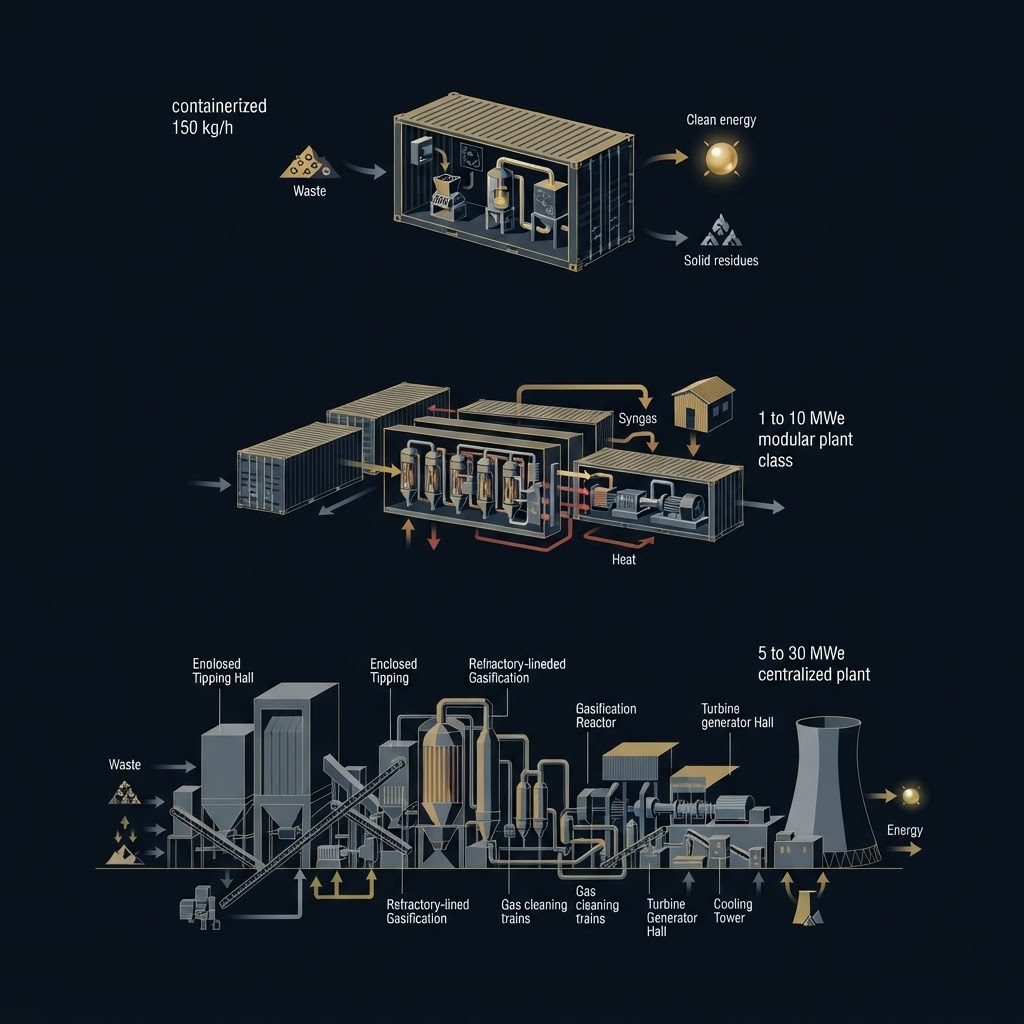
Centralised plants: 5 to 30 MWe
This is the class most search results describe. The Energos design, running since 1997, comes in two standard sizes with boilers of 13.5 MW and 16.4 MW nominal capacity, treating 5 or 6 tonnes of waste per hour. The fleet claim is the one worth noting: over 900,000 operating hours across 18 plants in Europe, with availability levels up to 8,000 hours a year, under 3% total organic carbon in the bottom ash and no ammonia or urea injection needed for emissions control (DP CleanTech, Energos).
Who it fits: a regional authority or waste contractor with 40,000 tonnes or more of contracted residual waste a year, a district heat customer, and the balance sheet to carry a multi-year permitting and build.
Mid-scale modular: 1 to 10 MWe
The EQTEC paper positions its agricultural and food-industry plants at 1 to 10 MWe and its municipal waste ambitions at 5 to 30 MWe. Its most useful claim is a single plant, built in 2011 for a Spanish agricultural client processing olive pomace, that has logged over 125,000 independently audited engine hours. The paper also notes that the UK exports 3.5 million tonnes of refuse-derived fuel a year for lack of processing capacity, which is the market this class is chasing.
Who it fits: an agri-industrial site or food processor with a single dry, consistent residue stream in the tens of thousands of tonnes, and a power or heat demand on site.
Containerised units: the 150 kg/h class
Below one megawatt the market goes quiet, which is strange because this is where most of the people typing this query actually sit. A hotel, a wastewater works, a farm cluster or a village produces single-digit tonnes a day, not hundreds. Our own X-150 is built for that band: a containerised 150 kg/h fixed-bed downdraft unit validated at Paris COMETHA, at Verkoso with Fraunhofer IKTS and at Hochschule Zittau/Goerlitz, on high-ash sewage sludge, municipal waste and digestate, the feedstocks that clean-wood gasifiers clinker on (Zero-X).
Who it fits: anyone paying to haul waste off a site that also pays a high price for energy. The full buyer's logic for this band is in small scale waste to energy systems.
What it costs: specific investment per kWe
The honest answer is a range so wide that quoting an average would mislead. A 2023 peer-reviewed overview of gasification plant costs tabulates specific investment for named electricity plants from 2,318 EUR/kWe at the low end to 12,991 EUR/kWe at the high end, with one high-temperature municipal waste project standing at 215,211 EUR/kWe. The same review records that several plants have been closed or remain in planning, mostly because of high investment costs and economically unattractive commercial operations, and that the pressing economic issues at large scale are boiler cost, char and ash valorisation and polygeneration (MDPI Recycling).
Two things follow. First, capital cost, not conversion efficiency, is the variable that kills gasification projects, so a vendor who leads with efficiency is answering the wrong question. Second, the cost per kWe rises as plants shrink, which is why the small class only works where disposal savings and displaced energy are both large. We work through that arithmetic in what it costs to build a waste to energy plant.
The lever that changes the arithmetic is public money. In the markets where we are rolling out first, governments fund 56 to 70% of project CAPEX: 70% through the IER route in Cadiz and Andalusia, 60 to 72% through SICE in Portugal's Alentejo, and 56% in Patras, Greece. A plant that is marginal at full price is often bankable at a third of it, and the application process is the real work. See government grants for waste to energy for the routes by country.
Track record: operating hours are the only spec that matters
Every gasification vendor publishes efficiency. Far fewer publish continuous hours on waste, and the gap between the two is where projects fail.
Put the published evidence on one line. The centralised Energos fleet claims 900,000 cumulative hours over 18 plants since 1997. The mid-scale EQTEC flagship claims 125,000 audited engine hours since 2011. At the modular end, a UK government feasibility study of a compact gasification-to-hydrogen system reports lifting its technology readiness level from 4 to 6, a levelised cost of hydrogen of 120 GBP/MWh against 39.60 for steam methane reforming, 30 kg/h hydrogen modules, and a plan to run 1,000 continuous hours in a later funded phase (UK BEIS feasibility report). That is a credible programme and an honest one, and it shows how much of the modular market is still ahead of its first thousand hours.
Our own number for the small class is a single unbroken run rather than a cumulative total: 1,939 hours, 80 consecutive days, in Paris under the COMETHA project, processing 16,382 kg of digestate pellets at 33% hydrogen in the syngas, 99.98% tar conversion and a hydrogen to carbon monoxide ratio of 1.95:1 in oxy-steam mode (Zero-X COMETHA campaign). We lead with it because digestate is a difficult feedstock and a continuous figure on a difficult feedstock is the only version of the claim that transfers to your site.
The mechanism behind most short runs is tar. Raw gas at 5 g/m3N, the figure EQTEC quotes at the gasifier outlet, has to come down by orders of magnitude before an engine will accept it, and when feedstock moisture or ash drifts the tar rises and condenses on everything downstream. That is a gas-cleaning design problem, and tar removal from syngas explains why it decides more projects than the reactor does.
A municipal case: sewage sludge gasification at Loganholme
Municipal buyers want a worked example, and the best public one is a wastewater treatment plant in Queensland. Logan Water secured an AUD 6.2 million grant from the Australian Renewable Energy Agency in 2020 for a biosolids gasification facility. A demonstration plant ran over 450 hours on two biosolids sources that year, which informed the design of the full-scale facility built in 2021 to 2022 and in commissioning and optimisation since early 2023.
The process details are the useful part. Biosolids leave the centrifuges at about 22% dry solids and are thermally belt-dried to around 90%, a 10% moisture content, before gasification. The biosolids carry an average net dry calorific value of 17.3 MJ/kg, and the heat released in gasification is recovered to power the dryer, which is what makes the energy balance close. The facility is credited with cutting carbon emissions by about 4,800 tonnes a year against conventional biosolids treatment and disposal (ARENA knowledge sharing report).
Three lessons for any sludge project. Drying is half the plant, and recovered heat has to pay for it. A grant covered a large share of a first-of-a-kind build. And even a well-run utility spent a demonstration year and a commissioning year before calling it operational. The European version of this problem, with the phosphorus mandate attached, is in sewage sludge gasification.
Modular or centralised: how to decide
Four questions settle it.
- How many tonnes a day do you control under contract? Above about 100 tonnes a day, the centralised class and its fleet-level track record are the conventional answer. Under 10 tonnes a day, nothing in that class will be sized for you, and a containerised unit is the only option that matches the feedstock.
- How far does the waste travel? A life cycle assessment comparing the options found small-scale distributed pyrolysis or gasification better for energy recovery than large centralised incineration, because hauling and the energy spent moving waste count against the big plant (ecozone LCA). Distance is an argument for modular, and the shorter the haul the stronger it gets.
- Which grant route can you actually win? A large plant competes for infrastructure funding on a multi-year cycle. Small units fit regional industrial and rural programmes with 56 to 70% CAPEX rates and shorter decisions.
- Who runs it on a Tuesday? Gasifiers need daily attention. A utility has shift staff. A hotel needs a service partner, which is why our model hands the machine, the German OEM supply chain and certified operations and maintenance training to a local partner rather than selling a container and leaving.
If you want to see who sits in each class before you shortlist, waste gasification companies maps the vendors by scale and readiness level.
The pattern across every source above is the same. The plants that survive are the ones sized to a feedstock their owner actually controls, funded at a capital cost the revenue can carry, and run by people who have seen a thousand continuous hours before signing. Size the plant to the waste, not the waste to the plant.
FAQ
How much waste does a gasification plant need per day? It depends entirely on the class. Standard centralised units treat 5 or 6 tonnes per hour, roughly 120 to 145 tonnes a day at full load. A containerised 150 kg/h unit processes about 3.6 tonnes a day at full availability, which matches a large hotel, a wastewater works or a farm cluster rather than a city.
Is gasification cheaper than incineration for waste to energy? Not on capital cost per installed kilowatt at large scale, where published specific investment runs from roughly 2,300 to 13,000 EUR/kWe and high investment cost is the main reason plants have closed. Its advantages are a usable syngas instead of flue gas, a char instead of wet ash, and better energy recovery at small distributed scale where hauling is avoided.
Can a gasification plant run on sewage sludge? Yes, provided the sludge is dried first. The Loganholme facility dries biosolids from about 22% to 90% dry solids using heat recovered from the gasifier itself. High-ash sludge also clinkers in gasifiers designed for clean wood, so the reactor has to be validated on sludge specifically, as the X-150 was at COMETHA and with Fraunhofer IKTS.
How many hours a year does a gasification plant run? Mature centralised fleets claim availability up to 8,000 hours a year on their design feedstock. The number to ask any vendor for is different: the longest single continuous run on a feedstock like yours. Many modular systems are still planning their first 1,000 continuous hours.
We use cookies to improve your experience on this site. By continuing, you agree to our Privacy Notice.