Waste to Energy Technology Licensing: What a Deal Costs
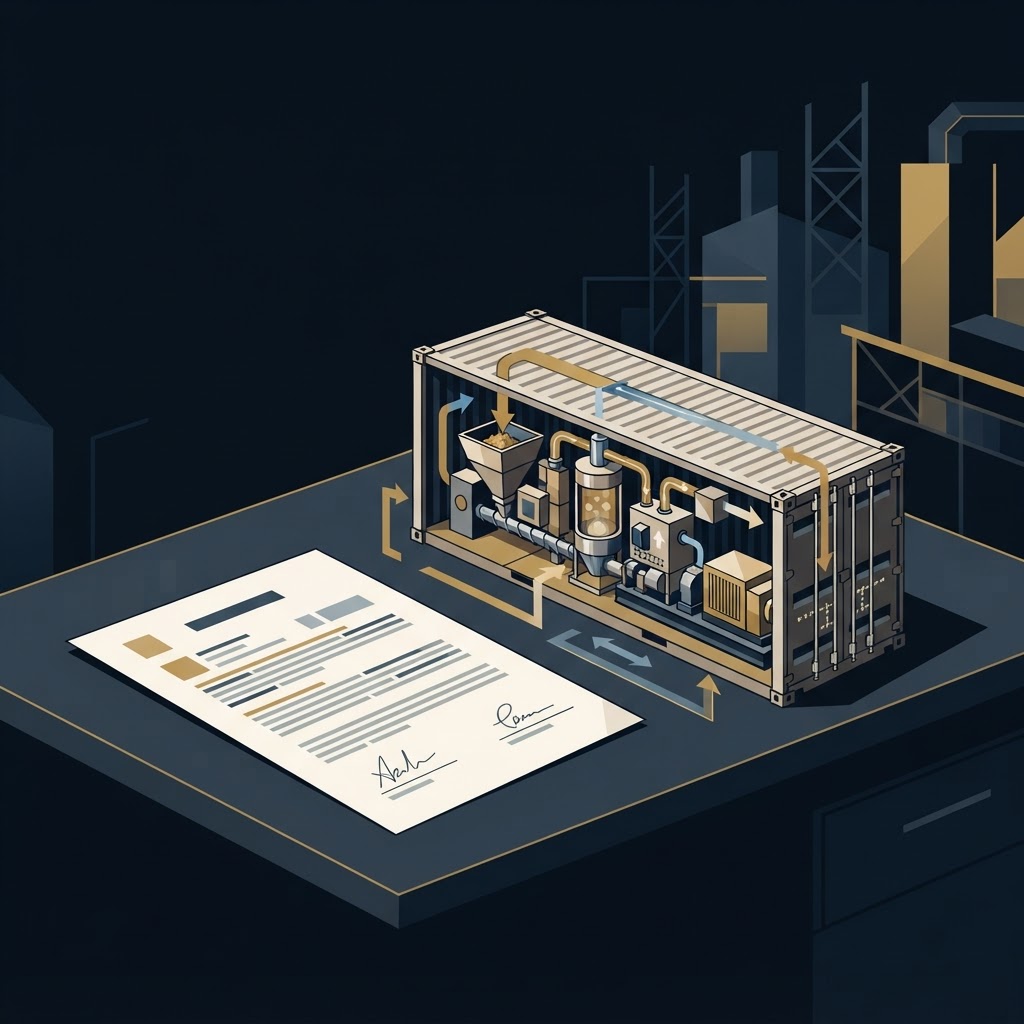
Search waste to energy technology licensing and almost nothing comes back. One competitor, Sierra Energy, runs a Licensing tab next to its gasification pages and says almost nothing about how the model actually works. Everyone else in this space either builds plants themselves or licenses quietly, deal by deal, with the terms buried in filings nobody reads before signing their own.
Those filings are public, and they are more useful than any marketing page. Real gasification and waste-conversion license agreements, name real numbers: fees, royalties, exclusivity terms, minimum commitments. This is what they say, and what a license in this exact sector actually contains, costs and requires you to commit to.
What a waste to energy technology license actually contains
The cleanest public example is recent. In September 2024, LanzaTech signed a Master License Agreement with SEKISUI Chemical to build commercial-scale plants across Japan converting municipal and industrial solid waste into ethanol. The agreement bundles intellectual property, equipment packages, engineering and advisory services, and consumables, with the first facility expected to produce 10 to 12 kilotons of ethanol a year, convertible onward into sustainable aviation fuel feedstock.
That bundle is the point. A waste-to-energy technology license is rarely just a patent. It is IP plus the equipment supply chain plus the engineering support to actually commission a plant, because a licensee buying only the right to use a patent still cannot build anything with it.
Three ways a gasification license actually gets priced
Ask what one of these deals costs and there is no single number, because real precedent uses three different structures, and each allocates the downside risk differently.
A flat technology fee plus equipment revenue
Synthesis Energy Systems' 2017 deal with Australian Future Energy is the most transparent public example. SES priced the technology license and Process Design Package at $27 million, with roughly $120 million of proprietary equipment expected at full build-out and a combined package near $150 million, paid at milestones across design, construction, start-up and operations. The underlying license text scopes the grant strictly to one named Facility and one Project, with novation to a project company built to hold it.
A royalty on what the plant produces
Covanta's license for a waste-to-diesel technology pays no large upfront number at all: a 5% royalty on diesel sale revenue for 20 years from first sale, plus a separate 15% royalty on RIN credit revenue. A much older deal, Biosphere Development Corp's 2009 license into Romania, runs the same logic for the life of the asset rather than a fixed term: 15% of gross revenue generated by every licensed system, for its complete operational lifetime. Klean Industries confirms the pattern from the licensor's own side: its public FAQ states up-front fees plus ongoing production royalties, both negotiable by territory, with technical assistance billed separately on a reimbursable basis.
A fee tied to licensed capacity
A third structure skips revenue entirely and prices the license against nameplate throughput. The Entsorgafin-BioHiTech agreement sizes its fee to a 165,000 ton per year design capacity for one named plant, with any unused portion creditable toward a future facility. Alterra's 2025 plastics-to-fuel license follows the same shape, scoped to a defined territory and up to five sites, with sublicense rights restricted to affiliates only. A capacity fee is due whether or not the plant ever hits that throughput, which makes it the structure that puts the most risk on the licensee before a single tonne is processed.
Exclusivity is a commitment, not a gift
Exclusivity in every real deal above is conditional, not automatic. The Romania license is the sharpest example: an exclusive five-year grant with rollover options, but the exclusivity holds only if the licensee reaches and maintains sales of at least three 6MW/hr systems a year, with a 50% deposit due on the first one. SES's own license into the platform it uses shows the same mechanism from the technology-holder's chair: its original grant from the Gas Technology Institute was non-exclusive for biomass and was later amended to exclusive for coal and coal-biomass mixtures, meaning exclusivity itself was negotiated, not granted by default. Covanta splits the same lever by geography rather than performance, exclusive rights in the United States, non-exclusive rights elsewhere. Whichever mechanism a deal uses, the question to ask before signing is the same: what minimum performance keeps your territory exclusive, and what happens the year you miss it.
Licensing versus building it yourself
This is not a niche shortcut. ADI Analytics tracks a deliberate industry-wide shift toward process-technology licensing as a capital-light strategic lever across the EPC sector, with firms including Technip Energies, Toyo Engineering, JGC, Sinopec Engineering Group, Engineers India and KBR building licensing-only or integrated licensor-EPC positions specifically to capture recurring margin without the risk profile of lump-sum turnkey contracts. GE's own gasification history shows what that validation compounds into over time: its first Russian licensing agreement in 2007 followed 30 separate agreements already running in China.
The honest framing for a territory partner comparing the two paths: licensing does not remove execution risk. It transfers technology risk, the years of reactor design and gas-cleaning validation a licensor has already paid for, to the licensor. Site selection, feedstock security and project financing stay with the licensee either way, whether they build or license.
What Zero-X's own license actually includes
Zero-X's Tier 1 National Master Partner grants an exclusive country license to deploy, sell and sublicense the X-150, full brand use and the grant-application playbook, with exclusivity contingent on deployment milestones, the same pattern set by every precedent deal above rather than an exception to it. Every partner tier receives the X-150 and SyngaPure gas-cleaning technology license, engineering and commissioning support, certified training and access to the German OEM supply chain.
The performance evidence behind that license is public. The X-150 ran 1,939 continuous hours in Paris under the COMETHA project, processing 16,382 kg of digestate pellets at 33% hydrogen in the syngas and 99.98% tar conversion, and SyngaPure was selected for support under Germany's federal BMWK go-inno programme in December 2025. The grant layer sits alongside the license rather than after it: target markets fund government grants for waste to energy at 56 to 70% of project CAPEX, and that stack gets negotiated in parallel with the license terms, not once the plant is already built.
What to ask before signing
Every real deal above answers a different version of the same six questions. Which of the three pricing structures is this, flat fee, revenue royalty or capacity fee, and who eats the downside if the plant underperforms. What minimum performance keeps an exclusive territory exclusive, and what is the consequence of missing it. Do you receive sublicense rights, or are they restricted to affiliates only, as Alterra's license states. Is technical assistance and know-how transfer included, or billed separately as reimbursable cost, as Klean Industries states plainly. Does the royalty run for a fixed term, twenty years in Covanta's case, or for the operational lifetime of every unit sold, as in the Romania deal. And before treating the 5% and 15% royalty figures found across these agreements as sector-specific, check them against the average royalty rate for licensing intellectual property generally, since a rate that looks high or low in isolation often looks ordinary next to the wider cross-industry range.
None of this replaces reading the actual agreement. But a buyer who knows the three pricing shapes, the conditional nature of exclusivity and the real evidence a licensor should be able to produce is negotiating from a position nobody selling against this keyword currently helps them reach. Before comparing any license fee to nothing, it is also worth comparing it to what building the plant costs from scratch, since licensing and building are the same decision seen from opposite ends.
FAQ
What does a waste to energy technology license typically include? More than IP. The clearest public example, LanzaTech's Master License Agreement with SEKISUI, bundles intellectual property, equipment packages, engineering and advisory services, and consumables. Zero-X's own tier structure adds certified training, a grant-application playbook and access to its German OEM supply chain on top of the core technology license.
How much does a gasification technology license cost? There is no single figure. Synthesis Energy Systems' Australia deal named a $27 million technology license and design-package fee plus roughly $120 million of equipment revenue. Covanta's diesel-from-waste license instead charges an ongoing 5% royalty on revenue for 20 years. Others size the fee to licensed processing capacity rather than to a price or a percentage.
Are waste to energy technology licenses exclusive? Only when the licensee earns it. The Romania license grants a five-year exclusive territory conditioned on selling a minimum of three systems a year; miss that and exclusivity is at risk. Covanta's license splits exclusivity by territory instead. Zero-X's own Tier 1 exclusivity is explicitly contingent on deployment milestones, not granted outright.
Is licensing cheaper than building a waste to energy plant from scratch? It is a different risk allocation, not automatically a cheaper one. Licensing transfers technology risk, the years of reactor design and gas-cleaning validation a licensor has already paid for, to the licensor. It does not remove site, feedstock or financing risk, which stays with the licensee under either path.
Available for advisory work, board seats and media appearances.
Julien Uhlig advises boards and funds and briefs newsrooms across Europe and North America. Enquiries are read personally.
We use cookies to improve your experience on this site. By continuing, you agree to our Privacy Notice.