Types of Gasifiers: Which One Survives Real Waste
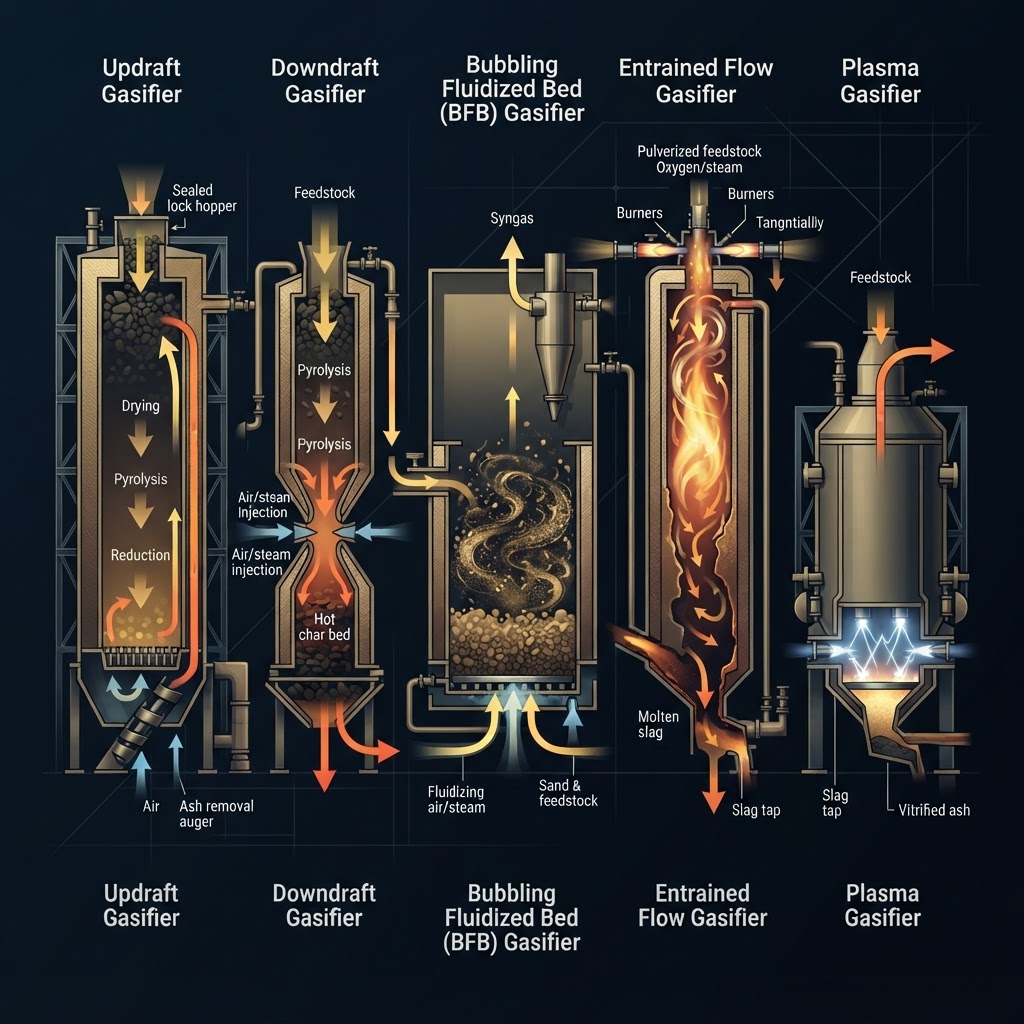
The types of gasifiers in commercial use fall into five families: fixed bed, fluidized bed, entrained flow, rotary kiln and plasma. A 2025 review of the field opens by admitting the useful thing about them, which is that no clear guidelines exist for choosing between them for a given feedstock and a given product (Cardona-Giraldo et al., Gases).
So here is a rule to read the rest of this page by. The reactor type does not decide whether you get power. It decides how much tar you have to remove afterwards, and therefore what the plant costs.
That is measurable. Tar loading in the raw gas runs from 0.01 to 6 g/Nm3 in a downdraft fixed bed, 6 to 12 g/Nm3 in a fluidized bed, and averages around 50 g/Nm3 in an updraft (Gautam et al., BioResources). Three orders of magnitude between the extremes, for the same waste.
We license and operate a 150 kg per hour fixed-bed downdraft machine, so this comparison is written by someone who has to live with the choice rather than sell every option in it.
Fixed bed gasifiers: updraft, downdraft, crossdraft
Fixed bed means the fuel sits in a column and moves down through it by gravity. What changes between the three is where the air goes and which way the gas leaves.
Updraft
Fuel in at the top, air or steam in at the bottom, so fuel and gas travel in opposite directions. Char falls and burns to provide the heat, and the gas leaves at the top rich in methane and tar (NNFCC and E4tech).
The tar is not a design flaw. The rising gas never passes through the hot zone, so nothing cracks it, and the gas leaves cool and thermally efficient because it has handed its heat to the incoming fuel on the way out. If your destination is a burner, that tar burns with everything else and updraft is the cheapest honest answer on this page.
If your destination is an engine, updraft is disqualified before you start.
Downdraft
Fuel in at the top, air in at the top or sides, both moving the same way. Part of the fuel burns and falls through a throat to form a bed of hot charcoal, and all the product gas is forced through that bed on its way out. That single geometric decision is what cracks the tar.
Downdraft units run at roughly 788 to 1200 degrees C and cannot handle more than 20% moisture (Sierra Energy). Hold that number, because it comes back later and it is the reason most fixed-bed waste projects fail before commissioning.
Downdraft is the standard answer below about a megawatt, and it is the class we build in.
Crossdraft
Air enters from the side and gas exits opposite it, giving a very small, very hot reaction zone and a fast response to load changes. It runs on charcoal or highly prepared fuel and is mostly of interest for small mobile units. For a waste project it is a footnote.
Fluidized bed gasifiers: bubbling, circulating, dual
Fluidized bed replaces the static column with a bed of hot sand, limestone or alumina kept in motion by the gas blown up through it. The fuel is fed into the side and mixes into that bed instead of resting on it.
Bubbling and circulating
The difference is velocity. A bubbling bed blows upward at 1 to 3 m/s, just fast enough to agitate the material. A circulating bed runs at 5 to 10 m/s, fast enough to carry the bed through the reactor and back around via a cyclone. Both operate below 900 degrees C, and not for chemical reasons: above that, ash starts to melt and stick, which ends the run.
That temperature ceiling costs you. It sits below the band where thermal cracking really works, which is why a fluidized bed makes more tar than a downdraft despite its excellent mixing.
What you buy in return is tolerance. The bed absorbs variation in particle size, moisture and composition that would bridge or channel a fixed bed, which is why fluidized designs dominate above roughly 10 MW where nobody can afford to sort the feed perfectly. In these reactors, and in plasma, the four stages of how waste gasification actually works still happen, but dispersed and simultaneous rather than stacked in visible zones.
Dual fluidized bed
Two chambers. Biomass is gasified with steam in the first, the leftover char is burned with air in the second, and the hot bed material shuttles between them carrying the heat across. Nothing from the combustion side enters the product gas.
The result is nitrogen-free syngas without the cost of an oxygen plant, which matters enormously if you intend to synthesise anything. It is also two reactors, two solids loops and a lot of engineering, so the complexity has to be paid for by the product.
Entrained flow and plasma: the high temperature end
Entrained flow takes powdered feedstock with pressurised oxygen or steam and burns part of it in a turbulent flame at 1200 to 1500 degrees C. Conversion is fast and near complete, the ash melts onto the walls and is tapped as slag, and the syngas is the highest quality on this list.
The catch is the word "powdered." Milling energy climbs steeply as target particle size falls, and fibrous biomass resists grinding in a way coal does not. Entrained flow is an industrial-scale technology that quietly assumes an industrial-scale feed preparation plant in front of it.
Plasma drops untreated feed into an electrically generated plasma at 1500 to 5000 degrees C. Organic matter becomes high quality syngas, inorganic matter is vitrified into inert slag, and almost nothing is landfilled. It is genuinely the most feedstock-agnostic option available.
It is also the one with the number that ends most business cases. Plasma gasifiers consume 40 to 50% of the energy they produce to run the arc, on top of prohibitive capital and operating costs. The same source, a vendor of a competing high-temperature process, puts its own FastOx technology at around 2200 degrees C with a cold gas efficiency of 66 to 79% and a parasitic load of 16 to 20%.
Treat that last set of figures as what it is: a vendor's claim about its own machine, published without operating data. The UK government's benchmarking of advanced gasification technologies found none of the technologies it assessed were in commercial operation, with technology readiness levels between 6 and 8 (BEIS, AECOM and Fichtner). That verdict covers most of this section.
Tar is the number that actually chooses the type
Put the per-type tar ranges next to what the equipment downstream will accept, and the comparison stops being academic.
The tolerable tar limit is about 500 mg/Nm3 for a compressor, 100 mg/Nm3 for an internal combustion engine, 5 mg/Nm3 for a gas turbine and 0.5 mg/Nm3 for methanol synthesis.
Now compare. Downdraft, the low-tar design, starts at 0.01 g/Nm3 and runs to 6 g/Nm3, which is 10 to 6000 mg/Nm3. The engine limit sits at 100. So the best fixed-bed geometry available spans a range whose upper end is sixty times what an engine will take.
And the measured reality is worse than the brochure. In a commercial 25 kWe stratified downdraft gasifier running clean wood pellets, tar came in at 340 to 680 mg/Nm3, three to seven times the engine limit, in the type everybody calls the clean one, on the easiest fuel anyone gasifies.
Two more things the type comparison hides.
Temperature moves tar more than geometry does. In a circulating fluidized bed, raising the reactor from about 700 to 820 degrees C cut tar from 15 to 0.54 g/Nm3, a factor of nearly thirty, in the same machine. How you run it competes with what you bought.
A low tar number is not the same as an easy one. Downdraft gasifiers produce stable tertiary tar, the condensed aromatic kind, while updraft tar is mostly primary and fluidized bed tar is a mixture. The downdraft has less tar and harder tar. What that actually takes to remove is a longer story in tar removal from syngas, and what is left in the gas afterwards is the subject of syngas composition.
How to pick: three questions, in this order
What is your feedstock, measured not assumed
This is the question that decides the other two, and it is the one most projects answer with a national average.
Take the numbers seriously. The UK benchmarking work sets its design basis for municipal solid waste at 17.86% ash, 34.65% moisture and 0.96% chlorine, with a net calorific value of 9.70 MJ/kg. Set that against the 20% moisture ceiling on a downdraft.
Real municipal waste is roughly twice as wet as the reactor most often quoted for it.
There are only two honest responses. Sort, dry and densify the feed, in which case the dryer and the pelletiser are capital items inside your plant and belong in the CAPEX. Or buy a fluidized bed and pay for tolerance in the reactor instead. Anyone who tells you a downdraft eats raw municipal waste has not measured either the waste or the gasifier. The hardest version of this problem, sewage sludge gasification, is where ash content stops being a specification and becomes the entire design.
What scale are you building
Fixed bed for the sub-megawatt class, where fuel is prepared and the plant sits next to the waste that feeds it. Fluidized bed above roughly 10 MW, where feedstock heterogeneity is unavoidable. Entrained flow at large industrial scale, where an oxygen plant and a milling line are already justified.
Scale is not a preference. It is what makes the auxiliary equipment affordable or not, and the sub-megawatt class behaves differently enough that small scale waste to energy systems is its own discipline.
What is the gas for
If you want megawatts, air-blown is defensible and the nitrogen it drags in is somebody else's problem.
If you want molecules, air disqualifies you at the top of the process. Fischer-Tropsch over a cobalt catalyst wants an H2 to CO ratio just above 2, sulphur down at 10 to 100 ppb and heavy tars below tens of ppb. Every molecule of nitrogen has to be carried, heated and compressed through every one of those steps for no return. That is why dual fluidized bed and oxygen-blown designs exist despite costing more, and it is a different argument entirely from gasification vs incineration, which is decided on efficiency and emissions rather than on what the gas can become.
What the type does not decide, and what we run
No gasifier type on this page produces gas an engine or a catalyst will accept unaided. Not one. What you are really choosing is a pairing: a reactor and the cleaning train behind it, priced together.
The industry prices them separately, and that is where projects die.
Our own configuration is the fixed-bed downdraft class described above, containerized at 150 kg per hour. Its longest documented campaign ran 1,939 continuous hours in Paris through the COMETHA project on 16,382 kg of digestate pellets, reaching 33% hydrogen at an H2 to CO ratio of 1.95:1 in oxy-steam mode with zero nitrogen ballast, and holding 99.98% tar conversion throughout (Zero-X).
Read that against the measured downdraft figure above. The geometry gave us a starting point. The cleaning gave us the number that lets an engine run, and we treat it as a product rather than a fitting: SyngaPure removes 99% of tar compounds while maintaining energy efficiency (Zero-X), using real-time sensing of tar, H2S, NH3 and particulates under AI-supported control, and it was selected for German federal BMWK go-inno support in December 2025 (Zero-X).
The platform has been independently validated at Paris COMETHA, at Verkoso with Fraunhofer IKTS and at Hochschule Zittau/Goerlitz, on high-ash sludge, MSW and digestate rather than on clean wood (Zero-X).
So when a vendor answers "which type of gasifier" with a name, the answer is incomplete. Ask instead: how many continuous hours has it run, on my named feedstock, at what ash and moisture, and who owns the gas cleaning. A type name is a category. Those four numbers are a machine.
FAQ
Which type of gasifier is best? There is no best type, only a type matched to a feedstock, a scale and an end use. Downdraft for sub-megawatt power on prepared fuel, fluidized bed for heterogeneous feedstock above about 10 MW, entrained flow or dual fluidized bed where synthesis-grade gas is the goal. The 2025 multi-criteria review of biomass gasifiers exists precisely because no clear selection guideline existed before it.
What is the difference between updraft and downdraft gasifiers? The direction the gas travels relative to the fuel. Updraft is counter-current: gas leaves at the top without passing through the hot zone, so it stays methane and tar rich, averaging around 50 g/Nm3 of tar. Downdraft is co-current: the gas is pulled down through a bed of hot char that cracks much of the tar, bringing the range down to 0.01 to 6 g/Nm3. That is why downdraft is the design usually paired with an engine and updraft is paired with a burner.
Is plasma gasification better than conventional gasification? It converts almost any feedstock and vitrifies the inorganic fraction into inert slag, which is a real advantage. It also spends 40 to 50% of the energy it produces on running the electric arc, on top of high capital and operating costs. That parasitic load, not the chemistry, is why plasma projects rarely close a business case.
Which gasifier type handles municipal solid waste? Not a fixed bed on raw waste. Published MSW design basis runs about 34.65% moisture and 17.86% ash against a downdraft ceiling near 20% moisture. Either the waste is sorted, dried and densified first, which makes feed preparation part of the plant, or a fluidized bed absorbs the variability at the cost of more tar and a larger minimum scale.
How much tar is too much tar? It depends entirely on the destination: about 500 mg/Nm3 for a compressor, 100 mg/Nm3 for an internal combustion engine, 5 mg/Nm3 for a gas turbine and 0.5 mg/Nm3 for methanol synthesis. No reactor type meets the engine figure unaided, which is the practical reason gas cleaning belongs in the plant budget rather than in the accessories list.
Available for advisory work, board seats and media appearances.
Julien Uhlig advises boards and funds and briefs newsrooms across Europe and North America. Enquiries are read personally.
We use cookies to improve your experience on this site. By continuing, you agree to our Privacy Notice.