Gasifier Feedstock Moisture Content: Limits by Type
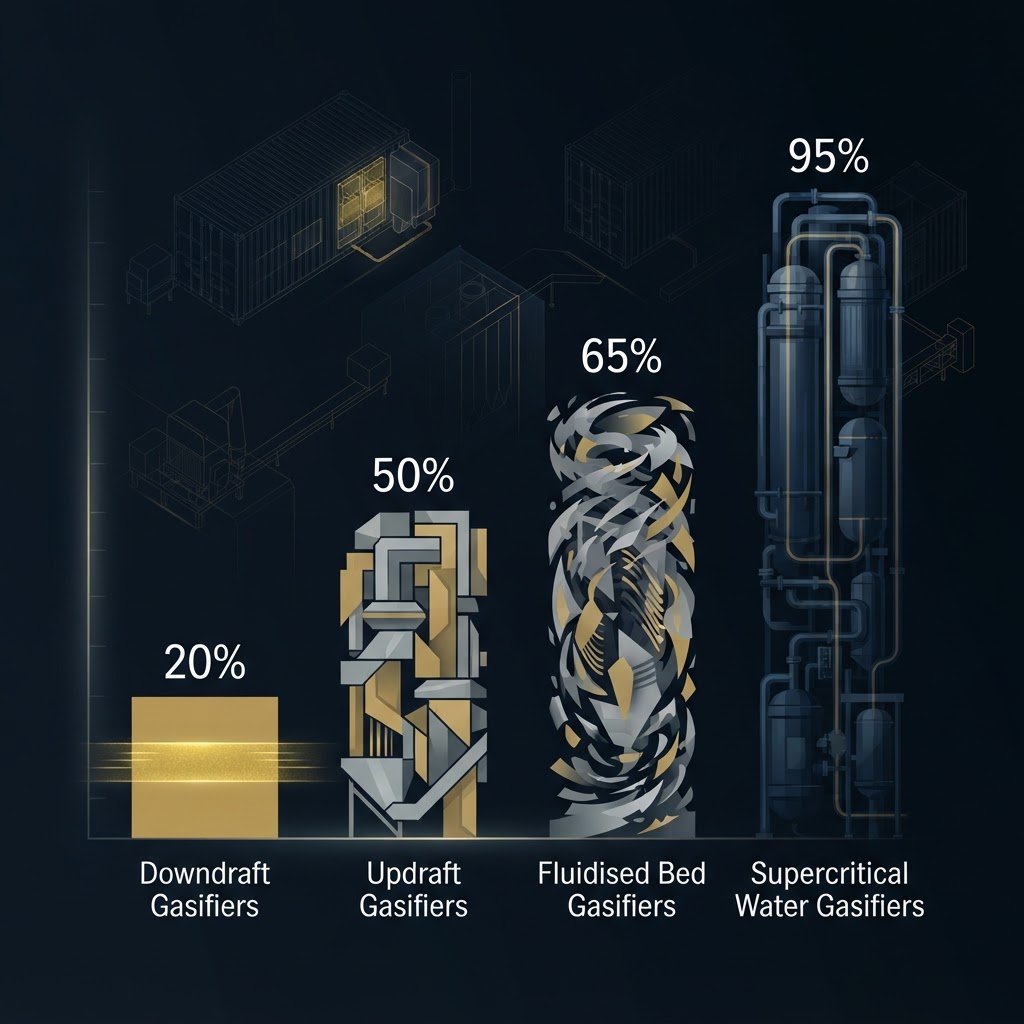
Gasifier feedstock moisture content is the first number on any feed specification, and for good reason: it decides whether the reactor runs hot enough to crack tar, whether the gas will fire an engine, and how much of the project's energy goes into boiling water instead of making syngas. For the fixed-bed downdraft units that dominate small-scale gasification, the working window is narrow. Brammer and Bridgwater's review of drying technologies for integrated gasification plants puts it at 10 to 20% on a wet basis, and both edges of that window matter.
The published thresholds look like they disagree. They mostly do not: they describe different reactors, and some quote dry basis while others quote wet basis. Below we line them up, explain what the water is doing inside the reactor, and then run the numbers the fact sheets skip: what it takes to get a genuinely wet waste such as dewatered sewage sludge from 80% down into the downdraft window.
Moisture limits by gasifier type
The headline limits from the main references:
| Gasifier type | Maximum feed moisture (wet basis) | Source |
|---|---|---|
| Fixed-bed downdraft | 10 to 20%, about 20% ceiling | Brammer and Bridgwater; WSU Extension |
| Fixed bed (general) | Under 20% | US EPA CHP catalog |
| Fixed-bed updraft | Up to 40 to 50% | IEA Bioenergy Task 33; WSU Extension |
| Bubbling or circulating fluidised bed | 15 to 30% typical, up to 65% tolerated | US EPA; WSU Extension |
| Supercritical water (R&D) | Up to 95% | WSU Extension |
Downdraft: 10 to 20% wet basis
The WSU Extension Energy Program's guide to biomass drying and dewatering for heat and power notes that most biomass gasifiers are downdraft fixed-bed units because they suit small sizes and make little tar, and that they "cannot tolerate moisture contents above about 20%." The US EPA biomass CHP technology catalog lists the same ceiling for fixed beds and names it as the main disadvantage of the downdraft design: the biomass must be very dry.
IEA Bioenergy Task 33's slide deck on biomass as gasification feedstock gives the optimum more tightly, at 10 to 15% by weight. Treat 20% as the ceiling and 10 to 15% as the target.
Updraft and fluidised bed: more tolerant, with a price
Updraft gasifiers accept wetter fuel because the hot gas rising through the bed pre-dries the incoming feed. Task 33 puts their tolerance at 40 to 50%, and WSU at 50%. Fluidised beds use the thermal inertia of a hot sand bed to absorb wet particles; WSU cites a tolerance as high as 65%, while the EPA catalog lists 15 to 30% as the normal design range.
Tolerating water is not the same as liking it. The World Bioenergy Association gasification factsheet advises keeping any gasifier feed below 30% for a reasonable gas heating value, and drier still, down to 10%, for pellets. Updraft tolerance also comes bundled with the highest tar output of any fixed-bed design, which we cover in types of gasifiers.
Why the published numbers disagree
Three reasons. First, reactor type, as above. Second, application: the FAO gasifier manual notes that when gas is burned directly in a kiln or boiler, a low heating value is acceptable and wetter feed is feasible, while engines are far less forgiving. Third, and most often missed, the basis.
Wet basis versus dry basis
Moisture can be expressed against the total wet mass or against the dry solids only. The FAO manual uses dry basis; almost every other source in the table uses wet basis. The conversion is simple:
- Dry basis = wet basis / (1 minus wet basis)
- Wet basis = dry basis / (1 plus dry basis)
Run the FAO downdraft limit through it. FAO says downdraft units need fuel below 25% moisture on a dry basis. That is 0.25 / 1.25 = 20% on a wet basis, exactly the ceiling WSU and EPA quote. The rule has always been the same; only the arithmetic changed.
The gap widens fast for wet waste. Dewatered sludge at 80% wet basis is 400% on a dry basis: four kilograms of water for every kilogram of solids. Always state the basis on a feed specification, a lab report or a supplier contract. A dispute over "20% moisture" can be a dispute over 5 percentage points of water.
What water does inside the reactor
Too wet: cold oxidation zone, tar and weak gas
Every kilogram of water in the feed has to be heated and evaporated before the solids can pyrolyse. Brammer and Bridgwater describe the consequence for downdraft units: above the window "the reactor temperature is too low." In all gasifier types, they add, a wetter feed means more energy spent on evaporation, a lower reaction temperature, a poorer gas with more tar and lower conversion efficiency, plus more water in the product gas and a bigger wastewater treatment burden.
The EPA catalog explains the chemistry. At high temperature water dissociates and its hydrogen adds to the gas, but the hydrogen and oxygen tend to recombine as the gas cools, so the net energy in the syngas still falls. Push the moisture high enough and "the gasification process cannot sustain itself without an external source of heat."
For engine projects the limit is the gas itself. FAO notes that engines need gas of at least 4,200 kJ/m³ to maintain a reasonable efficiency, and that in downdraft units wet fuel also cools the oxidation zone enough to weaken its tar-cracking capability. That oxidation and reduction zone is where a downdraft reactor does most of its tar destruction, which is why moisture shows up first as a tar problem. We walk through that chain in how tar forms in a gasifier.
Too dry: slagging
The lower edge is real too. Brammer and Bridgwater note that below about 10% "slag formation becomes a problem." Water moderates the peak temperature in the hearth; take it all out and the hottest zone can exceed the ash fusion temperature. For high-ash waste feedstocks this matters more than for clean wood.
The tar nuance
The relationship is not linear at very low moisture. A 2020 downdraft study on wood pellets varied moisture between 2 and 6 wt% and found that raising it slightly decreased the total tar concentration. Inside the window, a little water acts as a reactant. The tar penalty comes from water beyond what the reactor can heat, not from water as such.
How wet real waste feedstocks arrive
Clean wood pellets sit comfortably inside the downdraft window. Real feedstocks do not:
- Fresh biomass. WSU reports 40 to 65% for freshly harvested hardwoods, softwoods and herbaceous material. Brammer and Bridgwater cite 50% as typical for woody material at harvest in Europe, with plants likely to receive 30 to 60% woody and 15 to 40% herbaceous feed through the year.
- Wet wastes. WSU groups municipal wastewater sludge, animal wastes, paper mill sludges and food wastes in the high-moisture band. The techno-economic analysis of biosolids gasification by Porter and colleagues takes 80 wt% as the moisture of dewatered, post-centrifuge sludge and states it must be dried below 28 wt% for their system.
Mechanical dewatering will not close the gap on its own. Brammer and Bridgwater note presses and centrifuges generally cannot get below about 55% wet basis, and WSU says such equipment may get to roughly 50% at best. Passive filter bags can reach 30% at low cost, but over two to three months. For sewage sludge gasification and food waste gasification, thermal or solar drying is not optional; it is part of the plant. Woody residues are easier, which is part of the appeal of waste wood gasification.
Getting sludge from 80% to 10%: the numbers
Worked mass balance per tonne
Take one tonne of dewatered sludge at 80% moisture. It holds 200 kg of dry solids and 800 kg of water.
- At 20% moisture (downdraft ceiling), those 200 kg of solids weigh 250 kg in total. You evaporate 750 kg of water.
- At 10% moisture (inside the optimum), they weigh about 222 kg. You evaporate about 778 kg.
Roughly three quarters of the delivered mass leaves as vapour before the gasifier sees anything. Note how little extra water stands between 20% and 10%: about 28 kg. The expensive part is getting from 80% to the window at all.
Thermal drying energy
Measured and modelled figures agree that this is a large energy line:
- Porter and colleagues estimate that up to 60% of the sludge's fuel energy is needed to thermally dry it from 80 wt% to 10 wt%.
- Gil-Lalaguna and colleagues' energetic assessment of sewage sludge gasification calculates almost 8 MJ per kg of dried sludge to go from 77% to 6.5%, and shows the requirement roughly halves if mechanical dewatering first brings the sludge to 65%.
- At CIEMAT's Soria pilot, the LIFE-DRY4GAS solar drying and gasification test dried 8,170 kg of sludge from 80% to 12% at a specific energy of 6,474 kJ per kg of evaporated water, with 95% of that energy from renewable sources (solar plus hot air from a biomass burner).
Applied to our worked example, 778 kg of water at the CIEMAT figure is about 5,000 MJ, or roughly 1.4 MWh of heat per tonne of wet sludge. That is why every reference points the same way: dry with waste heat from the plant, not with purchased energy. Gil-Lalaguna's model also shows that if the product gas is used efficiently, its energy can cover both the drying and the gasification. For the dryer and route choices themselves, Energaia's guide to thermal treatment of sewage sludge goes deeper.
Solar drying
Where land is available, solar drying changes the cost picture. The German Environment Agency's technical guide on municipal sludge treatment reports:
- Optimum output around 70% dry solids, with up to 85% possible.
- About 850 litres of water evaporated per m² of hall per year under Central European solar radiation.
- About 25 kWh of operating energy per tonne of evaporated water.
- Specific investment of 280 to 400 EUR per m² of drying area.
A modified solar greenhouse trial dried 97% moisture sludge to close to 5% in 25 winter days, at about 450 kWh per tonne of evaporated water against roughly 1,000 kWh per tonne for conventional thermal dryers.
Two caveats for a downdraft project. Standard solar halls stop at 70 to 85% dry solids, which is 15 to 30% moisture, so the top of that range still sits above the downdraft ceiling and needs a finishing step or pelletising. And at 850 litres per m² per year, our 778 kg per tonne example needs close to 1 m² of hall for every tonne of wet sludge processed annually in Central Europe. Sites with more solar radiation, such as southern Spain, should need less hall area, but measure it locally before sizing.
What this means for a small-scale downdraft project
A practical checklist before you size anything:
- Get the moisture of the feed as delivered, across seasons, on a stated wet basis. One sample in a dry month will mislead you.
- Specify the reactor window, not just a maximum: 10 to 20% for a downdraft gasifier, with 10 to 15% as the target.
- Count the water you must evaporate per tonne, using the mass balance above, and put a heat source against it: engine jacket water, exhaust, flue gas or solar.
- Squeeze mechanically first. Every point of moisture removed before the dryer is cheaper than one removed in it.
- Pelletise where you can. Pellets give the even moisture and particle size a fixed bed needs, and Brammer and Bridgwater note that time-averaged moisture matters more than particle-to-particle variation provided the feed is well mixed.
This is how Zero-X runs waste through a downdraft reactor. The X-150 is a fixed-bed downdraft unit, and in its Paris COMETHA campaign it ran 1,939 hours continuously on 16,382 kg of digestate pellets, producing syngas with 33% hydrogen at 99.98% tar conversion. It has been independently validated at COMETHA, Fraunhofer IKTS and Hochschule Zittau/Görlitz on high-ash sludge, MSW and digestate, feedstocks that arrive far wetter than any downdraft window. The moisture problem is solved upstream, in preparation, not by hoping the reactor tolerates it.
FAQ
What is the ideal moisture content for biomass gasification?
For most small units, 10 to 15% on a wet basis, the optimum IEA Bioenergy Task 33 gives. Downdraft gasifiers have a hard ceiling around 20%.
Can you gasify wet feedstock without drying it?
Only in limited cases. Fluidised beds tolerate up to 65% moisture at a heavy efficiency cost, and supercritical water gasification can take up to 95%, but the latter is still at the research stage.
Can a feedstock be too dry for a downdraft gasifier?
Yes. Below about 10% moisture the hearth can run hot enough for slag to form, especially with high-ash feeds.
How do you measure feedstock moisture content on site?
Weigh a representative sample, dry it in an oven until its weight stops falling, and weigh it again. The lost mass divided by the original wet mass is the wet-basis moisture; record the basis every time.
We use cookies to improve your experience on this site. By continuing, you agree to our Privacy Notice.