Waste to Hydrogen: What the Gas Actually Contains
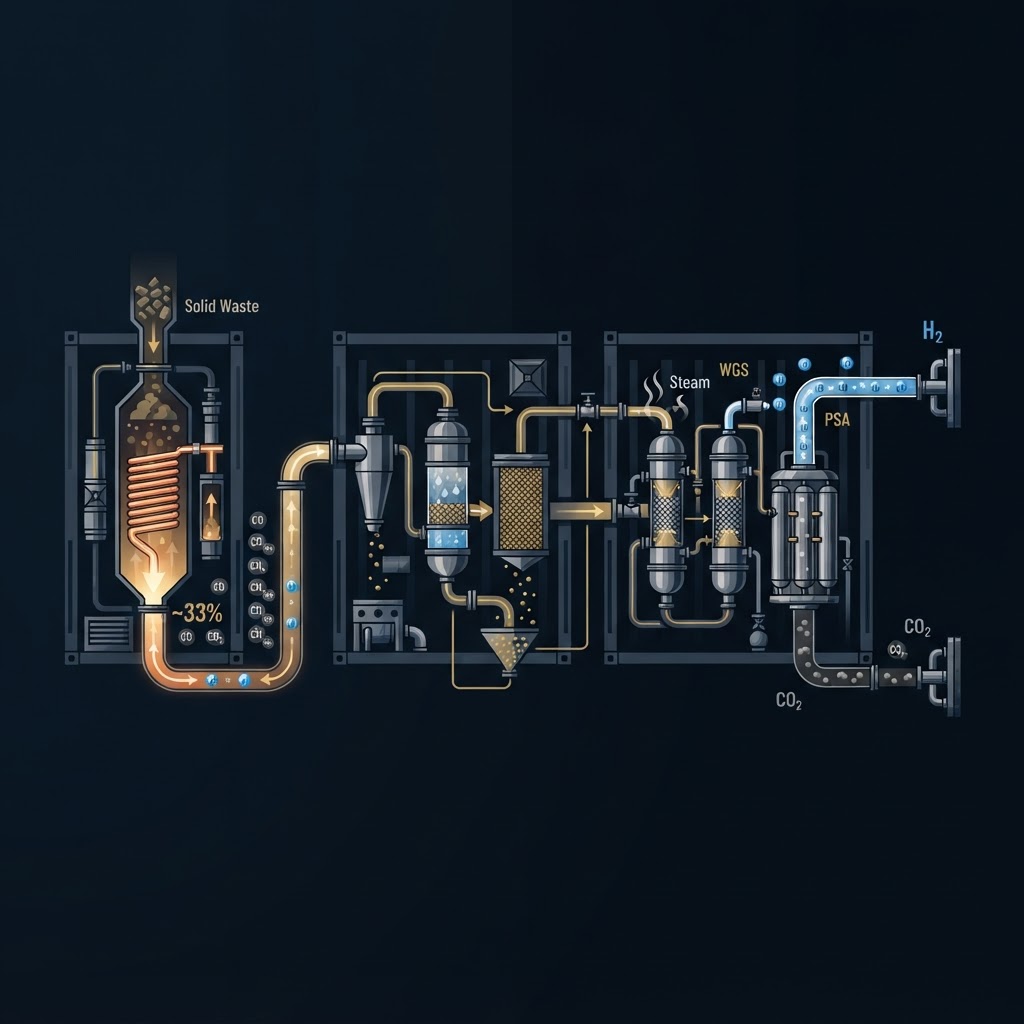
Search waste to hydrogen and you get two kinds of page. Press releases about plants that will start in 2027, and journal reviews behind a login. Neither tells you the thing a buyer needs: what comes out of the reactor, which stage decides whether the project survives, and what a kilogram costs against the incumbent.
This is the operator's version. Every number below is either from published literature or from a measured campaign, and where a figure comes from our own plant we say how many hours it ran for.
Waste to hydrogen is three processes, not one
The single biggest misreading in this category is treating waste to hydrogen as one machine. It is a chain of three, and each link has its own failure mode.
Gasification makes syngas, not hydrogen
A gasifier heats waste in a starved-oxygen environment so the hydrocarbons crack rather than burn. What leaves the reactor is synthesis gas: mostly hydrogen and carbon monoxide, with carbon dioxide, methane, water vapour, tar and contaminants along for the ride. Feedstock, reactor geometry and gasifying agent all move the composition, which is why the literature treats waste gasification as a family of processes rather than a single specification.
Nobody sells that gas as hydrogen. It is an intermediate.
The shift stage converts carbon monoxide into more hydrogen
To turn syngas into a hydrogen product you inject steam and let the water-gas shift reaction pull hydrogen out of the water using the carbon monoxide as the reducing partner. Run alongside steam reforming of the residual methane, this is the standard downstream configuration in the sector, and it is the reason vendors can quote hydrogen yields higher than the hydrogen chemically bound in the waste itself. The extra hydrogen comes from the steam, not from the rubbish.
Separation sets the purity your offtake will accept
The shifted gas still has to be split. Pressure swing adsorption or membranes lift hydrogen out to fuel-cell grade and leave a concentrated carbon dioxide stream, which is exactly the route Zaragoza specified in its 200 million euro Zero Residuos tender for 150,000 tonnes of non-recyclable waste a year.
Three stages, three capital items, three sets of operating risk. If you want the chain stage by stage with the reactions written out, that is how the process works end to end. What follows is the buyer's read of it.
How much hydrogen is actually in there
Here is the number nobody puts in a press release. Across the published work on municipal solid waste, tyres and waste plastics, hydrogen productivity spans 15 to 300 grams of H2 per kilogram of feedstock.
That is a factor of twenty. Turned around, it means somewhere between roughly 3 kg and 67 kg of waste per kilogram of hydrogen produced. A feedstock contract sized at the wrong end of that range is not a rounding error, it is a different business.
What 33% hydrogen in the raw syngas looks like
A specific plant produces a specific number, and the honest way to publish one is with the hours behind it. In the COMETHA project in Paris, a Zero-X X-150 ran 1,939 consecutive hours and processed 16,382 kg of digestate pellets, delivering 33% hydrogen in the syngas at an H2/CO ratio of 1.95:1 in oxy-steam mode with zero nitrogen ballast.
Two details in that sentence carry most of the weight. Oxy-steam with no nitrogen ballast means the gas is not diluted by air, so the hydrogen fraction is real rather than a percentage of a mostly inert stream. And 1,939 hours is 80 consecutive days on a high-ash feed, which is a different class of evidence from a commissioning test.
The H2/CO ratio decides what you can make
Hydrogen fraction tells you what is in the gas. The H2/CO ratio tells you what you can do with it downstream. A ratio near 2:1 is the window chemical synthesis routes want, which is why it matters for anyone whose plan is a product slate rather than a single hydrogen offtake. A gas built for an engine and a gas built for a chemical plant are not interchangeable, and the same applies across the wider set of small-scale waste-to-energy systems where the offtake is power rather than molecules.
The stage that kills these projects is not the reactor
Waste to hydrogen projects rarely fail at gasification. They fail between the gasifier and the shift catalyst, because the gas arriving at that catalyst is dirty.
Tar condenses and fouls. Sulphur and chlorides poison the catalysts that the shift and separation stages depend on. Every piece of expensive equipment in a hydrogen train sits downstream of the least clean gas in the plant, and the cleaning stage is what makes chemical-grade routes reachable at all. In our own case that stage is SyngaPure, which removes 99% of tar compounds while maintaining energy efficiency. It is a modular AI-supported system with real-time sensing of tar, H2S, NH3 and particulates, and it was selected for support under the German BMWK go-inno programme in December 2025 on the strength of that instrumentation.
The specification discipline behind those numbers deserves its own treatment, and we have written it: tar removal from syngas explains why a conversion percentage without an inlet loading and a duration is not a specification.
Who is running and who is announcing
Sort the field by evidence class rather than by logo and it thins out fast.
Operating. Hyundai Motor Group has completed a 500 kg per day waste-to-hydrogen facility in North Chungcheong Province, South Korea, with an upgrade to two tonnes per day planned by 2030. On our side, the first Zero-X waste-to-hydrogen reactor became operational in Paris in May 2024, fed by household waste and sewage sludge, and produced the campaign data above.
Committed but not yet built. BEEAH and Chinook Hydrogen are building what they describe as the Middle East's first commercial-scale plant in Al Sajaa, Sharjah: 7 tonnes of hydrogen a day in phase one, commissioning in Q2 2027, on technology independently assessed at TRL 6 to 7. That is a credible project. It is not operating data, and a reader who does not check the date will file it as if it were.
Tendered. Zaragoza's Zero Residuos refinery is a 25 to 30 year concession put out to tender, not a plant.
The distinction is not pedantry. A sector where most of the visible activity is future tense is a sector where the only differentiator that survives due diligence is measured hours on a named feedstock. For the vendor-by-vendor version of this, see waste to hydrogen companies.
What a kilogram of hydrogen from waste costs
Now the part vendor pages leave out. A Glasgow techno-economic study of distributed waste-to-hydrogen systems put the levelized cost of hydrogen at 2.22 GBP per kg for municipal solid waste gasification and 2.02 GBP per kg for waste wood, against 1.06 GBP per kg for conventional steam methane reforming, with CAPEX the largest single sensitivity for the thermochemical routes.
Read that plainly: on the hydrogen line alone, waste costs about twice the incumbent. Anyone selling you waste to hydrogen as a cheaper kilogram is selling you something else.
Two things close the gap, and neither is the reactor.
The first is the gate fee. Waste feedstock has a negative cost, because somebody pays you to take it. That payment is contractual, it is senior to commodity price risk, and it is the line a lender will actually size debt against. It is also why municipalities like Zaragoza structure these as long concessions: they are buying waste diversion, and the hydrogen is the by-product that pays for the plant.
The second is public CAPEX support, which matters precisely because the study above names CAPEX as the dominant driver. Governments fund 56 to 70% of project CAPEX in our target markets, with validated routes in Spain, Portugal and Greece. Halve the capital cost and the levelized cost moves more than any efficiency gain available inside the process. The mechanics of that are covered under government grants for waste to energy.
The same review that gives the yield range above reaches this conclusion from the other direction: hydrogen from waste has real productivity potential, but frame conditions and subsidies are what bring it to market. That is not a weakness of the technology. It is the shape of every infrastructure asset that displaces a cheaper polluting incumbent.
Five questions before you believe a waste to hydrogen number
- Which feedstock, and what was its ash content? Clean wood proves very little. High-ash sewage sludge, mixed municipal waste and digestate are where fixed-grate systems clinker and stop. Our platform has been validated at Paris COMETHA, at Verkoso with Fraunhofer IKTS and at Hochschule Zittau/Goerlitz on exactly those feeds, and the sludge case has its own economics under sewage sludge gasification.
- Is that a hydrogen fraction or a hydrogen purity? Thirty-three percent in raw syngas and 99.99% after separation are both true statements about the same plant at different points. Ask which point.
- Held for how many continuous hours? A number from a commissioning day and a number from 1,939 hours describe different machines. If a vendor cannot give you a duration, you have been shown a test result.
- Where does the carbon dioxide go? Separation hands you a concentrated CO2 stream. Whether it is captured, used or vented is what decides the carbon intensity of your hydrogen, and it is a cost line either way.
- Who pays the gate fee, and for how long? It is the only contractual revenue in the stack. If it is assumed rather than signed, the model is merchant risk wearing a green label.
Waste to hydrogen works. The chemistry has been settled for decades and the plants that exist do what they say. What is unsettled is whether a given project has proven it on real waste for long enough to finance, and that question is answered with hours and feedstock names, not with renderings.
FAQ
Is hydrogen from waste considered green hydrogen?
It has no colour of its own in the standard taxonomy, and reviews of the field classify it as green because the feedstock is a residue rather than a fossil fuel. What actually decides its carbon intensity is the fate of the CO2 separated out at the end of the chain.
How much waste does it take to make one kilogram of hydrogen?
Published yields span 15 to 300 grams of hydrogen per kilogram of feedstock, so roughly 3 kg to 67 kg of waste per kilogram of hydrogen depending on the feed and the process. A quote outside that band needs its assumptions opened up before you build a feedstock contract on it.
Is waste to hydrogen cheaper than steam methane reforming?
Not on the hydrogen line alone. The Glasgow study puts municipal solid waste gasification at roughly twice the levelized cost of conventional steam methane reforming. Gate fees and public CAPEX support are what make the comparison work, not process efficiency.
Can you make hydrogen from sewage sludge?
Yes, and it is one of the more demanding feedstocks because high ash content defeats many systems. The first Zero-X waste-to-hydrogen reactor in Paris ran on household waste and sewage sludge, which is why that combination is the reference case rather than clean wood.
How big does a waste to hydrogen plant have to be?
The announced commercial classes sit far apart, from a 500 kg per day unit up to configurations treating around 100 tonnes of waste a day. Scale is usually set by the distance to a hydrogen customer rather than by chemistry, because trucking compressed hydrogen erodes the margin quickly.
Does gasification for hydrogen differ from gasification for power?
The reactor can be the same, the gas cleaning cannot. A gas engine tolerates contaminants that would poison a shift catalyst or a separation membrane within weeks, so a hydrogen route carries a materially stricter cleaning specification than a power route on the same feedstock.
Available for advisory work, board seats and media appearances.
Julien Uhlig advises boards and funds and briefs newsrooms across Europe and North America. Enquiries are read personally.
We use cookies to improve your experience on this site. By continuing, you agree to our Privacy Notice.