Plasma Gasification Pros and Cons: The Honest Numbers
Plasma gasification pros and cons are usually presented by two camps that never talk to each other. Vendors list the advantages: it eats anything, the gas is clean, the ash turns to glass. Campaign groups list the failures. Both are partly right, and the useful question is which pros hold up once you put an electricity bill and a maintenance schedule next to them.
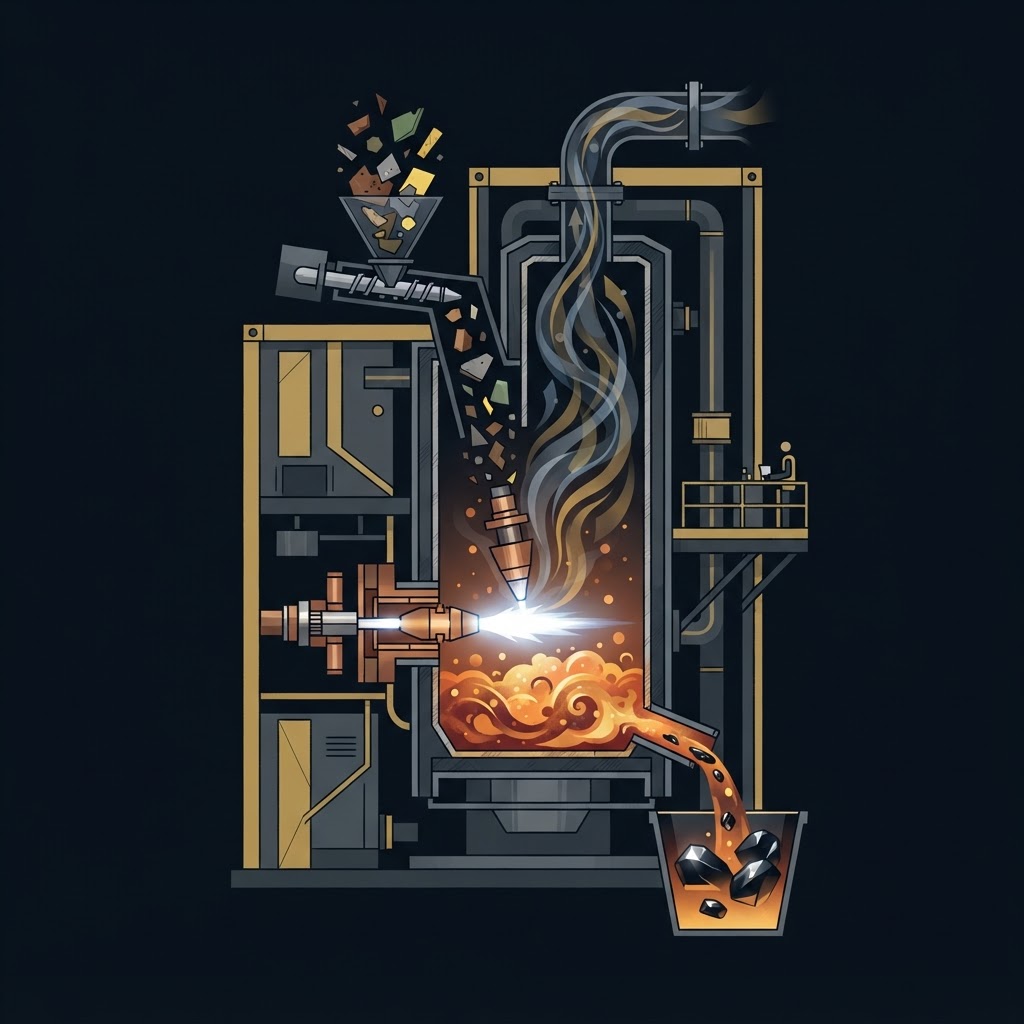
In plasma gasification an electric arc heats a gas to thousands of degrees. Organic matter breaks down into syngas (mainly hydrogen and carbon monoxide) and the inorganic fraction melts into a glassy slag. Our stake, stated up front: Zero-X licenses a fixed-bed downdraft gasifier, not a plasma system. We have a view, so every number below is linked to its source. For how plasma sits among the other reactor families, see our guide to types of gasifiers.
Plasma gasification pros and cons in one table
| Claim | What the evidence says | |
|---|---|---|
| Pro | Takes almost any waste | True. The limit is electricity, not chemistry |
| Pro | Very low tar and dioxins | True at plasma temperatures |
| Pro | Glassy slag instead of ash | True, but selling it carries liability |
| Pro | More electricity per tonne | Modest gain over incineration, in studies |
| Con | Arc eats part of the output | 15% to 50%, depending on design |
| Con | High capital cost | Higher per tonne than grate incineration |
| Con | Torches and refractory wear fast | Long planned shutdowns |
| Con | Thin, painful track record | Several flagship failures |
| Con | Still needs sorted, drier feed | Wet and unsorted waste costs energy |
The pros, with the evidence behind them
It takes almost anything
This is the genuine advantage. A Columbia University analysis of plasma-assisted waste to energy notes that the reactor can treat all waste materials, nuclear waste aside, because the only variable is the electricity needed to melt it. No conventional gasifier can say that. Fixed beds, ours included, need a feed of the right size and moisture.
Very little tar and dioxin
At these temperatures tars barely survive. A 2025 life cycle review in Discover Sustainability reports, from the studies it surveyed, dioxin and furan emissions as low as about 3% of those reported for gasification, particulate emissions 40% lower and sulfur oxides 35% lower than incineration. A modelling study puts plasma at 84% efficiency, with electricity as its main disadvantage. Clean syngas matters most if you want hydrogen or chemicals rather than heat, because tar is what destroys engines and catalysts downstream.
Slag instead of ash
The inorganic fraction leaves as a vitrified slag that the same 2025 review describes as non-leachable and usable as construction aggregate or asphalt filler. One caution: the GAIA campaign report notes that selling slag as a building material raises risk and potential liability for workers and occupants. GAIA opposes incineration, so read it as the critics' case, but the liability question is one your permit authority will ask too.
More electricity per tonne, on paper
The 2025 review cites a best case of around 816 kWh per tonne of municipal waste. The more sober figure comes from a Columbia techno-economic study: its base case plasma-assisted plant netted 533 kWh per tonne, against about 500 kWh for an average US waste to energy plant, which the author judged not enough for a substantial economic benefit. The gain is real but small, and it disappears quickly if the arc draws more than planned.
The cons, and the one that decides most projects
Why sources disagree on the torch's power draw
Search this topic and you will find the arc consuming anything from 15% to 50% of the plant's output. These numbers are not contradictions. They describe different machines.
- Lecture material from a US national lab repository cites the plasma torch using 15 to 20% of the electricity generated.
- A Georgia Tech Research Institute poster puts it at about 40% for the torches and the plant, with 60% left to sell.
- Sierra Energy, which sells a competing high temperature process, says plasma gasifiers consume 40 to 50% of the energy they produce.
The split is between designs where the arc does all the work and designs where it only finishes the job. The Columbia paper estimates that a pure plasma "zapper" needs about 0.8 MWh of electricity per tonne and cannot compete, so the commercial designs it studied gasify the waste conventionally and use the arc only to crack the gas and melt the ash. The same paper notes the torch itself returns only 50% of its electrical input as heat in small units and 75% in megawatt-scale units, with the rest lost to cooling water. Ask any vendor which kind they are selling, and what the net export is per tonne of your waste, not the gross.
Capital cost
The 2025 review puts a 500 tonne per day plasma plant at USD 65 to 200 million, against about USD 80 million for conventional gasification and 87 million for pyrolysis at similar capacity. The Columbia study found a capital charge of USD 76.8 per tonne for its base plasma case versus USD 60 for a grate incinerator. The cost of the torches themselves is the main reason.
Torches and refractory wear out fast
The review states that certain parts of the plasma source may need replacing within 30 days of installation. The best real operating data comes from Inertam, Europlasma's asbestos vitrification plant in France. Its own newsletter reports that the furnace refractories wear significantly faster than in conventional processes: fully renewed every 16 months, repaired every 4 months. The full renewal needs a 7 week shutdown and each of the three repairs a 4 week one. Add those up and the furnace is down about 19 weeks for every 16 months of operation, planned. And that is at a plant whose team cites more than 25 years of experience vitrifying asbestos.
A short and painful track record
When the City of Honolulu reviewed plasma for its waste, it found that costs were hard to estimate because operating history was so thin, and the only plant then processing municipal waste, in Yoshii, Japan, handled 24 tons a day. Since then the big projects have mostly failed:
- Tees Valley, UK. Air Products abandoned its plants in 2016 and took a charge of USD 900 million to 1.0 billion.
- Plasco, Canada. The Ottawa developer filed for creditor protection in 2015 without financing its commercial plant.
- Pune, India. A 350 tonne per day plasma waste-to-hydrogen project lost its municipal funding before producing anything. CleanTechnica's analysis models hydrogen at USD 6 to 8 per kg and a power demand of 525 to 700 MWh a day; those are the author's estimates, not measurements, but no one has published better ones.
We go through the shared causes in why gasification plants fail. The short version: very high temperature does not fix feedstock variability, refractory life or a weak offtake contract.
It still needs sorted, drier feed
"Eats anything" has a commercial footnote. The 2025 review says poorly sorted waste reduces syngas output and damages refractory linings, and wet waste takes more energy to process. Metals and glass are better recovered and sold than melted. So most plasma projects still pay for a front end, one of the general waste gasification disadvantages that plasma does not escape.
Where plasma actually earns its keep
Plasma works where the waste is hazardous enough that someone pays a high gate fee to destroy it, so the electricity bill is a cost of service, not a hole in a power plant's revenue. The Columbia paper notes plasma has been widely used to destroy hazardous waste such as asbestos, at a high electricity cost. Europlasma has operated its own plasma asbestos vitrification plant in France for 15 years, sized at 40 tonnes a day, and has supplied ash vitrification units to incinerators in France, Japan and South Korea.
The pattern is consistent: plasma succeeds on small, toxic, high-fee streams and struggles on large, wet, low-fee municipal waste where it must compete with landfill and incineration on price per tonne.
Getting plasma's main benefit without the arc
Most buyers who look at plasma want one thing from it: syngas clean enough for hydrogen, chemicals or an engine. That target can be approached without an arc. Our X-150 is a 150 kg per hour fixed-bed downdraft unit. In an 80 day, 1,939 hour continuous campaign in Paris on digestate pellets it reached 33% hydrogen in the syngas and 99.98% tar conversion in oxy-steam mode, with no nitrogen ballast. Our approach is explained in oxy-steam gasification, and the gas cleaning side in tar removal from syngas: SyngaPure, our sensor-controlled cleaning system, was selected for German BMWK go-inno support. The platform has been validated on high-ash sludge, municipal waste and digestate.
The honest boundary: a fixed bed does not vitrify ash and is not the tool for asbestos or incinerator fly ash. For those, plasma remains the stronger option. For turning organic waste into a clean gas at small scale, the arc is an expensive way to buy a result you can reach with temperature control and cleaning.
Questions to ask a plasma vendor
- What is the net electricity export per tonne of my waste, at my moisture content?
- Does the arc gasify the waste, or only polish the gas and melt the ash?
- How many operating hours between electrode changes, and what does a set cost?
- How long is a refractory campaign, and how many weeks of shutdown per year does it imply?
- Which reference plant runs on my waste type at my scale today?
- During shutdowns, where does the waste go, and who pays?
FAQ
Why isn't plasma gasification more widespread? Because municipal waste pays little per tonne and plasma's costs are high per tonne: electricity for the arc, expensive torches, frequent refractory shutdowns and a lack of reference plants that lenders trust. It persists where gate fees are high, such as asbestos and toxic ash.
What are the major costs of running a plasma gasification plant? Beyond construction, the recurring costs are the electricity the arc consumes, electrode and torch replacement, refractory relining and the lost revenue during those shutdowns, plus sorting and drying the incoming waste.
Does plasma gasification produce net energy? Designs that gasify conventionally and use plasma only to finish the gas can export power. A process that relies entirely on the arc needs roughly 0.8 MWh of electricity per tonne and struggles to produce a surplus.
Is plasma gasification the same as incineration? No. Gasification runs short of oxygen and makes a fuel gas, while incineration burns the waste completely. In practice the syngas is often burned for power, which is why regulators frequently permit both under similar rules. We compare them in gasification vs incineration.
We use cookies to improve your experience on this site. By continuing, you agree to our Privacy Notice.