Waste Gasification Disadvantages: 8 Honest Drawbacks
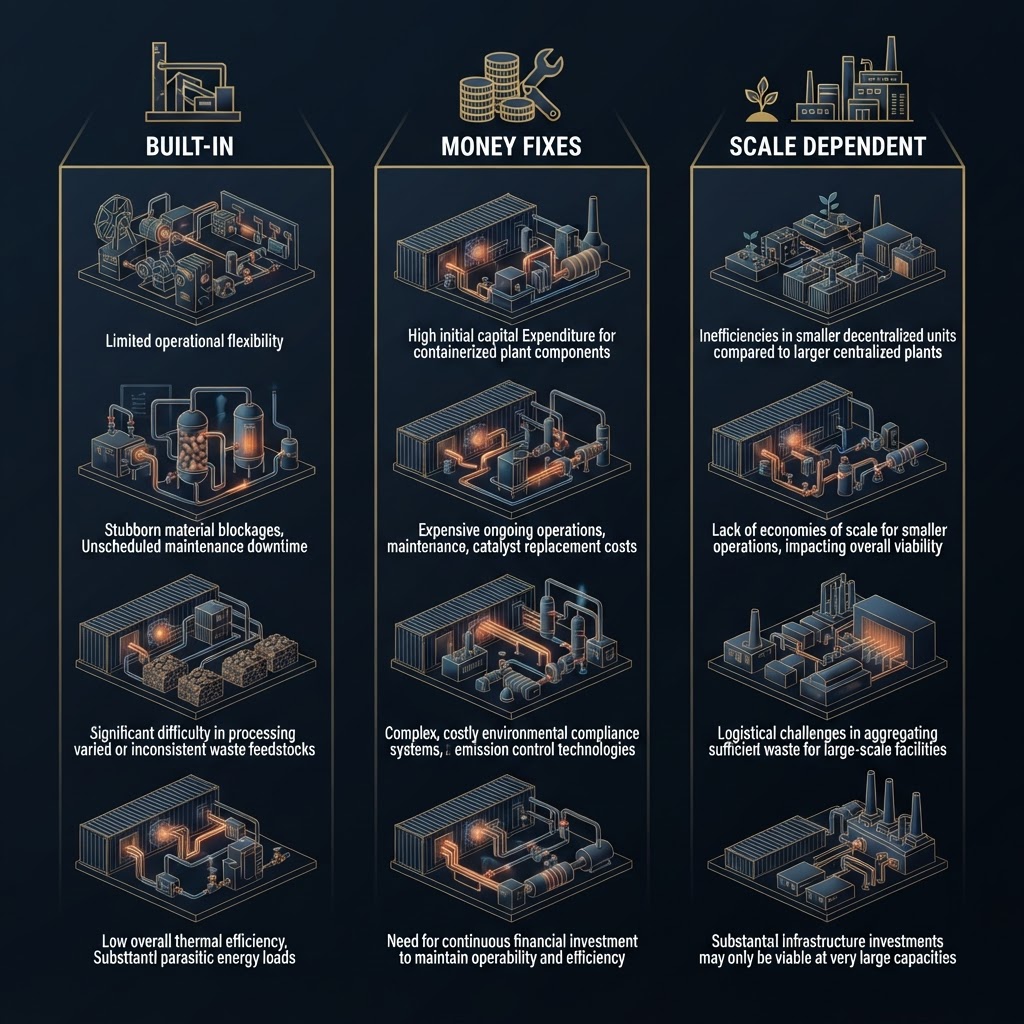
Most lists of waste gasification disadvantages are written by people who want you to build one or people who want you never to. Both make the same mistake: they put every drawback in one pile. Some are physics and stay with the process forever. Some are engineering problems that cost money to solve. Some depend on how big the plant is and what waste it eats.
We build and license a small gasifier, so we have a stake in this. That is why the list below is sourced to NREL, IEA Bioenergy, the UK government and peer-reviewed work, with campaign groups named as campaign groups. If you need the basics first, start with how waste gasification works.
The eight disadvantages at a glance
| # | Disadvantage | Kind | Ask the vendor |
|---|---|---|---|
| 1 | Waste must be prepared first | Built in | What does your front end reject, and at what cost per tonne? |
| 2 | Raw syngas is dirty | Built in | Show tar data at the limit of the machine after the gasifier |
| 3 | Residues and emissions remain | Built in | Where does the ash go, and under which permit? |
| 4 | High capital cost per tonne | Money fixes | What is the cost per tonne of annual capacity, installed? |
| 5 | Shorter plant life | Money fixes | What is replaced when, and what does it cost? |
| 6 | Availability risk | Money fixes | Where does the waste go when the plant is down? |
| 7 | Thin commercial track record | Scale | Which reference matches my fuel, size and end use? |
| 8 | Competes with recycling | Context | Which fraction of my waste do you need, and is it recyclable? |
Disadvantages built into the process
1. Waste has to be prepared before it can be gasified
This is the most underrated drawback. NREL's comparison of thermochemical options notes that some mass burn incinerators accept unprocessed, mixed municipal waste, while gasification requires metal and glass to be sorted out, and may require shredding, drying and sizing to suit the gasifier.
Moisture matters most. Gasification runs above the boiling point of water, so every kilogram of water is heated before any useful gas is made. The campaign group GAIA argues that in countries where waste is high in food and organics, the syngas can be too low in calorific value to produce net energy, and that some operators find output is little more than the plant's own demand. The direction is right even where the framing is not: wet, mixed waste is a poor fuel, and making it a good one is a second industrial process.
A 2026 critical review in Renewable and Sustainable Energy Reviews makes the academic version of the point: reported advantages in syngas yield, tar reduction and efficiency come mainly from idealised or pre-processed feedstocks under lab or pilot conditions. Real moisture, chlorine, sulfur and alkali content change the results.
2. Raw syngas is dirty, and cleaning it costs energy
Gasification makes a fuel gas, not a clean fuel gas. A Columbia University thesis on municipal waste gasification lists what comes along: tars, heavy metals, halogens and alkalis. Tars ruin reforming catalysts, sulfur removal systems and ceramic filters. Alkalis cause agglomeration in fluidized beds and damage gas turbines. Halogens are corrosive.
The gap between raw gas and what a machine accepts is large. Raw gas can carry up to 150 g/m3 of tar, while an engine in combined heat and power service needs about 0.01 g/m3. Closing that gap is the core engineering problem of the whole technology, covered in tar removal from syngas. Cleaning also costs energy and produces its own streams to dispose of, such as spent scrubber liquid and filter dust.
There is a safety cost too. A review in MM Science Journal names a complex and therefore expensive facility, tighter safety rules for handling combustible gas, and impurity removal as the main disadvantages, with tar and dust the biggest limits on using the gas.
3. It is not a way to make waste disappear
Gasification converts the carbon in waste. It does not convert glass, metal, grit or mineral ash. NREL lists ash, char or slag and small amounts of tar as byproducts. GAIA puts the residue at 20 to 30% of the incoming weight for gasification, pyrolysis and plasma alike. In one documented US case, the Taylor Biomass project, a filing reviewed by the Partnership for Policy Integrity showed about one third of the material by weight left after gasification, to be burned in a conventional incinerator on site.
Regulators have noticed. IEA Bioenergy's review of waste gasification explains that in the EU all thermal treatment of waste, including gasification, is defined as incineration and falls under incinerator law, unless the gas is cleaned well enough to become a product in its own right. Gasification does not get a lighter permit for being a different technology.
Carbon does not disappear either. When syngas from waste is burned, the carbon leaves as CO2, and plastic in the feed is fossil carbon.
Disadvantages that cost money to fix
4. Capital cost is high for the tonnage
Gasification plants carry an extra process stage, the gas cleaning train, that a mass burn incinerator does not have. NREL's reported examples (2020 dollars) range from $14 million for a gasification to electricity plant of about 20,000 tonnes a year in Philadelphia to $80 million for a 93,000 tonne a year plasma arc plant in Iowa in syngas-only configuration.
Plasma is the expensive end. A 2025 life cycle review in Discover Sustainability cites USD 65 to 200 million for a 500 tonne a day plasma plant, against about USD 80 million for conventional gasification at similar capacity, and notes that parts of the plasma source may need replacing within 30 days.
5. Plant life is shorter than an incinerator's
NREL gives gasification a plant life of 20 to 30 years, against 30 to 40 years for combustion. Over a project's financing period, ten fewer years of service is a cost that sits next to the higher capital. High temperatures, corrosive halogens and abrasive ash mean refractory, filters and reactor parts wear faster than in a boiler fed with clean fuel.
6. Availability risk lands on whoever owns the waste
A power plant that stops loses revenue. A waste plant that stops also leaves the waste. The UK government's benchmarking of advanced gasification technologies puts it plainly: waste keeps being produced, is difficult to store in large volumes and expensive to move, and other facilities may lack the capacity at short notice. The same report says local authorities may be particularly reluctant to rely on technologies that are novel or seen as carrying availability risk.
How this plays out in real projects, from Derby to Fulcrum, is documented in why gasification plants fail. The short version: a technical fault takes away operating hours, and the project's finances then have to survive the time it takes to fix it.
Disadvantages that depend on scale and context
7. A thin commercial track record
Incineration has more than 40 years of commercial history. NREL counted 75 commercial waste incineration facilities in the United States, against one commercial gasification facility and two demonstration units, plus fewer than 50 gasification plants in Europe and Asia. That one US commercial plant was Fulcrum's Sierra Biofuels, whose owner filed for Chapter 11 in September 2024.
IEA Bioenergy describes the few waste plants with extensive gas cleaning as having had more or less severe teething problems, tied to mixed feed, the quality of refuse-derived fuel and gas cleaning that did not perform as intended. A thin record means every new plant carries some first-of-a-kind risk, and the bigger the leap in scale from the reference, the bigger that risk.
8. It competes with recycling for the best fuel
Gasifiers run best on high-calorific material: plastics, paper, card. The UK anti-incineration network UKWIN argues that these are often the most valuable parts of the waste stream for recycling, and that long supply contracts can lock a council into delivering them. The same 2010 briefing estimated that electricity-only UK gasification proposals would emit nearly four times the CO2 per unit of power of a conventional fossil power station. That figure is a campaign estimate for low-efficiency designs, but the mechanism is real: burning syngas only for electricity, with the heat thrown away, wastes most of the energy.
This disadvantage is context, not physics. It is serious where recycling infrastructure exists and the gasifier wants the recyclables. It largely disappears with feedstocks nobody recycles, such as sewage sludge, digestate or contaminated residues.
What the critics leave out
A fair list also notes where gasification beats the alternative. NREL's own table gives conventional gasification 685 kWh of electricity per tonne of municipal waste against 544 kWh for combustion. IEA Bioenergy's review profiles working industrial examples, such as the CEMEX Rüdersdorf gasifier feeding a cement kiln in Germany and the Lahti plants in Finland feeding cleaned gas to boilers. And the gas is a product: it can become heat, power, hydrogen or chemicals, which a grate fire cannot offer. For the full side by side, see gasification vs incineration.
The honest summary: disadvantages 1 to 3 never go away, 4 to 6 are paid for in capital and engineering, and 7 and 8 depend on where you build and what you feed it.
Which disadvantages a small machine does not escape
Zero-X's X-150 is a containerized fixed-bed downdraft gasifier at 150 kg an hour. Small scale changes the size of a mistake. It does not repeal the list.
What we can show: a 1,939-hour continuous campaign at COMETHA in Paris, 16,382 kg of digestate pellets processed at 99.98% tar conversion, with 33% hydrogen in the syngas. SyngaPure adds real-time sensing of tar, H2S, NH3 and particulates, which addresses disadvantage 2. The platform has been validated at COMETHA, Fraunhofer IKTS and Hochschule Zittau/Goerlitz.
What we cannot claim: digestate pellets are a prepared fuel, so disadvantage 1 still applies to your waste. Our plant leaves ash and biochar, and its permit is still a waste permit. Eighty days is a strong campaign, not a twenty-year record. Grants covering 56 to 70% of CAPEX in our target markets reduce disadvantage 4 but do not remove it. For a broader buyer's view, compare small scale waste to energy systems and the field of waste gasification companies, us included.
FAQ
Is waste gasification bad for the environment? It depends on the feed and the gas cleaning. Gasifying mixed waste with plastics and chlorinated material produces pollutants similar to incineration, which is why the EU regulates it under incinerator law. On a narrow, non-recyclable feed with good gas cleaning and full use of the heat, the picture is better.
Is waste gasification safe? It is safe only with serious process safety. Syngas is toxic and flammable because of its carbon monoxide and hydrogen content, so plants need gas detection, purge procedures and trained operators. The risk is managed, not absent.
Is plasma gasification free of these disadvantages? No. It reaches higher temperatures, which helps with tar, but it costs more to build, uses a lot of electricity, needs sorted feed and has parts that wear out quickly.
Does gasification produce less CO2 than incineration? Not per tonne of carbon fed in: carbon that is converted leaves as CO2 either way. Any saving comes from producing more useful energy per tonne, using the heat, or locking part of the carbon into biochar instead of releasing it.
We use cookies to improve your experience on this site. By continuing, you agree to our Privacy Notice.