Phosphorus Recovery From Sewage Sludge: 2029 Options
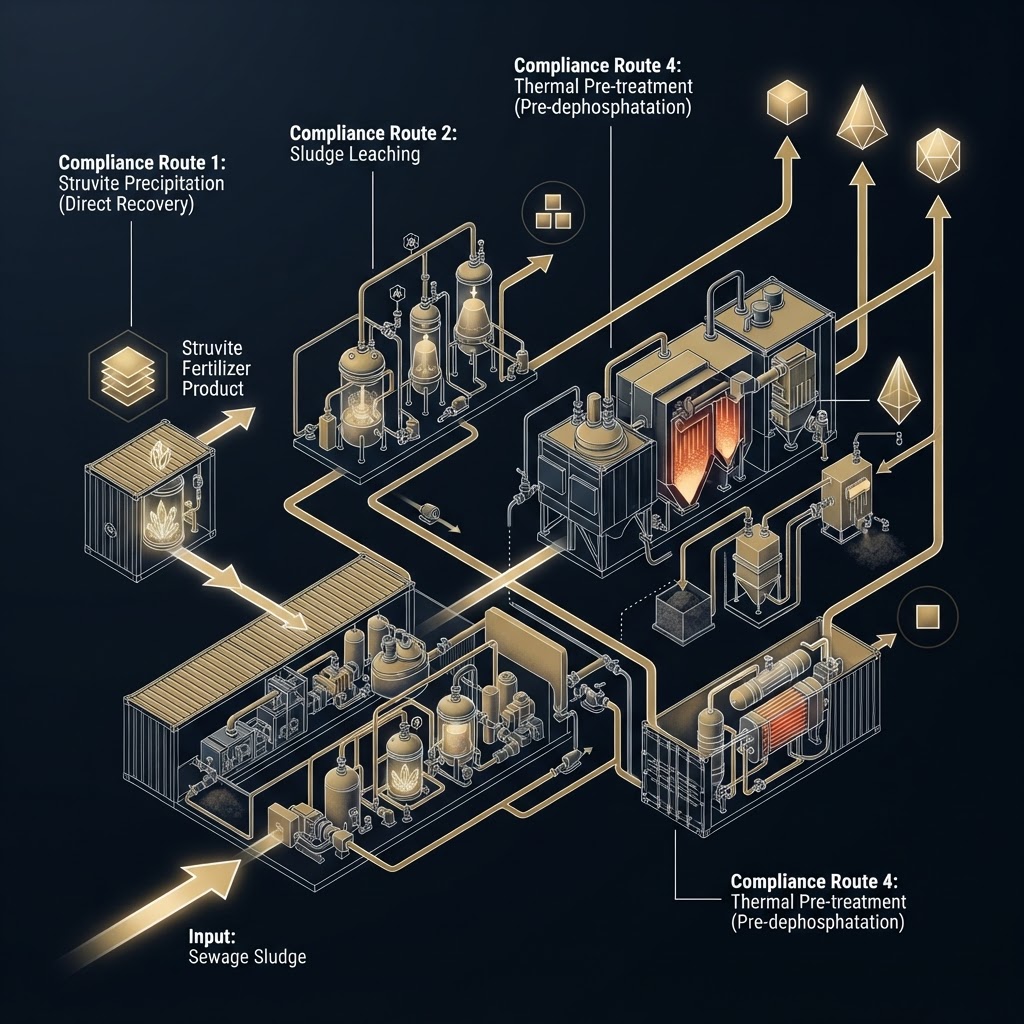
Phosphorus recovery from sewage sludge stops being a research topic in Germany on 1 January 2029 and becomes a duty with an inspector attached. The English-language material on it is thin: a ministry summary, a few vendor pages, and a wall of German PDFs. What an operator actually needs is the comparison nobody publishes, which is the four routes to compliance side by side, what each one really recovers, what each one costs per kilogram of phosphorus, and which of them are still procurable in the time left.
Here is that comparison, including the part where we tell you what our own machine cannot do.
What the 2029 obligation actually says
The amended Sewage Sludge Ordinance makes recovery obligatory for operators of wastewater treatment plants and sludge incineration plants from 2029 at the latest, and the trigger is concentration, not plant size: the duty applies when sludge contains 20 grams of phosphorus or more per kilogram of dry solids. The ordinance deliberately prescribes no technology, leaving room for innovative processes, according to the Federal Environment Ministry. Most municipal sludges sit above that threshold, so for most operators the exemption is theoretical.
What plant size does change is the soil route. Soil-related utilisation stays open to plants under 100,000 population equivalents from 2029, and only to plants under 50,000 PE from 2032. Operators who keep that route are exempt from the recovery duty regardless of phosphorus content, which is the legal structure the Deutsche Phosphor-Plattform sets out in its note on the 2029 and 2032 regime. Everyone above the line loses a disposal path and gains an obligation in the same moment.
The two quotas that decide your route
Route choice is not free, because the ordinance sets different bars depending on where in the process you intervene. Recover from the sludge and you must pull out at least 50 percent of the phosphorus, or bring the content below 20 g/kg TM. Recover from mono-incineration ash and the bar rises to more than 80 percent, which also means less than 20 percent of the ash phosphorus may end up in the various residue and side streams, as the DWA working group report on the ordinance spells out. Thermochemical ash processes are held to the same 80 percent.
That asymmetry explains most of the decisions being made in German municipalities right now. The easier quota sits on the harder stream.
The four routes, and what each one actually recovers
Concentration drives everything. Phosphorus runs at under 0.001 percent in wastewater, rises to roughly 1 percent in sludge, and reaches 6 to 8 percent in sludge ash, which is the reason ash-based processes promise the highest recovery rates, as the RWTH Aachen work on fluidised-bed incineration with integrated recovery documents.
Route 1, precipitation from the liquid phase. Struvite crystallisation from digester supernatant is the most mature option and the easiest to retrofit. It is also the weakest on volume: recovery relative to plant influent tops out around 25 percent, against roughly 40 to 50 percent for processes working on the sludge itself and 60 to 90 percent from ash, in the integrated comparison of 19 recovery technologies by Egle and colleagues. On its own it does not discharge the duty at a plant whose sludge stays above the threshold.
Route 2, recovery from the sludge. Leaching and wet-chemical processes acting on sludge or sludge water are capped near 50 percent in theory and land at 20 to 40 percent in practice, which is why the Schlitz municipal feasibility study excluded them outright when the stated goal was maximum recovery. If your target is the 50 percent bar and nothing more, this route is live. If you want a phosphorus product with a market, it usually is not.
Route 3, mono-incineration plus ash recovery. The default answer, and the one most new German capacity is being built for. It clears the 80 percent bar, produces a phosphorus-concentrated ash, and destroys organic pollutants on the way. It also requires a mono-incineration plant, which most operators do not own and cannot build alone. Co-incineration in cement works, coal plants or municipal waste incinerators does not substitute: it remains permitted only where phosphorus has already been separated at the treatment plant, per PTC Parforce's English summary of the ordinance, because co-incineration ash is too dilute to recover from. Co-incineration capacity is shrinking anyway as coal plants close, a point the Klarissa regulatory briefing makes alongside its estimate that tenders for thermal treatment run 12 to 24 months from specification to contract.
Route 4, thermal pre-treatment and pass the residue on. The ordinance recognises thermal pre-treatment and then places the recovery duty on what comes out of it, naming both the incineration ash and the carbonaceous residue. That is the clause under which gasification and pyrolysis enter the picture, and it is the one most often misread.
Where gasification fits, and where it does not
We build gasifiers, so take this in the spirit it is offered. A gasifier is not a shortcut around a phosphorus quota.
Pyrolysis coke and carbonisate from sewage sludge currently hold no fertiliser approval under the German DueMV. The Schlitz study excluded both from its options list for that reason and classified them as a possible pre-stage to incineration, an alternative to sludge drying rather than to recovery, and a specifically more expensive one. Any vendor telling a municipality that char output satisfies the 2029 duty is describing a regulatory position that does not exist yet.
What thermal conversion is genuinely good for on this feedstock is the part before the recovery step: destroying organics, cutting volume, and turning a disposal cost into energy. High-ash sludge is exactly the material that clinkers and sinters conventional systems, which is the practical argument for looking at sewage sludge gasification at all. Our X-150 ran a 1,939-hour continuous campaign in Paris under the COMETHA project, processing 16,382 kg of digestate pellets at 99.98 percent tar conversion, which is the sort of number that decides whether a system survives real sludge, as documented on our own channel. The platform has been validated independently at COMETHA, at Verkoso with Fraunhofer IKTS, and at Hochschule Zittau/Goerlitz on high-ash sludge, MSW and digestate, as listed on our partner page.
That makes gasification an energy and volume play that sits upstream of your recovery decision, and it is worth understanding what the biochar from sewage sludge output is and is not before anyone builds a compliance case on it. The recovery quota still has to be met downstream, by ash or by wet chemistry. Plan for both boxes, not one.
What phosphorus recovery costs
Recovery does not pay for itself at fertiliser prices, and pretending otherwise wastes a council meeting. Specific costs run from minus 4 to 10 EUR per kilogram of phosphorus recovered, against roughly 1.6 EUR per kilogram for conventional fertiliser production. Precipitation processes range from minus 0.14 to 0.23 EUR per population equivalent per year, sludge leaching sits around 2.50, and processes using dried sludge or mono-incineration ash run 0.33 to 3.13 depending on the existing disposal path. The IWA cost assessment of nine recovery processes puts the annual figure at under 3 percent of total wastewater disposal cost, which is the number to take to a fee committee. For reference, phosphorus from rock phosphate costs about 0.9 EUR per kilogram and triple superphosphate about 1.7, per the Egle comparison.
So it is a compliance cost with an import hedge attached, not a revenue line. The financing question is when you start recovering it. German operators must invest now for a duty that begins in 2029, and the UBA published an opinion in 2025 on how those present-day investments can be passed into municipal wastewater fees, one of several practical points in the Baumann Rechtsanwaelte briefing for municipal operators. The same briefing notes that smaller operators can join municipal Zweckverbaende to hold their position in the market.
The deadline that binds is 2027, not 2029
Three things collapse the timeline. The ordinance required a concept on planned recovery measures by 31 December 2023, and requires the phosphorus measurement to be repeated with an updated concept in 2027. Tendering thermal treatment or recovery takes 12 to 24 months before a contract even starts. And the escape hatch closed: the DWA's attempt to push the deadline to 2039 was rejected by the BMUKN in February 2026, with the Deutsche Phosphor-Plattform opposing the delay in January 2026.
The aggregate position is worse than most individual operators realise. Around 1.7 million tonnes of dry matter per year will be subject to treatment, representing a recovery potential near 50,000 tonnes of phosphorus annually, and the Environment Ministers' Conference recorded in December 2023 that six years after the ordinance came into force, few recovery plants were even planned. The joint federal and state declaration on expanding phosphorus recovery also warns that the Section 3b exemption for temporary ash storage is being used to defer investment, when it was meant as a bridge for projects already under construction.
Read that as market information. Capacity that is not contracted by 2027 will be contracted at 2028 prices, against a queue.
The upside nobody puts in the tender documents
Phosphorus is classified by the EU as strategically important and comes overwhelmingly from Morocco, China, the USA and Russia. Germany's recoverable 50,000 tonnes per year would cover more than 40 percent of national agricultural demand, according to the Weserland summary of the 2029 regime. Against annual German consumption of about 170,000 tonnes, the wastewater path could supply roughly 66,000 tonnes, near 40 percent, on the RWTH figures.
An operator who solves this before 2029 is not just compliant. They own a nutrient stream in a market that will be short of processing capacity, and in most cases the capital is partly public: grant routes cover 56 to 70 percent of project CAPEX in our target markets, and the mechanics of that are covered in our guide to government grants for waste to energy.
Start with the phosphorus number in your own sludge. Everything else follows from whether it sits above or below 20 g/kg.
FAQ
Does the phosphorus recovery obligation apply to plants under 50,000 PE?
The recovery duty itself is size independent once sludge exceeds the 20 g P/kg TM threshold. What size changes is the soil route: plants up to 100,000 PE keep it until the end of 2031 and plants up to 50,000 PE keep it after that, and using that route exempts an operator from the recovery duty regardless of phosphorus content. Smaller plants are therefore not exempt by size, they are exempt only for as long as they still have somewhere to spread.
Is co-incineration of sewage sludge still allowed after 2029?
Yes, but not as a way of avoiding recovery. Co-incineration in cement works, coal power plants or municipal waste incinerators stays permitted only where the phosphorus has already been separated at the treatment plant or the content is below 20 g/kg TM. Because co-incineration mixes sludge ash with other ash, the resulting phosphorus content is too low to recover from, so it functions as a residual route for already-treated or naturally low-phosphorus sludges.
Can we store sewage sludge ash instead of recovering the phosphorus now?
Section 3b permits time-limited storage of sludge incineration ash under landfill rules, and later recovery must remain possible. The joint federal and state declaration treats it as a bridge only where an investment is already decided and construction and commissioning are under way, and names its wider use as one reason national recovery capacity is behind schedule. It buys time on a specific project, not on a strategy.
Can recovered phosphorus be sold as a fertiliser product?
Only once it clears both waste law and fertiliser law. Recovered phosphorus does not automatically stop being waste at the moment of recovery, and it can legally be sold as waste, though at a lower price than as a product. A straight phosphate fertiliser needs at least 10 percent P2O5 for German DueMV approval, or 12 percent for EU single-nutrient approval, which is why ash quality and process choice, not just the recovery percentage, determine whether the output is a product or a residue.
Available for advisory work, board seats and media appearances.
Julien Uhlig advises boards and funds and briefs newsrooms across Europe and North America. Enquiries are read personally.
We use cookies to improve your experience on this site. By continuing, you agree to our Privacy Notice.