Syngas Cleaning: What to Remove, in What Order, to What Spec
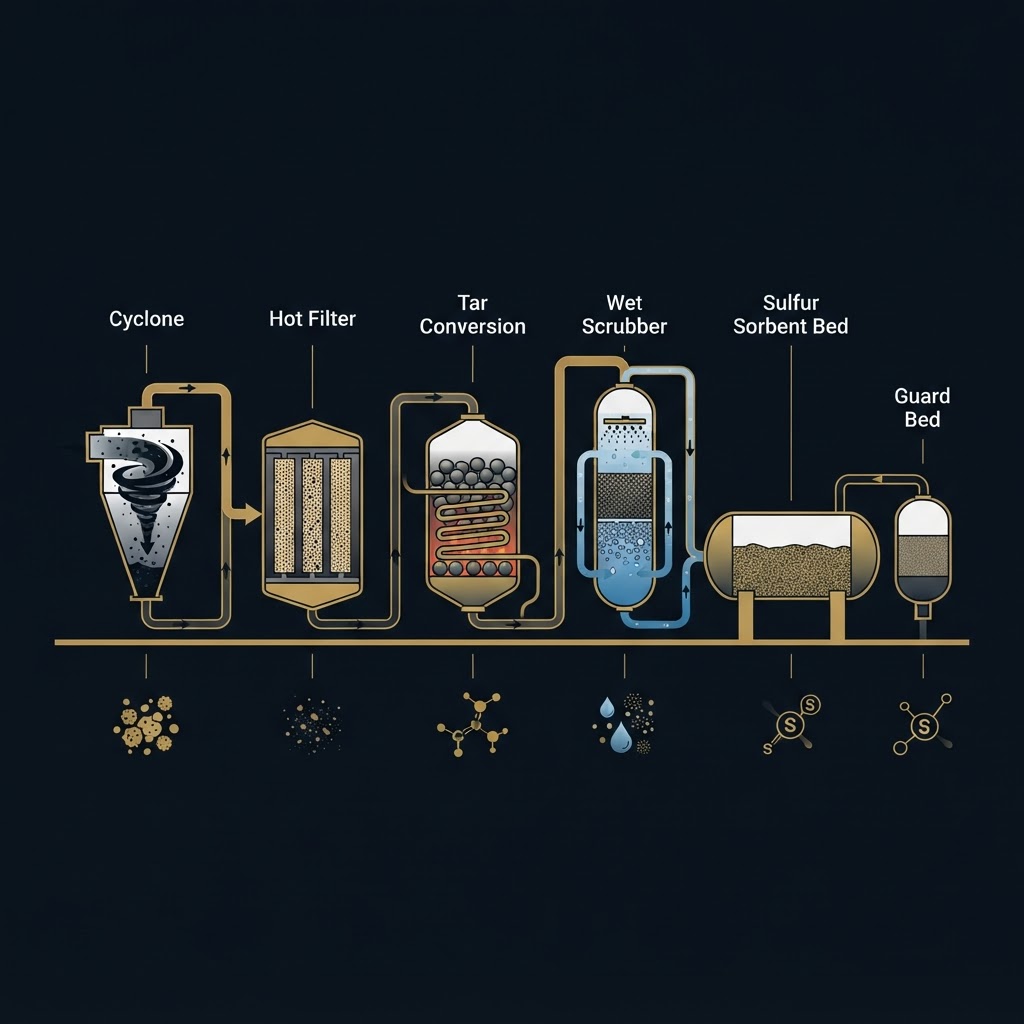
Syngas cleaning is usually discussed as if it were one problem called tar. It is six problems, and they arrive together. Raw gas from biomass gasification carries tar at 3,000 to 20,000 mg/Nm3, hydrogen sulfide at 20 to 500 ppm, hydrogen chloride at 30 to 1,000 ppm and ammonia at 20 to 1,000 ppm, according to a 2025 study on refuse-derived fuel purification, before you count particulate, alkali metals and trace heavy metals.
A cleaning train is the sequence of steps that takes each of those numbers down to whatever your offtake can live with. This page walks through what each contaminant does, what each end use tolerates, the order the steps have to run in, and what changes when the feedstock is waste rather than clean wood.
What syngas cleaning has to remove
Six contaminant families, not one
The IEA Bioenergy Task 33 review lists the byproducts that have to be reduced or eliminated as char particles and fly ash, H2S, carbonyl sulfide, NH3, hydrogen cyanide, HCl and vapour-phase tar, plus alkali and alkaline earth metals that must come out for almost any process. Each does different damage:
- Particulate (ash, unconverted char, condensed salts) erodes and fouls moving parts.
- Tar condenses as the gas cools and blocks lines, filters and engines.
- Sulfur (H2S, COS) poisons catalysts and becomes SO2 in exhaust.
- Nitrogen (NH3, HCN) becomes NOx when burned and poisons synthesis catalysts.
- Halides (mainly HCl) corrode metal and deactivate catalysts.
- Alkali and trace metals (potassium, sodium, mercury) deposit on hot surfaces and catalysts.
How much of each you get depends on the feedstock and the reactor, which is covered in more detail under syngas composition.
Why waste feedstocks raise the bill
Wood is the easy case. In woody biomass producer gas, NH3 runs from 100 to 2,000 ppmv and H2S from 20 to 230 ppmv. Waste changes the nitrogen and sulfur picture by an order of magnitude.
The clearest comparison comes from a pilot downdraft gasifier, the same reactor family as most small units, run on poplar, solid recovered fuel and mixtures with tyre, plastic and sewage sludge. Wood produced 619 ppm of ammonia; the SRF mixes produced 2,107 to 7,518 ppm. H2S went from 6 to 8 ppm on wood to 44 to 96 ppm on the mixes, with up to 11 heavier sulfur compounds on top.
That is the practical meaning of "proven on real waste". A cleaning train sized on wood data is undersized for sewage sludge gasification before it starts.
The offtake sets the spec, not the gasifier
Engines are forgiving, catalysts are not
There is no single definition of clean syngas. A boiler or direct burner can tolerate particulate limited mainly by emissions rules; reciprocating engines, gas turbines and synthesis reactors get progressively stricter. The spread is enormous. A 2024 mini review in Frontiers compiled the literature into one table of maximum limits by process, and on hydrogen sulfide alone a gas engine sits at 812 ppmv while Fischer-Tropsch synthesis sits at 0.01 ppmv. That is a factor of 81,200.
A tolerance table you can use
From the same Frontiers table, maximum values:
| Contaminant | Gas engine | Gas turbine | Methanol synthesis | Fischer-Tropsch |
|---|---|---|---|---|
| Particles (mg/Nm3) | 50 | 20 | 0.05 | 0.10 |
| Tars (mg/Nm3) | 50 | 5 | 0.10 | 0.01 |
| NH3 (ppmv) | 78 | 50 | 0.10 | 0.01 |
| HCl (ppmv) | 330 | 0.5 | 0.001 | 0.01 |
| H2S (ppmv) | 812 | 1 | 0.01 | 0.01 |
| Alkali (ppmv) | 11 | 0.0005 | 0.10 | 0.10 |
For the synthesis routes, the authors note that the limits reflect the economic optimum for catalyst lifetime rather than a hard physical threshold. For hydrogen, the same review lists HCl at 0.001 ppmv and H2S at 0.10 ppmv.
Two consequences follow. First, decide the end use before you design anything, because the jump from engine to synthesis is not an upgrade, it is a different plant. Second, read the table against the waste numbers above: SRF-derived gas at 2,107 to 7,518 ppm of ammonia is 27 to 96 times over the engine limit before the first cleaning step. The full menu of end uses is laid out in what syngas is used for.
The order of the cleaning train
The sequence matters as much as the steps. A 2026 ACS Omega review gives the typical order as particulate first, then bulk and polishing tar removal, then HCl, NH3, HCN and metals, and sulfur last, followed by conditioning such as water gas shift and CO2 removal. Each stage protects the one after it.
1. Particulate
Cyclones take the coarse fraction by centrifugal force, then bag, ceramic or sintered metal candle filters catch the fines, with ceramic and metal filters used where the gas is still hot. Particulate goes first because everything downstream, from scrubber packing to catalyst beds, plugs if it does not.
2. Tar
Tar is the stage that decides whether a small plant runs. It gets its own page, tar removal from syngas, which covers the primary and secondary methods and why a conversion percentage without an outlet concentration is not a specification. If you want the upstream half of that story, see how tar forms in the reactor.
3. Halides and nitrogen
HCl is very soluble in water, so wet scrubbing is the standard route, made more effective with sodium hydroxide; one sieve plate scrubber with a 5 mol/m3 NaOH solution reached up to 93.98% HCl removal in the RDF study cited above. Ammonia leaves in the same wash water. The equipment choices and the effluent they create are covered in syngas scrubber designs and their wastewater.
The hot alternative is solid sorbents. A review of hot gas HCl cleaning identified sodium aluminate and sodium carbonate at 450 to 550 C as the most effective sorbents, able to bring HCl below 1 ppm. There is an ordering catch: H2S cannot be removed at the same time and has to come out first, because it reduces the HCl sorbent's capacity. In a hot train, sulfur moves forward.
4. Sulfur
How deep you go depends on the table above. For power applications, which allow roughly 10 to 30 ppmv, chemical solvents such as MDEA are normal; for chemical synthesis needing under 1 ppmv, physical solvents such as Rectisol and Selexol take sulfur out almost completely. Rectisol, which runs on cold methanol, is quoted at total sulfur below 80 ppb.
Those are large-plant processes. At small scale the realistic tools are zinc oxide beds, which react with H2S to form zinc sulfide, and amine scrubbing. MDEA solutions have reached 98.33% H2S removal in one study and 99% at pilot scale on coke oven gas in another, both reported in the RDF paper, which also notes that some solid sorbents are unsuitable for organic sulfur in the form of COS. Where the end use needs very low sulfur, below 10 ppmv, carbonyl sulfide may have to be hydrolysed to H2S first.
5. Polishing and conditioning
Mercury comes out on sulfided activated carbon beds, which remove over 90% of it along with other heavy metals, per the same NETL page. The IEA review then puts guard beds at the end of the train to catch whatever trace remains before a catalyst sees the gas. Conditioning, adjusting the H2/CO ratio by water gas shift and stripping CO2, comes after cleaning, not instead of it.
Hot, warm or cold cleaning
Every step above has a hot and a cold version, and the choice is a trade between energy and money. Hot gas cleaning works on raw gas above 673 K and keeps the heating value of the gas with minimal byproducts; wet cleaning runs at 293 to 333 K and is much cheaper, at the cost of the gas's sensible heat.
Cold cleaning also produces something you have to deal with. The HCl review is blunt that low temperature cleanup below 50 C consumes water and produces polluted water that must then be purified, which is why it favours mid temperature (400 to 600 C) and high temperature (600 to 850 C) sorbent routes for efficiency. Heat recovery is worth real money either way: on large plants it reclaims 5% to 25% of the energy contained in the syngas.
In practice most small trains are hybrids: hot filtration and tar conversion close to the reactor, then a cooled wet or sorbent stage for the soluble and acid species. The question is not which philosophy is right but where in the train the gas crosses its tar dew point, and whether anything sticky is still in it when it does.
What this looks like behind a small waste gasifier
The Zero-X X-150 is a containerized 150 kg/h fixed-bed downdraft platform built for high-ash sludge, municipal solid waste and digestate, the feedstocks that push ammonia and sulfur up. That is why its cleaning stage, SyngaPure, is built around measurement rather than a fixed recipe.
SyngaPure is a modular AI-supported cleaning system that senses tar, H2S, NH3 and particulates in real time and adjusts control accordingly. It was selected for support under the German BMWK go-inno programme in December 2025. The reason it matters for waste is the variability: a sludge or mixed-waste feed does not deliver the same sulfur and nitrogen load from one week to the next, and a train sized on one lab analysis drifts out of spec silently.
The operating record behind it is an 80-day campaign at the COMETHA project in Paris, where an X-150 ran 1,939 continuous hours on 16,382 kg of digestate pellets at 99.98% tar conversion, producing 33% hydrogen in oxy-steam mode. Hydrogen and chemical routes sit at the strict end of the tolerance table, which is the point: a gas clean enough for those routes is far inside the engine limits.
Questions to settle before you specify a cleaning train
Most of the reasons why gasification plants fail trace back to a cleaning train specified on the wrong assumptions. Five questions prevent most of them:
- What is the end use? Engine, turbine, hydrogen or synthesis. Write down the limit for each contaminant from the table before talking to vendors.
- What is in your feedstock? Get sulfur, nitrogen and chlorine content analysed on the real waste, not a reference wood. The downdraft data above shows why.
- What outlet concentration does each stage guarantee? Per contaminant, in ppmv or mg/Nm3, not a removal percentage.
- How is it measured in operation? A train with no continuous sensing finds out it has drifted when the engine or catalyst does.
- What liquid and solid streams leave the train? Wash water, spent sorbent and filter cake are part of the operating cost, and on a waste plant they are part of the permit.
FAQ
What is the difference between syngas cleaning and syngas conditioning?
Cleaning removes contaminants such as particulate, tar, sulfur, ammonia and chlorides. Conditioning changes the composition of the clean gas, typically adjusting the H2/CO ratio by water gas shift and removing CO2, so it suits a specific synthesis.
Does a gas engine need H2S removal?
Usually for emissions rather than for the engine. Combustion turns each mole of H2S into a mole of SO2, and the downdraft study above calculates that the European waste incineration limit of 50 mg/m3 SO2 equals about 17 ppm, which only the wood-derived gases in that study met.
Can one wet scrubber clean syngas completely?
No. A water scrubber removes particulate, ammonia and chlorides well and part of the H2S, but it does not reach synthesis grade sulfur levels and it leaves you with contaminated wash water to treat.
How clean does syngas need to be for hydrogen production?
Very clean. The Frontiers compilation lists hydrogen routes at 0.001 ppmv HCl and 0.10 ppmv H2S, which puts hydrogen at the same strict end of the table as methanol and Fischer-Tropsch synthesis.
We use cookies to improve your experience on this site. By continuing, you agree to our Privacy Notice.