Syngas Scrubber: Water, Oil and Venturi, and the Wastewater
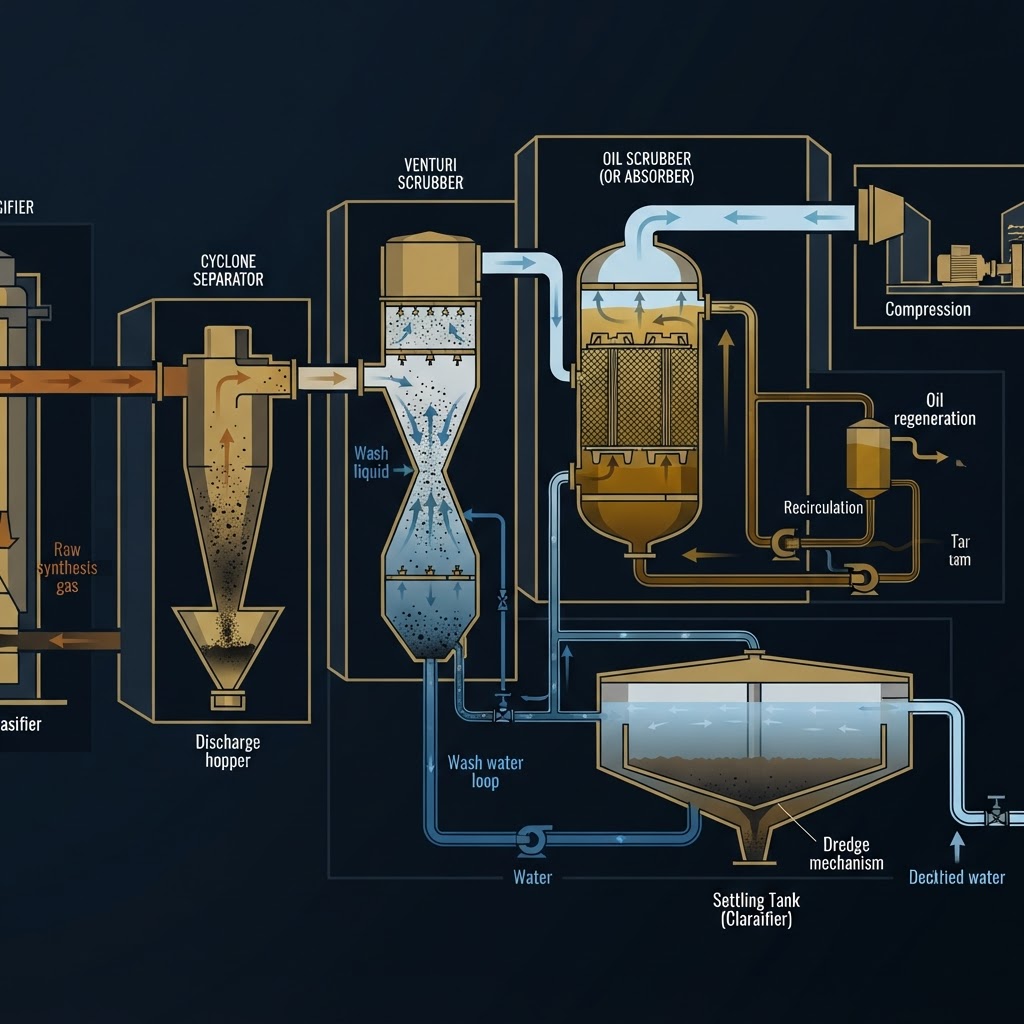
A syngas scrubber is usually the cheapest line on a gas cleaning quote and the one with the longest tail. The vessel is simple: raw gas meets a liquid, cools, and drops what it was carrying. What it drops does not disappear. It moves into the wash liquid, and from there it becomes your problem in a settling tank, a carbon filter or a discharge permit.
This guide compares the designs a buyer will actually be offered, water spray, packed and tray columns, venturi, and oil or biodiesel scrubbers, and then follows the liquid out of the scrubber, which is where most quotes stop. If you need the tar spec itself and the method families around it, that is covered in our piece on tar removal from syngas. This page is about the equipment.
What a syngas scrubber does, and what it cannot
A scrubber is a gas and liquid contactor. In commercial gasification trains, wet scrubbing is the step that removes fine particulates, ammonia and chlorides, plus some of the H2S, with the spent water sent on to sour water treatment, a gravity settler and a filter press.
Wet gas cleaning typically runs at about 20 to 60 C, and at that temperature water also pulls out soluble gases such as NH3, HCl, H2S and SO2. That last list matters: a scrubber is one of the few units in the train that touches particulate, tar, nitrogen and chlorine species in one pass.
What it cannot do is set the outlet spec on its own. It takes out a share of each contaminant, not a guaranteed concentration, and the share depends on what is in the gas when it arrives. Start from what is actually in raw syngas for your feedstock, then size the scrubber against it.
Why the dew point decides where the scrubber sits
The single most useful number in scrubber design is not a removal percentage. It is the tar dew point. Producer gas typically has a tar dew point between 150 and 350 C, while the coldest point in the process sits around 30 to 40 C. Somewhere between those two temperatures, tar will condense. The scrubber is where you choose for it to happen.
The same research group drew the lesson from 15 years of running tar removal systems: dust, tar and water should not be allowed to mix. Every design below is a different answer to that rule. Water scrubbers break it and manage the consequences. Oil scrubbers try to obey it.
Water scrubber designs compared
Spray towers and open-spray scrubbers
The spray tower is the simplest scrubber there is. A good modern example is an open-spray, counter-current unit built for syngas from a biochar pyrolysis line: gas enters above 500 C and is quenched in a pre-wash section, the wash liquid is chilled below the solidification point of the heavy tar so it drops out as solids in a clarifier, and subsequent sections run caustic with sodium hypochlorite, a neutral cooling wash and two non-polar solvent stages.
The design argument is the absence of packing. No packing means minimal pressure loss and nothing for sticky tar to bridge across. Fresh water make-up and drain are triggered by pH and conductivity measurements, which tells you something on its own: the liquid is continuously spent and continuously replaced.
Packed and tray columns
Packed beds add contact surface for better absorption and pay for it in fouling risk when tar is present. Tray columns are common at large scale; one documented syngas scrubber on an oil gasifier is a four-tray column for soot and condensate, whose trays were dislodged by a 6 bar uplift at start-up until they were redesigned. Mechanical design for transients matters as much as mass transfer.
Venturi scrubbers
A venturi accelerates the gas through a throat and shears the liquid into fine droplets. It is more expensive than other scrubbers and removes up to 99% of particulate matter but only 50% to 90% of tar. That review also names the structural costs of every wet method: energy spent on heating and cooling, a liquid stream that has to be treated, and the tar's chemical energy leaving with the waste instead of staying in the gas. It adds that a tar emulsion in water is difficult to separate.
Venturi makers design around tar rather than for it. Practitioner guidance puts dry cyclones ahead of the venturi, uses an adjustable throat with automatic pressure drop control, runs several smaller venturis in parallel at the hot end, and follows them with a direct contact cooler filled with oversize dumped packing because tar condenses wherever hot gas meets water. A complete skid of cyclones, venturi, absorber and subcooler has been reported at 99.5% overall contaminant removal on reformer syngas, a figure for all contaminants combined rather than for tar.
By tar class, a holistic review puts wet scrubbers and wet ESPs mostly at 50% to 75%, against more than 99% for every tar class with the oil-based process described next.
Oil and biodiesel scrubbers: taking tar out before the water
OLGA
OLGA, the Dutch acronym for an oil-based gas washer, was built to obey the no-mixing rule. It runs above the water dew point, so tar is removed before any water condenses. ECN reports tar dew points below -15 C, process water that stays clean, and captured tar recycled into the gasifier to be destroyed rather than shipped off as waste. The TNO paper above adds that it also strips dust, thiophenes and dioxins while leaving methane and ethylene in the gas.
The catch is scale. ECN puts OLGA's economics as favourable above roughly 4,000 m3/h of gas, about 10 MW of biomass input, at a total specific cost of around 1.5 euro cents per kWh electric. That is a utility-scale answer. It tells a developer of a containerised 150 kg/h unit very little about what their own scrubber should cost.
RME and biodiesel as the scrubbing liquid
Smaller plants get some of the same benefit from a cheaper organic liquid. In tests on a fluidized bed gasifier, rapeseed methyl ester scrubbed tar better than water in every operating condition tried. A 120 kWth downdraft plant documented in the literature runs two scrubbers in series: a biodiesel scrubber for heavy, hydrophobic tar, then a water scrubber for the remaining light, phenolic tar. That arrangement is honest about the trade. The oil takes the heavy tar, and the water stage still produces wastewater.
The wastewater problem nobody quotes
What is in the water
Wash water from a wood gasifier carries ammonium, cyanide, phenols and PAH. In that study, trickling filters brought phenol down from 83.5 to 2.5 mg/L and cyanide from 0.32 to 0.02 mg/L over 63 hours, which is a workable result and also a description of a second process plant you now have to run.
The Lotfi review cited above is blunter: water scrubbing produces large amounts of toxic waste, with the treatment and sludge disposal costs that come with it, and at large scale needs a remarkably large scrubber and water supply. ECN made the same point from the operator's side, noting that removing tar components from process wastewater requires considerable investment.
Treating it
There are workable routes. Lime and alum coagulation followed by powdered activated carbon reached 92.3% COD removal and 100% phenol removal on tar-containing gasifier wastewater, and that study notes most plants recirculate treated water back into gas cleaning. That is the reason treatment is not optional even with zero discharge: dirty recirculated water scrubs worse.
Adsorbent choice is a cost question. In the downdraft plant study above, gasification biochar adsorbed about 65 mg of phenol per gram against about 270 mg/g for a commercial activated carbon, and real scrubber water needed at least 1.5 times more carbon than the phenol-only model predicted. Char is weaker but it comes free from the gasifier; activated carbon works harder but has to be bought. For a wider view of what biochar does and misses in wastewater treatment, our sister institute has the detail.
Where Zero-X sits on this
Zero-X builds the X-150, a containerized fixed-bed downdraft platform validated at Paris COMETHA, Verkoso (Fraunhofer IKTS) and Hochschule Zittau/Goerlitz on high-ash sludge, MSW and digestate. Downdraft geometry is the low-tar starting point, which is why gasifier geometry is the first decision in any cleaning design, not the last.
Its cleaning stage, SyngaPure, was selected for German BMWK go-inno support in December 2025 for real-time sensing of tar, H2S, NH3 and particulate with AI control. That is the relevant point for scrubber buyers: a scrubber whose wash liquid is dosed and drained on measured contaminant load behaves differently from one run on a timer. SyngaPure removes 99% of tar compounds while maintaining energy efficiency, and the X-150 held 99.98% tar conversion across a 1,939-hour continuous campaign in Paris.
The X-150 also produces char. The published evidence above shows gasifier char adsorbs scrubber phenol, at a lower capacity than activated carbon. If you are already making biochar the gasifier already produces, testing it against your own wash water is a cheap experiment before buying carbon.
Questions to put to a scrubber vendor
Take these into the quote meeting:
- Outlet, not efficiency. What tar and particulate concentration in mg/Nm3 leaves the scrubber on my gas, and does that meet the limit of my offtake, for example a syngas engine?
- Liquid. Water, oil or biodiesel? What is the consumption per operating hour and what does make-up cost?
- Wastewater. What volume leaves the unit, what is in it (phenol, ammonium, cyanide, COD), and is treatment in your scope or mine?
- Captured tar. Is it recycled to the gasifier, landfilled or sold?
- Fouling access. Where will tar deposit, and how is that surface cleaned without a shutdown?
- Pressure drop. What does the fan see at clean and at fouled conditions?
A scrubber is one stage in the full syngas cleaning train. Specify it as one.
FAQ
Does a water scrubber remove H2S from syngas?
Only partly. Water picks up some H2S along with ammonia and chlorides, but a plant needing low sulfur gas adds a dedicated sulfur removal step after the scrubber.
What is the difference between a venturi scrubber and a spray tower?
A spray tower lets droplets fall through rising gas, has very low pressure loss and is hard to foul. A venturi forces gas through a throat for much finer droplets, captures up to 99% of particulate, and costs more than other scrubber types.
Can scrubber wastewater be reused in the scrubber?
Yes, and most biomass gasification plants recirculate it. It has to be treated first, because phenol and COD build up in a closed loop and the scrubber's own performance drops.
What scrubbing liquid works better than water for tar?
Organic liquids. Rapeseed methyl ester beat water in every test condition on one fluidized bed gasifier, and oil-based processes like OLGA reach tar dew points below -15 C at large scale.
We use cookies to improve your experience on this site. By continuing, you agree to our Privacy Notice.