Syngas Applications: Power, Hydrogen, Methanol and FT Fuels
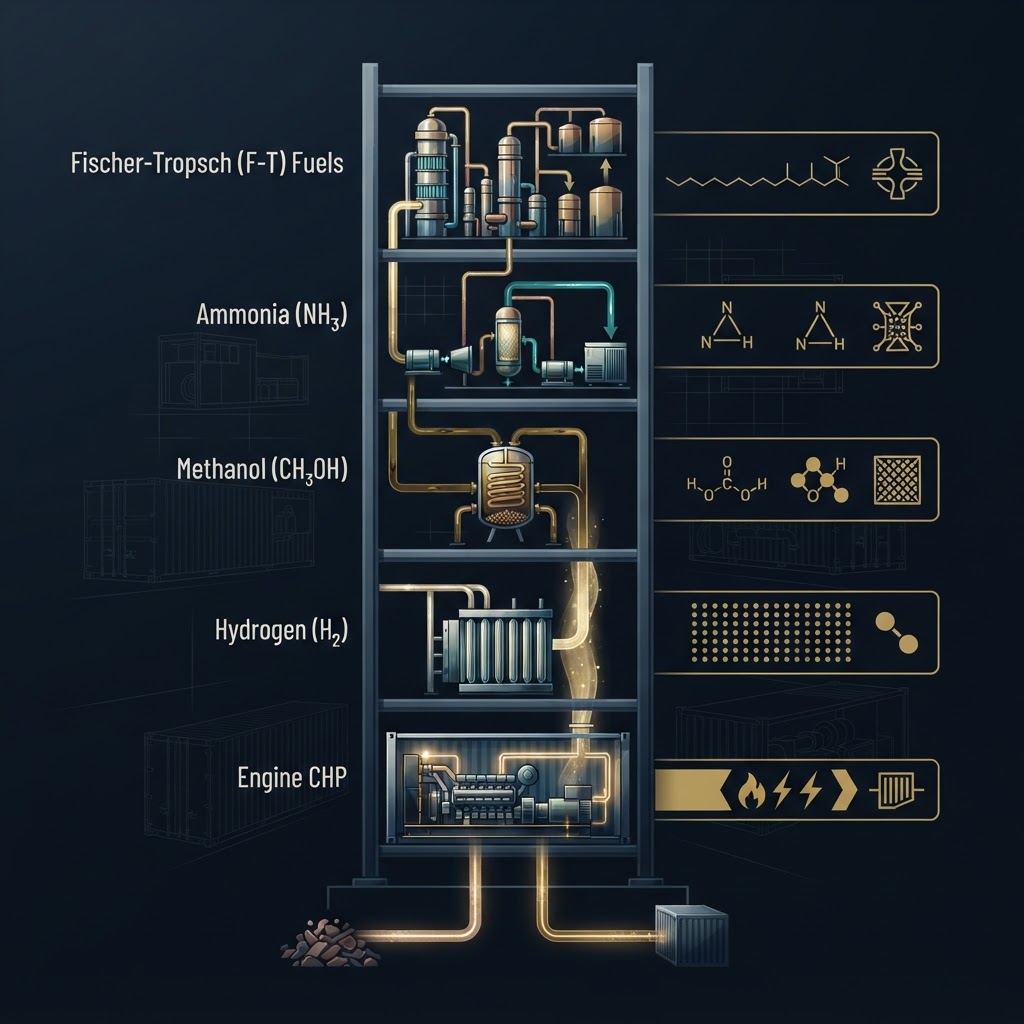
Every list of syngas applications reads like a menu: electricity, hydrogen, methanol, ammonia, synthetic diesel, jet fuel. The menu is correct. It is also useless for anyone deciding what to build, because the items on it do not cost the same. An engine will burn gas that a methanol catalyst would reject on sight, and a Fischer-Tropsch unit asks for a gas composition that most small gasifiers do not produce without help.
Syngas is a mixture of mainly hydrogen and carbon monoxide, often with some carbon dioxide and methane, and it is used primarily for hydrocarbon fuels such as diesel and methanol, and for industrial chemicals, particularly ammonia. That definition hides the real engineering question. Syngas is an intermediate. The application you pick decides the gasifier mode, the cleaning train and the scale of the plant, not the other way round.
So this guide does not list applications. It ranks them, from the most forgiving offtake to the most demanding, and says what each rung requires.
The three numbers that decide every syngas application
Before comparing end products, fix the three variables every route is judged on.
1. The H2/CO ratio
Catalytic synthesis is stoichiometry, and stoichiometry does not negotiate. A ratio near 2:1 is ideal for methanol and Fischer-Tropsch synthesis, while hydrogen-rich syngas favours DME production and direct hydrogen extraction. The same review makes the point that decides project economics: syngas reaches its highest value when converted into chemicals and advanced fuels, and in those cases precise ratio control and extensive gas cleaning become essential.
Air-blown gasification dilutes the gas with nitrogen. Oxygen and steam change the picture, which is why the gasification mode matters as much as the reactor.
2. Cleanliness
Tar, sulfur, ammonia and particulates are tolerated to different degrees by different offtakes. Even the least demanding route has a hard ceiling: an internal combustion engine in combined heat and power service tolerates a maximum of 0.01 g/m3 of tar, against raw gas that runs from 0.1 to 150 g/m3 depending on fixed-bed design. Catalysts are stricter still, because a poisoned catalyst does not degrade gracefully. The whole cleaning question is covered in tar removal from syngas.
3. Scale
Synthesis routes were built for world-scale plants. Power and hydrogen can be done at the scale of a hotel, a farm or a small municipality. That difference, more than chemistry, is what separates a realistic waste project from a slide.
Rung 1: power and heat in engines and CHP
The most forgiving use of syngas is to burn it. It can be used directly as a fuel in internal combustion engines or in combined heat and power systems, and gas turbines and generator sets are the standard hardware.
What makes CHP the entry rung:
- Ratio does not matter much. An engine cares about heating value and stability, not whether H2/CO is 1:1 or 2:1.
- Scale is small by default. A documented example is the KOPF sludge gasification line, whose gas engine unit generates about 70 kW of electricity from solar-dried digested sludge. The same source notes that most full-scale sludge gasification installations operate in Europe, mainly in Germany.
- Revenue is local. Power offsets a grid or diesel bill, heat offsets fuel, and both are sold at the fence.
The catch is tar. An engine is forgiving on composition and unforgiving on condensables, so a CHP project lives or dies on its cleaning stage. For most small-scale waste-to-energy systems, this is the first application to prove, and the one that pays for learning the rest.
Rung 2: hydrogen
Hydrogen is where syngas stops being a fuel and starts being a product. The route is established: the shift reaction moves CO and steam toward more hydrogen, then separation strips the rest. Sierra Energy describes its route as water gas shift followed by pressure swing adsorption, producing hydrogen for pipeline injection or fuel cells.
Two things make hydrogen harder than CHP:
- Carbon monoxide has to go. Raw syngas can feed molten carbonate and ceramic fuel cells, but because of its CO content it is incompatible with low-temperature fuel cells, which is why a shift and purification step is needed first.
- Nitrogen dilution is expensive. Every unit of nitrogen from air-blown gasification is gas you compress and separate for nothing.
This is the rung Zero-X was built around. In the COMETHA campaign in Paris, an X-150 ran 1,939 continuous hours on 16,382 kg of digestate pellets, producing 33% hydrogen in the syngas at an H2/CO ratio of 1.95:1 in oxy-steam mode with zero nitrogen ballast, with 99.98% tar conversion. Oxy-steam removes the nitrogen problem at the source instead of paying for it downstream.
The full process chain is in how waste to hydrogen works, and the market picture is in waste to hydrogen.
Rung 3: methanol, ammonia and chemicals
This is where the textbook applications live, and where the gas has to be close to perfect.
Methanol
Methanol is a chemical intermediate and a fuel. Industrially it is made from a gas of roughly CO2:CO:H2 = 5:5:90 at 50 to 100 bar and 225 to 275 C over a Cu/ZnO/Al2O3 catalyst. From methanol, further catalytic steps lead to formaldehyde, acetic acid or even gasoline. A catalyst running at that pressure is a long way from an engine's tolerance, so a waste-derived gas needs a cleaning train that delivers chemical grade, not engine grade.
Ammonia
Ammonia comes from the hydrogen in syngas combined with nitrogen through Haber-Bosch, and its main end use is fertilizer. For a waste project that means ammonia is really a hydrogen project with a synthesis loop added, and it inherits every hydrogen requirement above.
Why this rung is hard at small scale
Methanol has generally been produced from syngas derived from fossil fuels. A small waste gasifier competes on feedstock cost and carbon story, not on unit cost. The 1.95:1 H2/CO ratio from the COMETHA run sits close to the 2:1 methanol target, which matters, because it means the chemistry is reachable. Whether the economics are reachable at 150 kg/h is a separate question that has to be modelled per site, not assumed.
Rung 4: Fischer-Tropsch fuels and sustainable aviation fuel
Fischer-Tropsch synthesis converts syngas into hydrocarbons that form the basis for gasoline, diesel, jet fuel, olefins and waxes. It is proven technology: it sits at the heart of gas-to-liquids and coal-to-liquids plants in South Africa, Qatar, Nigeria, Uzbekistan, Malaysia and China, and cobalt catalysts are often used in small-scale FT plants such as power-to-liquids units.
FT is the route to drop-in diesel and to jet fuel, which is why it keeps appearing in SAF strategies. The fuel is high quality: FT diesel contains no sulfur or nitrogen, has very low aromatics and a high cetane number. The same analysis argues that co-producing electricity with liquid fuels or methanol can improve plant economics, while warning that feasibility and viability have to be examined case by case.
FT demands everything at once: a ratio near 2:1, gas clean enough not to poison the catalyst, and enough throughput to justify a synthesis loop and product upgrading. Entrained flow gasifiers produce relatively clean, low-tar gas suited to FT, which is part of why they dominate that segment at large scale.
Matching the application to the feedstock and the scale
Put the rungs side by side:
| Application | H2/CO requirement | Cleanliness demand | Realistic scale for waste syngas |
|---|---|---|---|
| Engine CHP / power | Low | Strict on tar | Small to large |
| Hydrogen | Hydrogen-rich, low N2 | High, CO removal | Small to medium |
| Methanol / DME | Near 2:1 (DME hydrogen-rich) | Chemical grade | Medium to large |
| Ammonia | Hydrogen route plus N2 loop | Chemical grade | Medium to large |
| Fischer-Tropsch / SAF | Near 2:1 | Chemical grade | Large, or clustered |
Three practical conclusions fall out of that table.
Start at the rung the site can pay for. A hotel, farm or municipal sludge line with a disposal problem earns first from power, heat and gate fees. Hydrogen is the next step when there is an offtaker. Synthesis is a cluster play.
Pick the gasification mode for the top rung you want to reach. If hydrogen or chemicals are on the roadmap, air-blown gas will cap you. Oxy-steam operation and a measured cleaning stage keep the upper rungs open. SyngaPure, the cleaning system behind the X-150, removes 99% of tar compounds while maintaining energy efficiency, which is what makes waste-to-hydrogen and chemical-grade routes reachable rather than theoretical.
Feedstock is not a detail. Clean wood makes predictable gas. Real waste does not. The X-150 is a containerized 150 kg/h fixed-bed downdraft platform validated on high-ash sludge, MSW and digestate, the feedstocks that clean-wood gasifiers cannot handle. Knowing what actually sits in the gas before choosing an offtake is the subject of syngas composition.
In the EU there is also a regulatory tailwind for every rung: syngas from biomass or waste counts as a gaseous biofuel and a renewable energy carrier when it meets the sustainability criteria of the Renewable Energy Directive.
FAQ
What is syngas mainly used for?
Mainly for making hydrocarbon fuels such as diesel and methanol, and industrial chemicals, above all ammonia. For waste-derived syngas, the most common first use is power and heat in engines and CHP units, because that route is the least demanding on gas composition.
What H2/CO ratio does methanol or Fischer-Tropsch synthesis need?
A ratio near 2:1. Hydrogen-rich gas is better suited to DME and to direct hydrogen extraction. Air-blown gas diluted with nitrogen usually needs shift and separation steps before it gets close.
Can syngas run a fuel cell?
High-temperature molten carbonate and ceramic fuel cells can use syngas directly. Low-temperature fuel cells cannot, because carbon monoxide poisons them, so the gas must be shifted and purified to hydrogen first.
Does syngas from waste count as renewable in the EU?
Yes, if it meets the sustainability criteria of the Renewable Energy Directive, syngas from biomass or waste is classified as a gaseous biofuel and a renewable energy carrier.
Available for advisory work, board seats and media appearances.
Julien Uhlig advises boards and funds and briefs newsrooms across Europe and North America. Enquiries are read personally.
We use cookies to improve your experience on this site. By continuing, you agree to our Privacy Notice.