Small Scale Waste to Energy Systems: A Buyer's Guide
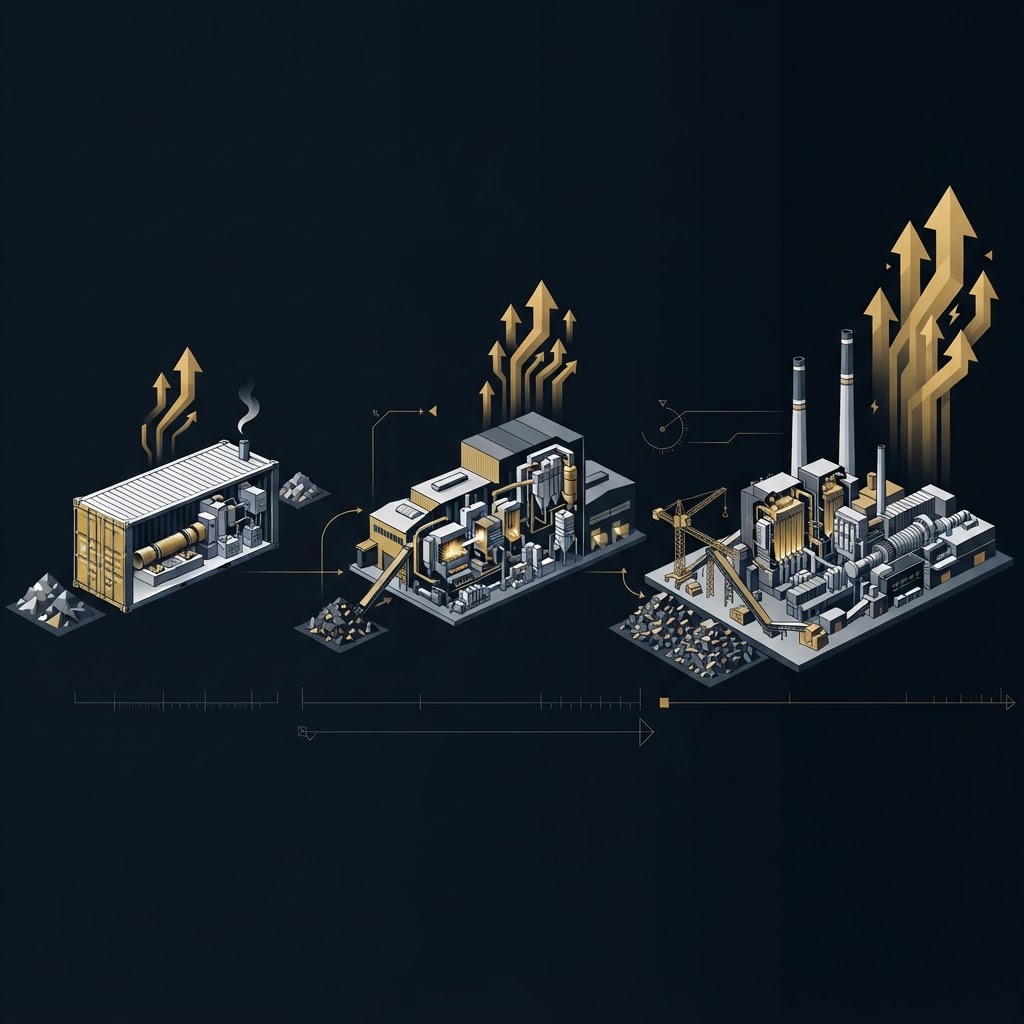
Every guide to small scale waste to energy systems argues about technology. Incineration or gasification. Pyrolysis or anaerobic digestion. Plasma, if the brochure is expensive enough.
That is the wrong argument. The published evidence points at a variable almost nobody quotes in a proposal: the number of hours per year the machine runs on your feedstock, not on the fuel the vendor tested with. Get that number wrong and the technology choice is irrelevant, because two plants of the same class and size can return a 3.8 year payback in one setting and an uncompetitive result in another.
This is the buyer's guide the search results do not contain. Real capacity bands, what each technology can actually digest, where the economics invert, and the questions that separate a machine that runs from a machine that demonstrates.
What counts as small scale, in numbers
The word gets stretched until it means nothing, so here are the bands as they exist in the field.
City scale is mass burn on a moving grate, the dominant technology for large facilities. Small municipal is the class studied at Columbia University using the International Solid Waste Association dataset: of over 330 European plants surveyed, about 170 were small scale, with 84 under 50,000 tonnes of annual capacity and another 85 between 50,000 and 100,000 tonnes, together handling just over 8.5 million tonnes of feedstock. The Energos units in that band ran from 30 to 118 tonnes per day (Ellyin, Columbia University).
That study also gives small plants their two structural advantages. Capital cost per tonne of annual capacity rises as capacity falls, but a low capacity facility needs a footprint under one hectare, and building near the waste avoids the economic and environmental cost of hauling it a long way.
Then there is the class most people typing this search actually mean: containerised units rated in kilograms per hour rather than tonnes per day, sized for a hotel, a farm, a resort, a wastewater works or a village. Our own X-150 sits here at 150 kg/h (Zero-X).
Notice the gap. The most visible vendor content aimed at a small buyer, a modular use case written for a holiday resort, starts at roughly 170 tonnes per day (WOIMA). That is around fifty times the size of what a single resort produces. Much of the market is answering a question nobody asked, which is why the sub-megawatt class is so poorly documented.
The four technologies, and what each one actually eats
Compare these by appetite rather than by chemistry. Chemistry is what every competing page already explains, and appetite is what decides whether the plant runs in March.
Small grate combustion burns waste as received. It is the most feedstock-tolerant option and the most heavily regulated on emissions, and it produces heat rather than a usable gas. If you have mixed municipal waste and a heat customer, it is the conventional answer.
Anaerobic digestion is biological, not thermal. It handles wet organics well and cannot process the dry, plastic-rich or high-ash fraction at all. It is a food waste and sewage technology, not a general waste one.
Gasification and pyrolysis convert the feedstock into syngas plus a solid carbon residue rather than burning it outright. Conversion efficiency of gasification runs 75 to 80%, and the device that turns the gas into electricity delivers anywhere from about 21% to 65% depending on whether it is an engine, a turbine or a fuel cell (Indrawan et al., Energies). At small scale the practical outcome is more modest: monitored gasification CHP plants show electrical efficiency of roughly 20 to 30% with overall CHP efficiency near 70%, and the published small-scale range is 17 to 26% electrical (Springer, Waste and Biomass Valorization). The trade is that syngas is flexible: it can feed an engine, or be cleaned and upgraded toward hydrogen and chemicals. How the gasifier types compare is a separate decision inside this family.
Plasma gasification is where small buyers lose the most money, and there is a documented case rather than a rumour. EcoValley in Hokkaido, the first plasma facility built for municipal and shredder waste, hit three commissioning problems: a gasifier bottom diameter so large that cold spots made it inoperable, refractory that did not last, and particulate carry-over that damaged downstream refractory and was not resolved for more than five years. The fix was to drop syngas exit temperature from 1200 to 750 degrees C, which cost efficiency: a heat recovery boiler designed for 1200 C ended up running at 900 C. By then several waste suppliers had found other outlets, the plant ran at about half capacity, it was losing money, and operations ceased in 2013 (Willerton, ASME).
Read that failure carefully, because the ending is the part that generalises. The engineering problems were eventually solved. The plant still died, because by then it could not contract enough waste.
The number that decides everything: hours, not kilowatts
Here is the finding that should reorganise how you evaluate every quote you receive.
Manufacturers of small-scale CHP units under 200 kWel ensure 7,000 operating hours a year, with 8,000 the norm. That comes from a monitoring campaign across an entire regional fleet, 47 plants authorised and 42 operating, measuring real machines rather than modelling them. The same campaign measured what those machines were being fed: humidity always below 12% and ash content below 1%. Most manufacturers claim that with small modifications their gasifiers will eventually run on agricultural waste instead of high-quality biomass, and the researchers state plainly that this supposition has not been confirmed (Patuzzi et al.).
Read those two facts together. The advertised uptime is real, and it belongs to a machine eating clean dry wood. It is not a promise about your waste.
What happens when fuel varies is documented at flagship scale. The GoBiGas plant in Gothenburg spent years fighting moisture. Early operation on pellets fouled the product gas cooler so fast that only about 10 hours were possible between cleanings. Later, wet chipped wood hindered continuous operation beyond roughly 200 hours and produced no biomethane for most of a year. Dried bark was rained on in storage, so moisture varied across the stack and disrupted operation again. Only after returning to pellets did the plant run continuously for 1,850 hours and hit its design output (Larsson, Gunnarsson and Tengberg).
Nothing was wrong with the technology. The fuel moved, and the plant stopped.
This is also where the money is. In the 2025 Italian assessment, a loss in yearly operating hours and a reduction in unit capital cost had the largest impacts on unit cost, while heat valorisation, biomass cost and plant size were secondary. Hours are not an operational detail sitting below the business case. They are the business case.
Which is why the number worth asking any vendor for is a single unbroken run on a difficult feedstock. Ours is 1,939 hours of continuous operation in Paris under the COMETHA project, processing 16,382 kg of digestate pellets at 33% hydrogen in the syngas and 99.98% tar conversion (Zero-X). We publish it because digestate is not clean wood, and a continuous-hours figure on the hard feedstock is the only version of that claim worth anything.
Why tar is the failure mode nobody quotes in a proposal
The mechanism behind almost every uptime story above is the same. Variability in biomass moisture, size and quality forces gasifiers outside their design parameters, and producer gas tar content rises. Because gas must be cooled before an engine will take it, those tars condense and stick to valves and other components (Barriers to Success, Energies).
The industry has two answers, and both cost you something. Narrow the operating window, which means committing to selected dry biomass at nominal power and giving up the fuel flexibility that made waste attractive. Or over-build filtration, which means high capital cost, high filter maintenance and the ongoing problem of disposing of filter by-product. The same review notes that gasifiers need daily maintenance where solar and wind need monthly or yearly attention.
The third answer is to design the gas cleaning for real waste from the start, which is the problem why gasification projects die of tar covers in full.
The economics flip depending on what you are replacing
Same technology class, opposite verdicts. This is the most important commercial point on the page.
The pessimistic case. A 225 kWel gasification CHP plant in the Italian mountains, at 7,500 operating hours a year and biomass bought at 70 EUR per tonne, produces a levelised cost of 388 EUR/MWh. That is uncompetitive against photovoltaic plus storage or biogas, and it needs a 237 EUR/MWh subsidy to close the gap. In the same analysis, a 125 kWel plant using pomace pellets available at negative cost and selling biochar at 150 EUR per tonne returned an internal rate of return of 7.26%.
The middling case. A 60 kW downdraft gasifier on biomass and municipal waste gives a 7.7 year simple payback, a 10.9% internal rate of return and a net present value of 84,550 USD, with the feed-in tariff the largest single positive contributor. The feedstock economics are visible in one comparison from that study: syngas costs about 0.042 USD/kWh made from wood biomass, and about 0.02 USD/kWh made from municipal solid waste.
The optimistic case. A 5,274 tonne per year plant with a 235 kW Organic Rankine Cycle unit, modelled for the Maldives, returns a simple payback of 3.8 years, a net present value of AUD 846,547 and a levelised cost of AUD 0.11/kWh (Murdoch University).
Three studies, one technology family, and a spread wide enough to make the average meaningless. The variable is not the machine. It is the counterfactual.
Buying fuel at 70 EUR a tonne is a cost line. Being paid a gate fee to accept waste is a revenue line, and the swing between those two is larger than any efficiency gain on offer. Then add what you displace. Grid electricity in an EU country is cheap competition. Island diesel at 0.40 USD per kWh is not, and neither is a Bali hotel's 338K USD a year spent trucking waste off the property.
That single arithmetic decides most projects, and it is why the honest answer to "is small scale waste to energy viable" is a question about your site, not about the sector. It is worth working through what a waste-to-energy plant costs to build and whether the result is profitable with your own disposal invoice in hand rather than a sector benchmark.
Revenue lines a small system can actually stack
Four, in descending order of reliability.
Gate fees. In the UK review of the sector, most consultees felt it was difficult to envisage a waste gasification project being viable in the current context without gate fee revenue (Supergen Bioenergy). Treat this as the primary revenue line, not a bonus.
Power. Worth most when self-consumed on site, because you avoid a retail price rather than earning a wholesale one.
Heat. Real, but only where there is genuine local demand, and the Italian study found heat valorisation and remuneration to be secondary factors. Do not let heat revenue be the thing that rescues a marginal case.
Char. A genuine line, as the 150 EUR per tonne biochar case shows, and dependent on your feedstock and local market.
Grants sit alongside all four and change the CAPEX rather than the revenue, which is a different exercise entirely: see government grants for waste to energy.
What to ask a vendor before you sign
Each of these maps to a documented failure above.
- What is the longest single unbroken run this machine has achieved, and on what? Not annual hours. One continuous number, with the feedstock named.
- What were the measured moisture and ash content of the fuel behind your quoted performance? If the answer is under 12% moisture and under 1% ash, you are being quoted a clean-wood machine.
- What happens at part load? Systems designed for nominal power only degrade badly when your waste arrives unevenly.
- What is the tar specification at the engine inlet, and what does the filtration cost to run? Include filter by-product disposal.
- Is ash and char removal continuous, or does it require a shutdown? This quietly caps your annual hours.
- Is the feedstock contracted for the life of the asset? These are roughly 20 year infrastructure projects, and both feedstock and heat and power offtake need securing long term (IEA Bioenergy). EcoValley is what happens when only one side is locked in.
- What is your permitting timeline? UK experience put environmental permitting at around 12 months against a four month target, with grid and gas connections adding difficulty.
- What availability do you expect in year one? Ramp-up periods are routinely underestimated, and long-term availability rates historically arrive around the fourth or fifth year of operation.
The IEA Bioenergy review reached a conclusion worth keeping in view through all of this: the authors began assuming that problems with biomass gasification were mainly technical, and found that plants which failed usually failed for economic reasons instead.
So does small scale actually work
It works where three things are true at once.
You have a feedstock you are currently paying to get rid of. Your incumbent energy is expensive, which in practice means diesel, bottled gas or an unreliable grid rather than subsidised European power. And you have an operator resourced for daily maintenance, because this technology does not behave like solar.
Where all three hold, the Maldives-style numbers are achievable and the payback is short. Where none hold, the 388 EUR/MWh result is the honest expectation, and nobody should sell you past it.
Our own answer to the middle problem is to design for the difficult feedstocks first: the X-150 has been validated at Paris COMETHA, at Verkoso with Fraunhofer IKTS and at Hochschule Zittau/Goerlitz, on high-ash sludge, municipal waste and digestate that clean-wood gasifiers cannot handle. The reason is not purity of engineering. It is that the sites where this technology earns its keep, including waste to energy for hotels and resorts, never produce clean wood.
FAQ
What is the smallest viable waste to energy plant? There is no universal floor, only a floor for a given site. Published viable cases run from a 60 kW gasifier upward, including a 5,274 tonne per year island plant with a 235 kW ORC unit. The binding constraint is that capital cost per tonne of capacity rises as plants get smaller, so gate fees plus displaced energy cost have to rise with it.
Can a small system run on mixed household waste, or does it need sorted feedstock? Most cannot, whatever the datasheet says. The monitored commercial fleet ran on wood under 12% humidity and 1% ash, and the industry's own claim that those machines will later accept agricultural waste is documented as unconfirmed. Ask for continuous-run data on your feedstock specifically.
How many hours a year will it actually run? Manufacturers of sub-200 kWel units ensure 7,000 hours with 8,000 the norm, on their specified fuel. Your figure depends on how much your waste varies. Treat any annual number given before your feedstock has been characterised as marketing.
Is small scale waste to energy cheaper than solar plus batteries? Not on levelised cost in a grid-connected European setting, where the 225 kWel case came in at 388 EUR/MWh and was judged uncompetitive. The comparison changes completely where you are also avoiding a disposal bill and displacing diesel, and solar does not make your waste disappear.
Why did so many small waste to energy projects fail? Mostly for economic rather than technical reasons. Feedstock security and long-term offtake are what underwrite the economics, and EcoValley is the clean illustration: the engineering problems were eventually solved, but the plant could not contract enough waste, ran at half capacity and shut down.
Available for advisory work, board seats and media appearances.
Julien Uhlig advises boards and funds and briefs newsrooms across Europe and North America. Enquiries are read personally.
We use cookies to improve your experience on this site. By continuing, you agree to our Privacy Notice.