Waste to Energy Business Plan: Revenue, Grants and the SPV
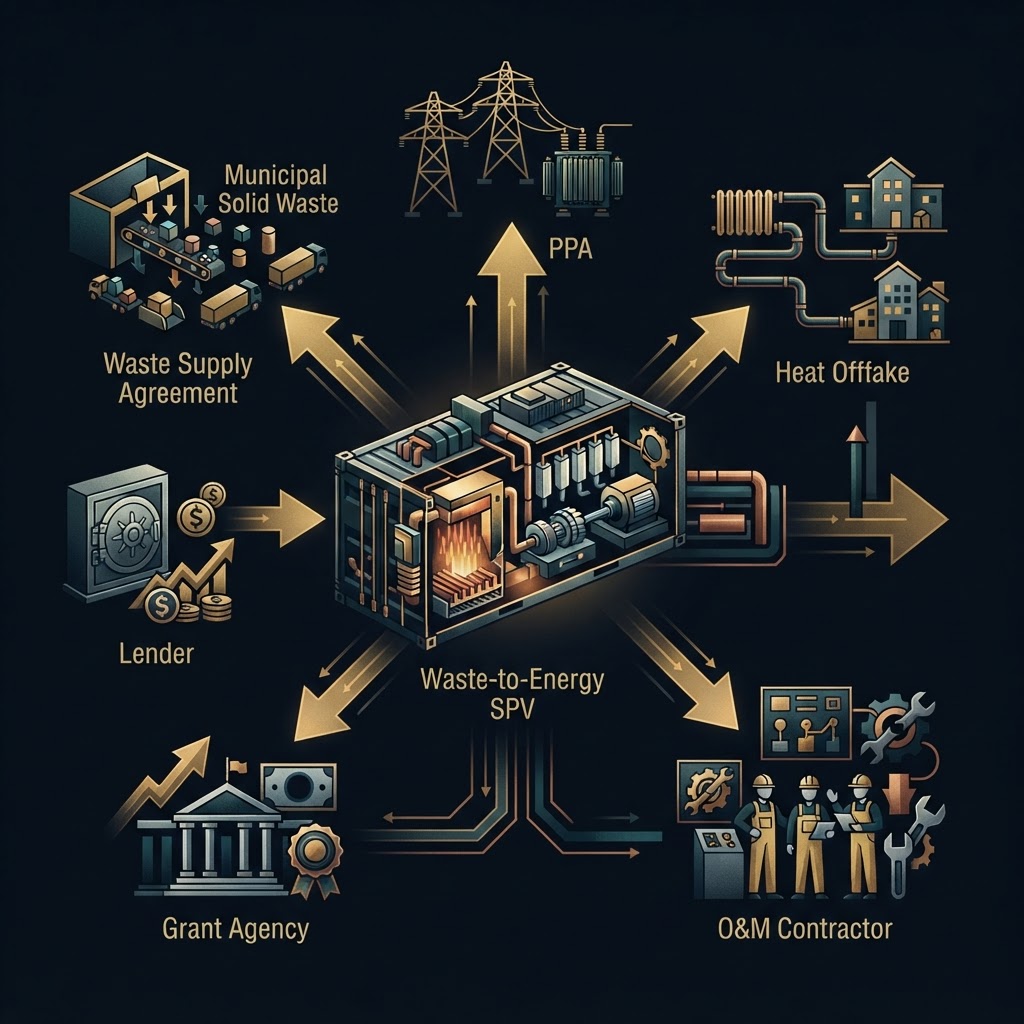
Most pages about a waste to energy business plan sell you a template. Fill in the tabs, show breakeven in year three, done. Then the plan meets a lender, a grant agency or a municipal waste department, and it falls apart on questions the template never asked: who is contractually obliged to deliver the waste, which revenue line carries the debt, and what proves the machine runs on that waste for months, not hours.
This guide is written from the developer's side. It is how we help Zero-X territory partners structure small and mid-scale gasification projects, and every number below comes from a published project or lender document, not from a model we made up.
What a waste to energy business plan has to prove
A for-profit waste to energy plant makes money in two main ways: gate fees for the waste it receives and sales of what it produces, usually electricity. The front end is governed by a concession or supply agreement, the back end by a power purchase agreement. The same source makes a point most templates skip: many lenders and private equity investors do not ask for a business plan at all. They read the feasibility study and its projections.
So your plan is not a marketing document. It is the wrapper around four questions lenders ask of every project: is the feedstock available in consistent quantity and quality, is the technology proven at that scale, are the offtakers creditworthy, and are cost and schedule credible. Each chapter of the plan should answer one of them with a contract or a measurement.
If you are still choosing the system itself, start with our buyer's guide to small scale waste to energy systems and come back with a capacity and a feedstock in mind.
Revenue: rank the lines by how bankable they are
Templates list revenue streams side by side. Lenders rank them. Order yours the same way.
Gate fee first
Institutional lenders treat waste infrastructure as a contracted cash flow business, and the tipping or gate fee agreement is the cornerstone of financeability. What they check: contract tenor, minimum guaranteed volumes, take-or-pay terms, the counterparty's credit, inflation indexation and whether the currency matches your debt. Energy prices move; demand for disposal does not.
For a hotel, farm or factory hosting a small unit, the gate fee is often the avoided cost of hauling. Our guide to waste to energy for hotels and resorts shows how that saving becomes the anchor revenue line.
Power and heat
Power is the second leg, and it rarely carries a plant alone. The Asian Development Bank's analysis of the 500 tonne per day Greater Male plant priced power at $100 per MWh and resort waste at $32 per tonne, assumed only 75 percent of revenue in the first year for start-up issues, and still found that operations would not fully cover O&M costs until 2035. Power sales were the main revenue line, which is exactly why the plan needed a government backstop.
Heat changes the picture when there is a buyer nearby. Yukon Energy's business case booked $1.79 million a year of district heat revenue against a $54.25 per tonne tipping fee, and still landed at $0.16 per kWh of electricity. A plan without a named heat customer should not show heat revenue.
By-products and carbon
Metals, ash, biochar and carbon credits belong at the bottom of the stack. Yukon priced carbon at $25 per tonne and it contributed about $71,000 a year, small next to the other lines. Show them, but run the base case without them.
The single most common revenue mistake is a flat price. A feasibility study for a Brazilian plant found an NPV of minus $250 million, mainly because tipping fees and electricity rates did not escalate with inflation while debt service did. Every revenue line in your plan needs an indexation clause behind it.
CAPEX, OPEX and the contingency lenders expect
Price the machine, then everything around it. A peer-reviewed study of a 60 kW downdraft gasifier running on biomass and municipal solid waste is useful because it is small and honest about returns: a payback of 7.7 years and an IRR of 10.9 percent, with the feed-in tariff the biggest positive driver of NPV. That is a realistic shape for a distributed unit, and it tells you where your sensitivity analysis must focus.
Yukon's case shows the discipline lenders expect on top: a contingency of 25 percent on capital and 15 percent on operating costs, and every assumption that could not be pinned down stress-tested. For line-by-line capital costs by plant size, use our breakdown of what it costs to build a waste to energy plant rather than a template's placeholder.
The capital stack: grant share, debt and equity
This is the chapter that decides whether a small plant gets built. In the markets where our partners work, governments fund 56 to 70 percent of project CAPEX: 70 percent through Andalusia's IER, 60 to 72 percent through SICE in Alentejo, and 56 percent in Patras. A plan that assumes the grant must show the route, the eligibility and a timeline. Our guide to government grants for waste to energy covers how aid intensity works, and the dated list of waste to energy funding opportunities covers which calls are open.
Then be realistic about the rest. Klean Capital, which finances these projects, says private equity needs an unlevered project IRR in the high teens to mid twenties, developers must fund early pre-development work themselves, and larger lenders mostly look at projects above $50 to $75 million. On debt, lender-grade models typically need a minimum debt service coverage ratio of 1.25x. A grant that removes most of CAPEX is what makes those hurdles reachable at small scale.
EX Venture lays out how grants, concessional money and senior debt layer together in its waste to energy funding capital stack.
The SPV and the contracts it signs
Lenders lend to a project company, not to your group. The plan should describe that special purpose vehicle and every contract it holds.
Indonesia's 2026 framework is a clean template. The SPV signs two primary agreements: a cooperation agreement with the local government covering waste quantity, quality and land, and a PPA. Both now run 30 years from commercial operation so they cannot drift apart, the local government pays penalties if it under-delivers waste, and power above the contracted level is bought at only 20 percent of the base tariff. That last clause stops developers from sizing plants on optimism.
The Palembang plant shows the full structure in practice: a $300 million build-own-operate project under a 30-year concession, a waste fee capped at about $33 per tonne, a feed-in tariff of $0.1335 per kWh, an eight-year non-recourse loan split between US dollars and rupiah to match the two revenue currencies, and roughly $200 million of sponsor equity.
Public authorities also decide which lever you compete on. The World Bank's model concession documents let the authority set a capital grant, a per-tonne processing fee or the power tariff as the bid parameter. Know which one your tender uses before you build the model.
At 150 kg per hour the same logic holds, only smaller. A Zero-X Tier 2 partner sets up the project SPV, holds the site and the waste contract, and can co-invest alongside capital partners. The licensing side of that model is explained in waste to energy technology licensing.
The technology chapter: evidence, not brochures
This is where small-scale plans usually lose credibility. Klean Capital is blunt about it: feasibility studies and white papers carry no weight with financiers, pilot plants are not proof of concept, and the project needs an EPC able to guarantee performance.
Write this chapter around measured operation. For our own X-150 that means a 1,939-hour continuous campaign in Paris on 16,382 kg of digestate pellets, with 33 percent hydrogen in the syngas and 99.98 percent tar conversion, plus independent validation at Fraunhofer IKTS and Hochschule Zittau/Goerlitz. We put those logs in front of grant evaluators and capital partners because they answer the lender's second question with data. Be equally precise about what is not yet proven, for example the run hours on your specific feedstock. A plan that overstates maturity gets found out in due diligence.
A business plan outline you can use
| Section | What it must contain | Evidence lenders want |
|---|---|---|
| Feedstock | Tonnes per year, composition, moisture, seasonality | Signed supply agreement with minimum volumes and quality specs |
| Revenue | Gate fee, power, heat, by-products, ranked | Draft PPA and gate fee contract with indexation |
| Technology | Capacity, availability, output per tonne | Operating hours on comparable feedstock, performance guarantee |
| CAPEX and OPEX | Equipment, site, grid, permits, O&M, staff | Quotes plus 25% capital and 15% operating contingency |
| Capital stack | Grant share, debt, equity | Grant route and timeline, DSCR at or above 1.25x |
| SPV and contracts | Ownership, concession, offtake, O&M | Term sheets from parties who can actually sign |
| Risks | Feedstock drift, tariff, permits, currency | Sensitivity table, base case without by-products |
If a row has no evidence yet, that row is your next three months of work, not a slide to polish.
FAQ
Do lenders want a business plan or a feasibility study?
Usually the feasibility study and its projections. The business plan matters more for equity investors, grant agencies and municipal partners, and it should be built on the feasibility study, not instead of it.
Can a small waste to energy plant work without a feed-in tariff?
It can, but the gate fee or an avoided cost has to do the work instead. In the 60 kW gasifier study, the feed-in tariff was the largest positive driver of NPV, so without one you need a disposal fee, avoided diesel or a heat customer strong enough to replace it.
How long should the waste supply contract run?
At least as long as the debt, and ideally as long as the power contract. Indonesia now aligns the waste cooperation agreement with the 30-year PPA term so the plant never holds a power contract without guaranteed fuel.
We use cookies to improve your experience on this site. By continuing, you agree to our Privacy Notice.