Waste to Energy Funding Opportunities: 2026 to 2027 Calls
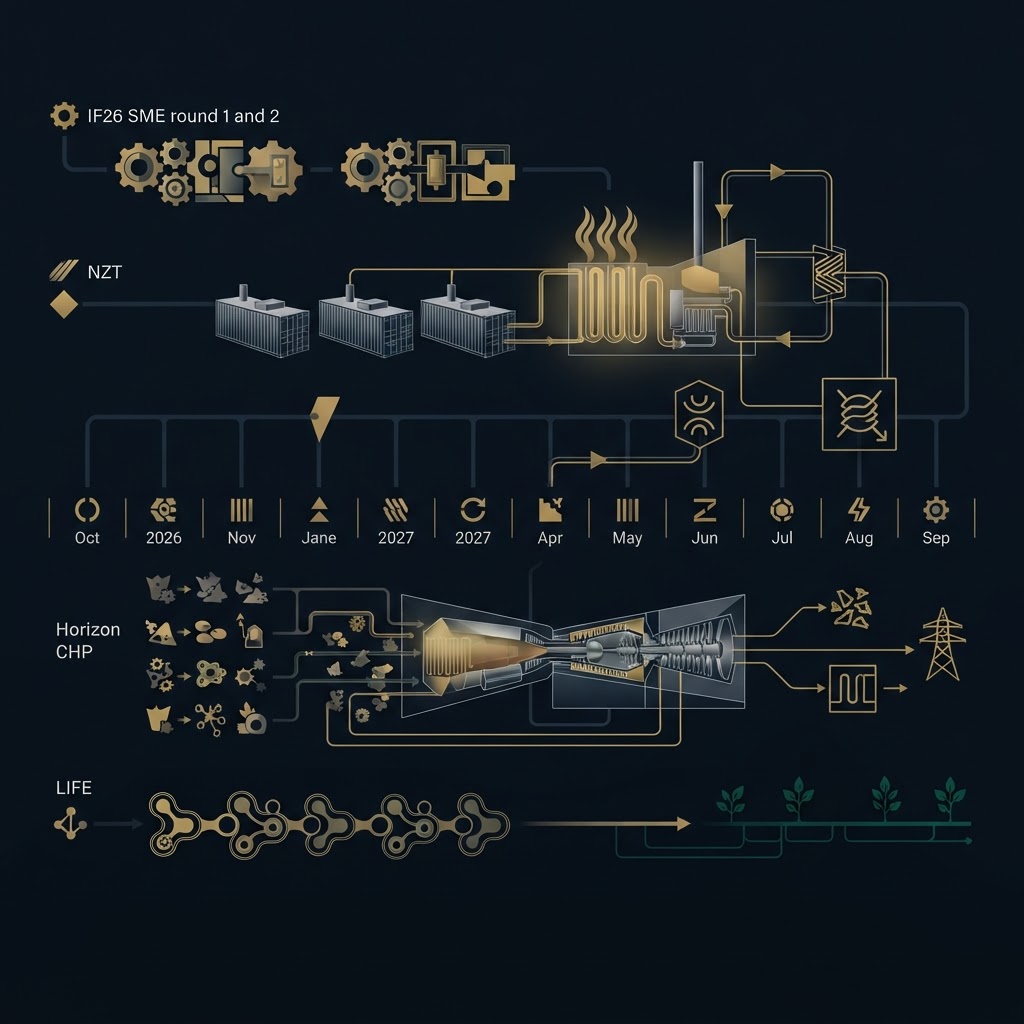
Search for waste to energy funding opportunities and you get one funder describing one programme, or a long EU list where energy recovery is buried between building renovation and textile recycling. Neither tells you which windows are actually open for a waste to energy project right now, or which one fits the stage you are at.
This is the calendar we keep for our own territory partners in Germany, Spain, the US and Nigeria, written as of 20 October 2026. Every size, rate and date links to the funder's own page. How aid intensity and state aid ceilings work is covered in our guide to government grants for waste to energy. This page is about timing.
The next 12 months at a glance
| Opportunity | Who it is for | Size and rate | Window |
|---|---|---|---|
| Innovation Fund IF26 SME call | All-SME consortia, CAPEX EUR 2.5m to 20m | EUR 200m total | Opens December 2026, round 1 closes end of March 2027 |
| Innovation Fund IF26 NZT call | Any company, project in EU/EEA | Up to 60% of relevant costs | Opens December 2026, closes April 2027 |
| EIC Accelerator | Start-ups and SMEs, TRL 6 to 8 | Grant below EUR 2.5m, plus EUR 1m to 10m equity | Short proposals any time |
| Horizon Europe solid biofuel CHP demo | Consortia of 3+ EU partners | 70%, up to EUR 6.75m | Closes 1 December 2026 |
| EEW Module 2 (Germany) | Companies using renewable process heat | 40% to 60%, up to EUR 20m | Rolling |
| RENOCOGEN (Spain) | Owners of cogeneration or waste treatment plants | Up to 65% plus SME bonus | Second call closed 2 March 2026 |
| REAP (US) | Rural small businesses, farmers | Grant up to $500,000 | New rule in force, window not yet announced |
| DARES performance-based grants (Nigeria) | Mini grid developers | Per connection | Rolling |
Read the table as a starting point, not a promise. Most EU dates below are labelled planned or indicative by the funders themselves.
EU-wide opportunities
Innovation Fund IF26: the new SME call is the headline
There are no Innovation Fund calls open today. The Commission's calls page says five calls open in December 2026: the regular Net-Zero Technologies call, two new calls for SMEs and the maritime sector, and auctions for hydrogen and industrial heat. NRW.Energy4Climate pins publication to the first week of December 2026, with online info days on 10 December for the SME call and 15 December for NZT.
The SME call is the one that matters for modular waste to energy. It is built for small-scale projects with CAPEX between EUR 2.5 million and EUR 20 million, with a planned EUR 200 million budget. If you apply as a consortium, every member must be an SME. There are two rounds: publication in December 2026 with a deadline at the end of March 2027, then a second phase opening April 2027 and closing at the end of September 2027. The Commission promises less paperwork and a semi-automated greenhouse gas calculator, which until now was the part that sank first-time applicants.
Larger projects go to the NZT call. Its small and medium-scale topic covers CAPEX from EUR 2.5 million to EUR 100 million. It plans to open in December 2026 and close in April 2027. A project eligible for the SME call cannot use NZT unless it is a pilot.
Evaluators score five criteria: greenhouse gas avoidance, degree of innovation, project maturity, replicability and cost efficiency. Maturity is where waste projects usually lose points, and we come back to that below.
EIC Accelerator: funding the technology, not the plant
The EIC Accelerator funds a company developing an innovation at TRL 6 to 8, not a plant operator. The grant component is below EUR 2.5 million, and the equity component runs from EUR 1 million to EUR 10 million. Short proposals can be submitted at any time and are batched on the first Tuesday of each month. The last 2026 full-proposal batch is 4 November. The applicant guide caps the grant at 70 percent of eligible costs, and the EIC takes at most 25 percent of voting shares.
For a gasification or gas cleaning technology company, this is the route for the next product generation. It is the wrong tool for financing a site.
Horizon Europe: solid biofuel CHP demonstration, deadline 1 December 2026
One Horizon Europe topic fits biogenic waste directly. It funds demonstration of regional solid biofuel value chains feeding 10 to 30 MWe CHP plants, at 70 percent of eligible costs and up to EUR 6.75 million. You need at least three independent partners from EU member states or associated countries, and the deadline is 1 December 2026. That is six weeks from today, so it is realistic only for consortia already in formation.
LIFE: the 2026 round has closed
Most LIFE 2026 deadlines fell on 22 September 2026. The only live stage is full proposals for Strategic Integrated Projects, due 4 March 2027, and that is open only to applicants who filed concept notes by 3 September. Treat LIFE as a 2027 planning item.
National opportunities in our four markets
Germany: EEW Module 2 and go-inno
The federal EEW programme's Module 2 funds renewable process heat, including solid biomass firing and biomass CHP. It pays 60 percent for small companies, 50 percent for medium and 40 percent for large, with reduced rates for biomass and a EUR 20 million ceiling. More than half the heat must go to production processes.
Here is the trap for gasification projects. BAFA's technical leaflet says heat used to make fuels, including pyrolysis gas, and heat used to generate electricity do not count as process heat. Neither does drying sewage sludge you then burn on site. An EEW application has to be built around an industrial heat customer, not around the gasifier.
For technology development, the BMWK go-inno programme is the practical entry point. Our own SyngaPure gas cleaning system was selected for go-inno support in December 2025.
Spain: RENOCOGEN shows the shape of the next call
Spain's IDAE ran a second RENOCOGEN call with EUR 50 million, open from 26 January to 2 March 2026. It funded biomass and biogas power, cogeneration and heat, with installations to be finished before 30 June 2029. Aid reaches 65 percent, plus 10 points for small and 5 for medium companies. Investment runs from EUR 50,000 to a maximum aid of EUR 15 million, and up to 80 percent can be paid as an advance against a guarantee. The catch is that the new plant must sit within 10 km of an existing cogeneration or waste treatment plant, so the applicant is usually the incumbent operator.
The window has closed, but it tells you who to partner with when the next call opens. Regional routes are often bigger. In our partner markets, government programmes fund 56 to 70 percent of CAPEX, with Andalusia's IER at 70 percent.
United States: REAP now pays after you build
The biggest change of 2026 is in the US. USDA's final rule, effective 16 October 2026, turns REAP into a post-completion programme. You build first, run the system, and apply with 12 months of measured output against 12 months of baseline data. It also replaces state-level competitions with one national scoring process.
The new regulation text sets a maximum renewable energy system grant of $500,000, cost sharing of at least 75 percent, and a project completed 12 to 24 months before you apply. For first-time waste to energy plants, REAP is now a refund on a plant you have already financed, not seed capital. Plan your debt accordingly; EX Venture's breakdown of the waste to energy funding capital stack shows how grants, concessional money and senior debt fit together.
State programmes fill some of the gap. Nebraska's $57 million wastewater co-digestion programme closed in June 2026. It was open to publicly owned treatment works, with private companies as partners or co-applicants. Municipalities can also get no-cost technical assistance from DOE; its 2026 portal closed on 30 May.
Nigeria: DARES and the development route
Nigeria's DARES programme has US$410 million for mini grids. US$215 million goes to minimum subsidy tenders and US$195 million to performance-based grants that run on a rolling basis. The programme manual sets grants of US$350 to US$600 per connection for isolated AC mini grids, and the programme is designed around solar hybrid mini grids under 1 MW. A waste to energy unit therefore enters DARES as part of a hybrid mini grid with real productive loads, and the eligibility of the gasifier component needs confirming with REA. Developers who win a grant can also draw on a NGN 100 billion interest-free facility from Lotus Bank.
For German or EU technology partners entering Africa, develoPPP funding is the complementary co-financing route.
Which opportunity fits your project stage
- Developing the technology (TRL 6 to 8): EIC Accelerator, go-inno in Germany.
- First commercial unit in the EU, CAPEX EUR 2.5m to 20m, SME-led: IF26 SME call, round 1 or round 2.
- Larger EU plant or a non-SME consortium: IF26 NZT, plus national top-ups.
- Selling heat to a German manufacturer: EEW Module 2, with the heat customer as the anchor.
- Already running in rural America: REAP under the new rule.
- Rural electrification in Nigeria: DARES as part of a hybrid mini grid, develoPPP for the partnership.
- Still at feasibility: municipal study grants, for example Canada's Green Municipal Fund (see the FAQ).
If none of these fit, the problem is usually the business case, not the funding search. Start with a waste to energy business plan before chasing calls.
What evaluators reward, from our own applications
Every programme above scores maturity, whatever it calls it. A drawing does not win. Measured operation does. We have taken our Jenja through a 1,939-hour continuous campaign in Paris with 99.98 percent tar conversion, plus validation at Fraunhofer IKTS and Hochschule Zittau/Goerlitz. Those logs go into the maturity and cost-efficiency sections of an application.
That is also why our partners do not apply alone. Under waste to energy technology licensing, a territory partner brings the site, the waste contract and the local applicant entity. We bring operating data, the engineering package and the grant routes we have already mapped.
FAQ
Can a company from outside the EU apply to the Innovation Fund?
Yes. Applicants can be based anywhere in the world as long as the project is built in the EU or the EEA (Norway, Iceland, Liechtenstein). Calls fund up to 60 percent of relevant costs. Auctions can cover up to 100 percent.
Does the IF26 hydrogen auction fund waste to hydrogen plants?
No. The auction is for renewable hydrogen of non-biological origin and low-carbon electrolytic hydrogen. Hydrogen from waste gasification has to compete in the NZT or SME call instead.
Is there funding for a waste to energy feasibility study?
Yes, mostly for public bodies. Canada's Green Municipal Fund pays up to 50 percent of a feasibility study, up to CAD 200,000. Communities of 10,000 people or fewer can get up to 80 percent. In the US, DOE's technical assistance programme is free for state, local and Tribal governments.
Which waste to energy funding opportunities are reserved for SMEs?
The IF26 SME call is SME-only. That means fewer than 250 staff and turnover up to EUR 50 million or a balance sheet up to EUR 43 million. The EIC Accelerator's grant-only option is also limited to start-ups and SMEs.
We use cookies to improve your experience on this site. By continuing, you agree to our Privacy Notice.