Textile Waste Gasification: Which Reactor Can Take It
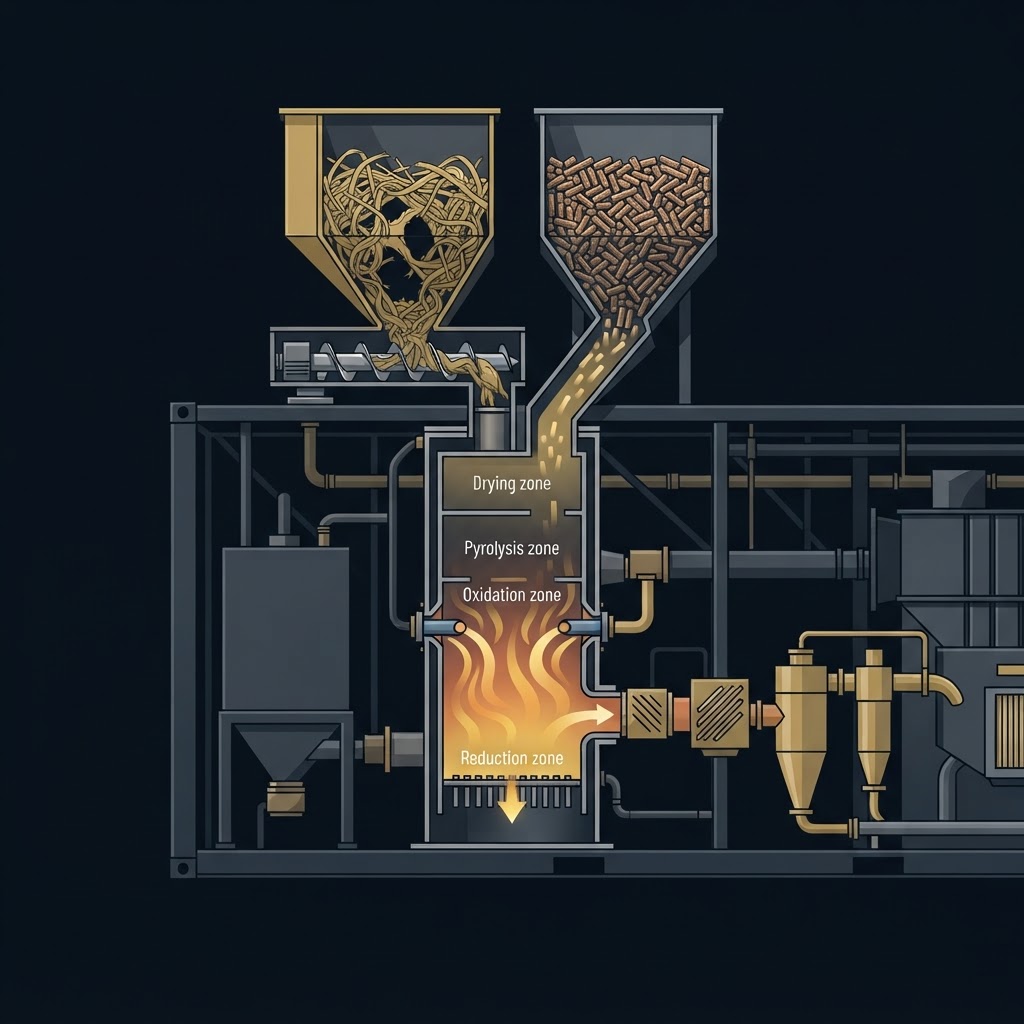
Textile waste gasification is technically proven. Every lab that has tried it got a usable syngas out of old clothes. What page one does not tell you is the part that decides whether a real plant runs: which reactor, and in what form the fabric goes in. The only published trial of loose textile in a small fixed-bed downdraft gasifier never reached steady state. The fluidized-bed trials, by contrast, ran fine.
This is the operator's version. What fabric looks like to a gasifier, what the trials measured, why the downdraft trial failed, and how a small plant would have to prepare textile before it could take it.
Why textile waste is now a gasification question
Europe has a textile residue problem with a deadline attached. EU Member States generated about 6.94 million tonnes of textile waste in 2022, around 16 kg per person, and the capture rate of separate collection was just under 15 percent. From 2025 the Waste Framework Directive makes separate textile collection mandatory, so the volume that reaches sorting plants will rise.
Not all of it can be reused or recycled. Of the textile waste that is already separately collected, 26 percent was incinerated or landfilled in 2022. Count the textiles thrown into household bins and the share going to landfill or incineration rises to 73 percent. Globally, waste textile production exceeds 92 million tons a year, most of it landfilled or burned.
That residue, the fraction that sorting rejects because it is worn out, mixed fibre or contaminated, is where gasification enters the picture.
What fabric looks like to a gasifier
Volatiles, fixed carbon and ash
Gasifiers care about the proximate analysis, not the label on the shirt. In the one downdraft trial on record, a recycled textile sample from BWF Recycling measured 89.67 percent volatiles, 4.66 percent fixed carbon and 4.19 percent ash on a dry basis, with a lower heating value of 19.22 MJ/kg. The same report puts typical wood chip fixed carbon at 12 to 20 percent.
So the energy is there: the heating value is comparable to woody biomass. The problem is the fixed carbon. A downdraft gasifier relies on a bed of glowing char to crack tar and reduce CO2 and steam into CO and hydrogen. Textile makes very little of that char.
Cotton and polyester behave differently
"Textile" is not one feedstock. Cotton is cellulose, close to wood in chemistry. Polyester is PET, a plastic. Both carry a lot of oxygen, and a Chalmers thesis reviewing the experiments found that CO2 is the dominating species in the gas from both, which lowers gas quality.
The fibre mix decides the product. In a 2025 bubbling fluidized bed study on real post-consumer waste, PET-rich model mixtures gave mainly CO2 and benzene (15 and 26 percent carbon yield), while the real textile stream, over 50 wt percent cotton, shifted towards a gas made mainly of hydrogen and carbon monoxide. A polyester-heavy bale behaves like plastic waste gasification feed. A cotton-heavy bale behaves more like biomass.
What the published trials got out of it
Gas quality by gasifying agent
The most complete exact-match study gasified textile waste at 900 °C with air, CO2 and steam blends (Gracia-Monforte et al., 2025). Results:
| Gasifying agent | Syngas LHV (MJ/m³ STP) | What it is good for |
|---|---|---|
| Air | about 5 | Boilers; the most efficient agent energetically |
| CO2 | about 7 | Highest gas yield and cold gas efficiency |
| Steam blends | about 10 | Higher H2/CO, more tar |
The process cut textile mass by 50 to 70 percent depending on the agent, and the syngas carried 4 to 9 MJ per kg of textile more energy than the process needed. The best H2/CO ratio, with steam, was 1.4, short of the 1.8 the authors cite for Fischer-Tropsch synthesis. Read syngas composition for what those ratios mean downstream.
Hydrogen
With a catalyst, textile can make a hydrogen-rich gas. Steam plus an iron-nitrogen biochar catalyst raised hydrogen from 17.79 to 50.91 vol percent at bench scale in the MDPI study above. Without one, an equilibrium model of textile-based refuse-derived fuel predicted 11.11 to 19.92 percent hydrogen, and found the equivalence ratio mattered more than reactor temperature.
Tar
Tar is the bill that comes with textile. The 2025 study measured 4.1 to 9.2 g/m³ of tar across all agents, and concluded it must be removed before the gas goes to an engine or turbine. That is an order of problem, not a footnote: see tar removal from syngas for what that cleaning involves.
Why loose textile fails in a fixed-bed downdraft
Here is the result nobody on page one mentions. The BWF trial tried textile fibre "pucks" in a 10 kW Power Pallet, a small downdraft unit. It failed, and the report is specific about why:
- Bridging. The material resisted flow in the hopper and kept bridging, so it never fell reliably into the auger.
- Dust. The pucks broke up and formed dust that clogged the bed until gas could not flow and the reactor would not ignite.
- Too little char. With 4.66 percent fixed carbon, it would need blending with wood chip in appreciable amounts to sustain reduction reactions.
- Handling. Bulk density was 124 g/L, about half that of wood chip, and the fibre was highly hygroscopic. In a blend, the authors expected gravity separation in the hopper within a few hours, wood sinking and textile rising.
The authors' own conclusion: in that form, textile suits fluidized or circulating beds better, which blow shredded feed through the hot zone and may take 100 percent textile.
There is a useful analogy that cuts the other way. In an Imbert-type downdraft, 80 wt percent paper mill rejects blended with 20 percent wood chip, pre-conditioned before feeding, ran and powered a 10 kWe engine on a 7.3 MJ/Nm³ gas. Rejects are mostly fibre plus some plastic, which is close to a textile residue. The limit in the failed blends was agglomeration of the plastic fraction. In other words: fibre can go into a downdraft, but only densified, blended, and with the synthetic share kept in check.
If you are choosing between reactor classes, our guide to types of gasifiers sets out what each one tolerates.
How to make textile work in a small plant
None of the following is a Zero-X validated number. It is what the published trials imply for anyone running a fixed-bed downdraft unit.
Densify first
Loose fabric and soft pucks fail on flow and dust. The feed has to become a durable pellet or briquette that survives the hopper and auger without breaking. Dry it too: textile soaks up water fast, and a wet feed wrecks the heat balance. Our piece on feedstock moisture content covers the limits.
Blend with a char former
Textile alone will not build the char bed a downdraft needs. Blend it into a feed that does: wood, or the high-ash residues that already form a stable bed. And blend at the pellet stage, not in the hopper, so the fractions cannot separate.
Watch the synthetic share
The more polyester, the more the feed behaves like PET: CO2 and aromatics instead of syngas, and melting risk in the bed. Cotton-rich residue is the easier stream. Knowing the fibre mix of the bale is not optional.
Where Zero-X stands
We will be direct. The X-150 has been validated at COMETHA in Paris, at Fraunhofer IKTS (Verkoso) and at Hochschule Zittau/Görlitz on high-ash sludge, MSW and digestate, the feedstocks clean-wood gasifiers cannot handle. Its longest public campaign ran 1,939 continuous hours on digestate pellets with 99.98 percent tar conversion and 33 percent hydrogen in the syngas.
Textile is not on that list. What those campaigns do show is the approach textile would need: pelletised feed and serious gas cleaning. The SyngaPure system removes 99 percent of tar compounds, which matters for a feedstock that produced up to 9.2 g/m³ in the lab. Any partner with a textile residue stream should expect a feed test, not a promise.
Gasification, incineration or recycling for textile residue
Gasification is not a substitute for reuse or fibre-to-fibre recycling. The EEA's position is that separately collected textiles that cannot be reused should go to recycling, and that is the right order. Gasification is for what is left after that.
For the residue, the comparison is with incineration, where most of it goes today. Gasification makes a gas you can clean and use for power, heat or hydrogen, not just flue gas, a difference covered in gasification versus incineration. At the larger end, a semi-industrial dual fluidized bed at Chalmers steam-cracked sorting rejects and reached a carbon recovery of nearly 70 percent across chemicals, syngas and CO2, against about 3 percent closed-loop recycling in current European schemes.
The honest summary: textile waste gasification works in fluidized beds today. In a small fixed-bed downdraft unit it is a blend component that must be densified first, and nobody has published a long run proving it.
FAQ
Can you gasify polyester clothing?
Yes, but polyester is PET and behaves like plastic. In fluidized bed trials, PET-rich mixtures produced mainly CO2 and benzene rather than syngas. Cotton-rich textile waste gave a gas made mainly of hydrogen and carbon monoxide.
What is the calorific value of textile waste?
A recycled textile sample tested for downdraft gasification measured a lower heating value of 19.22 MJ/kg, comparable to some woody biomass fuels. The energy is there; the low fixed carbon and poor flow are the problems.
Is syngas from textiles good enough for Fischer-Tropsch fuels?
Not directly. The best H2/CO ratio in the 2025 lab study was 1.4, below the 1.8 cited for Fischer-Tropsch, and the gas carried a lot of tar. It would need tar removal and ratio adjustment first.
How much does gasification reduce textile waste?
In the lab, by 50 to 70 percent of the original weight, depending on the gasifying agent. Steam gave the lowest reduction because unreacted steam condenses into the liquid by-product.
We use cookies to improve your experience on this site. By continuing, you agree to our Privacy Notice.