Biosolids Gasification: What US Utilities Learned
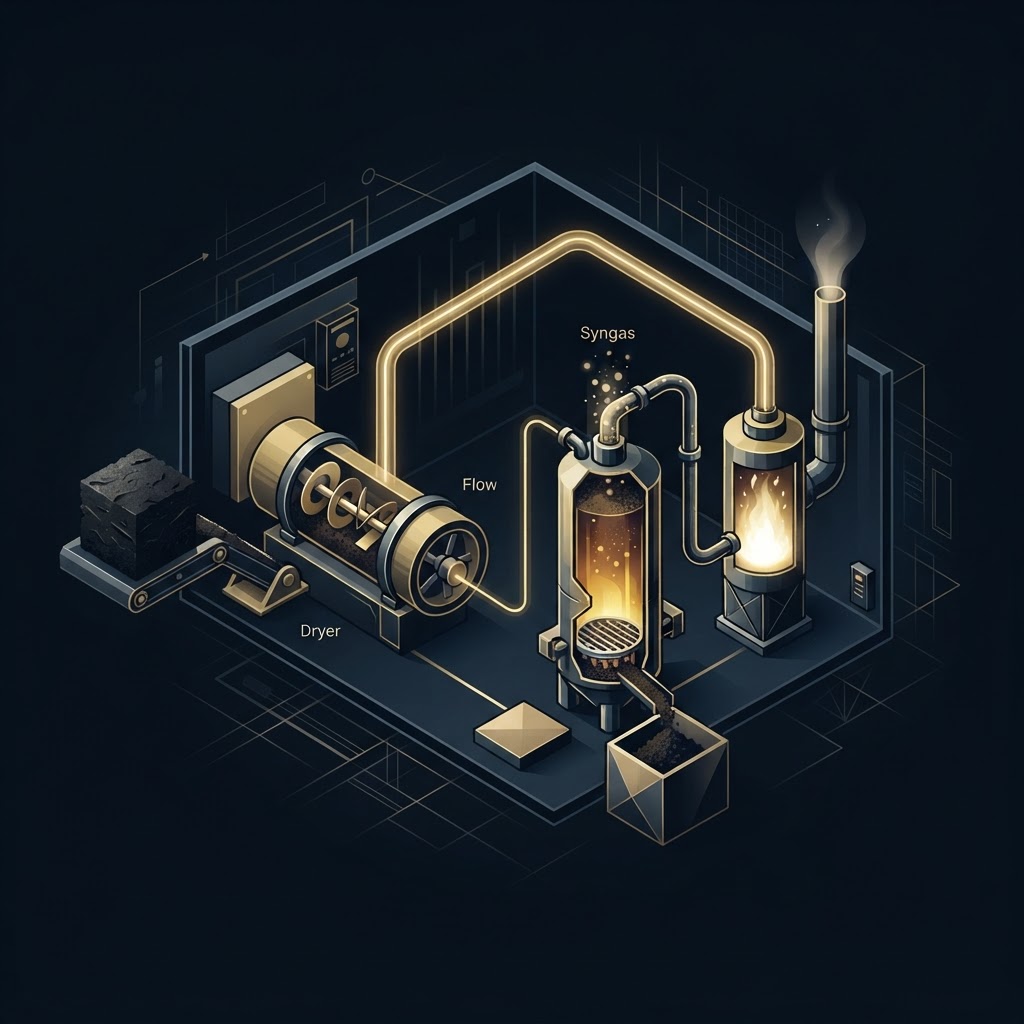
Biosolids gasification is back on utility shortlists, and for a blunt reason: the three traditional exits for treated sewage solids, land application, landfill and incineration, are each getting more expensive or less certain at the same time. What the search results do not give a utility engineer is the operating record. Review papers describe reactor parameters. Vendor fact sheets describe the future. This article does the part in between: which biosolids gasification plants exist, what went wrong at them, what the PFAS evidence actually says, and the questions to ask before signing.
If you want the feedstock chemistry (ash sintering, drying energy, tar) and the European regulatory angle, that is covered in our piece on sewage sludge gasification. Here the lens is the utility buyer.
What biosolids gasification is, in one paragraph
Every commercial system follows the same three steps. The status-of-the-industry review in Water Environment Research describes them as drying the solids, converting them in a thermal reactor, then burning the off-gas in a thermal oxidizer for energy recovery and emissions control. The gasifier runs with a controlled, sub-stoichiometric dose of air, oxygen or steam at roughly 800 to 1,000 degrees C. The oxidizer's heat goes back to the dryer. What leaves the site is a small stream of mineral-rich char, usually sold or given away as biochar.
That loop is the whole business case. Drying is the biggest energy load, and the gas from the solids is meant to pay for it.
Why US utilities are suddenly looking at it
Land application is no longer a safe default
The WEF early-adopters paper lists the pressures plainly: rising transport and landfill costs, less land available for application, odor complaints, and regulatory risk from contaminants of emerging concern such as PFAS. Its warning shot is Maine, where utilities faced significant disruption and cost increases when the state banned land application of all biosolids and biosolids-containing products in April 2022.
No utility wants to be the next Maine with no plan B. A thermal route that shrinks the mass and changes the contaminant profile is an insurance policy, which is why interest has returned after an earlier generation of plants struggled.
What the PFAS evidence says, and does not say
This is where marketing outruns the data, so precision matters.
A 2025 critical review of thermal biosolids treatment reports more than 90 percent removal of PFOA and PFOS from biosolids under pyrolysis conditions at 500 to 700 degrees C, with residual levels in the char below 0.2 ng/g or below detection in most cases. That is good news for the solid product.
It is not the same as proving destruction. PFAS that leaves the char goes into the gas phase, and the industry review above is explicit: coupling a thermal oxidizer will likely destroy most organic contaminants, PFAS included, but this still requires additional research. Any vendor who tells you PFAS is "solved" without stack test data at full scale is selling ahead of the evidence. Ask for the emissions sampling method, not the char result alone.
The biosolids gasification plants that actually exist
The honest count is small. When the industry review was written, its authors found only three commercial-scale facilities processing sludge in the US, and only two of them were gasifiers.
Edmonds, Washington
Edmonds is the most useful case study in the market because it is documented warts and all. According to the commissioning paper presented at WEF, the city's Carbon Recovery Project, a dryer plus gasifier, replaced a fluidized bed incinerator at the end of its service life on a tight downtown site treating 5.6 MGD.
It took over two years longer than expected. Construction during COVID, incomplete installation, leadership changes at the city, the state agency and the energy services company, and a switch in O&M management all contributed. During that extended commissioning, dewatered sludge was hauled to landfill at a cost of over $5 million.
What fixed it was not hardware. An engineering consultant ran a three-day chartering session with all four parties, after which the system ran for four weeks and reached limited substantial completion. The city then signed a six-month O&M contract with the gasifier provider to train its own staff.
The lesson: the technology risk was manageable; the delivery and organisational risk nearly sank it.
Lebanon, Tennessee and Morrisville, Pennsylvania
The two US gasifiers in the industry review's facility table tell different stories:
| Site | Vendor and process | Commissioned | Rated input | Energy | Output |
|---|---|---|---|---|---|
| Lebanon, TN | Aries downdraft gasification | 2016 | 29 wet tons/day, blended waste wood, scrap tires and biosolids | 420 kW electric via ORC | 1.5 wet tons/day |
| Morrisville, PA | Ecoremedy fluid lift gasification | 2019 | 32 wet tons/day at 27% solids | Heat for thermal drying | 2.4 wet tons/day |
Two details matter. Lebanon is not a pure biosolids plant; it blends in wood and tires, which makes the fuel far easier. And Morrisville was a demonstration whose equipment has since been decommissioned. Neither fact is a reason to dismiss the technology, but both are reasons to read any reference list carefully.
Logan, Queensland
Outside the US, Logan Water's Loganholme plant is Australia's first biosolids gasification facility. It handles over 90 percent of the city's wastewater, reduces the amount of biosolids by 90 percent, reuses its own heat for drying and offsets electricity with a 1.1 MW solar farm. The trial facility cost AU$17.28 million, of which AU$6.2 million came from an ARENA grant. That is one of the very few published capital figures in this field, and it is a useful anchor for any budget conversation.
Kearny, New Jersey (proposed)
Aries has proposed a regional facility in Kearny which, according to its project fact sheet, would divert 160,000 tons of biosolids a year from landfills and incinerators and turn them into biochar for concrete. Treat these as proposal figures, not operating ones. The fact sheet also states that USEPA ruled the Aries process a gasifier, not an incinerator, a classification that matters for permitting.
Why biosolids are harder than wood
Gasification is decades old in the biomass world. It is new to wastewater, and the early-adopters paper names the reason: high ash and metals content compared to woody biomass create unique operating challenges.
Moisture is the other enemy. The critical review puts the threshold at under 25 percent moisture in the feed for a neutral thermal balance. The older EPA technology assessment describes drying to 10 to 20 percent before the gasifier, and classed sludge gasification as an early commercial technology to be evaluated site by site. Dewatered cake arrives far wetter than that, so the dryer is never optional.
Metals do not disappear either. Most of them, except volatile ones such as mercury, arsenic and cadmium, concentrate in the char at higher levels than in the parent biosolids. That shapes what you can legally do with the product.
Biochar: product or disposal problem
Every plant above sells the same idea: the char is a product, not a waste. Logan lists soil improvement, filtration and building materials, and is helping develop an End of Waste code for biochar. Aries targets concrete, a use with its own dosage and strength questions covered in biochar in concrete.
The reality check comes from Cambi's overview of sludge gasification, which flags uncertain markets for biochar and ash, variable quality and regulatory ambiguity as real limits on sales. Plan the business case as if the char has zero value, and treat any offtake revenue as upside. If you want the production side in more detail, see biochar from sewage sludge. If phosphorus in the residue matters in your market, see phosphorus recovery from sewage sludge.
Scale and cost
Size decides a lot. Cambi cites a techno-economic analysis finding that a gasification system becomes economically attractive above roughly 7,600 m3/day of wastewater capacity, about 2 MGD. Smaller plants either aggregate solids regionally, as Kearny proposes, or need equipment sized for them.
That is the gap modular units are designed for. The Zero-X X-150 is a containerized 150 kg/h fixed-bed downdraft gasifier, independently validated at Paris COMETHA, at Verkoso with Fraunhofer IKTS and at Hochschule Zittau/Goerlitz on the hard feedstocks: high-ash sludge, MSW and digestate. A unit that size will not replace an incinerator at a big-city plant, but it changes the math for a utility well under the 2 MGD line, or for one that wants to pilot before committing to a large build.
Lessons early adopters paid for
Pull the Edmonds story and the early-adopters paper together and you get a procurement checklist. The paper's own list of challenges runs from technology readiness and commercial viability to supply chain, compliance with US codes and standards, vendors' limited experience with public utilities, and their financial strength. Turned into questions:
- What is the longest continuous run on biosolids like mine? Hours, on a single campaign, on a comparable feed. Blended wood and tire plants do not count.
- Who has the vendor delivered to before, and how did commissioning go? Edmonds lost two years. Ask for the reference utility's phone number, not a logo.
- What is the plan B for solids during commissioning? Budget the hauling. Edmonds spent over $5 million on it.
- Who operates it in year one? A vendor O&M and training contract is not a weakness; Edmonds needed one.
- What do the stack tests show for PFAS? Not only the char.
- Is the vendor financially able to stand behind a 20-year asset? The early-adopters paper lists financial maturity as a risk in its own right.
- Who validated the performance, by name? An institute that will be quoted is worth more than an internal report.
On the first question, Zero-X's answer is 1,939 continuous hours, 80 consecutive days on the X-150 in Paris, processing 16,382 kg of digestate pellets with 99.98 percent tar conversion. The first reactor in that project went operational in May 2024, fed by household waste and sewage sludge. Hold every vendor, us included, to that kind of number.
FAQ
Is biosolids gasification considered incineration? No. A gasifier runs with less oxygen than combustion needs and produces a fuel gas plus char, while an incinerator burns the solids completely. USEPA has ruled at least one commercial biosolids process a gasifier rather than an incinerator. The practical differences are covered in gasification versus incineration.
Does biosolids gasification destroy PFAS? The char result is strong: published work shows more than 90 percent PFOA and PFOS removal at 500 to 700 degrees C, with residues mostly below detection. Full destruction depends on the thermal oxidizer downstream, and full-scale emissions data are still limited, so ask for stack tests.
How much does gasification reduce biosolids volume? Logan reports about a 90 percent reduction. At Morrisville, 32 wet tons per day in came out as 2.4 wet tons per day of residue.
What size utility does biosolids gasification suit? Large central systems pencil out above about 2 MGD. Smaller utilities can aggregate solids regionally or use modular containerized units sized to their flow.
We use cookies to improve your experience on this site. By continuing, you agree to our Privacy Notice.