Biochar Production Equipment: Kilns vs Continuous Gasifiers
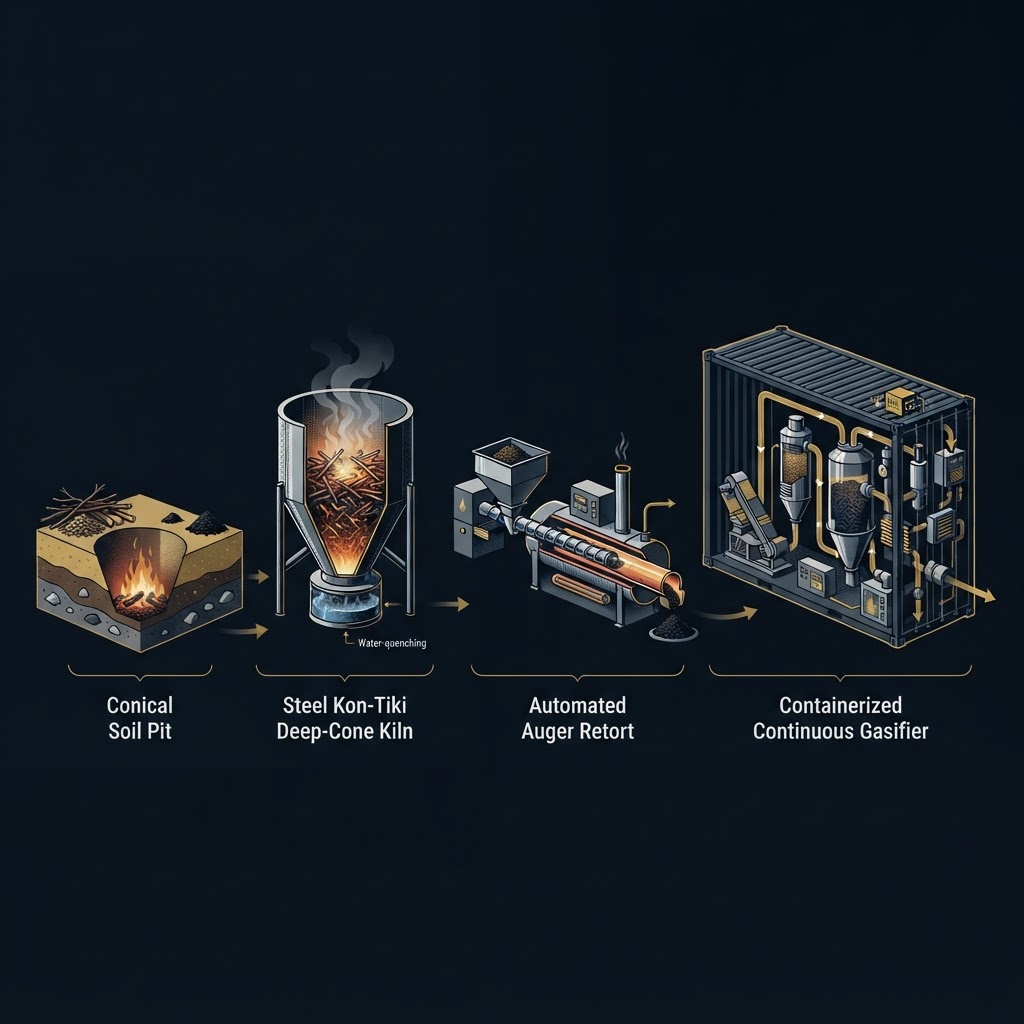
The price range for biochar production equipment spans five orders of magnitude. A conical soil pit costs about EUR 30. A continuous industrial plant runs past $2 million. Both make biochar. Almost every buying guide that ranks for this term is either a vendor pricing its own catalog or an academic review you cannot buy a machine from, so the honest spread of prices, yields, labor and failure modes rarely appears in one place. This guide puts it there, and it adds the option those guides skip: a machine that produces biochar as a by-product while waste fees and energy sales pay for it.
The single question that decides everything below is not price. It is whether biochar is your product or your by-product. Answer that first, and the equipment ladder sorts itself out.
The biochar equipment ladder at a glance
A 2026 market survey of more than 30 manufacturers groups the field into three tiers, and the boundaries are about labor and automation as much as capacity:
- Entry level, $1,000 to $10,000. Open-flame and simple retort kilns. Low automation, high labor, modest throughput, often portable. Right for pilots, small farms and community projects. At the very bottom, a fabricated drum kiln from a local artisan costs as little as US$13 to $100.
- Mid-range, $25,000 to $150,000. Semi-continuous and automated batch systems, most of them commercially viable for small carbon-removal projects, often shipped with monitoring sensors or a certification pathway.
- Industrial, $500,000 to $2 million and up. Fully continuous, high-automation systems processing thousands of tonnes a year. They need expensive infrastructure, skilled operators and grid or generator power, and they only work financially when co-product revenue is built into the model.
Across the whole ladder, most systems convert 15% to 40% of dry biomass into biochar. The rest leaves as gas and heat. What separates a $30 kiln from a $2 million plant is not char quality alone; it is who does the work, how much you produce per day, and whether the energy in that escaping gas is wasted or sold.
Flame curtain kilns: the Kon-Tiki class
The cheapest serious biochar production equipment on the market is a cone. The Kon-Tiki flame curtain kiln was designed in 2014 in Switzerland and has since spread to more than 50 countries by open-source technology transfer.
How the flame curtain works
Biomass is pyrolyzed layer by layer in a conically formed metal kiln or soil pit. You start a fire, spread embers across the bottom, then add a thin layer of biomass. The rising pyrolysis gas is caught in the flames and burns off as it passes through the hot fire front, while that same flame curtain shields the char below from oxygen. When white ash appears, you add the next layer. The main pyrolysis zone sits at 680 to 750 degrees Celsius. No external start-up fuel, no electronics, no gas-cleaning train.
What a Kon-Tiki actually produces
The numbers are genuinely good for the price. One run of a 2 cubic meter kiln produces 500 kg of biochar in about three hours, and the char meets IBI and EBC quality standards. Capital cost ranges from EUR 30 for a soil pit to about EUR 5,000 for a fabricated steel deep-cone kiln.
The labor math nobody prints
Here is the cost the sticker hides. A Kon-Tiki must be hand-fed every 5 to 10 minutes for the entire burn, which takes two to eight hours per cubic meter depending on moisture and piece size. One person can tend two to four kilns in parallel and produce 1 to 1.5 tonnes of biochar in a working day. That matches the daily output of a medium industrial plant, but it is human output, not machine output. There is also an emissions catch: methane runs around 30 kg per tonne of char on wet biomass and closer to 5 kg per tonne when the feedstock is under 15% moisture and the operator is skilled. The flame curtain is cheap because it converts capital cost into labor and attention.
Drums, retorts and TLUDs: the middle of the market
Between the open cone and the industrial plant sits a crowded middle. Artisan drum kilns cost US$13 to $100, reach yield efficiencies of 10% to 46%, and produce char with fixed carbon anywhere from 26% to 87%, a spread that tells you how much feedstock and operation matter over the machine itself.
A retort is a step up in control. It is an airtight vessel that is externally heated, with the pyrolysis gases fed back to a combustion chamber, which cuts emissions and improves batch-to-batch consistency at the cost of a more complex, more expensive unit. At the automated end of this tier, a twin-screw auger retort kiln costs about US$100,000, turns out over 10 cubic meters of biochar in one to two days at better than 40% efficiency, and needs grid power plus a skilled operator to drive the augers. Better char consistency than an open kiln, still fundamentally batch labor, and now with an electricity bill.
Continuous industrial plants: when biochar is the product
If biochar is your actual product and you need tonnes per day of consistent, certifiable char, this is the tier. It is also where the price tags stop being intuitive.
What the price tags really include
Industrial biochar equipment prices break down by capacity: roughly $80,000 to $200,000 for a small batch system at 10 to 50 tonnes a day, $200,000 to $600,000 for semi-continuous, and $600,000 to over $2 million for a fully continuous plant. Those are equipment-only figures. A turnkey build with site engineering, installation, commissioning and operator training adds another 20% to 40%. The most common industrial design worldwide is the Chinese rotating drum, which runs 500 to 2,000 kg/h, produces char at about 450 degrees Celsius at 20% to 35% yield, and costs US$200,000 to $1 million.
Operating costs the brochures skip
Capital is only the entry fee. Industrial systems carry maintenance of 3% to 5% of CAPEX per year, need shift teams of five to eight people, and some draw 25 to 30 kW continuously. The one spec that most changes operating economics is gas recirculation: routing the pyrolysis syngas back as fuel cuts external fuel cost by 60% to 80%. A 2,000 kg/h indirect-heated kiln processing dry wood chips typically claims payback in three to five years, and projects on near-zero-cost waste feedstock reach it faster. Those payback figures come from an equipment vendor, so treat them as a best case, not a promise, and check the numbers against your own small biomass gasifier prices and feedstock costs.
The option the buying guides skip: biochar as a by-product of waste to energy
Every tier above treats biochar as the goal. There is another path the equipment marketplaces rarely mention, because they do not sell it: make biochar as the solid by-product of a machine you bought to solve a different problem.
Gasifiers make char while making energy
Gasification is not pyrolysis for char; it is sub-stoichiometric conversion aimed at energy-dense gas, and the char falls out as a bonus. Downdraft gasifiers are the most common gasification technology for small-to-medium-scale biochar, and while the char yield is lower than a dedicated pyrolysis kiln, the product is cleaner and more reactive. The economics work because the machine earns on multiple lines at once. SynCraft, a gasification competitor, reports that its gasification biochar sells for around EUR 200 per tonne and that a single plant can trade roughly 600 tonnes of CO2 equivalent per year. That is char paying you twice, as a product and as a carbon sink, on top of the power the plant already sells.
What 1,939 continuous hours on real waste looks like
The reason we can write about this with numbers rather than brochures is that we run the machine. Zero-X's X-150, a containerized fixed-bed downdraft gasification platform, ran a 1,939-hour continuous campaign in Paris under the COMETHA project, processing 16,382 kg of digestate pellets, producing syngas at 33% hydrogen with 99.98% tar conversion. The platform is independently validated at COMETHA, Fraunhofer IKTS and Hochschule Zittau/Goerlitz on high-ash sludge, municipal solid waste and digestate, the exact difficult feedstocks the IBI guide notes that batch kilns exclude. Those feedstocks clinker or foul most fixed-grate systems; running them continuously for 80 days is the proof point a cone kiln cannot offer.
The financial reframe follows from the feedstock. When the machine exists to divert waste and generate energy, the biochar is upside, not the business case. Governments also fund 56% to 70% of project CAPEX in Zero-X target markets, which changes the math on the equipment tiers above more than any spec sheet does. We work through the full picture in is biochar production profitable and the sludge-specific case in biochar from sewage sludge.
How to choose: six questions before you buy
- Product or by-product? If char is the goal, buy a kiln or a dedicated pyrolysis plant. If you have a waste and energy problem, a gasifier makes char for free.
- What is your feedstock, really? Moisture, particle size and ash content decide more than brand. Batch kilns exclude MSW, manures and sludges; if that is your feedstock, a kiln is the wrong tool.
- Labor or capital? A Kon-Tiki trades a low sticker for constant human attention. A continuous plant trades capital for automation. Price your labor before you decide which is cheaper.
- Do you need carbon credits? Certifiers require an H:C molar ratio below 0.7, and flame curtain kilns and continuous machines can reach below 0.4, but feedstock and treatment temperature decide that, not the machine.
- What is the total cost? Add turnkey delivery of 20% to 40% and annual maintenance of 3% to 5% on top of the sticker.
- Who services it? High-temperature equipment with rotating parts fails. Spare parts and support decide uptime, and uptime decides return.
What the equipment cannot promise
Be skeptical of any spec sheet that guarantees an outcome. Machinery cannot guarantee the carbon content or the H:C ratio of the char; those depend on your feedstock and operating temperature. Char prices swing hard too: IBI-certified biochar sells for roughly $300 to $800 per tonne, while a 2016 study put industrial-grade char at US$600 to $900 per tonne against equipment costing over US$500,000. No honest guide turns those ranges into a revenue projection for your site.
The reframe we keep coming back to, from a Kon-Tiki cone in Bali where our X-5 prototype runs at a Canggu hotel to a containerized gasifier on sewage sludge, is this: buy equipment for the problem you actually have. If that problem is waste and energy, the biochar takes care of itself. For the wider view of the market, see biochar production at industrial scale.
FAQ
How much does biochar production equipment cost?
It ranges from EUR 30 for a soil-pit Kon-Tiki and US$13 to $100 for artisan drum kilns up through entry kilns at $1,000 to $10,000, mid-range systems at $25,000 to $150,000, and continuous industrial plants at $600,000 to over $2 million. Turnkey delivery adds another 20% to 40%.
Can you make biochar without expensive equipment?
Yes. A Kon-Tiki flame curtain kiln produces 500 kg of IBI and EBC quality biochar in about three hours and can be built as a EUR 30 soil pit. The cost you pay instead of capital is constant hand-feeding for the whole burn.
What is the difference between a kiln, a retort and a gasifier?
A kiln is a heated chamber that can be open or closed. A retort is an airtight vessel that is externally heated with its gases recycled for lower emissions. A gasifier drives sub-stoichiometric conversion aimed at syngas, and yields less char but cleaner and more reactive char as a by-product.
How much biochar can one machine produce per day?
One operator running two to four Kon-Tiki kilns makes 1 to 1.5 tonnes a day. Continuous industrial plants process 30 to 50 tonnes of biomass per day at 15% to 40% char yield.
Which biochar equipment qualifies for carbon credits?
Certifiers require an H:C molar ratio below 0.7, which flame curtain kilns and continuous machines can beat, reaching below 0.4. The machine alone does not decide it; feedstock and treatment temperature do, and registries also require ongoing monitoring and traceability. Worth knowing before you sell anything: carbon credits and carbon offsets are not interchangeable, and biochar removal sits on the credit side of that line.
Available for advisory work, board seats and media appearances.
Julien Uhlig advises boards and funds and briefs newsrooms across Europe and North America. Enquiries are read personally.
We use cookies to improve your experience on this site. By continuing, you agree to our Privacy Notice.