Biochar Production: Process, Yields and Industrial Scale
Biochar production is a carbon allocation problem. You heat biomass with little or no oxygen, and the carbon in that feedstock leaves the reactor in one of three forms: a solid char, a condensable liquid, or a combustible gas. Every production method, from a hand-fed cone in a field to a containerized gasifier on sewage sludge, is a different answer to one question: how much of that carbon do you want as char, and how much as energy?
Most of what ranks for this term is academic review papers or plant-testing protocols written for clean wood. They are accurate, and we cite them below. What they skip is the decision a project developer actually faces: which route suits your feedstock, what you give up in yield when you also want power, and what happens when the feedstock is waste rather than wood chips. That is where we operate, so that is where this guide goes further.
What biochar production actually is
The International Biochar Initiative defines the core process plainly. Pyrolysis is the thermal degradation of biomass in the absence of oxygen, and it results in three products: biochar, non-condensable gases, and condensate (tars and water). The proportion of each is a strong function of the feedstock and the operating conditions.
That last sentence is the whole game. The same sawdust can come out as mostly oil, mostly char or mostly gas depending on how fast you heat it, how hot you run it and how long it stays in the hot zone. Slow pyrolysers are built around the char with gas as the main co-product. Fast pyrolysers are built around bio-oil with char as a co-product. Gasifiers are built around the gas.
The four stages inside every reactor
Whatever the reactor looks like from the outside, the biomass inside goes through the same sequence. IBI's plant guidelines break it down by temperature:
- Drying. Moisture evaporates as the feedstock heats to roughly 120 to 150 °C. Every percent of water here is energy that does not go into making char.
- Torrefaction. Between roughly 150 and 250 °C the biomass starts to depolymerise and gives off low molecular weight compounds.
- Pyrolysis. From around 250 °C the structure breaks down in earnest into char, vapours and gas. Many units burn their own syngas to drive this stage.
- Cooling and recovery. The char is cooled without air so it does not burn away.
Before any of this, feedstock usually needs preparation. Washington State University's biomass guide notes that pretreatment such as drying and size reduction improves pyrolysis efficiency, and that the lowest emissions come from equipment designed to run on the synthesis gas it produces for its own process heat.
Biochar production methods compared
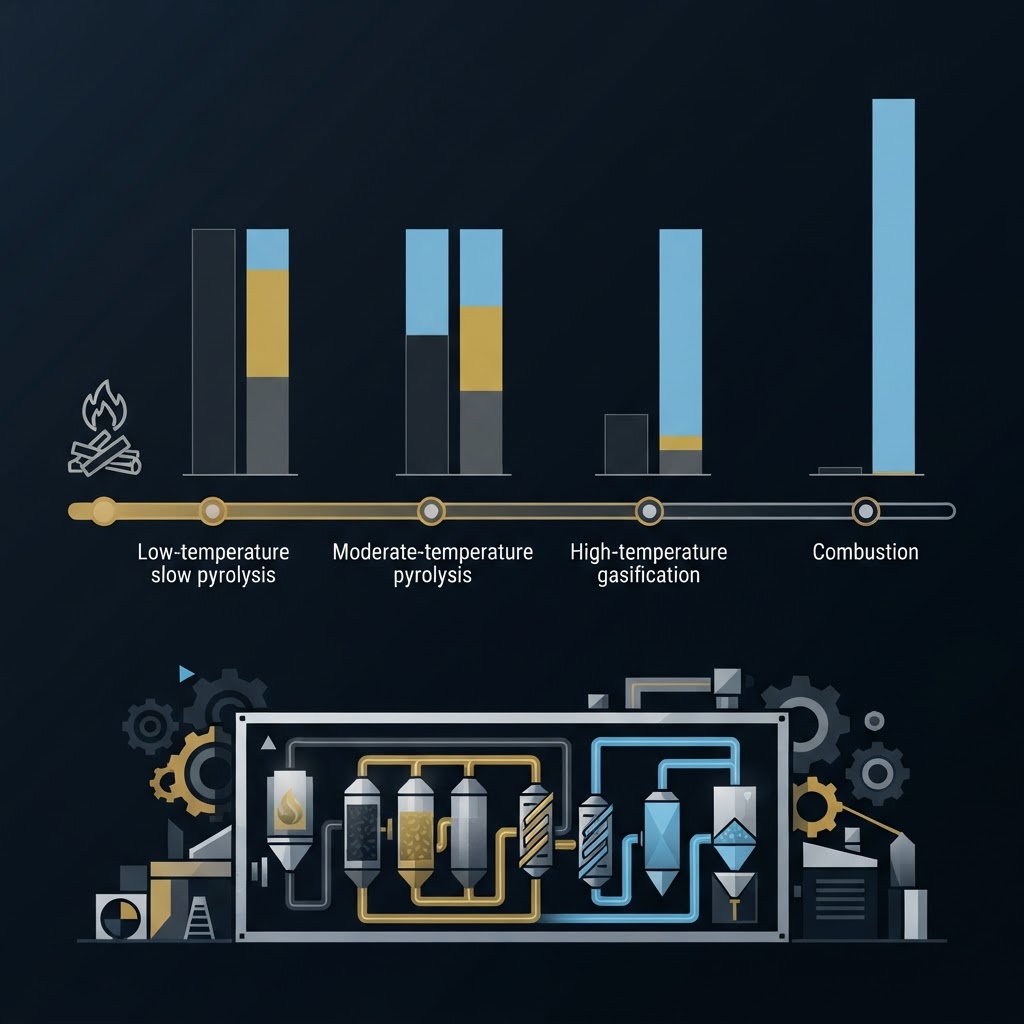
Here is the single table that explains most of the market. It comes from the same WSU chapter and compares the main thermochemical routes on wood.
| Process | Temperature | Reaction time | Main product | Biochar yield (wt %) |
|---|---|---|---|---|
| Slow pyrolysis | 300 to 800 °C | minutes to hours | biochar | 35 to 50 |
| Fast pyrolysis | 400 to 700 °C | seconds | bio-oil | 15 to 30 |
| Gasification | 750 to 1,000 °C | seconds | syngas | 5 to 10 |
| Combustion | 1,000 to 1,200 °C | seconds | heat | under 2 |
Read it as a slider. Move right and you trade char for energy.
Slow pyrolysis
This is the classic route when char is the product. A 2025 review in Sustainability describes slow pyrolysis as running at 300 to 650 °C with residence times from 5 minutes to 12 hours and heating rates of 10 to 30 °C per minute, and puts the solid fraction at 20% to 40% of total products. Different sources give different yield bands because feedstock and reactor design move the number so much. It tolerates large particles, down to wood chips and even logs, and it is what almost every biochar kiln and retort on the market does.
Fast pyrolysis
Fast pyrolysis heats small particles, generally under 5 mm, extremely quickly to maximise bio-oil. It is a fuel technology first. WSU makes a point most buyers miss: most commercial fast pyrolysis systems consume the biochar they make as fuel rather than recovering it. If you want char to sell or bury, a fast pyrolysis plant is usually the wrong starting point.
Gasification
Gasification adds a controlled amount of oxygen or steam at higher temperatures and aims at syngas, a mix of carbon monoxide, hydrogen and carbon dioxide. Char yields are low, and design matters: downdraft gasifiers produce engine-grade gas with biochar yields of 2% to 5%, while updraft gasifiers can reach up to 15%.
Two advantages make up for the lower yield. First, a comprehensive review of biochar technologies found gasification can process a wide range of biomass feedstocks because its operating conditions are flexible, and high-moisture biomass is practical only through gasification or hydrothermal carbonization. The same review notes that downdraft gasifiers running around 900 °C tend to leave final tar yields under 1 wt%. Second, the energy that a kiln vents is the product you sell. If you want the mechanics in more depth, we cover how waste gasification works separately.
Hydrothermal carbonization and torrefaction
Two routes sit outside the dry-heat slider. Hydrothermal carbonization cooks wet biomass in water at 180 to 300 °C for 1 to 16 hours, yielding 50% to 80% of a solid called hydrochar without drying the feedstock first. Torrefaction at around 290 °C keeps about 80% of the mass as a solid, but it is a mild roast that improves fuel properties rather than producing a stable, carbon-dense char.
What decides biochar quality
Yield is only half the story. A tonne of unstable, contaminated char is worth less than a smaller tonnage of clean, stable char.
Temperature
The US Forest Service's reactor review states the inverse clearly: biochar yield falls as temperature rises, because higher temperatures drive off more volatile matter. Pore volume and pH climb with temperature. The catch is polycyclic aromatic hydrocarbons (PAHs), which increase significantly above 750 °C, although the same review notes that gasification often reduces PAH levels in biochar compared with slow pyrolysis char.
Feedstock
Feedstock is the lever most buyers underestimate. High-ash feedstocks like rice husk behave differently from pine or wheat straw, and small differences in moisture shift surface area and PAH content. The USDA review also flags a hard boundary: several biochar standards and carbon registries exclude some feedstocks, including some manures and municipal sewage sludge, because contaminants make the char unsuitable for soil. That does not make sludge char useless. It changes what the char is for, a topic we cover in biochar from sewage sludge.
Stability
For char sold into soil or carbon removal markets, stability is measured by the hydrogen to carbon ratio. Certifiers require an H:C molar ratio below 0.7, and no machine can guarantee it: the ratio depends on feedstock and treatment temperature, not the brand on the reactor.
Scale: from a cone in a field to a continuous plant
Biochar production spans a remarkable range of hardware. At the bottom, a Kon-Tiki flame curtain kiln can make 500 kg of biochar in about three hours at 680 to 750 °C, with char meeting IBI and EBC quality standards. The cost is labor: the kiln is hand-fed for the whole burn. At the top sit continuous industrial plants with rotating drums and augers. Across the market, most systems convert 15% to 40% of dry biomass into biochar.
The spec that most changes operating costs at industrial scale is gas recirculation. Routing pyrolysis syngas back as process fuel cuts external fuel cost by 60% to 80%. Prices, labor and payback by tier are broken down in our guide to biochar production equipment.
Biochar production from waste: where gasification earns its place
Everything above assumes you are buying a machine to make char. There is a second model: you have a waste problem and an energy need, and biochar comes out of the machine you bought to solve them.
Char as a by-product that still pays
The USDA review notes that downdraft gasifiers are the most common gasification technology for small to medium scale biochar production. The char yield is lower than a kiln, but the machine earns on several lines at once. SynCraft, a gasification competitor, reports that its gasification biochar sells for around EUR 200 per tonne and that a single plant can trade roughly 600 tonnes of CO2 equivalent per year, on top of the electricity and heat it already sells. Whether those lines add up for your site is the question in is biochar production profitable.
What continuous operation on real waste looks like
Here is why we can write about this with operating data rather than a literature review. Zero-X's X-150 is a containerized fixed-bed downdraft gasification platform. In Paris, under the COMETHA project, it ran a 1,939-hour continuous campaign, 80 consecutive days, processing 16,382 kg of digestate pellets and producing syngas at 33% hydrogen with 99.98% tar conversion.
Digestate is exactly the kind of feedstock the kiln guides leave out. The platform is independently validated at COMETHA, Fraunhofer IKTS and Hochschule Zittau/Goerlitz on high-ash sewage sludge, municipal solid waste and digestate, feedstocks that clean-wood gasifiers cannot handle. Tar is where most small gasification projects fail, which is why gas cleaning gets its own treatment in our piece on tar removal from syngas. And in Zero-X target markets, governments fund 56% to 70% of project CAPEX, which changes the economics of a waste-fed plant more than char yield ever will.
Choosing a biochar production route
- Char is your product, feedstock is clean and dry: slow pyrolysis. Highest yield, simplest certification path.
- Fuel oil is your product: fast pyrolysis, and expect little recoverable char.
- Feedstock is wet: hydrothermal carbonization, or gasification with drying.
- You have a waste stream and need power or heat: gasification. Lower char yield, but multiple revenue lines and the widest feedstock tolerance.
- You want carbon credits: check registry feedstock rules before you pick a reactor, then design temperature around the H:C threshold. The market side, from prices to standards, is covered in this guide to biochar carbon credits.
The mistake we see most often is choosing the machine before answering whether biochar is the business or the bonus. Answer that, and the route picks itself.
FAQ
What temperature is biochar produced at?
Pyrolysis begins around 250 °C. Slow pyrolysis for biochar typically runs at 300 to 800 °C, fast pyrolysis at 400 to 700 °C, and gasification at 750 to 1,000 °C. Higher temperatures give less char but more stable char.
Which process gives the highest biochar yield?
Among dry thermal routes, slow pyrolysis gives the most char, around 35% to 50% by weight on wood. Hydrothermal carbonization reports 50% to 80% hydrochar, but from wet feedstock and as a different material.
Is pyrolysis the same as gasification?
No. Pyrolysis heats biomass without oxygen and can be tuned for char. Gasification adds a limited amount of oxygen or steam at higher temperatures and is designed to make syngas, with char as a smaller by-product.
Can any biomass be used for biochar production?
Most biomass can be converted, but not all char is saleable for the same use. Some biochar standards and carbon registries exclude certain manures and municipal sewage sludge as feedstocks, so that char needs a non-soil use or a different business case.
Available for advisory work, board seats and media appearances.
Julien Uhlig advises boards and funds and briefs newsrooms across Europe and North America. Enquiries are read personally.
We use cookies to improve your experience on this site. By continuing, you agree to our Privacy Notice.