Small Biomass Gasifier Price: What Each Tier Buys
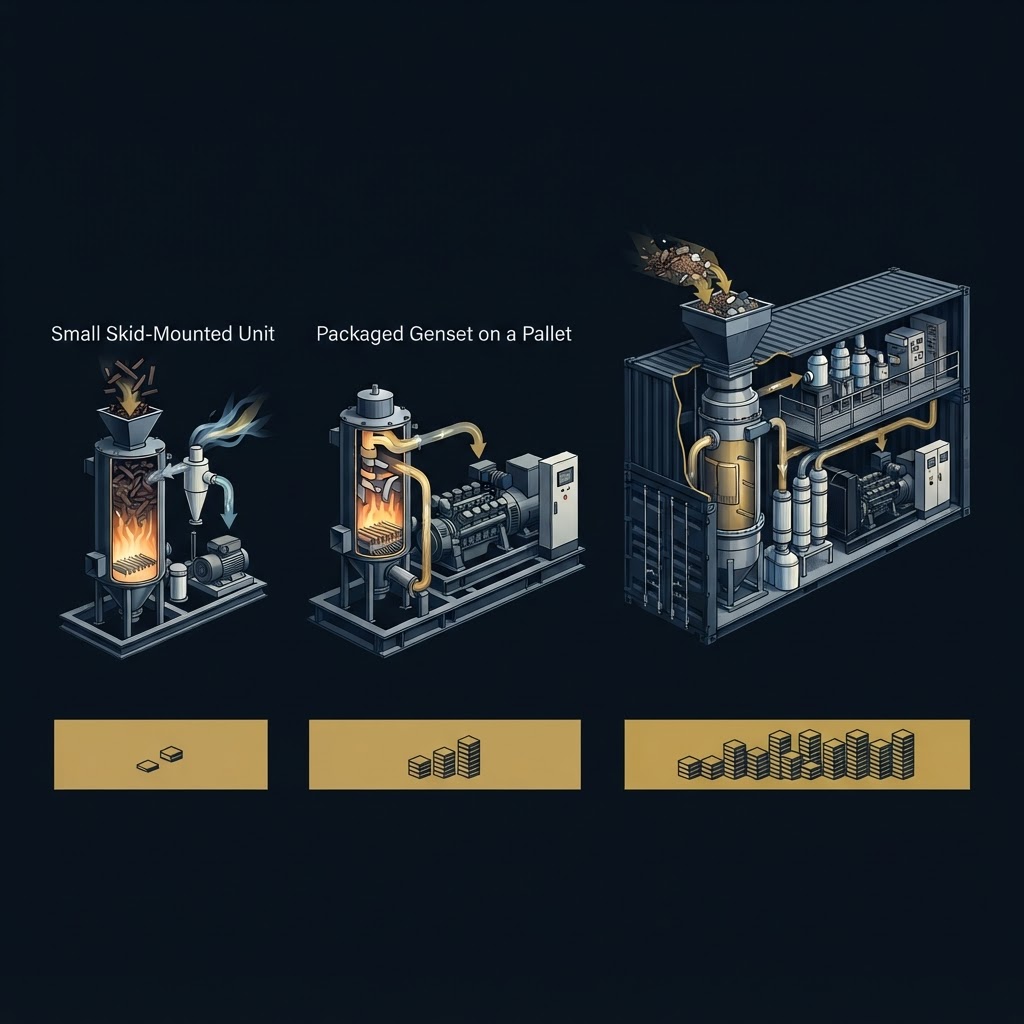
Search for a small biomass gasifier price and the first numbers you meet are four figures. A wood gasifier on a Chinese trade marketplace lists at US$1,949 per set for one to nine sets, falling to US$1,545 at ten sets and US$1,285 at fifty. Three clicks later a comparable machine in Europe is quoted at sixty thousand dollars. Both are real prices. They are not prices for the same thing, and no listing on the first page of results explains the difference.
This is the price ladder, tier by tier, in the units that let you compare rungs: dollars per installed kilowatt, and hours per year.
What counts as a small biomass gasifier
Sellers quote two different capacities and rarely say which one they mean. Thermal feed rate is how much biomass the reactor eats, in kilograms per hour. Electrical output is what comes out of the generator, in kilowatts electrical (kWe). A gasifier rated 6.5 kg/h and one rated 5 kW can be the same machine.
The conversion is close to one to one at this scale. All Power Labs publishes 1.0 kg/kWh of dry biomass for its 25 kW Power Pallet, with an electrical efficiency around 23% on woody biomass and startup in 10 to 15 minutes. So a 150 kg/h platform sits in a different class from a 15 kg/h one by an order of magnitude, even though both get called small.
Three bands cover almost everything on the market: kit-class units below roughly 30 kWe, packaged gensets from about 20 to 200 kWe, and containerized industrial systems built around continuous waste throughput. Prices behave differently in each.
The three price tiers you will actually be quoted
Tier 1: $1,000 to $12,000 for the reactor
At the bottom of the market a mini biomass gasifier is offered at US$1,000 to US$12,000 with a minimum order of one set. The published specifications are an 180 kg shipping weight, an 80 watt fan and a one year warranty. There is no rated electrical output, because there is no generator. This is a reactor body and a blower.
That is not a scam, it is a component. If you are a fabricator building your own gas cleaning train and coupling it to an engine you already own, it is a reasonable purchase. If you expected a power plant, the listing never promised one.
Tier 2: $20,000 to $200,000 for a packaged genset
The next rung is where most buyers actually land. An Indian manufacturer lists a 5 kW standalone downdraft unit at INR 630,000, consuming 6.5 to 7.5 kg/h, running at 1050 to 1100 degrees C, weighing 1.2 to 1.5 tonnes and needing a footprint of roughly 26 by 12 feet. A Chinese factory quotes US$20,000 to US$200,000 per set across a downdraft fixed bed family spanning 10 kW to 1000 kW and 15 to 1500 kg/h, which is a catalogue range rather than a price.
The reference product for the class is the Power Pallet. All Power Labs put the full featured version at approximately $2 per watt when it launched, with enclosure, grid tie and combined heat and power in the base machine. A later sales reply put equipment cost at approximately $65k, with a catalytic exhaust and an automated feed system at $5k each, a 10% deposit at order, a six month lead time, and no CE or UL certification at the time of writing. Those last two lines are price information. A six month lead time is working capital, and missing certification can be a hard stop on a European or North American site.
Tier 3: containerized systems, priced as projects
Above that band the number stops being a product price. A containerized platform sized for continuous waste throughput is quoted against a feedstock, a site and a permit, which is why Zero-X publishes no list price for the X-150. The platform is independently validated at Paris COMETHA, Verkoso (Fraunhofer IKTS) and Hochschule Zittau/Goerlitz on high-ash sludge, municipal solid waste and digestate, and what a partner buys is the machine plus process design, commissioning, the German OEM supply chain and the grant playbook. Compare that against what a full waste-to-energy plant costs rather than against a marketplace listing.
Cost per kilowatt goes up as the machine gets smaller
Most buyers assume a smaller unit is cheaper per kilowatt. The opposite is true, and the size of the effect is documented.
A Czech study surveyed 21 commercial small-scale gasification models from 10 to 200 kWel and found roughly EUR 6,000 per installed kWel below 30 kWel against roughly EUR 5,000 above it, inside an IRENA range of EUR 5,500 to 6,500 per kW for gasifier cogeneration. The same paper cites EUR 3,390 per kWel for an 11 MW unit in Portugal. Scale up by a factor of a hundred and the specific cost roughly halves.
More recent European quotations sit higher. A 2025 techno-economic study of a 225 kWel installation reports commercial quotations averaging about 8,200 EUR/kWel in 2022, or 8,657 EUR/kWel once indexed to 2023. Inflation in this equipment class has been real.
Why the engine and gas cleaning are half the bill
A capex survey across operating gasification plants separates the two scopes cleanly: total installed capital costs of EUR 1,965 to 5,235 per kW for fixed and fluidised bed gasifiers, against EUR 5,115 to 6,010 per kW once a CHP system is included. Adding the engine, the gas cleaning and the electrical balance of plant roughly doubles the number.
That single comparison explains the whole ladder. Tier 1 sells the left-hand figure. Tier 2 sells the right-hand one.
Manufacturing location moves the range too. A techno-economic model of small industrial plants in Pakistan puts average required capital investment at US$569 per kW, with a 100 kW corn-stover plant modelled at US$56,882 total investment. A European buyer will not see those numbers, but a Nigerian or Indonesian one might, and it is the honest bottom of the range.
The feedstock clause is the real price
Here is the clause that decides which tier you are even allowed to shop in. The PP30 sales reply is admirably specific about what the machine may be fed: wood chips and nut shells only, excluding peanut, pistachio and almond, moisture content under 30%, pieces between 1 and 4 cm, and never shredded, because stringy wood will not flow through the auger.
That is good engineering stated honestly. It is also a wall. If your feedstock is sewage sludge, mixed municipal waste, digestate, wet straw or empty fruit bunches, the kit tier and most of the packaged tier are not underpriced for your job. They are not offered for it. The Czech survey makes the same point from the other side: small fixed-bed units depend on high-quality fuel.
What sits between a difficult feedstock and a working machine is tar. Zero-X ran the X-150 for 1,939 hours continuously in Paris on 16,382 kg of digestate pellets, at 99.98% tar conversion and 33% hydrogen in the syngas. SyngaPure, the modular gas cleaning system with real-time tar, H2S, NH3 and particulate sensing that makes those hours possible, was selected for German BMWK go-inno support in December 2025. If you want the mechanism rather than the result, tar is what closes small gasifiers down.
Paying more for a reactor that eats your actual waste is not paying a premium. It is buying a different machine.
Operating hours decide the cost per kilowatt hour
The purchase price is the smaller half of the question. The 2025 Italian study found that yearly operating hours had a larger impact on levelized cost than biomass price or plant size, and it modelled 7,500 hours a year to get there. Its base case still landed at 388 EUR/MWh, which the authors call uncompetitive against photovoltaic plus storage.
Read that alongside the Power Pallet terms, which state batch operation of 8 to 20 hours a day and maximum continuous operation above 16 hours. A machine that stops every night cannot reach 7,500 hours. This is why an uptime figure belongs in a price comparison, and why 1,939 hours of unbroken operation on a difficult feedstock is a commercial claim and not a technical trophy.
The other lever is where the biomass comes from. The Pakistan model puts unit electricity cost at US$0.12/kWh on externally sourced biomass against US$0.07/kWh on onsite biomass. If you are already paying to dispose of the feedstock, the arithmetic changes again, which is the case for small-scale waste-to-energy systems at hotels, farms and processing plants.
The cost lines that sit outside the quote
Replacement cycles are the largest omission. A review of small-scale gasification power puts the installed first cost of a 96 kWe system at about $460/kWe, then shows that present value rises to roughly $800/kW over a 25 year period once the gasifier and engine are replaced every six years and the cleanup and control systems every ten. A separate estimate in the same review puts a then newly commercial system at about $1,200/kWe installed. Whichever you take, the purchase price is roughly half the lifetime equipment cost.
Then the site: civil works, fuel handling and drying, electrical connection, and the operator. None of that appears on a marketplace listing, and all of it is quoted per project. Anyone comparing gasifier generator packages on headline price alone is comparing the smallest line item in the budget.
What you actually pay after grants
The last number nobody in the search results publishes is the net one. Zero-X works in markets where governments fund 56 to 70% of project capex, with validated routes including 70% via IER in Cadiz and Andalusia, 60 to 72% via SICE in Alentejo, and 56% in Patras.
Run that against the European commercial benchmark. At 8,200 EUR/kWel, a 100 kWe installation is EUR 820,000 before support. At a 60% grant rate the developer funds EUR 328,000 of it. That does not make the technology cheap, and it does not turn an uncompetitive power-sales case into a good one on its own. It does mean the tier of machine that can win a grant is a different tier from the one you can buy with a credit card, because grants attach to projects, permits and feedstock contracts rather than to equipment. The mechanics of that are in our guide to government grants for waste to energy.
FAQ
How much does a 10 kW biomass gasifier cost?
No manufacturer publishes a clean price at exactly 10 kW, so build it from the benchmark: the sub-30 kWel band runs about EUR 6,000 per installed kWel in the European commercial survey, which puts a packaged 10 kWe system near EUR 60,000. An Indian 5 kW standalone unit lists at INR 630,000. Anything advertised at four figures for 10 kW is a reactor, not a system.
Why are Chinese biomass gasifiers so much cheaper than European ones?
Three reasons visible in the listings themselves. The price is quantity-tiered wholesale, falling from US$1,949 to US$1,285 as the order reaches fifty sets. The scope is the reactor rather than gasifier plus gas cleaning plus engine, and that scope difference alone roughly doubles the per-kW cost. And there is no CE or UL certification burden priced in.
Can a small gasifier run on any kind of biomass?
No, and the good manufacturers say so in writing. The restrictions on the reference product are wood chips and nut shells under 30% moisture, sized 1 to 4 cm and not shredded. Wet, ashy or mixed waste needs a reactor and a gas cleaning train designed for it, which is a different purchase rather than a bigger version of the same one.
Is a small biomass gasifier cheaper than diesel?
It depends entirely on the feedstock. The Power Pallet one-sheet compares gasified biomass at $0.00 to $0.06/kWh against diesel, LPG and gasoline at $0.25 to $0.75/kWh, but that assumes the biomass is free at the gate. The Pakistan modelling shows the gap between US$0.07/kWh on onsite biomass and US$0.12/kWh once you buy and haul it. Model your own feedstock cost before assuming a saving.
Can grants pay for a small gasifier?
In several European markets public programmes fund a majority share of project capex, at 70%, 60 to 72% and 56% in the routes named above. They fund projects rather than machines, so a unit bought off a marketplace and installed without permits, a feedstock contract and an engineering package is generally outside the scope of the programmes that would have paid for most of it.
Available for advisory work, board seats and media appearances.
Julien Uhlig advises boards and funds and briefs newsrooms across Europe and North America. Enquiries are read personally.
We use cookies to improve your experience on this site. By continuing, you agree to our Privacy Notice.