Biochar Phosphorus: Source, Sorbent, or Locked Away?
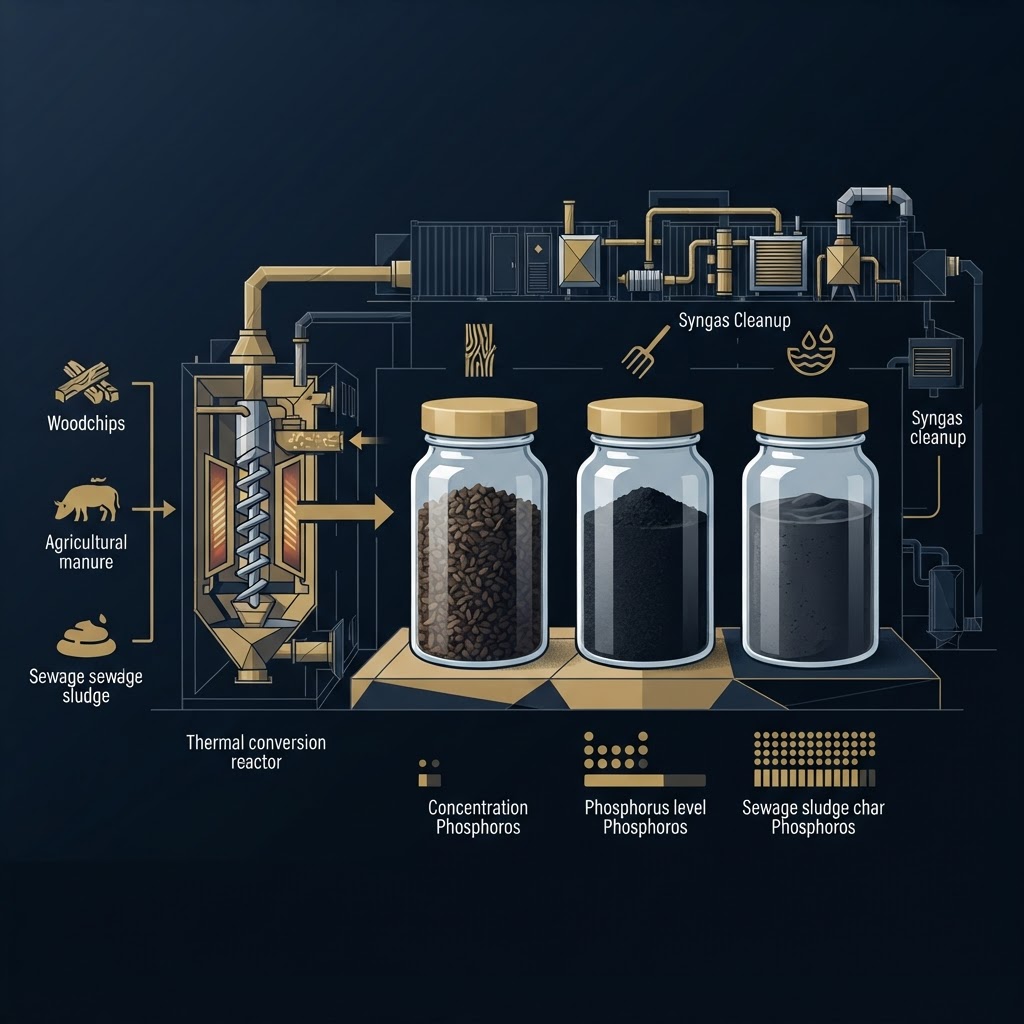
Search for biochar phosphorus and you get soil-science reviews that treat biochar as one material. It is not. A char made from pine chips and a char made from iron-dosed sewage sludge have almost nothing in common when it comes to phosphorus, and the difference decides whether your solid residue is a fertiliser feedstock or a disposal cost.
Our X-150 gasifier is built for the feedstocks most of the literature avoids: high-ash sludge, municipal waste and digestate. So this guide is written for the person who has to decide what that char is worth. Short version: biochar can carry phosphorus, capture phosphorus and free up phosphorus already in soil. Sludge char carries a lot of it. Most of that phosphorus is locked away until you do something about it.
Biochar does three different things with phosphorus
Every claim you read about biochar and phosphorus belongs to one of three roles, and mixing them up is how bad business cases get written.
- Source. The char itself contains phosphorus from the feedstock, and some fraction of it reaches the plant.
- Sorbent. The char captures phosphate from water or soil solution and holds it.
- Soil P shifter. Added to soil, the char changes pH, cation balance and microbial activity, which can release phosphorus the soil already had but could not give up.
The second and third roles look contradictory, since one captures phosphorus and the other releases it. They are not. A 2025 review in Biochar describes a dynamic adsorption and desorption equilibrium: biochar holds phosphate when soil solution is rich and releases it when the soil runs low, which is why it behaves like a slow-release fertiliser. The same review cites a meta-analysis of 124 studies that found biochar raised available phosphorus by 45% and microbial biomass phosphorus by 48%.
How much phosphorus is in biochar
Feedstock decides almost everything
Most biochar carries very little. A Chemosphere study on biochar phosphorus fertilisers puts the phosphorus content of typical biochar below 1%, with manure char the exception at 2.6 to 13.5% as P2O5. For scale, commercial triple superphosphate is over 46% P2O5.
The other end of the range is bone. A Geoderma study on biochar and soil phosphorus reports 152.0 g/kg total phosphorus in bone char, of which only 6.6 g/kg was water-extractable. Total content and available content are different numbers, and that gap is the theme of this article.
Researchers now group the high end as "P-rich char": a 2024 review of phosphorus-rich biochar and hydrochar defines it as 1 to 8% phosphorus, against typically less than 0.5% for unmodified char.
Sewage sludge sits on the rich side. Municipal sludge contains up to 2.5% phosphorus on a dry basis, and because carbon, hydrogen and oxygen leave during heating while phosphorus stays, the char concentrates it. One slow pyrolysis trial at 450 °C measured total phosphorus 77% higher in the char than in the dried sludge, with available phosphorus three times higher. For the full mass balance and the metals that concentrate alongside the phosphorus, see our guide to biochar production from sewage sludge.
Temperature moves availability, not just content
The same Geoderma study cites woody char with 23 g/kg Olsen phosphorus when made at 500 °C, against only 1.2 g/kg from the same feedstock at 300 °C. Process conditions are a phosphorus lever, not a footnote. Hold that thought for the sludge section, where the direction is less friendly.
How much of that phosphorus can a plant use
Here is the number most product sheets leave out. The European Biochar Certificate guidelines state that only about 15% of the phosphorus in biochar is plant-available in the first year, against roughly 1% for nitrogen and up to 50% for potassium. The rest returns to the biological cycle slowly, over years to decades.
The indirect effect on soil is bigger. A meta-analysis of 516 data pairs from 86 studies found that biochar raised soil available phosphorus by 65% and plant phosphorus uptake by 55% on average. The effect was strongest with manure char, char made below 300 °C, soils with pH under 5, fine-textured soils and soils very low in phosphorus. In other words, acidic, phosphorus-starved clay is where biochar earns its keep.
It does not work everywhere. A meta-analysis of 74 datasets on inorganic phosphorus fractions found that wood-residue char with a C/N ratio above 200 did not significantly raise the labile phosphorus fractions at all. If your char is clean wood, sell it on carbon and soil structure, not phosphorus.
Biochar as a phosphate trap, then a fertiliser
The sorbent role is where the most interesting phosphorus numbers sit. Plain biochar is a modest sorbent: the Chemosphere study cites 4.3 to 5.3 mg P/g for sugar cane and Miscanthus char. Load the char with magnesium and the picture changes.
- A magnesium-modified corn char reached a maximum of 239 mg P/g and kept releasing phosphorus slowly after use.
- An MgO-impregnated char from 2025 adsorbed 189.90 mg/g, released 59.02% of it into soil within 35 days, and raised bok choy dry weight by 131.58% over the unfertilised control.
- A magnetic MgO char recovered more than 99.5% of phosphate from solution at 121.25 mg P/g.
The result that matters for waste owners: a Brazilian team made magnesium-impregnated chars from poultry litter, pig manure and sewage sludge, loaded them with phosphate, and grew maize. The phosphorus-loaded chars produced plant growth and phosphorus accumulation similar to or greater than triple superphosphate. That closes a loop: waste becomes char, char cleans phosphate out of water, the loaded char goes back on the field. Our sister company Energaia covers the wider question of what biochar removes from wastewater, including the pollutants it does not.
Sludge char: the iron problem
Now the part the reviews bury. Most wastewater plants strip phosphorus with iron or aluminium salts. That phosphorus ends up in the sludge, then in the char, as iron and aluminium phosphates. A 2026 Technion comparison of manure and sludge chars and ashes found manure products dominated by apatite phosphorus, while sludge products were dominated by iron and aluminium phosphates and showed lower plant-available phosphorus. The phosphorus is there. The plant cannot get to most of it.
Pyrolysis, gasification and incineration compared
A Danish team ran the same municipal sludge through pyrolysis, gasification and incineration and compared the residues side by side, which nobody in the consumer SERP has done. In their incubation study, the two pyrolysis chars reached about 50% of the extractable phosphorus of a mineral fertiliser reference. The gasification ashes managed about a third of that level. Their verdict: residue quality cannot be predicted from the process category alone, because heating rate, retention time and atmosphere matter as much as temperature.
It gets starker with iron. In pot trials with spring barley, ash from low-temperature gasification of wheat straw reached 44% of the effectiveness of mineral phosphorus after six weeks. Ash from gasifying Fe-rich sewage sludge had a phosphorus fertiliser value of practically zero.
As a gasification company, we would rather you read that here than discover it after commissioning. A gasifier turns sludge into energy and a sanitised, much smaller solid. It does not, on its own, turn iron phosphate into plant food.
Three fixes that work
The good news is that the same research shows how to unlock it.
- Post-oxidation and grinding. A Roskilde study found that oxidising chars and gasification ashes after the process, and reducing particle size, increased plant phosphorus uptake by up to 60%. Oxidation of poorly soluble iron phosphates appears to drive it.
- Co-feeding. In low-temperature gasification trials at 100 kW and 6 MW, co-gasifying sludge with straw produced ashes with more phosphorus and potassium, less cadmium, and better plant phosphorus availability than mono-sludge ashes.
- Chlorine additives. Adding chlorides during sludge pyrolysis at 700 °C raised phosphorus solubility in neutral ammonium citrate from 40.08% to between 72.07% and 76.57%, while stripping much of the zinc, copper and lead. Magnesium chloride performed best because it formed magnesium phosphate.
What this means for a gasifier operator
The X-150 is a fixed-bed downdraft gasifier, validated on high-ash sludge, municipal waste and digestate, the feedstocks clean-wood gasifiers cannot handle. In the Paris COMETHA campaign it ran 1,939 hours and processed 16,382 kg of digestate pellets. We have not published phosphorus availability figures for that char, so we will not quote any. What the research says, and what we tell partners, is this: treat the char as a phosphorus intermediate, test it with a plant-availability method rather than total P, and design the oxidation, co-feed or downstream recovery step in from the start. Our pages on sewage sludge gasification and biochar from a gasifier cover the process side, and biosolids gasification covers the treated-sludge case.
What you are allowed to call it
The EBC requires phosphorus to be declared for every certification class. Sludge char has a bigger problem: the EBC restricts sewage sludge as a feedstock and recommends the Basic Materials class, which cannot go on soil. Sludge char is approved for agricultural use in some countries, including Czechia, Sweden, Italy, Denmark, Estonia, the UK, Norway, Israel and Australia. In Germany, making char does not by itself satisfy the sludge ordinance; our guide to phosphorus recovery from sewage sludge explains what does.
Five questions before you bank on phosphorus revenue
- How does the plant precipitate phosphorus? Iron or aluminium dosing means locked phosphorus unless you treat it.
- What are the temperature, atmosphere and retention time? They move availability more than the process label does.
- Is there a post-oxidation step? It is the cheapest proven lever on availability.
- What else goes in the reactor? Straw or other biomass can improve both phosphorus availability and metal content.
- Which test is on the spec sheet? Total phosphorus tells a buyer almost nothing. Ask for water, citrate or ammonium citrate extractable phosphorus, or better, a pot trial.
FAQ
Does biochar bind phosphorus so plants cannot get it?
Usually not for long. Phosphate held on biochar is largely reversible and desorbs as soil phosphorus drops, so it acts as a slow-release pool. One exception: in soils with repeated freeze and thaw, biochar amendment increased phosphorus desorption and loss risk, so researchers advise against applying it during snowmelt.
Can biochar replace phosphate fertiliser?
Not tonne for tonne. Most char holds under 1% phosphorus against more than 46% P2O5 in triple superphosphate. Engineered, phosphate-loaded char is the exception: in maize trials it matched or beat superphosphate on phosphorus uptake.
Which biochar has the most phosphorus?
Bone char, at 152 g/kg total phosphorus, followed by manure char. Sewage sludge char is also rich, though much of its phosphorus is bound to iron and aluminium. Clean wood char has the least.
Is phosphorus in gasification ash the same as in biochar?
Not in practice. The phosphorus starts the same, but process conditions change its form. In head-to-head tests on the same sludge, gasification ashes released less plant-available phosphorus than pyrolysis chars unless they were post-oxidised.
We use cookies to improve your experience on this site. By continuing, you agree to our Privacy Notice.