Syngas Engine: Spark, Dual-Fuel and Diesel Conversions
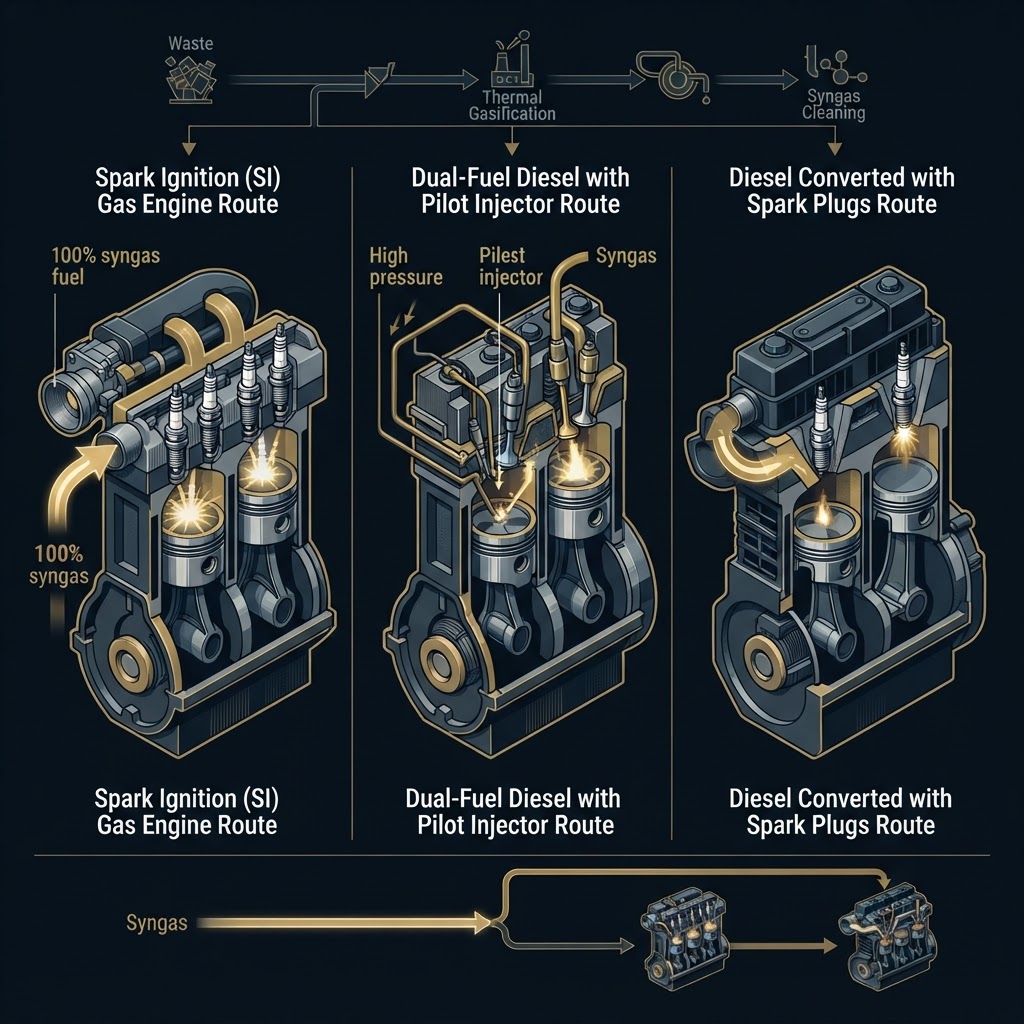
A syngas engine is any piston engine that runs on the gas coming out of a gasifier. That covers three very different machines: a purpose-built spark ignition gas engine, an ordinary diesel running in dual-fuel mode, and a diesel stripped of its injectors and converted to spark ignition. All three work. They lose different amounts of power, need different hardware changes and fail in different ways when the gas is dirty.
Most of what ranks for this topic is either an engine maker describing its own product or a review paper comparing combustion models. This guide does the job in between: it puts the three routes side by side with measured numbers, then looks at the problem that decides engine life in practice, which is tar. If you need the plant-level picture (gas limits, heat recovery, CHP economics), that lives in our guide to syngas CHP. This page is about choosing the engine.
What a syngas engine is
Gasifier gas is a mix of hydrogen, carbon monoxide, carbon dioxide and, in air-blown units, a lot of nitrogen. The exact recipe depends on feedstock and process, as our syngas composition guide shows. Two properties make it awkward engine fuel.
First, it is thin. A 2020 review in Applied Energy concludes that the drop in volumetric efficiency is the main reason for lower power: syngas is low in density and needs a high air-to-fuel ratio, so each intake stroke carries less energy. The same review names the fixes, direct injection of the gas or a supercharged engine.
Second, it is fast. Hydrogen burns much faster than methane, and Clarke Energy, the Jenbacher distributor, warns that without countermeasures this causes pre-ignition, knock and backfire. The distinction between engineered syngas and older syngas versus producer gas matters here: the more hydrogen in the gas, the more this second problem dominates.
The FAO's classic manual on gas engines lays out the three engine routes: spark ignition engines can run on the gas alone, diesels can be converted to full gas by lowering the compression ratio and adding a spark system, or an unconverted diesel can run dual-fuel.
Route 1: spark ignition gas engines
This is the industrial standard. Gas engines are already built for gaseous fuel, and the FAO notes that their standard compression ratios of around 10 to 11 make them especially suited to gasifier gas.
How much power you lose
The answer depends on who you ask and what gas they tested. A 2025 review in Energies found that spark ignition engines can replace up to 100% of conventional fuel with syngas, typically at 20 to 30% reduced power. Clarke Energy quotes a wider loss for commercial engines: output typically falls to 50 to 70% of the natural gas rating, so an engine rated at 1,063 kW on natural gas delivers about 730 kW on syngas. Its syngas engines run from several hundred kilowatts to multi-megawatt installations.
The FAO manual adds two cheap gains. A properly designed gas and air mixer can raise maximum output by 10 to 15% over a basic pipe mixer, and because gasifier gas burns slowly at low hydrogen content, ignition should be advanced by 10 to 15 degrees to about 35 to 40 degrees before top dead centre. On a petrol engine without a turbo, the FAO puts the loss at about 30% once those changes are made, and says a turbocharged or supercharged engine can match its petrol output. The syngas heating value of your gas sets where you land in that range.
Hydrogen, knock and backfire
Hydrogen cuts both ways. It speeds up combustion and improves lean running, but it also raises knock risk. The Applied Energy review describes how GE designed the Jenbacher engine to run on very lean syngas and air mixtures specifically to avoid pre-ignition, knock and backfire, and lists flame arrestors among the features that guard against backfire. If you buy a gas engine for syngas, the engine maker must approve your gas analysis, not just your heating value.
Route 2: dual-fuel diesel engines
A dual-fuel engine is a normal diesel that breathes a mix of air and syngas through its intake. The diesel injector still fires, but only a small pilot shot to ignite the charge. Its big advantage, in the FAO's words, is flexibility: an engine drawing between 0 and 90% of its output from gas can switch to full diesel at once if the gasifier fails or the biomass runs out.
Diesel substitution in practice
The FAO puts dual-fuel derating for direct injection diesels at 15 to 20%, running on 80% gasifier gas and 20% diesel. The Applied Energy review reports a much wider literature range, with diesel replacement anywhere from 30% to 90%. The Energies review says compression ignition engines generally need a pilot fuel of 10 to 20% of total energy.
Field data from Sweden backs the FAO figure. A Scania D8 truck converted for dual fuel ran more than 91,500 km on wood gas and diesel with about 80% diesel substitution. To stop knocking, the testers cut the compression ratio from 16.5:1 to 15.9:1 with an extra copper shim under the cylinder head and advanced injection to 35 degrees before top dead centre.
The pilot fuel limits
Not every diesel qualifies. The FAO warns that prechamber and swirl chamber diesels run compression ratios too high for dual fuel and will knock, while direct injection engines usually convert well. Pilot fuel has limits on both sides: above roughly 30% of maximum output, extra diesel triggers detonation, and below a minimum of 3 to 5 cubic millimetres per cycle the charge will not light. The FAO recommends 8 to 9 cubic millimetres per cycle per cylinder to stay safe.
Route 3: diesel converted to spark ignition
Converting a diesel to run on gas alone means fitting spark plugs in place of injectors and lowering compression. It removes the diesel bill completely and gives you the robust bottom end of an engine designed for thousands of hours. The price is power.
A team at the University of Modena converted a 4.5 litre FPT diesel and fed it from a wood chip downdraft gasifier. Maximum output fell from 49.7 kW to about 22 kW, because the air and syngas mix carries less energy and density than diesel and air. Mechanical efficiency stayed at about 30% on either fuel, and emissions were much lower on syngas. The authors cite a compression ratio limit of 17 to avoid knock and needed spark timing between 0 and 15 degrees before top dead centre, far later than a slow producer gas would need, because hydrogen speeds up the flame.
Small packaged units show what the whole chain delivers. Measurements on the ECO 20, a 20 kWe and 40 kWth micro cogeneration unit, found syngas with a lower heating value of 3,731 kJ/Nm3, engine electrical efficiency of no more than 22.5% and a global plant electrical efficiency of about 13.5%. The biggest loss was in the gasifier, not the engine.
Side by side: which syngas engine for which project
| Route | Typical power loss | Hardware changes | Diesel fallback | Best fit |
|---|---|---|---|---|
| Spark ignition gas engine | 20 to 30% (Energies review) up to 30 to 50% (Clarke) | Gas mixer, ignition advance, knock and backfire protection | No | Continuous industrial power and CHP, hundreds of kW and up |
| Dual-fuel diesel | 15 to 20% at 80% gas (FAO) | Gas mixer on intake, injection advance, pilot limit, sometimes lower compression | Yes, instantly | Sites that cannot afford downtime, remote and island grids |
| Converted diesel | About 55% in the Modena test | Spark plugs, lower compression, ignition system | No | Small gensets where diesel supply is the problem |
Commercial suppliers sell both main configurations. Gasification supplier AHT CleanTec, for example, offers CHP units with pilot fuel and units with spark ignition, and claims over 40% electrical efficiency for its own units. For the small packaged genset class and what it can run 24/7, see our gasifier generator guide.
Tar is what kills syngas engines
Every route above assumes clean gas. Real gasifiers make tar, and our guide to tar formation explains why it never fully goes away. The engine pays for it.
The most honest record we know comes from a British government lab test of a 20 kW producer gas engine. Running on uncarbonised fuel in downdraft reactors, the cylinder head had to come off every 50 to 100 hours to scrape tar from the inlet manifold, valves and piston crowns; the longest run without it was 124 hours. On charcoal it reached 360 hours. After 855 cumulative hours, a piston ring failed and burned a piston crown, traced to ring sticking from tar carry-over. Each head job took a full working day.
The Swedish vehicle programme reported its own interval: cleaning the gas cooler and inlet manifold every 500 hours, and more often after a filter failure. That is the gap between a weekend project and a power plant. The fix is upstream: tar removal from syngas and a proper syngas cleaning train sized for your feedstock, not for clean wood.
This is the problem Zero-X built SyngaPure for. Our modular cleaning system monitors tar, H2S, ammonia and particulates in real time with AI control, and was selected for support under the German BMWK go-inno programme in December 2025.
What hydrogen-rich, nitrogen-free syngas changes
Both of the engine's core problems, thin gas and inconsistent combustion, come partly from nitrogen. Air-blown gasifiers dilute every cubic metre of gas with it. Oxy-steam gasification removes it.
In the COMETHA campaign in Paris, the Zero-X X-150 ran 1,939 hours continuously on digestate pellets in oxy-steam mode, producing syngas with 33% hydrogen, an H2/CO ratio of 1.95:1, 99.98% tar conversion and zero nitrogen ballast. Measured against the literature, that hydrogen level sits inside the 15 to 35% range the Energies review links to better ignition stability and lean running, and the review warns that many engine studies use synthetic gas above 50% hydrogen that real gasifiers do not make.
To be clear about what this does and does not prove: the COMETHA numbers describe the gas, not an engine test. More hydrogen also means more knock risk, so any engine running on X-150 syngas has to be specified and approved for that composition. What it changes is the starting point. A gas with almost no tar and no nitrogen gives the engine designer far more room than raw air-blown gas does.
Checklist before you pick a syngas engine
- Get a gas analysis at the engine inlet, after cleaning, on your real feedstock. Hydrogen, CO, nitrogen, heating value and tar.
- Decide if you need diesel fallback. If downtime costs more than diesel, go dual-fuel.
- Size on derated output, never nameplate. Use the loss range for your route from the table above.
- Check the engine type before converting a diesel: direct injection, not prechamber.
- Agree ignition timing and compression with whoever commissions the engine.
- Budget the maintenance interval in your O&M plan. If the gas cleaning cannot hold the tar spec, the head-off interval will set your real availability.
FAQ
Can a petrol engine run on syngas?
Yes. A spark ignition petrol engine can run on gasifier gas alone with a gas mixer and advanced ignition. The FAO expects about 30% less power from a naturally aspirated engine, while a turbocharged or supercharged one can match its petrol output.
How much wood does a dual-fuel engine need to replace diesel?
In the Swedish truck trials, it took about 3.6 kg of wood chips to replace 1 kg of diesel, which put the practical efficiency of the gasifier system at about 71%.
Why will some diesel engines not run on syngas?
Prechamber and swirl chamber diesels have compression ratios too high for dual-fuel operation. Combined with the slower ignition of gasifier gas, that produces knock. Direct injection diesels have lower compression and usually convert well.
Is a syngas engine less efficient than a diesel?
Not mechanically. In the Modena conversion, mechanical efficiency stayed at about 30% on both fuels. The engine makes less power because the fuel mix carries less energy per stroke, and the gasifier adds its own losses before the gas reaches the engine.
We use cookies to improve your experience on this site. By continuing, you agree to our Privacy Notice.