Carbon Negative Hydrogen From Waste: When It Holds
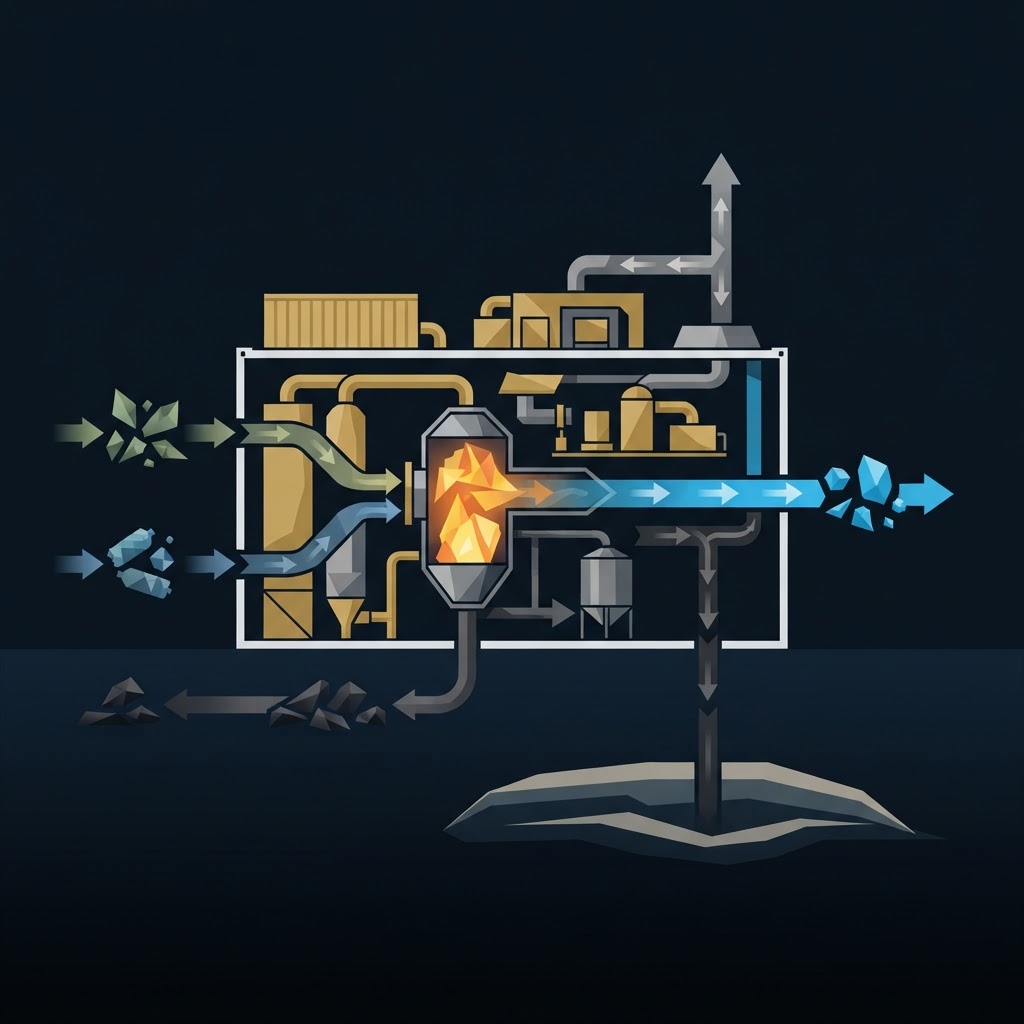
"Carbon negative hydrogen from waste" is one of the boldest lines in the hydrogen market. One developer has promised carbon-negative green hydrogen from non-recyclable waste at zero or below-zero cost. EU research projects put the phrase in their titles. Some of these claims will survive an audit. Many will not.
We build and run waste gasifiers, so we have a bias, and we will state it plainly: a reactor alone does not make hydrogen carbon negative. Three things outside the reactor decide it. This article walks through those three conditions, the published numbers, how EU rules now score the claim, and the questions to ask before you repeat it in a pitch deck.
What carbon negative actually means for hydrogen
Carbon negative means that across the whole life cycle, from collecting the waste to delivering the hydrogen, more CO2 is permanently taken out of the atmosphere than is put into it. Low-carbon is not enough. Carbon neutral is not enough. The balance has to go below zero and stay there.
The US Department of Energy's gasification programme is blunt about how you get there: to reach zero or negative life-cycle emissions, some degree of carbon capture must be implemented. Feeding cleaner waste lowers the footprint. Only removing carbon and keeping it out of the air takes it below zero.
That leaves three conditions. All three have to hold at once.
Condition 1: the carbon in the waste has to be biogenic
Waste carbon comes from two places. Biogenic carbon (food, paper, wood, garden waste, sewage sludge) was pulled out of the air by plants within the last few years. Fossil carbon (plastics, synthetic textiles, rubber) came out of the ground. When biogenic carbon is captured and stored, the atmosphere ends up with less CO2 than before. When fossil carbon is captured and stored, the best you get is a smaller increase.
The IPCC's default values make the split stark. Its waste guidance assigns 100 percent fossil carbon to plastics, 1 percent to paper and cardboard, 20 percent to textiles and none to food, wood or garden waste.
Why plastic-rich waste starts in the hole
Mixed municipal waste sits in between. The IPCC's incineration guidance puts the fossil share of CO2 from municipal waste at 33 to 50 percent. Measurements at three Swedish plants found fossil carbon at 31, 48 and 38 percent of total carbon, and the plant with the most plastic had by far the highest fossil emissions.
The practical rule: the more plastic in the feed, the more CO2 you have to store just to get back to zero. This is why our article on plastic waste to hydrogen fuel treats it as a waste solution first and a climate solution second.
Feeds like sewage sludge and digestate sit at the other end. Digestate is the residue of anaerobically digested organic waste, and sludge comes from the same biological cycle, so their carbon is overwhelmingly biogenic. Our longest run so far used exactly that kind of feed: a 1,939-hour continuous X-150 campaign in Paris processing 16,382 kg of digestate pellets, producing syngas with 33 percent hydrogen. For the full case on that feedstock, see hydrogen from sewage sludge.
Condition 2: the carbon has to be stored, not just captured
Gasification has a structural advantage here. The same DOE programme notes that the CO2 in syngas is much more concentrated and pressurised than in the flue gas of an incinerator, which makes it easier to separate. After the water-gas shift step that turns carbon monoxide into extra hydrogen, a waste-to-hydrogen plant is left with a fairly clean CO2 stream. What happens to that stream decides everything.
CO2 to geological storage
Pipe it into permanent geological storage and the biogenic part counts as removal. The EU's methodology subtracts this as a separate term, net savings from carbon capture and storage, in its emissions formula for low-carbon fuels. The German HyBECCS work frames negative emissions from organic waste the same way: biohydrogen production with carbon capture and storage.
Carbon locked in solid char
The second route keeps carbon in solid form. A UK project funded under the government's Hydrogen BECCS programme designed a plant producing 191 kg/h of hydrogen and 547 kg/h of carbon black, with net-negative emissions of 0.805 t/h. The report is clear that the negative figure depends on what happens to the char and carbon black, such as use in cement and concrete or inert underground storage, and that the system had not yet been demonstrated in an operational environment.
Gasifiers that leave a char or biochar residue, ours included, have this route available in principle. It only counts if the char is used or stored where its carbon stays put, and someone can prove it. How long that is depends on the char itself; the Energaia Institute covers how long biochar stores carbon in detail.
Why selling the CO2 is a different story
Many projects sell captured CO2 instead of storing it. The EU-funded CARMA-H2 project plans to make 500 kg/day of hydrogen and over 4,000 kg/day of food-grade CO2 from biogas at a wastewater plant in Navarra. That is a sound business and a real efficiency gain. But CO2 that goes into drinks or greenhouses is released again when the product is used. The EU formula only credits utilisation when the carbon is permanently chemically bound in long-lasting products. Captured is not the same as stored.
Condition 3: you count what the waste would have done otherwise
The third lever is the counterfactual. If the waste would otherwise have rotted in a landfill and released methane, or been burned in an incinerator, a waste-to-hydrogen plant can claim the avoided emissions. The independent DNV life cycle assessment behind Plagazi's process lists avoided emissions from landfilling or incinerating non-recyclable waste next to permanent CO2 storage as the reasons its hydrogen can reach net-negative.
The EU formula has a term for this too: emissions from the input's existing use or fate. It is legitimate. It is also the most assumption-sensitive number in any LCA, because it depends on what you say would have happened to the waste. A landfill without gas capture makes a project look far better than a modern incinerator with energy recovery. Ask to see the baseline.
What the published numbers say
The studies that do report a negative balance all combine biogenic feed with capture:
- Organic municipal waste, modelled for Stockholm. A process chaining anaerobic digestion, pyrolysis, reforming and pressure swing adsorption obtained 72.2 kg of hydrogen and 701.47 kg of negative CO2 equivalent per tonne of dry organic waste. Counting the negative emissions as income lifted the internal rate of return from 13 to 26 percent.
- Biomass co-gasification with capture. An integrated design with carbon capture, heat recovery and in-plant power reached -323.55, -465.84 and -68.28 kg CO2 eq for biomass, biomass with LDPE and biomass with coal. The authors name process energy requirements as the key driver of both emissions and cost.
- Mixed plastic waste at commercial scale. Plagazi's Gävle plant is designed to process 74,000 tonnes of mostly mixed plastic waste a year and capture up to 160,000 tonnes of CO2, backed by a EUR 29.5 million EU Innovation Fund grant. With a fossil feed, that capture is what does the heavy lifting.
Two of these are models and one is a plant under development. None is a multi-year operating record. The International Energy Agency's greenhouse gas programme frames the near-term case as waste to low-carbon, CCS-abated hydrogen, which is a more cautious target than carbon negative.
How EU rules treat hydrogen from waste
Europe now has a hard line for low-carbon hydrogen. Under the Gas and Hydrogen Market Directive, it has to deliver at least 70 percent emissions savings against a fossil comparator of 94 gCO2eq/MJ, a cap of 28.2 gCO2eq/MJ on a full life-cycle basis. That corresponds to 3.38 kg CO2e per kg of hydrogen.
The methodology, adopted on 8 July 2025, explicitly addresses feedstocks that already include a biogenic share from the outset, such as mixed municipal waste. Depending on the feedstock, waste hydrogen may be classified as a biofuel or a recycled carbon fuel, which is how Plagazi's LCA describes its own case. In other words, regulators already split your waste into its biogenic and fossil parts. Your carbon claim should do the same.
Note what the rules do not do: they define low-carbon, not carbon negative. "Carbon negative" remains a project claim, and its credibility rests on the LCA behind it.
Where the claim breaks
From the sources above, the claim usually fails in one of five places:
- Plastic-heavy feed. Fossil carbon cannot become removal, only reduced emissions.
- Capture without storage. CO2 sold for short-lived uses is a delay, not a removal.
- No CCS yet. Many projects are "CCS-ready", which means the negative number is a future scenario.
- Energy inputs. Grid electricity, oxygen production and compression add emissions that can erase a thin margin.
- Generous baselines. Assuming the worst landfill as the alternative inflates the avoided-emissions credit.
Here is our own honest position. The X-150 is a 150 kg/h fixed-bed downdraft gasifier that turns sludge, municipal waste and digestate into syngas, hydrogen and biochar. In the Paris campaign it ran in oxy-steam mode with zero nitrogen ballast, which leaves a syngas without nitrogen dilution and is the kind of gas that is easier to separate. But our units do not run carbon capture and storage today, and we do not call our hydrogen carbon negative. What we can say is that on a biogenic feed the machine produces the two streams a carbon negative project needs: a concentrated gas and a solid char. Whether those become removal depends on storage and accounting that sit downstream of us. For how much of the waste's energy actually reaches the hydrogen, see our breakdown of waste to hydrogen efficiency.
A checklist before you repeat the claim
If a developer, supplier or partner tells you their hydrogen from waste is carbon negative, ask:
- What share of the feed carbon is biogenic, and was it measured or assumed?
- Where does the captured CO2 go, and for how long does it stay there?
- If char is part of the claim, where is it used or stored, and who verifies it?
- What baseline was used for the waste's alternative fate?
- Is the LCA done to a recognised method, such as the EU delegated regulation or RED III, and by an independent party?
If any answer is "not yet", the honest label is "low-carbon, with a pathway to negative". For the wider picture of hydrogen from mixed bins, read our guide to municipal solid waste to hydrogen.
FAQ
Is hydrogen from plastic waste carbon negative?
Almost never on its own. Plastic carbon is fossil, so capturing and storing it avoids emissions but does not remove CO2 from the atmosphere. Going below zero needs a biogenic share in the feed as well as permanent storage.
Does hydrogen from waste count as low-carbon hydrogen in the EU?
It can, if its life-cycle emissions stay at or below 28.2 gCO2eq/MJ, about 3.38 kg CO2e per kg of hydrogen, calculated with the 2025 delegated regulation. The biogenic and fossil shares of the waste are treated differently in that calculation.
Can a small gasifier make carbon negative hydrogen without CCS?
Only through the char route: a biogenic feed plus char that is permanently stored or bound in long-lasting products, with verification. Without CO2 storage or durable char, a small gasifier makes low-carbon hydrogen, not carbon negative hydrogen.
We use cookies to improve your experience on this site. By continuing, you agree to our Privacy Notice.