Why Gasification Plants Fail: 8 Project Post-Mortems
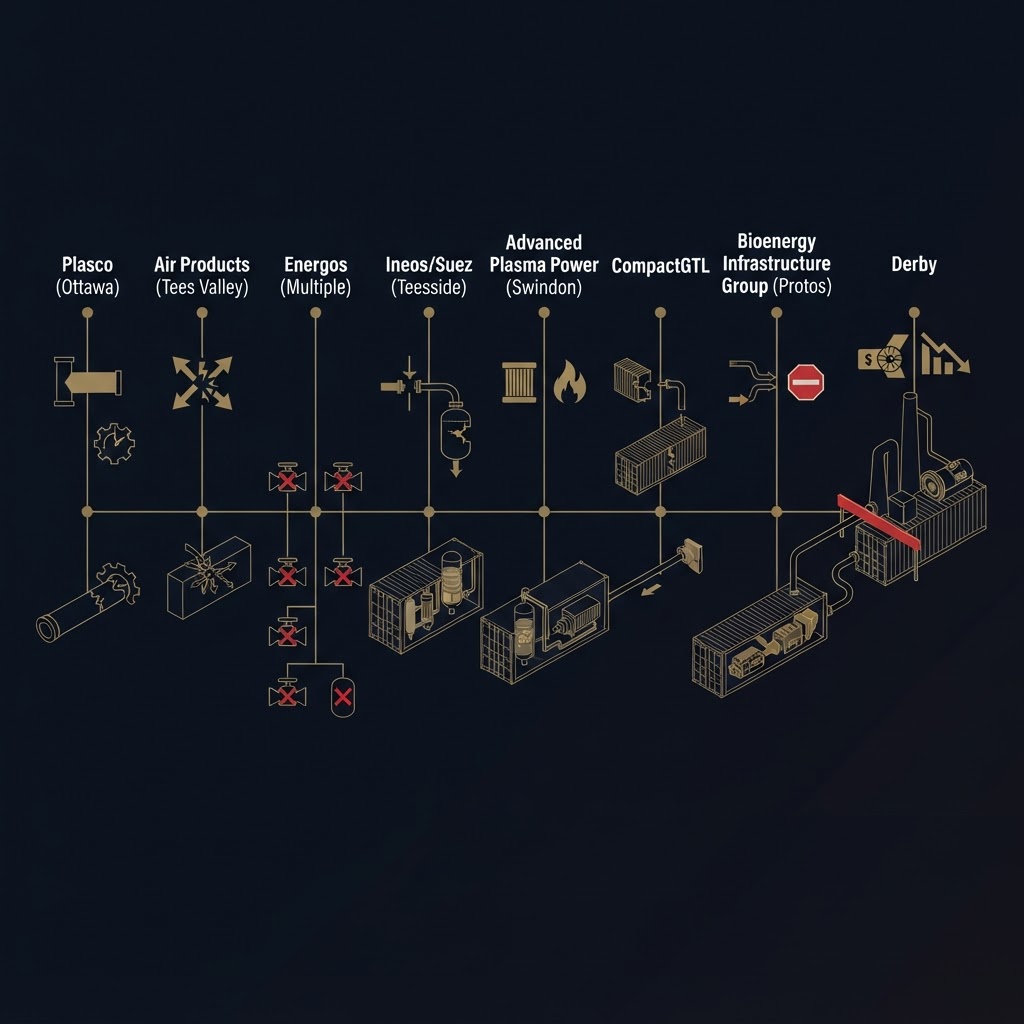
In March 2016, Air Products walked away from two plants at Tees Valley and took a charge of $900 million to $1.0 billion. Two months earlier its chief executive had said the technology was "proving to be a lot more difficult than people thought at the beginning" (quoted by UKWIN, a campaign group that opposes incineration).
Why gasification plants fail is usually answered with one word: tar. The record is less tidy. Across the eight projects below, a technical fault typically took away operating hours, and then the project's finances could not survive the time it took to fix it. Tar is one of six ways that sequence starts.
Eight plants, and what actually ended each one
| Project | Scale | What went wrong | How it ended |
|---|---|---|---|
| Tees Valley, UK | About 50 MW per unit | Start-up never completed | Owner exited in 2016 |
| Fulcrum Sierra, US | 11 million gallons a year | Nitric acid, cement-like buildup | Chapter 11, September 2024 |
| Derby Sinfin, UK | 190,000 tonnes a year | Failed commissioning tests | Decommissioning agreed, September 2026 |
| Agnion Grassau, Germany | 1.3 MW | Tar above gas engine limits | Insolvency, January 2013 |
| Plasco, Canada | 300 tonnes a day planned | Commercial plant never financed | Creditor protection, February 2015 |
| ARBRE, UK | Flagship energy crop plant | Technology, sponsor and contractor | Never reached commercial operation |
| Kemper, US | 585 MW | Scale-up from pilot | Switched to natural gas |
| GoBiGas, Sweden | 20 MW | Biomethane price, not the plant | Mothballed, May 2018 |
Two caveats. This is a selected sample, not a failure rate, and it mixes waste, biomass and coal. And the evidence is uneven: one hazard review notes that causes are seldom disclosed. Derby is unusually well documented only because a local campaigner won a ruling from the UK Information Commissioner.
The pattern: engineering starts it, the balance sheet finishes it
The most useful line in the literature comes from IEA Bioenergy. Its authors expected to find technical problems and concluded that plants often failed for economic reasons instead. A UK review explains why that split is misleading: finance, technical and non-technical barriers interact, and more money could often have overcome the other two.
GoBiGas shows the economic end in its purest form. It logged more than 12,000 operating hours and reached its full 20 MW in February 2018. The next month its owner decided to stop operations, with SEK 1.8 to 1.9 billion invested. Plasco shows the other extreme. It had raised more than $300 million, called itself pre-revenue, and missed its third and final financing deadline before a commercial plant existed.
Fulcrum shows how little is left at the end. It defaulted on $289 million in bonds tied to the Nevada plant, and the stalking horse bid that set the floor for that plant's assets was $15 million.
Failure 1: the fuel was not the fuel in the design
Derby's published documents are the best record of this, because the first problem was upstream of the gasifier. ENDS reported that the sorting and treatment lines could not make enough refuse-derived fuel to keep the plant's lines performing. Shredders broke down, the input pit overflowed, and in the 12 months before the documents were sent the plant processed 51% of its waste diversion target.
The underlying reason applies well beyond Derby. Mixed waste varies physically and chemically, and the Rollinson review ties the history of municipal waste gasifiers to that heterogeneity. A plant that needs a narrow fuel must either receive one or manufacture one, and manufacturing it is a second industrial process with its own failures. The buyer's guide on small scale waste to energy systems covers the same effect at GoBiGas, where moisture alone decided how long the plant could run.
Failure 2: the gas never got clean enough for the machine behind it
Agnion is the clearest small-scale case. Its 1.3 MW plant at Grassau failed at the gas purification step. Tar levels sat well above the limits for gas engines and could not be brought down reliably with the scrubber, and cold gas efficiency fell from over 70% in the pilot to under 50%. The company, with about 70 staff, then filed for insolvency.
The size of that gap is why this mode recurs. Raw gas can carry up to 150 g/m3 of tar, against 0.01 g/m3 for an engine in combined heat and power service. The full arithmetic is in tar removal from syngas.
The contrast is Lahti in Finland, opened in 2012 and listed as operating in a 2022 review. It gasifies 250,000 tonnes a year of solid recovered fuel, cools and cleans the gas, and burns it in a boiler. A boiler demands far less of the gas than an engine does. Every step up the value chain, from boiler to engine to synthesis, tightens the specification, which means the choice of end use is also a choice of risk.
Failure 3: chemistry that appeared only at full scale
At Tees Valley, startup was hit by unexpected nitric acid that attacked equipment. At Fulcrum, the same acid problem appeared alongside a cement-like buildup in the gasification system, and operations stopped in May 2024. Writing in The Chemical Engineer, Alex Howard argues the Fulcrum problems were not entirely unforeseen, because Tees Valley had shown them eight years earlier.
That is the uncomfortable part of this failure mode. Companies rarely publish what went wrong, so the next developer can pay for the same lesson. Howard's proposed remedy is an independent body that checks whether a technology has resolved known historical issues before it receives funding.
Failure 4: scaling past the evidence
The International Energy Agency's verdict on Kemper applies well outside coal: the rapid scale-up of a new technology from pilot to 585 MW proved far more complex than anticipated, and a USD 7.5 billion effort ended up as a natural gas plant. Fulcrum's version took longer. Planned to start in 2010, it began operating in 2022, and its widely publicised first railcar held 350 gallons.
Agnion adds a subtler warning. In April 2012, a Fraunhofer UMSICHT assessment reported stable pilot operation and expected more than 7,500 operating hours a year. Insolvency came nine months later. The pilot was real, but the commercial plant was not the same machine: its end use had moved from synthesis gas to gas engines, its combustion chamber had been redesigned, and its planned fuel moved from pellets to wood chip. A reference only covers the fuel, size and end use it was measured on.
Failure 5: the project structure broke before the plant did
ARBRE had three reinforcing problems: the lead financier withdrew for strategic reasons, the turnkey contractor went bankrupt, and technical faults could not be solved within the remaining time and money. The study's authors judged each one individually preventable.
Derby shows who pays when that structure fails. The joint venture missed its commissioning tests, the councils terminated in August 2019, and they later paid administrators £93.5 million. Total spending has reached £147.33 million, and in September 2026 both councils' cabinets decided to decommission and dispose of the plant. The UKWIN briefing records a similar supplier-side collapse: Energos entered administration in 2016, citing cash flow problems from disputes on two major contracts.
Public buyers are not protected by being small, either. In Wick, the UKWIN briefing quotes Audit Scotland finding that Caithness Heat and Power procured "experimental" gasification technology that could not be commissioned, and it puts Highland Council's loss at £11.5 million.
Failure 6: the revenue depended on somebody else's price
GoBiGas closed because the sales value of biomethane did not follow projections, according to the IEA Bioenergy status report. Derby's documents warned that income was "significantly lower than base case" and that its Renewables Obligation Certificates might not be available. IEA Bioenergy's broader point on large biomass plants is stark: direct competition with fossil fuels makes no business sense, so a greenhouse gas subsidy would have to be guaranteed for the plant's whole life.
That is an argument for building where the economics do not rest on one external price, which usually means a site already paying to dispose of a waste stream.
What the survivors did differently
Survivors did not avoid trouble. They outlasted it. Skive in Denmark, a 6 MWe wood gasification plant running gas engines, went through several years of intermittent operation before reaching high availability through work on fuel quality and its catalytic tar reformer. IEA Bioenergy lists "an interested and persistent host" first among its success factors.
Lahti and Skive also share two site conditions: each sells into a local heat system, and each runs a controlled fuel rather than raw mixed waste. The technology mattered, but so did the patience the site could afford.
Where this leaves a 150 kg/h machine
Small size fixes none of these six failure modes. It changes the size of the mistake. Derby was contracted for 190,000 tonnes a year, roughly 22 tonnes for every hour of the year. An X-150 takes 150 kg an hour, so a learning curve costs a container's worth of capital rather than a council's.
Our evidence is the 1,939-hour COMETHA run in Paris: 16,382 kg of digestate pellets at 99.98% tar conversion. SyngaPure adds real-time tar, H2S, NH3 and particulate sensing, and the X-150 has been independently validated at COMETHA, Fraunhofer IKTS and Hochschule Zittau/Goerlitz.
The same tests apply to us. Eighty days is a strong campaign, not a ten-year operating record. Digestate pellets are a prepared fuel, so a run on them is not proof on your waste. And grants covering 56 to 70% of CAPEX in target markets, as set out in government grants for waste to energy, reduce the capital at risk but do not create revenue. Before you shortlist any supplier, including us, compare the evidence in waste gasification companies.
A pre-mortem before you commit capital
Assume the project has already failed, then check which of these would have caused it.
- Fuel: Have you sampled your own feedstock across the seasons, and tested the full front end at contracted tonnage, not only the reactor?
- Gas: Have you written down the limit of the machine after the gasifier, and seen cleaning data at that limit on your feed?
- Chemistry: Has someone independent reviewed nitrogen, chlorine and ash behaviour through every downstream stream and material?
- Scale: Does your reference match your fuel, size and end use? If any one differs, treat it as a new plant.
- Structure: Who finishes the job if the sponsor leaves or the contractor goes bankrupt, and what does the contract require of them?
- Revenue and runway: How many months of zero output can the project survive, and does it still work without the price or subsidy you do not control?
A project that cannot answer the sixth should not rely on the other five. A UK review found overly optimistic cost estimates and missing contingency were themselves recurring reasons projects could not secure the finance to finish.
FAQ
Is plasma gasification more likely to fail than conventional gasification? Tees Valley and Plasco were both plasma projects, and so was EcoValley in Japan. That is a warning rather than a measured rate, since we found no comparable dataset covering both technology groups. Very high temperatures do not remove the feedstock, financing or scale-up risks above.
Why is gasification not more widespread than incineration for municipal waste? Incineration had the commercial track record first. A 2016 PNNL market survey found no commercial waste-to-energy gasification plants operating in the US at that time, and it cited higher capital cost and too few proven vendors against conventional mass-burn plants.
Can a failed gasification plant be fixed? Sometimes. Skive was brought to high availability after years of work. Derby went the other way: the procurement to fix and operate the plant ended in May 2026 with no contract awarded. Rectification needs a contractor willing to accept the remaining technical and commercial risk.
Are gasification plants dangerous? They need serious process safety. The gas is toxic and flammable, carbon monoxide levels are far above fatal concentrations, and hazard literature identifies start-up and shut-down as the highest risk periods. Stored refuse-derived fuel can also self-heat and ignite.
We use cookies to improve your experience on this site. By continuing, you agree to our Privacy Notice.