Waste to Energy for Islands: When a Small Plant Pays
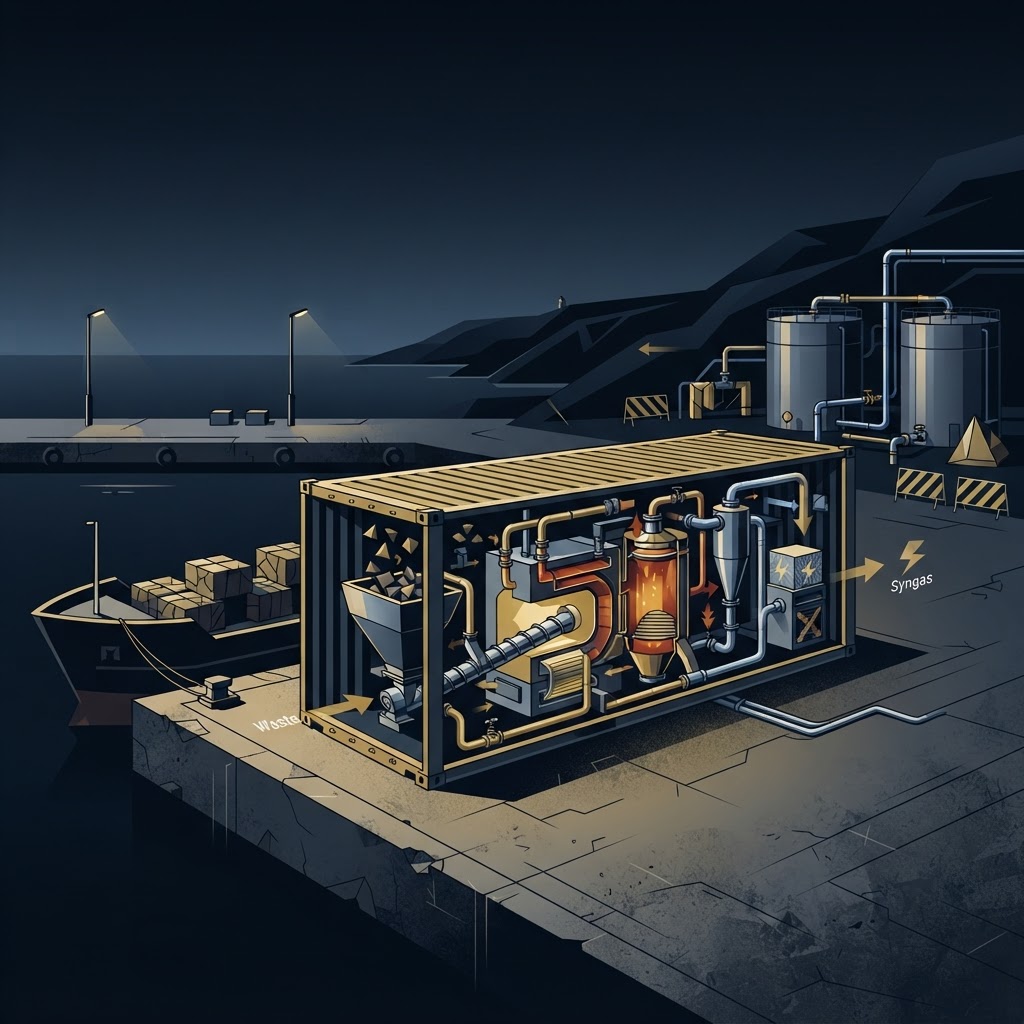
Waste to energy for islands is usually pitched as a technology question. It is really a freight question. An island pays for its waste twice: once to put it on a boat and ship it away, and again to ship in the diesel that the same waste could have replaced. On the mainland, a small plant almost never beats a big regional one. On an island, that double bill can flip the result.
This guide works through the numbers that decide it, which technology fits which island and which waste stream, and where a containerized gasifier like the Zero-X X-150 belongs in that picture.
Islands pay for waste twice
The Pacific regional environment programme's waste to energy research report lists what makes islands different: no land for new landfills, waste that is high in organics and moisture, distance from recycling markets, geographic isolation from technology providers and maintenance services, and limited energy security because of reliance on imported fuel. Every one of those points ends up on an invoice.
The first bill is disposal. Where there is no landfill space, waste either piles up in a dumpsite or goes to sea on a vessel that itself burns diesel.
The second bill is electricity. Island grids run on imported fuel delivered by small tankers. In the Maldives, electricity costs reach $0.40 per kWh in the outer islands. Any kilowatt hour made from local waste displaces one of those.
A mainland plant only competes against one bill. An island plant competes against both, and that is the whole case.
The Aeolian numbers: what EUR 300 a tonne does to the maths
The clearest public evidence is a 2025 pre-feasibility study for the Aeolian Islands north of Sicily, prepared by DNV for the Clean energy for EU islands secretariat. The islands run on diesel generators, renewables are below 1% of the electricity mix, and municipal waste leaves Lipari by ship. The study compared a small biowaste plant on Lipari with sending the same waste to a large mainland plant:
| Item | Small plant on Lipari | Large mainland plant |
|---|---|---|
| CAPEX per tonne of annual capacity | about EUR 1,300 | about EUR 250 |
| Value of displaced fuel and local fertiliser | EUR 80 per tonne | EUR 40 per tonne |
| Sea transport of waste | avoided | about EUR 300 per tonne |
| Remaining net handling cost | EUR 180 per tonne | EUR 310 per tonne |
The small plant costs five times more to build per tonne and still wins by EUR 130 a tonne. The study says it plainly: transport costs more than compensate for the higher investment. The diesel it replaces is also worth more on the island, because the island's generators are less efficient than the gas plants a mainland facility would displace.
Two other findings matter for anyone planning a plant. Organic waste swings from 380 tonnes a month in summer to 100 in winter, because tourism sets the waste curve. And about 47% of the organic fraction is dry cardboard, cellulose and wood, which the recommended digester cannot handle well; the study proposes a 1,500 m3 hall to store it for winter. Hold onto that number. It comes back below.
Scale: most islands are smaller than the technology
Malé: the rare island big enough for a grate incinerator
Large mass-burn incineration works where there is enough waste. The Greater Malé region generates around 836 tonnes a day, and for years the overflow was dumped and burned at Thilafushi, with smoke visible from the capital and the airport. The response is a 500 tonne per day plant with two 250 tpd grate lines and 8 MW of energy recovery, plus a landfill for the hazardous air pollution control residues, built on 15 hectares of land reclaimed from the lagoon.
That is a capital-city solution. Malé covers 5.8 km2 and generates 63% of the country's waste; the same study finds incineration infeasible for the roughly 194 scattered outer islands, where kitchen and yard waste make up as much as 67% of the stream.
Everyone else: tonnes a day
Most islands that ask about waste to energy produce a few tonnes to a few dozen tonnes a day. At that scale, conventional plants struggle in three predictable ways:
- The minimum size is too big. The main dry digestion vendors in the Aeolian study start at 12,000 tonnes a year and prefer more than 30,000. A techno-economic model for the Maldives put the smallest workable incinerator at 5,274 tonnes a year, and found the flue gas treatment system was the single largest capital item.
- Fixed plants get outgrown. On Tortola in the British Virgin Islands, the incinerator's 45 tonne per day capacity was exceeded by 1999, and waste piled up whenever it was shut down. A single large unit has no partial capacity: when it stops, everything stops.
- The money is not there. Across Caribbean small island states, about 80% of municipal waste goes to open dumpsites, and IRENA rates incineration the least likely scenario because of high investment and environmental management costs.
The pattern is consistent. Islands need capacity that comes in small, repeatable blocks.
Match the machine to the stream
There is no single waste to energy technology for islands. There are streams, and each has a best fit. We go deeper on the general trade off in gasification vs incineration; here is the island version.
Wet organics: anaerobic digestion
Food waste is wet and biodegradable, and digestion handles it well. It is what the Aeolian study recommends for kitchen waste, and what the Maldives study suggests for outer islands, where small digesters could cover 40% to 100% of household cooking energy. If an island's problem is mostly food waste, start there.
Dry and residual fraction: gasification
Digestion stops at cellulose, plastics, packaging, wood and garden waste. That is the 47% the Aeolian study has to warehouse, and on most islands it is the residual bag that actually fills the dumpsite. Gasification converts that dry, mixed fraction into syngas for power, and leaves a char that can be used as biochar. For a fuller comparison of the two routes, MFC Energy's guide on biomass gasification vs anaerobic digestion sets them side by side.
The two are complementary, not rivals. A digester takes the summer kitchen peak; a gasifier takes the dry fraction all year, including in winter when the digester is starved.
What island conditions do to any plant
The SPREP report's isolation point is the one that kills projects. When the nearest service engineer is a flight away, a plant that needs specialist intervention every few weeks becomes a stranded asset. For gasification the known weak point is tar, which fouls engines downstream; we cover it in detail in tar removal from syngas. Zero-X's SyngaPure gas cleaning system removes 99% of tar compounds, and it is the first thing we would ask any island vendor to prove.
Moisture is the second. Island waste is wet, and thermal conversion wants a dry feed. Source separation and drying are housekeeping problems, but they decide whether a unit hits its rated throughput.
What the island projects promise
Three recent island projects show what developers claim. All of the figures below are projections or models, not operating results.
- A Pacific island nation. Wildfire Energy's gasification project is planned to supply up to 20% of the island's electricity and, together with existing solar, replace up to 70% of diesel generation. Its slag is pitched as aggregate for concrete and seawalls, materials islands otherwise import.
- St John, US Virgin Islands. AST Clean Tech's resource recovery centre is designed for 25 tonnes a day and about 10,000 MWh a year, with zero waste shipped off-island.
- Tonga. A modelled network of combined cooling and power units burning waste and crop residue would supply 38% of national electricity demand and avoid 7.4 million litres of diesel a year.
The common thread is dispatchable power. Solar covers the day; waste power runs at night, which is exactly when island diesel sets work hardest.
Where a 150 kg/h containerized gasifier fits
The Zero-X X-150 is a fixed-bed downdraft gasifier in a container, rated at 150 kg of feed an hour. Run around the clock, that is 3.6 tonnes a day, so an island at St John's 25 tonnes a day would be looking at several units in parallel, and a small Aeolian-type island at one or two. That is arithmetic from the nameplate rate, not a quote for any project; a waste audit replaces it.
The modular format answers the scale problems above. Capacity is added in blocks as tourism grows, one unit can be serviced while the others run, and the whole thing arrives on a ship that already calls at the port. We explain the format itself in containerized waste to energy.
The evidence for reliability comes from long runs, not brochures. The X-150 completed a 1,939-hour continuous campaign in Paris within the COMETHA project, with 99.98% tar conversion. It has been independently validated at Fraunhofer IKTS (Verkoso) and Hochschule Zittau/Görlitz on high-ash sludge, municipal waste and digestate, the difficult feedstocks island waste resembles. And our first unit on an island runs at a hotel: the X-5 prototype is operational at Thrive Hotel in Canggu, Bali. If you are a property rather than an island authority, start with waste to energy for hotels and resorts; for one island in detail, see what Bali's municipal plant does and does not cover.
Who pays: the island's split incentive
The Aeolian study names the hurdle most island projects hit: the costs and the benefits sit with different parties. The plant owner pays the CAPEX, but the savings land with the regionally subsidised shipping service and the power company. Unless those parties are aligned in one deal, a project that is clearly cheaper for the island as a whole can still fail to get financed. The study also flags permitting on densely populated, UNESCO-protected Lipari as likely to be highly challenging, which is why a compact containerized footprint matters on islands.
Grants close much of the gap. In Zero-X's Wave 1 markets, validated routes fund 56% to 70% of project CAPEX: 70% in Cadiz and Andalusia, 60% to 72% in Alentejo and 56% in Patras. These are mainland regions; island projects in Spain, Portugal and Greece need their own route checked, which is part of the grant playbook partners receive. More on that in government grants for waste to energy.
A pre-feasibility checklist for an island
Before talking to any vendor, an island authority should be able to answer these:
- Tonnes per day, by fraction and by month. Wet organics, dry and residual, sludge. Plan for the off-season low, not the summer peak.
- What you pay today per tonne to move waste off the island. This is your biggest lever.
- What a kWh of diesel power costs on your grid, fully loaded.
- Who captures each saving: municipality, shipping operator, utility. Get them in the same room early.
- A site and its permits, including truck access and distance from homes.
- An O&M plan that assumes no outside engineer for weeks at a time, and certified local operators.
- A gas cleaning specification in writing, with tar figures from a long continuous run.
FAQ
Is waste to energy viable on a small island?
It can be, and the deciding numbers are freight and fuel, not plant efficiency. In the Aeolian study a small local plant handled waste for about EUR 180 a tonne net, against EUR 310 for shipping it to a large mainland plant, even though it cost five times more to build per tonne.
What is the minimum amount of waste for an island plant?
It depends on the technology. Large dry digestion lines start at about 12,000 tonnes a year, and a Maldives model put the smallest incinerator at 5,274 tonnes a year. Modular gasifiers have no plant-level minimum in the same sense, because each unit adds a fixed block of capacity, 150 kg an hour in the case of the X-150.
Can island waste to energy replace diesel generators completely?
Not usually. Waste supplies part of the load: up to 20% of electricity in the Pacific project above and 38% in the Tonga model. Its value is that it is dispatchable, so it fills the night hours solar cannot.
What happens to the ash on an island?
Large incinerators produce hazardous air pollution control residues that need a dedicated landfill cell, as planned in Malé. Gasification slag and char can be reused as aggregate or biochar, which matters where every bag of construction material arrives by boat.
We use cookies to improve your experience on this site. By continuing, you agree to our Privacy Notice.