Gasification Biochar Production: Power and Char in One Unit
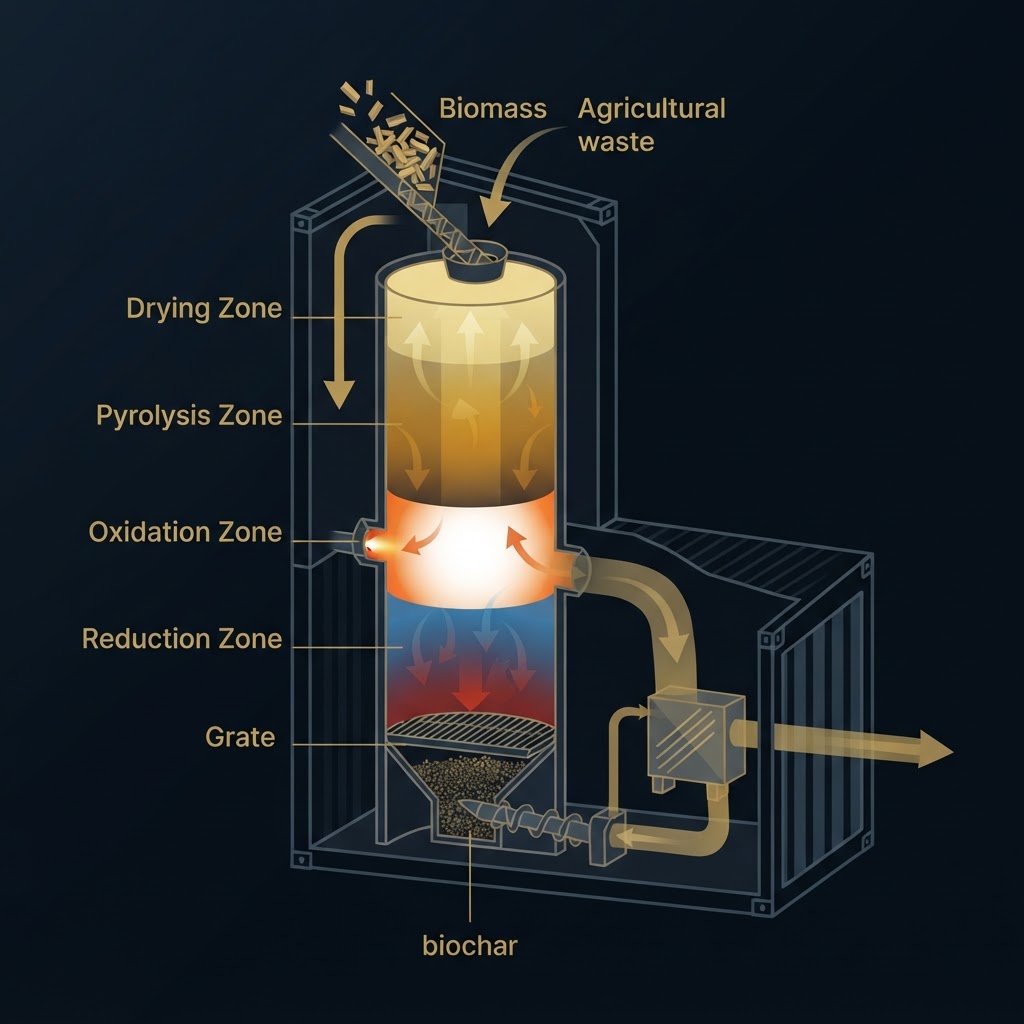
Almost every guide to biochar assumes you are running a pyrolysis kiln, where char is the product and the gas is something you flare or burn for process heat. Gasification biochar production is the opposite decision. You run the reactor for the gas, which drives an engine or a hydrogen train, and the char is what the reduction zone leaves behind. Less of it, with different chemistry, but it comes with electricity attached.
This article is for the operator who has to decide whether that trade is worth it. The numbers below come from measured reactor studies and from a gasifier that has run for months on real waste, and each one links to where it came from.
Why gasification biochar is not pyrolysis biochar
The first thing to get straight is yield. A review of gasification biochar across reactor types and feedstocks found the char yield generally below 200 g per kg of feedstock, against 200 to 500 g/kg for pyrolysis, with yield falling further as gasification temperature rises. If your business case needs a tonne of char for every three tonnes of feedstock, you want pyrolysis and this is the wrong article.
The second thing is chemistry. A Dutch study that ran the same feedstocks through both a slow pyrolysis unit and a gasifier found that the gasifier chars had lower yields but larger surface area, higher pH and ash content, and very low tar content measured as the 16 EPA PAHs. That last point matters more than it looks. PAH contamination is the thing that fails biochar at certification, and gasification burns it off as a side effect of making the gas.
So the frame is not "gasification is a worse way to make biochar". It is "gasification makes less char of a more carbonized, more alkaline, cleaner type, and pays for itself on the gas". For the broader map of routes see our guide to biochar production and the head-to-head on gasification vs pyrolysis.
What comes out of the reactor: the chemistry of gasification char
Carbon, H/C and O/C
The cleanest dataset is a downdraft gasifier run on oak at 850 C. The resulting char had 78.7% carbon, an H/C ratio of 0.368, an O/C ratio of 0.178, a pH of 10.10 and a BET surface area of 88.97 m2/g. The low H/C and O/C are the point. They mean the material is highly aromatic and stable, which is what you want from a carbon sink.
For reference, the International Biochar Initiative definition that the Dutch study applies requires molar H/C below 0.6 and O/C below 0.4. The oak char clears both with a wide margin, and that is typical of high-temperature gasification: the reactor runs hotter than a pyrolysis kiln, so it carbonizes harder.
Ash and the EBC category
Here is the catch. Because a gasifier partially oxidizes the feedstock, it burns off carbon and concentrates minerals. The gasification biochar review puts ash content as high as 60 wt% for some chars, though total carbon can still exceed 60 wt% with the right feedstock. A downdraft technical review puts the elemental carbon of gasifier char at 50 to 80% by weight, the rest being the inorganic fraction of the fuel.
When ash climbs that high, the Dutch study notes the material may no longer meet the biochar definition and instead falls under the European Biochar Certificate category of Pyrogenic Carbonaceous Material. That is not a failure grade. PCM that meets the other certificate thresholds can be marketed as EBC-certified PCM, and high-ash chars carry a nutrient load that pure wood char does not. It is simply a different product with a different buyer.
pH and surface area
Gasification chars sit in the alkaline range, broadly pH 7 to 12, because of their ash and their degree of carbonization. That is useful in acidic soils and awkward in already alkaline ones. The oak study also found a strongly negative surface charge, which supports heavy-metal immobilization and colloidal stability in soil. If you are selling into agriculture, the pH figure belongs on the spec sheet next to the carbon number.
How one downdraft reactor makes gas and char at the same time
The four zones
In a downdraft gasifier the air and the fuel move in the same direction, which is why the design is also called co-current. The fuel passes through drying, pyrolysis, oxidation and reduction zones in sequence, and the technical review notes that everything produced in the drying and pyrolysis zones is forced through the hot oxidation zone, where tars are cracked. The char that reaches the bottom of the reduction zone is what you draw off as biochar. If you want the full walk-through, read how waste gasification works and the comparison of types of gasifiers.
Equivalence ratio and temperature set the split
The operator has two levers. The equivalence ratio, meaning how much air you admit relative to full combustion, decides how much of the carbon is gasified versus left as char. A double-stage downdraft study on miscanthus briquettes found an optimal equivalence ratio of 0.35, which gave a syngas heating value of 5.5 MJ/Nm3 with 20.29% CO and 18.68% H2. Push the ratio higher and you get more gas, less char, and a leaner gas. Pull it lower and the char yield rises but the engine starves.
Temperature works the same way. Across feedstocks, char yield drops as gasification temperature rises, because more of the fixed carbon reacts to gas. There is no setting that maximizes both. The job is to pick the point where power sales and char sales together are highest, and to hold it.
The moisture limit
Downdraft units need a feedstock with water content under about 25% or the oxidation zone cools and ash fuses into clinker. Clinker is the single most common reason small gasifiers stop, and it is also the reason most of them only run on clean wood chips.
Feedstock decides the char: wood, sludge and agri-residues
The yield rule has exceptions, and they are the interesting ones. Sewage sludge and rice husk chars showed relatively high gasification yields in the review, because of ash contents in the raw feedstock of up to 36% for sludge and 24% for rice husk. The mineral fraction cannot gasify, so it stays in the char and props up the mass yield. Waste tyre char, by contrast, came out with carbon above 80 wt% because the carbon black in rubber survives the process.
This is where the machine matters. The X-150 is a containerized 150 kg/h fixed-bed downdraft gasifier that has been validated on high-ash sewage sludge, municipal solid waste and digestate, the feedstocks that clinker clean-wood gasifiers. The public operating record is the COMETHA campaign in Paris: 1,939 hours of continuous operation across 80 days, 16,382 kg of digestate pellets processed, 33% hydrogen in the syngas and 99.98% tar conversion in oxy-steam mode. Digestate is exactly the kind of high-ash, mineral-rich feedstock that produces a phosphorus-bearing char rather than a wood char, which is why the output belongs in the PCM conversation rather than the premium soil-biochar one.
If sludge is your feedstock, read the companion pieces on biochar from sewage sludge and phosphorus recovery from sewage sludge, because the phosphorus in that char is a regulated resource in Germany and a saleable one everywhere.
The two-product stack: what a 150 kg/h unit actually sells
A pyrolysis plant sells char and maybe heat. A gasification unit sells four things from one feedstock stream: electricity or hydrogen from the syngas, recoverable heat from the engine and the gas cooling, a gate fee for taking the waste, and the char. The char is the smallest line by mass, but it is the one with no fuel cost attached, because the feedstock was already paid for by the gate fee.
The gas side only pays if the gas is clean enough for an engine. Zero-X's SyngaPure cleaning stage removes 99% of tar compounds while maintaining energy efficiency, and in December 2025 it was selected for support under the German federal BMWK go-inno program as a system with AI support and real-time tar, H2S, NH3 and particulate sensing. Tar is what killed most of the small-scale gasification demos of the last decade. A char co-product does not rescue a plant whose engine is coked.
On capital, the grant picture changes the math more than any char price does. In Zero-X's Wave 1 markets, public programs fund between 56% and 70% of project CAPEX, with validated routes in Spain at 70%, Portugal at 60 to 72% and Greece at 56%. Put a subsidized unit next to a waste stream you are already paying to haul, and the char becomes the margin rather than the business. For the full cost picture, see is biochar production profitable and biochar production cost per ton.
A 2025 review of municipal solid waste gasification maps the same by-product logic at municipal scale: syngas to power, heat or chemicals, and char as a valorized solid, inside a circular-economy frame. The small-scale version is the same diagram with a shipping container around it.
What to test before you sell gasification char
Because the product varies with feedstock and operating point, the spec sheet does the selling. Before a batch leaves site, test:
- H/C and O/C molar ratios. Below 0.6 and 0.4 respectively to call it biochar under the IBI definition.
- Ash content. Decides whether you are selling biochar or EBC Pyrogenic Carbonaceous Material, and which buyer to call.
- pH and electrical conductivity. Alkaline, high-salt chars from manure or sludge need a soil match, not a generic listing.
- 16 EPA PAHs. Gasification chars test low here, but a certificate needs the lab number, not the literature.
- Heavy metals. Mandatory for any waste-derived char, and the reason sludge char usually goes to phosphorus recovery or industrial use rather than food soils.
Operating temperature moves every one of those numbers, which is why we cover it separately in biochar production temperature.
FAQ
What is the biochar yield from gasification?
Generally under 200 g per kg of feedstock, compared with 200 to 500 g/kg for pyrolysis, and it falls as gasification temperature rises. High-ash feedstocks such as sewage sludge and rice husk give higher mass yields because their minerals stay in the char.
Is gasification biochar good for soil?
It is alkaline, highly carbonized, high in surface area and very low in PAHs, which makes it well suited to acidic soils and to carbon storage. High-ash versions may be classified as EBC Pyrogenic Carbonaceous Material rather than biochar, and waste-derived chars need a heavy-metal test before agricultural use.
Can you make biochar and electricity at the same time?
Yes. That is what a gasifier does by design: the syngas runs an engine or a hydrogen route while the char is drawn from the reduction zone. The equivalence ratio and the reactor temperature set how much of the carbon becomes gas and how much stays as char.
Why does gasification biochar have more ash than pyrolysis biochar?
A gasifier runs hotter than a pyrolysis kiln and includes a partial oxidation stage, so more of the carbon is converted to gas and the mineral fraction of the feedstock is concentrated in what remains. Ash can reach 60 wt% in chars from mineral-rich feedstocks.
Available for advisory work, board seats and media appearances.
Julien Uhlig advises boards and funds and briefs newsrooms across Europe and North America. Enquiries are read personally.
We use cookies to improve your experience on this site. By continuing, you agree to our Privacy Notice.