Gasifier Generator: How It Works and What Runs 24/7
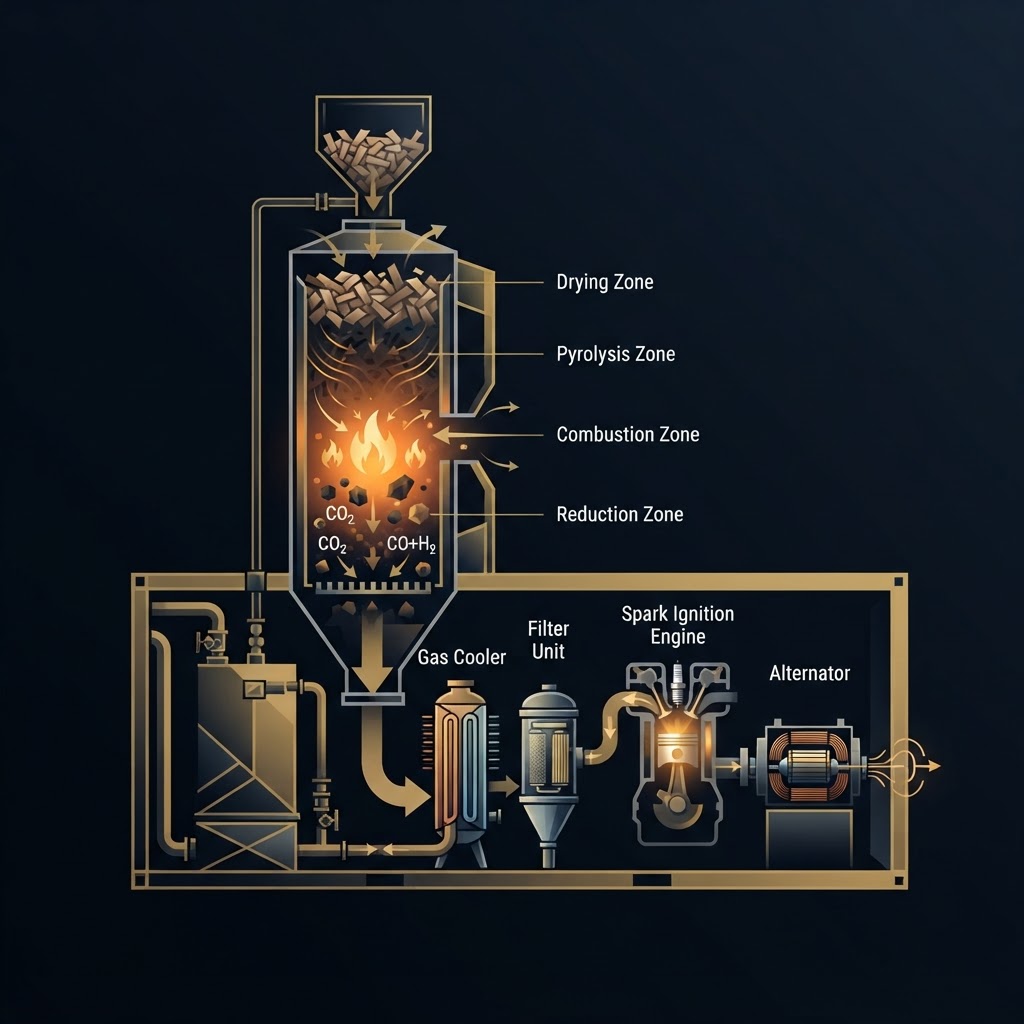
A gasifier generator is two machines bolted to one skid: a reactor that turns solid fuel into a combustible gas, and a spark ignition engine that burns that gas to spin an alternator. Every explainer on page one describes the four zones inside the reactor. Almost none of them answers the question a buyer actually has: how many hours a day will this run, on what fuel, before somebody has to open it up and clean it?
That question splits the market into three very different classes of machine. This guide walks through how a gasifier generator works, what it really delivers per kilogram of fuel, and why the jump from "runs for an afternoon on wood chips" to "carries a base load on waste" is an engineering problem, not a sizing one.
What a gasifier generator is
The reactor partially burns biomass with a restricted air supply. What comes out is producer gas, which a classic engineering study of small wood gas generators measured at 20 to 25% carbon monoxide, 16 to 18% hydrogen, 8 to 10% CO2 and 45 to 50% nitrogen, plus traces of methane. The gas is cooled, filtered and fed to the engine, where, as the FEMA emergency manual describes it, it is mixed with air in the carburettor and burned a few seconds after it is made. There is no storage tank. The reactor makes exactly as much gas as the engine pulls.
Why the gas is weak: nitrogen and heating value
Roughly half of producer gas is nitrogen from the intake air. It does not burn, it just takes up cylinder volume. That dilution is the root of almost every performance limit below, and it is why oxygen or steam blown systems that remove the nitrogen ballast produce a far more useful gas (see our breakdown of syngas composition).
How a gasifier generator works, zone by zone
Fuel moves down through four zones. At the top it dries. Below that it pyrolyses into char, tar vapours and gas. At the air nozzles it combusts at around 1,200 C. At the bottom the hot CO2 and water vapour pass through glowing charcoal and are reduced to CO and hydrogen. For a longer walkthrough of the chemistry, see how a gasifier works.
Why almost every gasifier genset is a downdraft
The direction of gas flow decides how much tar reaches the engine. In a downdraft (Imbert type) reactor, all pyrolysis vapours are forced through a hot constricted throat where most of the tar cracks. The same study notes that updraft and crossdraft designs are only suitable for fuels that do not emit tar. The measured gap is enormous: tar in raw gas runs 0.01 to 6 g/Nm3 for downdraft and around 50 g/Nm3 for updraft reactors, against an internal combustion engine tolerance of about 100 mg/Nm3. Even the best downdraft can exceed what an engine accepts, which is why the cleaning train matters as much as the reactor. Our guide to the types of gasifiers covers the other reactor families.
Output, fuel use and derating
The historical rule of thumb from the Indian Institute of Science work is that it takes about 3 kg of wood, or 1.7 kg of charcoal, to deliver the shaft power of one litre of petrol. For a modern stationary genset, the most useful planning number is the one published for the All Power Labs PP30: 1.0 kg of dry biomass per kWh, about 23% electrical efficiency, 25 kW at 60 Hz or 22 kW at 50 Hz, and a startup of 10 to 15 minutes. Chinese downdraft families quote a wider spread, 10 kW to 1,000 kW sets consuming 15 to 1,500 kg/h, which is 1.5 kg per kWh at nameplate.
Sizing rule of thumb: kilograms per kilowatt-hour
Take the continuous load in kW and multiply by 1.0 to 1.5 to get kilograms of dry fuel per hour. A 20 kW base load burns 20 to 30 kg an hour, or roughly half a tonne to three quarters of a tonne a day. That fuel has to be dried, sized and handled every day the machine runs.
Then derate the engine. A petroleum engine converted to producer gas typically delivers 20 to 40% less rated power, needs 15 to 30 minutes of startup and an operator present for fuel loading and filter maintenance. If you need 20 kW at the terminals, you are buying an engine rated well above that.
The real question: how many hours a day will it run
This is where the three classes separate, and where most buyers get the wrong machine.
Class 1: kits and DIY builds
The US emergency design documented by ORNL for FEMA is a good benchmark because it is honest about upkeep: a daily maintenance routine, a weekly one every 15 hours of operation and a biweekly one every 30 hours, plus a hand shaker to stop the fuel bed bridging. The FEMA manual adds a durability data point from the Second World War: homemade units lasted about 20,000 miles with many repairs, while factory built units ran up to 100,000 miles. Kits are useful for learning and for emergency power. They are not a base load asset.
Class 2: packaged wood gensets
The PP30 is the reference product in this class and its own documentation is clear about the envelope. The one-sheet rates maximum continuous operation at above 16 hours. The manufacturer's sales reply describes it as a batch machine run 8 to 20 hours a day, roughly $65k for the equipment with a 6 month lead time, and not CE or UL certified at the time. That is a serious, well engineered product for daytime loads on clean wood chips. It is not designed to run for weeks without stopping.
Class 3: containerized waste gasifiers
Base load operation needs continuous feeding, continuous ash handling and gas cleaning that holds tar below engine limits for weeks, not hours. This is the class Zero-X builds for. The X-150 is a 150 kg/h containerized fixed-bed downdraft platform, and in the COMETHA project in Paris it ran 1,939 hours (80 consecutive days) continuously, processing 16,382 kg of digestate pellets with 99.98% tar conversion and 33% hydrogen in the syngas. Digestate is a far harder fuel than wood chips. The duration is the point: 80 days is the difference between a generator and a power plant. For how this class fits alongside other options, see our overview of small-scale waste-to-energy systems.
Tar, condensate and engine wear
Tar is what shuts small gasifier generators down. Even with good gas, the engine pays. The same stationary power reference cited above puts it at oil changes two to five times as often as on petroleum and engine life reduced by 30 to 50%. Water is the other burden: every kg of dry wood releases about 0.4 litres of water loaded with organics, and treating that condensate takes 25 to 35% of the gas energy.
Owners describe the same reality in plain language. A long running community thread on using a wood gas generator in an off-grid system is dominated by cleaning, babysitting and lower output than expected.
The fix is engineered cleaning, not more filters. Zero-X developed SyngaPure, which removes 99% of tar compounds while maintaining energy efficiency and uses real-time sensing of tar, H2S, NH3 and particulates; it was selected for support under the German BMWK go-inno program in December 2025. The options from scrubbers to catalytic cracking are compared in our guide to removing tar from syngas.
Feedstock decides everything
Read the fuel clause before the kW rating. The PP30 is restricted to wood chips and nut shells under 30% moisture, sized 1 to 4 cm and never shredded, because stringy material jams the auger. That is typical of the class, not a criticism of one vendor.
Real waste is a different fuel. The UK government's benchmarking of advanced gasification used a municipal solid waste design basis of 34.65% moisture and 17.86% ash, and found conventional downdraft units unable to handle more than 20% moisture. If your fuel is sewage sludge, digestate, municipal waste or agricultural residue, a wood gasifier generator will clinker, bridge or tar up. The X-150 has been independently validated at COMETHA, Verkoso (Fraunhofer IKTS) and Hochschule Zittau/Goerlitz on high-ash sludge, MSW and digestate, the feedstocks clean-wood gasifiers cannot handle.
What a gasifier generator costs and when it pays
Prices span three orders of magnitude. A marketplace wood gasifier generator lists at US$1,949 per set with no output or feedstock specification, while the fully featured PP30 Cogen-CS is approximately $2 per watt. Plan for replacement too: the Princeton review of small-scale gasification power assumed the gasifier and engine are replaced every 6 years. The full price ladder is in our guide to small biomass gasifier prices, and current listings are collected under wood gasifier generators for sale.
On power sales alone, the economics are hard. A 2025 study of a 225 kWel plant found a levelised cost of 388 EUR/MWh at 7,500 operating hours a year with biomass bought at 70 EUR/t. Two things change that picture. First, a waste feedstock that you are paid to take rather than pay to buy. Second, public funding: in Zero-X's target markets governments fund 56 to 70% of project capex, with routes at 70% in Andalusia, 60 to 72% in Alentejo and 56% in Patras. See our guide to government grants for waste to energy.
Safety: carbon monoxide is the product
Carbon monoxide is not a by-product of a gasifier generator, it is the fuel. Proven designs are run outdoors or under a shelter open on two sides; indoor use is only defensible with strong negative pressure ventilation and several independent CO detectors. Never compress wood gas above 1 bar, and treat any experimental build as an outdoor-only machine with a second person present.
FAQ
Can a gasifier generator run 24 hours a day?
Kits cannot. Packaged wood gensets such as the PP30 are rated for more than 16 hours of continuous operation and sold for batch use of 8 to 20 hours a day. Multi-week continuous runs belong to the industrial class, such as the 1,939-hour X-150 campaign in Paris.
Can I run a diesel generator on wood gas?
Not as a straight swap. Producer gas is designed to be mixed with air and burned in a spark ignition engine, which is how the classic Imbert and FEMA systems work. A diesel engine needs conversion or a dual-fuel setup, which is an engineering job for the engine maker, not a bolt-on.
How much wood does a gasifier generator use per hour?
About 1 kg of dry biomass per kWh on the PP30 and up to 1.5 kg per kWh on some Chinese sets. A steady 20 kW load therefore burns 20 to 30 kg of dry, sized wood every hour.
Is it safe to run a gasifier generator indoors?
Generally no. The gas is roughly one fifth carbon monoxide by volume. Run it outdoors or under an open shelter, and only indoors with heavy ventilation and multiple independent CO detectors.
Available for advisory work, board seats and media appearances.
Julien Uhlig advises boards and funds and briefs newsrooms across Europe and North America. Enquiries are read personally.
We use cookies to improve your experience on this site. By continuing, you agree to our Privacy Notice.