Syngas Composition: H2, CO, CO2, CH4 and N2 by Agent
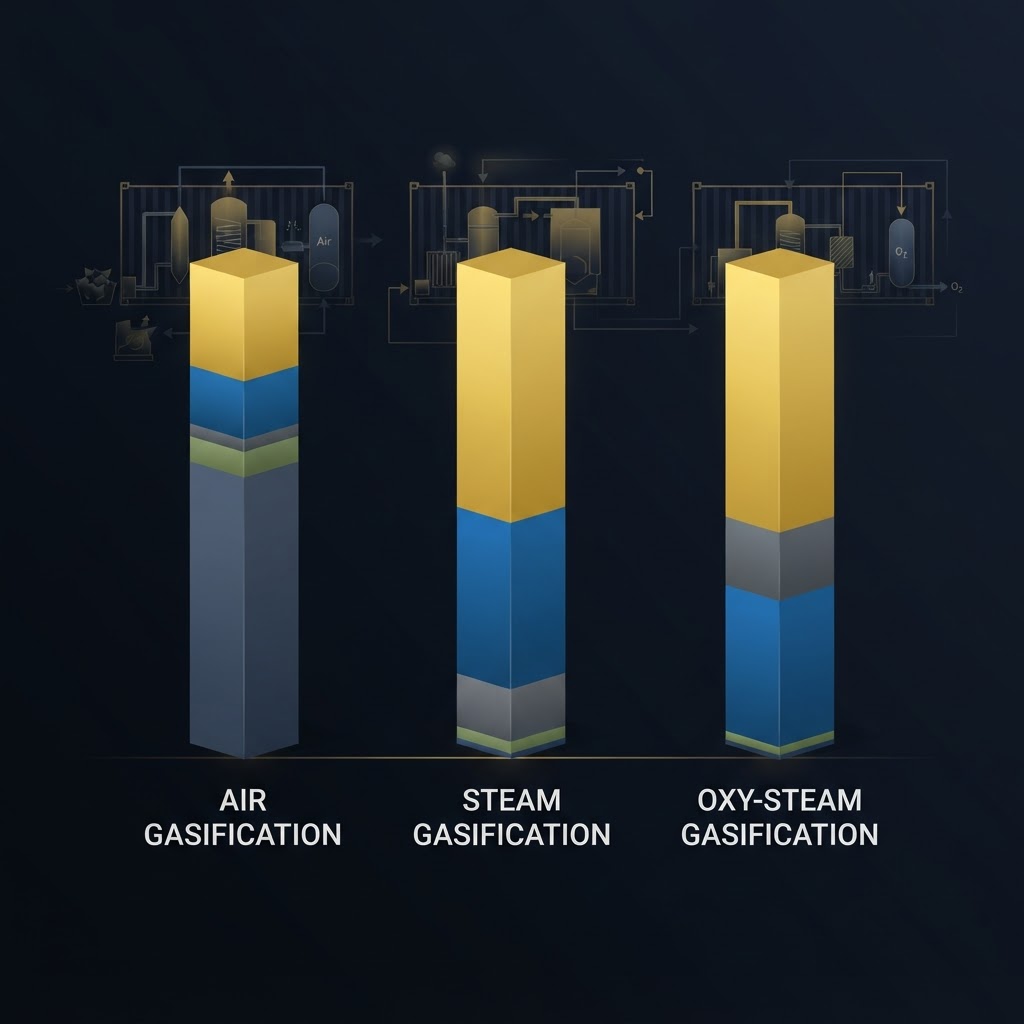
Ask for the syngas composition of a gasifier and the honest answer is a question back: blown with what? The same feedstock in the same reactor gives a gas that is half nitrogen with air, and a gas that is mostly hydrogen and carbon monoxide with steam and oxygen. Composition is not a property of the waste. It is a design decision, made mostly at the gasifier inlet.
The main components are always the same five: hydrogen (H2), carbon monoxide (CO), carbon dioxide (CO2), methane (CH4) and nitrogen (N2), plus water vapour, tar and trace contaminants. The literature draws a clean line through them. Gas made with air is called producer gas and is diluted with more than 45 vol% nitrogen; gas made with nitrogen-free agents carries 5 vol% nitrogen or less and is the true syngas that chemistry can use.
This guide gives the typical numbers, the levers that move each component, and one long-duration measured result from our own plant.
Typical syngas composition by gasifying agent
The ranges below are the reference values most engineers start from, from the same review cited above.
| Component (vol%) | Producer gas (air) | Syngas (O2 / steam) |
|---|---|---|
| Hydrogen, H2 | 13 to 19 | 20 to 40 |
| Carbon monoxide, CO | 18 to 22 | 35 to 40 |
| Carbon dioxide, CO2 | 9 to 12 | 25 to 35 |
| Methane, CH4 | 1 to 5 | 0 to 15 |
| Nitrogen, N2 | 45 to 55 | 2 to 5 |
| Lower heating value, MJ/Nm3 | 4.5 to 6.0 | 5.3 to 12.6 |
Air-blown producer gas
Air is the cheapest agent and the most common in small plants. In downdraft experiments published in 2025, pure air gave roughly 20% H2, 18% CO, 2% CH4, 15% CO2 and 45% N2. A separate comparison measured nitrogen at about 50% of the total volume when air was the agent. That gas burns well in an engine. It does very little else.
Steam and oxy-steam syngas
Swap air for steam and oxygen and the picture changes. In the same downdraft study, a feed of 20% oxygen and 80% steam produced more than 35% H2, 19% CO, 6% CH4, 30% CO2 and under 10% N2. With steam alone, one comparison reported 35.5% H2, 31.8% CO, 18.1% CO2 and 14.6% CH4, with the heating value rising from 9.3 to 13.1 MJ/Nm3 against air. In a fluidized bed test on wood sawdust, steam reached 31.5% hydrogen, oxygen 30.9%, and air only about 18.1%.
Why nitrogen is the enemy
Nitrogen does not react, does not burn and does not leave. Every cubic metre of it is a cubic metre you compress, clean, heat and cool for nothing. It is the reason producer gas sits at 4.5 to 6.0 MJ/Nm3 while syngas reaches 12.6.
More important, nitrogen closes doors. A methanol, Fischer-Tropsch or hydrogen train wants concentrated H2 and CO. Separating nitrogen out of a gas where it is half the volume is expensive, so the practical rule is simple: if you want chemicals or hydrogen, keep nitrogen out at the gasifier. Oxygen alone runs too hot, because it loses the cooling effect of nitrogen, which is why oxygen and steam mixtures are used to moderate temperature and push hydrogen up. That is oxy-steam mode, and it is the mode we run.
What moves the H2/CO ratio
The H2/CO ratio is the single number most downstream processes care about. Three levers set it.
Gasifying agent and steam
Steam drives the water-gas and water-gas shift reactions, so steam gasification produces higher H2/CO ratios than air or oxygen gasification. In a two-stage downdraft reactor fed with oxygen plus saturated steam, H2 ranged from 27.4 to 35.9% and LHV from 7.13 to 8.35 MJ/m3, nearly double the air case. The same review puts steam gasification at 10 to 18 MJ/Nm3.
Temperature
Higher temperature favours the endothermic reactions, raising H2 and CO and lowering CO2 and CH4, and it also cracks tar. There is a ceiling on the benefit for hydrogen: in the sawdust study, H2 peaked at 850 C for every agent and fell above it, while CO kept climbing.
Feedstock moisture
Wet feed acts like extra steam. Moisture raises H2 and CO2 and lowers CO and CH4, but the same work notes that the hydrogen gain does not fully compensate for the lost energy in the other gases. Drying still pays for itself on most waste streams.
What the composition decides downstream
Composition is where the gasifier and the business plan meet. Air-blown gas suits engines and boilers. A ratio near 2:1 with little nitrogen opens synthesis routes, and hydrogen-rich gas feeds shift and separation. We rank those outlets in detail in our guide to syngas applications, and walk through the full hydrogen route in how waste to hydrogen works.
Composition also sets the cleaning bill. Tar content, sulfur and ammonia vary with agent and feedstock, and they decide whether the gas is fit for an engine, a catalyst or a membrane. That is its own discipline, covered in tar removal from syngas. Reactor design matters too: fixed bed, fluidized bed and entrained flow units give different gas, as our overview of types of gasifiers explains.
A measured data point: 1,939 hours on digestate
Literature ranges come from short test runs on clean wood. Waste behaves differently, so here is what our X-150 produced over a long campaign. In an 80 day, 1,939 hour continuous run in Paris within the COMETHA project, the unit processed 16,382 kg of digestate pellets in oxy-steam mode and recorded:
- 33% hydrogen in the syngas
- an H2/CO ratio of 1.95:1
- zero nitrogen ballast
- 99.98% tar conversion
That ratio sits right at the 2:1 synthesis window, on a feedstock that clean-wood gasifiers are not built for. The zero nitrogen figure is the whole point of oxy-steam operation: the gas leaves the reactor already on the syngas side of the table above, not the producer gas side.
How to read a syngas analysis
Composition reports are easy to misread. Four checks before you compare two numbers:
- Basis. Is it wet or dry, and is it reported N2-free? An N2-free figure from an air-blown unit can look like syngas when it is not.
- Agent. A hydrogen percentage means nothing until you know what was fed alongside the feedstock.
- Duration. A snapshot from a stable hour is not a campaign average.
- Contaminants. Tar, H2S and NH3 rarely appear in the headline table but decide what the gas can be used for. Our SyngaPure cleaning module, selected for the German BMWK go-inno program, measures tar, H2S, NH3 and particulates in real time for exactly this reason.
FAQ
What is the difference between syngas and producer gas?
The gasifying agent. Air produces producer gas with 45 to 55% nitrogen. Oxygen, steam or oxy-steam produces syngas with 2 to 5% nitrogen, which can be used for hydrogen and chemical synthesis.
What is the heating value of syngas?
Roughly 5.3 to 12.6 MJ/Nm3 for oxygen or steam syngas, against 4.5 to 6.0 for air-blown producer gas. Steam gasification can reach 10 to 18 MJ/Nm3.
Does more steam always mean more hydrogen?
No. Hydrogen rises with steam and temperature up to a point, then falls; one study saw the peak at 850 C. Wet feedstock adds hydrogen but lowers overall energy conversion.
Can air-blown gas be upgraded to syngas later?
Not economically in most small plants. Nitrogen is locked in once air enters the reactor, so the choice between producer gas and syngas is made at the gasifier inlet.
Available for advisory work, board seats and media appearances.
Julien Uhlig advises boards and funds and briefs newsrooms across Europe and North America. Enquiries are read personally.
We use cookies to improve your experience on this site. By continuing, you agree to our Privacy Notice.