Biochar Production Plant Cost: Real CAPEX at Four Scales
Search for biochar production plant cost and you mostly find machine price lists with no context: a reactor number, a capacity in kilograms per hour, and nothing about what it takes to turn that reactor into a plant that runs. For a buyer in Europe or the US, the machine is only the start of the bill.
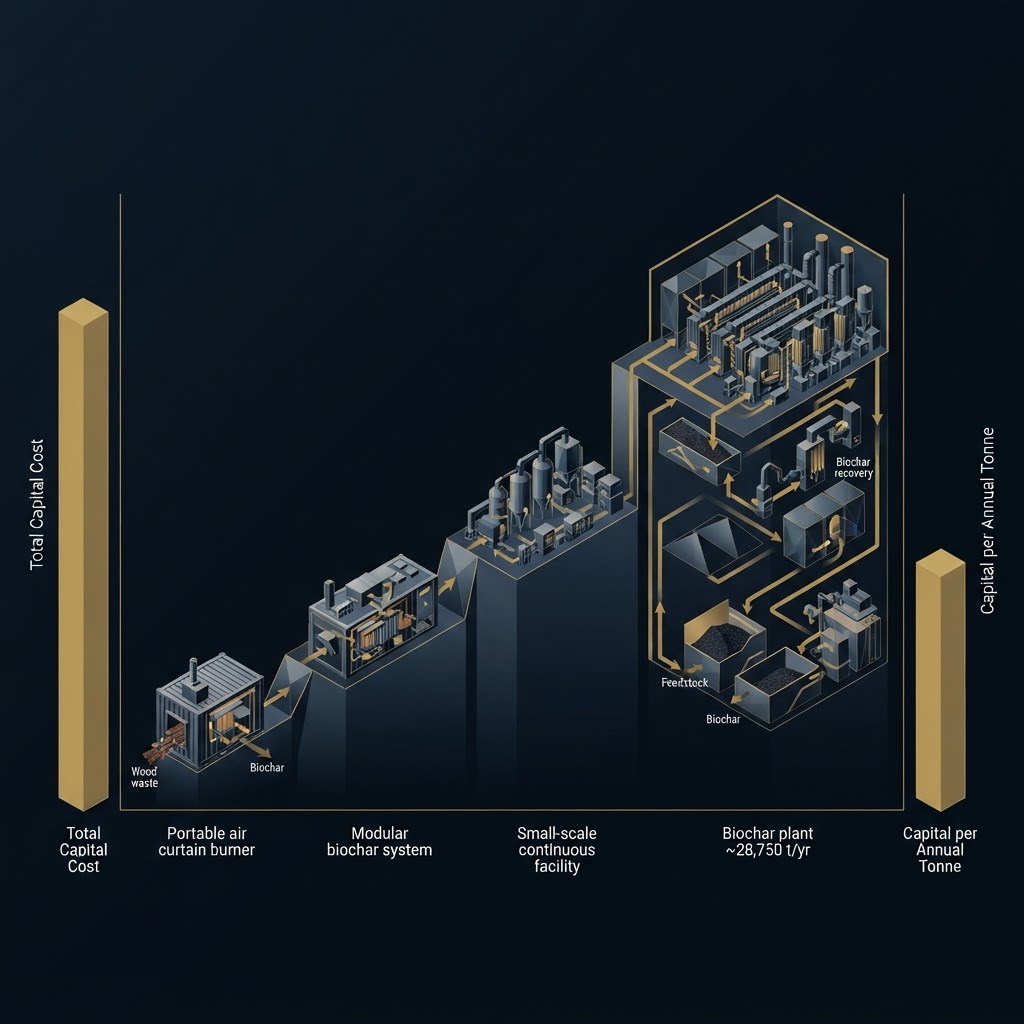
This guide lines up published capital costs for real plants at four scales, shows what the headline price leaves out, and explains how a plant earns its capital back. The short version: the price tag rises with capacity, the cost per annual tonne falls, and the plants with the best economics are the ones paid to take their feedstock.
Biochar production plant cost at four scales
These are documented figures from studies and project feasibility work, not vendor marketing.
| Scale | Setup | Capital cost |
|---|---|---|
| Portable | Air curtain burner system with loader and generator | $601,168 |
| Portable | Biochar Solutions system, two machines, pellet line | $764,899 |
| Modular stationary | Pyreg PX1500, 3,300 t/yr feedstock, plus dryer and pelletizer | EUR 2.35M equipment |
| Industrial | 10 MW pyrolysis plant, char and bio-oil | EUR 20.25M to EUR 25.93M |
| Large facility | 28,750 t/yr biochar, Florida | $52.688M |
| Refinery | 2,000 dry t/day slow pyrolysis | $128M |
The portable figures come from a techno-economic study of biochar pellet production from forest residues, which itemises every machine. The Pyreg figures are the equipment assumptions in the RWTH Aachen global biochar cost model. The 10 MW plant is a fully costed design in a 2024 pyrolysis plant analysis. The Florida facility is from a 2026 biochar manufacturing feasibility study, and the refinery case is a US slow pyrolysis techno-economic analysis.
Read the table as a ladder, not a menu. Each rung is a different business with a different feedstock supply, crew and customer, and the biochar production equipment that suits one rung rarely suits the next.
What the price tag includes and what it leaves out
Core reactor versus the full plant
The reactor is rarely the biggest number. In the portable study, the Biochar Solutions machines cost $340,000 each, and in the air curtain burner system the CAT loader alone cost $432,268, far more than the $168,900 burner it feeds. Material handling is a plant cost, and it is easy to forget when comparing reactor quotes.
The same pattern holds for stationary plants. The RWTH model prices the Pyreg PX1500 at EUR 2,000,000, then adds EUR 300,000 for a dryer and shredder and EUR 50,000 for a pelletizer. Preparation and pelletizing add 17.5% on top of the reactor before anything is built on site.
At industrial scale the extras multiply. The 10 MW design carries separate lines for biomass pretreatment, utilities, land, indirect costs of EUR 7.23M and working capital of EUR 0.96M. Indirect costs alone are more than a third of the EUR 20.25M total.
Operating costs that come with the plant
A plant cost is also a commitment to run it. The RWTH assumptions put maintenance at 2.5% of CAPEX a year and insurance at 0.5%, plus 288 MWh of electricity and 9,400 litres of LPG a year for one Pyreg module. The 10 MW plant needs EUR 2.99M a year in operation and maintenance. In the portable study, labor for one system was $166,800 a year, the largest single operating line.
Budget at least 3% of the equipment price per year for upkeep and insurance before labor, energy and feedstock, and ask every vendor what their figure assumes.
Capital per annual tonne: the number that compares plants
Absolute price tells you how much money you need. Capital per annual tonne tells you whether the plant makes sense. The Florida feasibility study states it directly: about $1,915.93 of invested capital per annual ton of biochar capacity.
Economies of scale are strong in biochar. An Aarhus University review of biochar production economics found that bigger plants produce cheaper char, but also that feedstock is bulky and expensive to haul, which favors large plants placed next to concentrated waste streams rather than large plants anywhere.
Capital matters because it does not go away when the plant idles. In a UK on-farm system, annualised capital was 38% of the cost of each tonne. Every day the plant stands still raises that share. If you are working back from plant cost to cost per tonne, our guide to biochar production cost per ton shows how utilisation, labor and feedstock move the number.
How the plant earns back its cost
Char and credit revenue
The Florida project shows what a bankable revenue mix looks like at scale: base-case revenue of $34.375M a year, of which $20.5M is contracted industrial biochar offtake and $8.9M carbon credits, for projected EBITDA of $16.5M. The study treated the offtake as the load-bearing revenue and stress-tested the credits rather than banking them at face value. That is the right instinct for anyone pricing a plant, and the wider question of whether margins hold is covered in is biochar production profitable.
Gate fees and energy sales
The Aarhus review adds the line that changes the plant's job. After counting revenue from nutrients and energy side streams, the net cost of biochar from straw was EUR 268 to 281 per tonne. From biogas digestate it was EUR -30 to -18, and from sewage sludge EUR -35 to -13. Negative means the plant earns money on each tonne before selling any char.
A plant on purchased straw has to recover its capital from char and credits. A plant on waste collects a disposal fee and sells energy, so the char becomes upside rather than the only way out. The economics of biochar from sewage sludge are the clearest European case.
Where a gasifier fits: biochar as a by-product
A pyrolysis plant is built to maximise char. A waste gasifier is built to convert waste into syngas, power, heat or hydrogen, and produces biochar alongside. The capital question becomes: what does an energy and disposal plant cost, and what does the char add on top?
Zero-X builds that second kind. The X-150, a 150 kg/h containerised fixed-bed downdraft gasifier, ran a 1,939-hour continuous campaign in Paris under the COMETHA project: 80 days without stopping, 16,382 kg of digestate pellets, 33% hydrogen in the syngas and 99.98% tar conversion. That is the utilisation that keeps capital per tonne down.
The platform has been validated at COMETHA, at Verkoso (Fraunhofer IKTS) and at Hochschule Zittau/Goerlitz on high-ash sludge, MSW and digestate, the feedstocks with negative net cost in the Aarhus data. In Zero-X's target markets, governments fund 56 to 70% of project capital, which cuts the capital line before the first tonne. See grants for biochar production for the routes.
We do not publish a list price, because the plant cost for a waste site depends on feedstock preparation, the energy product and site integration. Those are the same variables that move every number in this guide.
A checklist for pricing your own plant
Before comparing quotes, get these six answers in writing:
- Scope. Does the price cover the reactor only, or feedstock drying, shredding, handling, pelletizing and emissions control?
- Throughput. Tonnes of feedstock and tonnes of char per year at realistic operating hours, not nameplate.
- Feedstock. Is the plant proven on your feedstock, including its moisture and ash, over a long continuous run?
- Operating cost. Maintenance, insurance, energy and crew per year, as numbers.
- Energy balance. Does the plant buy energy or sell it, and in what form?
- Funding. Which grants and offtake contracts reduce the capital you must finance?
Divide the full installed cost by the realistic annual tonnes of char and compare it with the $1,915.93 benchmark above. If your plant also earns a gate fee and sells energy, that comparison flatters standalone pyrolysis, and the per-tonne capital stops being the deciding number.
FAQ
How much does a small biochar machine cost?
In the forest residue study, a complete portable system cost between $601,168 and $764,899 once loaders, generators and pelletizers were included. The Biochar Solutions machine itself was $340,000 per unit.
How long is a biochar plant expected to last?
The RWTH model assumes a 20-year lifespan for a stationary Pyreg plant. The portable study used a 10-year economic life for its equipment, with 10 to 20% salvage value.
Is a bigger biochar plant always cheaper?
Per tonne, usually yes, because of strong economies of scale. But feedstock is bulky and costly to transport, so large plants pay off best next to concentrated waste such as sewage sludge or digestate.
Available for advisory work, board seats and media appearances.
Julien Uhlig advises boards and funds and briefs newsrooms across Europe and North America. Enquiries are read personally.
We use cookies to improve your experience on this site. By continuing, you agree to our Privacy Notice.