Biochar Production in Nigeria: Feedstocks, Markets, Models
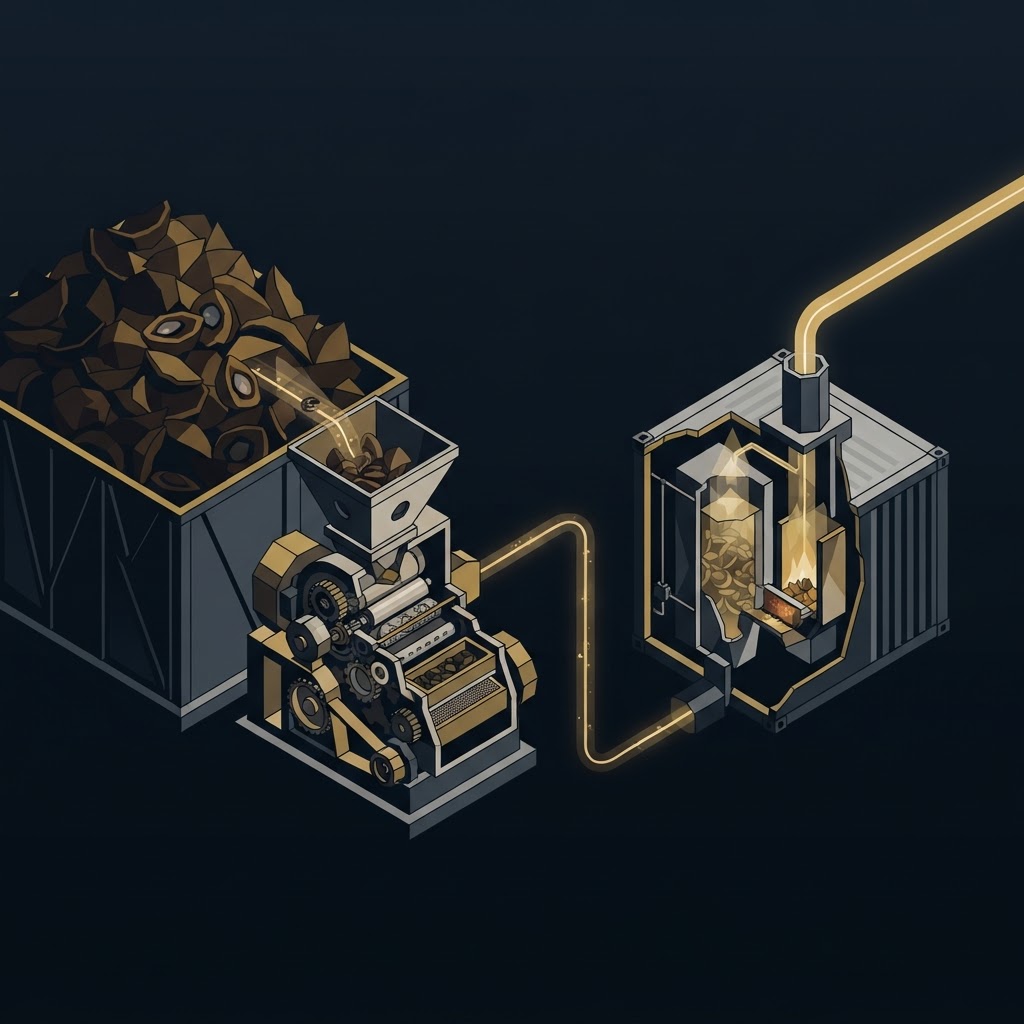
Biochar production in Nigeria crossed a line in 2025. For a decade it lived in university labs and on demonstration plots. Then Releaf Earth opened the country's first industrial biochar plant in Iwuru, Cross River State, running on palm kernel shells. In March 2026 a second model appeared in the north, when AirSmat and Dantata Foods announced a corn cob biochar project in Kano.
This guide is written for developers, agro-processors and partners deciding whether to build. It covers three things: what residue actually exists and where, how the first producers make money, and which machine model fits a country where most power comes from generators.
Why biochar production in Nigeria is moving from lab to plant
The research base is older than the plants. A review of Nigerian biochar studies by Ighalo and Adeniyi collects local work on elephant grass, plantain fibre, maize cob, rice husk and sawdust. One result shows the scale of those trials: elephant grass in a self-regulating hybrid gasification set-up gave a 14.29 wt% char yield at a peak of 300 C.
What changed is the money, not the chemistry. Releaf's founders told Ross Kenyon that the economics only worked once carbon removal credits entered the picture. Credits pay for production in the short term while a soil market for the char is built over the medium term. Two other things fell into place at the same time. Agro-processors had residue piles they were paying to get rid of, and there were now registries willing to verify African biochar.
Feedstock: what Nigeria actually has, and where
Every serious biochar plan starts with one question: what residue can you get, every month, at the plant gate?
The national residue pool
The most complete national estimate, by Ezealigo and colleagues, covers 27 residues from 17 crops using FAOSTAT data for 2008 to 2018. It puts the average theoretical crop residue at 109 Mt per year, of which 84 Mt is technically available. In 2018 Nigeria produced 10.2 Mt of maize, 6.81 Mt of rice and 7.85 Mt of oil palm fruit by the same FAOSTAT series.
Residue-to-product ratios tell you how much of each harvest becomes potential feedstock. The study uses 0.26 for rice husk, 0.29 for maize cobs and 0.07 for oil palm kernel shell. An older review by Anyanwu and colleagues put rice husk at about 0.540 Mt a year. It also counted 0.246 Mt of palm shells and 0.344 Mt of empty fruit bunches in 2012.
Southern belt: palm kernel shell and cashew
The regional feedstock review in Soil Systems identifies palm kernel shells, plantain and banana peelings as the southern feedstocks. Palm kernel shell is the one that has scaled, for a simple reason. It is dense, dry compared with peels, and it piles up in one place at a nut-cracking or milling site. Releaf's own Kraken nutcracker has processed more than 10,000 tonnes of palm nuts, which is where its char feedstock comes from.
Cashew is the second southern stream. Revata Carbon and Valency International are converting cashew shell waste at Valency's facilities in Nigeria and Ivory Coast, with 35,000 tonnes of waste processed a year across the project.
Northern belt: maize cobs, rice husk and stovers
In the far north the same review lists maize, sorghum and millet stovers and rice straw and husk as abundant after harvest, with no proper disposal in place. The Kano project picked corn cobs, with Dantata Foods providing farmer access, feedstock aggregation and warehousing. It is the template for the north. The developer runs the pyrolysers, and an established agribusiness with a farmer network handles collection.
Competing uses you must price in
Residue is not free just because it is burned in the field. A biomass resource assessment by Jekayinfa and colleagues notes that agricultural residues compete with livestock feed and soil rejuvenation, and cassava peels mostly go to animal feed today. Collection costs also vary a lot. An earlier study by Jekayinfa and Scholz put crop residue cost at US$6.45 to US$23.12 per tonne in 2008 terms, depending on the residue and the transport distance. The practical rule: build next to the mill that already concentrates the residue, not in the middle of the fields.
Who is producing biochar in Nigeria today
Three distinct models are visible, and they are not competing for the same thing.
| Model | Example | Feedstock | Main revenue |
|---|---|---|---|
| Industrial agro-processor | Releaf Earth, Cross River | Palm kernel shell from own nut processing | Carbon removal credits via Riverse Registry, soil product |
| Aggregator partnership | AirSmat and Dantata Foods, Kano | Corn cobs from a farmer network | Carbon removal credits with digital MRV |
| Farmer cooperative | SAA groups, Nasarawa | Crop and kitchen waste | Local sales of biochar and bokashi |
Releaf is the scale reference. Its Iwuru plant targets the removal of 40,000 tonnes of CO2e by 2030, with expansion planned for a further 60,000 tonnes at other sites. It secured a credit offtake with Milkywire's Climate Transformation Fund.
At the other end, the Sasakawa Africa Association trained two cooperatives in Nasarawa State to make biochar and bokashi, then linked them to a buyer for 2,000 kg valued at N158,000 (about $166).
The revenue question: soil product, carbon removal or both
Those two numbers frame the business. The cooperative price is real, but it shows that a soil product alone, sold to smallholders, is a thin market today. The industrial players lead with carbon removal and treat soil sales as the market they are building.
Agronomic results are what will make that soil market real. Releaf reports a 23% crop yield increase among farmers using biochar in its 2024 Cross River pilot. SAA's demonstration plots in Nasarawa showed a 19% increase in rice production against conventional practice. Both are early, local results, not a national average. They are still the evidence a Nigerian farmer will ask for.
Carbon revenue brings its own rulebook: permanence, application records and third-party verification. Energaia explains how biochar carbon credits work from certification to issuance. We cover what operators need in our guide to biochar carbon credits, and the full revenue stack in whether biochar production is profitable. The short version for Nigeria: plan your monitoring from day one, because both Releaf and the Kano project built verification into the operation instead of adding it later.
Choosing a production model for Nigerian conditions
Why power independence matters
Any biochar plant in Nigeria has to answer the power question first. The World Bank's National Energy Compact for Nigeria reports 61% electricity access in 2022, leaving more than 86 million people without power. Estimates put generator supply at about ten times the grid's roughly 4 GW. In rural areas, where residues are, the IEA country profile puts access at 37%. The country's NDC aims to eliminate diesel generators by 2030.
The Nigerian literature reached the same conclusion from the farm side. Ighalo and Adeniyi argue that a thermal process with no external power requirement will gain far more acceptance, because supply is unreliable and absent in remote areas. A continuous plant that needs a diesel genset to run its dryer, auger and controls is carrying a fuel bill the business plan rarely shows.
Kilns and pyrolysis: more char
If char is the only product, slow pyrolysis is the right tool. The same review notes that pyrolysis yields are generally higher than gasification yields across Nigerian studies, because the oxygen in gasification burns part of the carbon. This is the route Releaf and AirSmat took. It suits a site whose income is mainly carbon removal per tonne of char.
Gasification: power plus char
If the site also needs electricity, the trade flips. A downdraft gasifier gives up some char yield and in return makes a combustible syngas that can run an engine. So the residue that feeds the char line also powers the mill, the dryer or a nearby mini grid. We explain the mechanics in gasification biochar production, and the wider power case in waste to energy in Nigeria and off grid power solutions for Africa.
This is the space the Zero-X X-150 was designed for. It is a containerized 150 kg/h fixed-bed downdraft gasifier that turns waste into syngas, hydrogen and biochar. It has been validated on high-ash sludge, MSW and digestate, feedstocks that clean-wood gasifiers cannot handle. Reliability is what matters on a remote site with no service engineer nearby. The X-150 completed a 1,939-hour continuous campaign in Paris, processing 16,382 kg of digestate pellets. To be clear, it is a power-first, char-second machine. If you want maximum char per tonne, a pyrolyser will give you more.
A practical checklist before you build
- Lock the feedstock. Sign with the mill or aggregator that already concentrates the residue, and test moisture across both the rainy and dry season.
- Know your competing uses. If the residue already goes to feed or fuel locally, price it at that value, not at zero.
- Pick the product mix first, then the machine. Char only points to pyrolysis. Char plus site power points to gasification.
- Count your own energy use. Put generator fuel for drying and handling into the model, or design it out.
- Build MRV into operations. Feedstock logs, production records and application data are the credit, so start recording on day one.
- Line up the soil buyer. Even with carbon revenue, a local agronomic market is the long-term floor, and yield trials are how you earn it.
FAQ
What is the best feedstock for biochar in Nigeria?
Process residues already collected at one site. Palm kernel shell from nut-cracking and milling is the proven choice in the south. Maize cobs and rice husk from processors fit the north. Field stovers are plentiful but costly to collect.
How much does biochar sell for in Nigeria?
Public local prices are scarce. The clearest data point is a Nasarawa cooperative sale of 2,000 kg of biochar and bokashi for N158,000, about $166. Industrial producers currently earn mainly from carbon removal credits rather than local char sales.
Can biochar be produced in Nigeria without grid electricity?
Yes, and the Nigerian research literature says it should be. Self-heated kilns and gasifiers that generate their own power avoid dependence on an unreliable grid or a diesel generator.
Does biochar actually raise crop yields in Nigeria?
Early field results are positive. Demonstration plots in Nasarawa showed 19% more rice, and Releaf reported a 23% yield increase in its Cross River pilot. These are local pilot results, so run your own trials before promising farmers a number.
We use cookies to improve your experience on this site. By continuing, you agree to our Privacy Notice.