Biochar Production Carbon Credits: Operator Rules
Most pages about biochar production carbon credits are written for the people who buy them. This one is written for the people who make the char. If you run, or plan to run, a gasifier on sludge, digestate, straw or municipal waste, the credit is not something you apply for at the end. It is a property of the plant, the feedstock and the paperwork from the first day of operation. Get those three right and the registry audit is a formality. Get them wrong and no amount of marketing turns your char into a certified removal.
What a registry is actually paying for
A biochar credit is a claim that one tonne of CO2 was pulled from the atmosphere by plants, locked into stable carbon by heat, and will stay out of the air for a very long time. Puro's methodology quantifies that removal over a 100-year horizon and accepts biomass heated with no or limited oxygen, whether by pyrolysis or gasification. Verra's VM0044 draws the same line: pyrolysis, gasification and biomass boilers are eligible, torrefaction and hydrothermal carbonisation are not.
How much one tonne of char is worth in credits depends on its carbon content and stability, but the working range is two to three tonnes of CO2 per tonne of biochar once process emissions and a permanence discount have been deducted. That ratio is the single most important number in the economics below, and it is set by how you run the machine, not by the registry.
The five things your plant must prove
Stable carbon: the H/Corg ratio
The molar ratio of hydrogen to organic carbon is the lab proxy for how aromatic, and therefore how durable, the char is. The certification thresholds are 0.7 as the ceiling for any credit and 0.4 as the mark of industrial-grade char, with the European Biochar Certificate assuming a 0.3 percent annual carbon loss for compliant material. Lower is better, and the lever that drives it down is temperature. The European Union's new removal framework uses the same cut-off: under the CRCF delegated act biochar with an H/Corg above 0.7 earns no units at all.
An eligible feedstock, and a clean one
Registries publish positive lists of biomass categories. The harder rule for waste operators is impurities. Puro's 2025 edition is blunt about it: a 1 percent level of metal, glass or mineral impurity in the feedstock can become 4 to 10 percent in the biochar, and plastics that volatilise and burn can push project emissions up significantly. The supplier must report impurity levels per biomass batch. For mixed municipal waste or digestate, that means pre-sorting and sampling are part of the credit, not an optional upgrade.
Additionality when disposal is already regulated
Sewage sludge is the feedstock where this matters most. The same Puro edition requires that when a feedstock must already be treated or disposed of by law, and that disposal is an existing cost to whoever manages it, the financial additionality analysis must compare the project against that avoided cost. A plant that charges a gate fee and earns credits on the same tonne is allowed, but the model has to show both honestly. Our own guide to biochar production from sewage sludge covers the phosphorus side of that story.
A facility audit before the first credit
Credits are not issued on a promise. Puro requires a third-party Production Facility Audit, conducted on site by default, before any removal certificate can be issued, and then sets a crediting period of 10 years per facility that can be renewed twice against the latest methodology. Output audits follow during operation. In practice this means the commissioning data, the lab method and the metering plan are reviewed by an auditor who has seen a lot of plants, and gaps found at that stage delay revenue by months.
An end use that keeps the carbon in the ground
The removal only counts if the char goes somewhere it stays. Puro requires storage of at least 200 years with low reversal risk, through soil application or incorporation into materials. The European rules add a hard agronomic cap of 50 tonnes per hectare cumulative for soil use and a minimum production temperature of 350 degrees Celsius. An operator who cannot evidence delivery to an eligible end user has produced char, not credits.
Why gasifier char is different from pyrolysis char
Gasification runs hotter and leaner than slow pyrolysis. It yields less char per tonne of feedstock, because more of the carbon leaves as syngas, but the char it leaves behind is typically more carbonised and sits lower on the H/Corg scale. That is the trade a waste-to-energy operator makes: energy and hydrogen from the gas, a smaller but more stable char stream from the bottom of the reactor.
This is the configuration Zero-X has run at scale. Jenja completed a 1,939-hour continuous campaign in Paris, processing 16,382 kg of digestate pellets with 33 percent hydrogen in the syngas and 99.98 percent tar conversion. The platform has been independently validated at COMETHA, Fraunhofer IKTS and Hochschule Zittau/Goerlitz on high-ash sludge, municipal solid waste and digestate, which are the feedstocks that clinker in clean-wood gasifiers and that the methodologies subject to the strictest impurity rules. We will go deeper on the reactor side in a dedicated piece on biochar from gasification.
The point for a credit project is simple. A gasifier that holds temperature for 80 days on a difficult feedstock produces char with a consistent H/Corg signature. Consistency is what makes batch sampling cheap and what makes an auditor comfortable.
The data log a gasifier operator keeps from day one
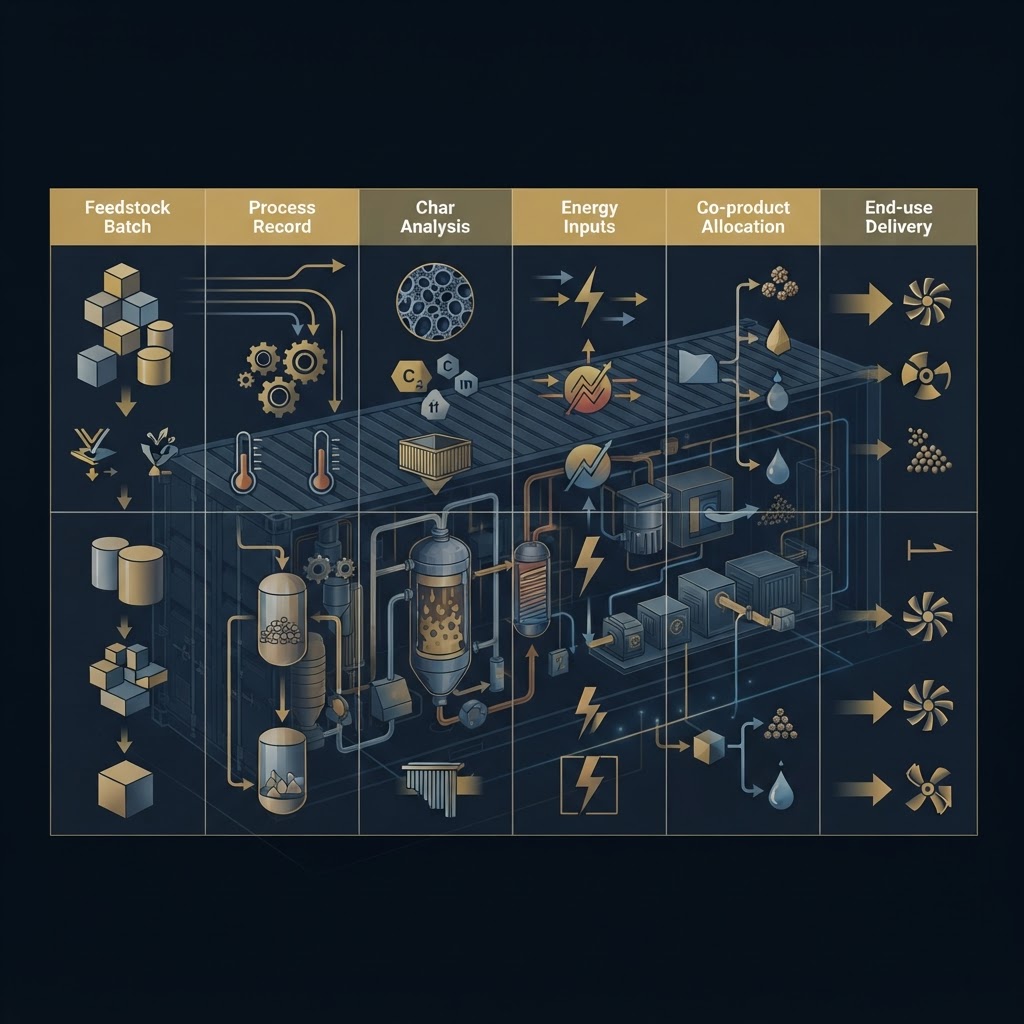
Every methodology ends up asking for the same evidence. The protocol comparison published by the Environmental Defense Fund shows the common core: a cradle-to-grave life-cycle assessment of the project, lab-measured organic carbon content of the char, and H/Corg used as the persistence factor. Translate that into a plant logbook and you get six columns:
- Feedstock batch: source, category on the registry's positive list, mass, moisture and measured impurity level.
- Process record: reactor temperature trace and residence time per batch, because both the 350 degree floor and the H/Corg outcome are argued from it.
- Char analysis: organic carbon and H/Corg from an accredited lab, per production batch or per sampling interval the auditor accepts.
- Energy and inputs: electricity, auxiliary fuel, oxygen or steam, and transport distances for the life-cycle assessment.
- Co-product allocation: how much syngas energy was exported, which matters both for the LCA and for the European rule discussed below.
- End-use delivery: who received the char, how many tonnes, the application, and the land or product it went into.
An operator who starts logging these on commissioning day has an audit file. One who starts when the first buyer asks has a reconstruction project.
What the credits are worth to the plant
The market is no longer small. CDR.fyi counts 3.04 million tonnes of biochar removal contracted between the start of 2022 and mid 2025, 1.6 million of them in the first half of 2025 alone, with 658 thousand tonnes delivered. On price, Sylvera puts the average biochar credit at 164 US dollars per tonne in 2025, up from 131 dollars in 2023, and Puro's Nasdaq-calculated biochar index CORCCHAR stood at 129.21 euros per tonne in July 2026.
For a plant, the arithmetic is char tonnes multiplied by the tCO2 ratio multiplied by the realised price, minus certification and sampling costs. Combined with gate fees and energy sales, the credit line is what turns the answer to is biochar production profitable from "it depends" into a number. We break down the cost side in biochar production cost per ton, and the capital side is softened where grants for biochar production are available. For the buyer's view of the same credits, and the checklist a serious offtaker will run on your plant, Energaia has written up whether biochar carbon credits are reliable, and that is the lens your first buyer will use.
Europe's second door: CRCF units
Voluntary registries are no longer the only route. The EU Carbon Removals and Carbon Farming regulation's first certification methodologies, including biochar, entered into force on 7 May 2026. The biochar rules set a five-year activity period with a zero baseline and a condition that waste-to-energy operators should read twice: feedstocks used for energy output are capped so that no more than half of the biomass may go to energy if the activity is to be certified as a removal. Certification schemes are still being recognised, and the first units are expected at the end of 2026 and into 2027, with the Union registry due by the end of 2028.
For a European gasifier project, the practical consequence is to design the plant so that the same batch records satisfy both a voluntary methodology today and a CRCF-recognised scheme tomorrow. The H/Corg threshold is identical, the temperature floor is easy to clear, and the energy-output rule is a design choice about how much syngas you export versus how much char you make.
FAQ
Does biochar from gasification qualify for carbon credits?
Yes. Verra's VM0044 lists gasification among its eligible conversion processes alongside pyrolysis and biomass boilers, and Puro defines eligible production as heating biomass with no or limited oxygen, which covers gasification. What is excluded is torrefaction and hydrothermal carbonisation, because the resulting carbon is not stable enough.
How many carbon credits does one tonne of biochar generate?
The working range is two to three tonnes of CO2 per tonne of biochar after process emissions and the permanence discount are subtracted. The exact figure depends on the measured organic carbon content and the H/Corg ratio of your char, which is why high-temperature gasifier char tends to sit at the upper end.
Can sewage sludge biochar earn credits?
It can, with two extra tests. The feedstock must be sampled and reported for impurities per batch, and because sludge disposal is already a legal obligation with a cost, the financial additionality analysis must account for that avoided disposal cost rather than ignore it. Puro's 2025 methodology addresses sludge explicitly.
How long does a biochar crediting period last?
Under Puro, a production facility is credited for 10 years from its first monitoring period, and that period can be renewed twice by passing a new facility audit against the methodology in force at the time. Under the EU's CRCF biochar rules the activity period is five years.
We use cookies to improve your experience on this site. By continuing, you agree to our Privacy Notice.