Syngas Price: What Gasifier Gas Costs per MWh and Nm3
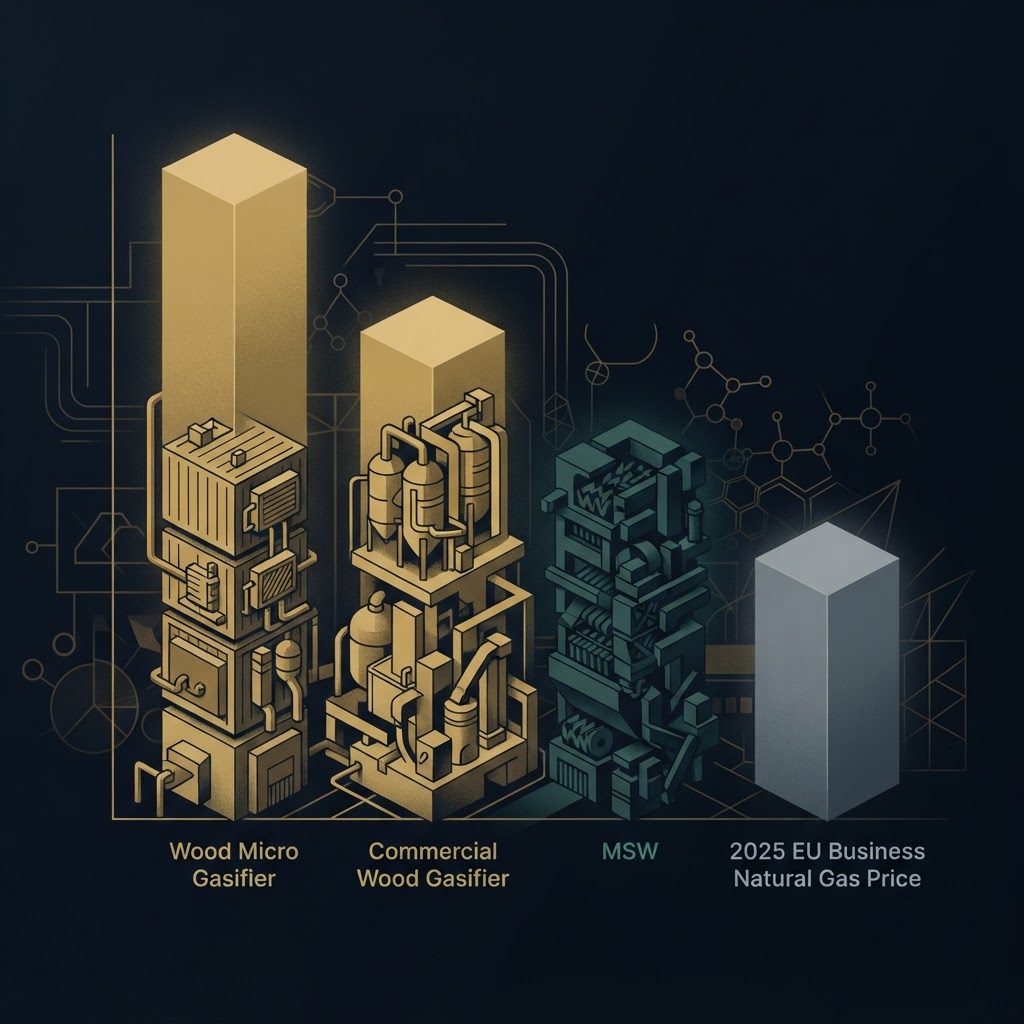
The syngas price you will find quoted runs from about 15 EUR per MWh to well over a dollar per Nm3. Both figures are honest. They describe different machines, different fuels and different operating hours. Syngas is not traded on any exchange. It is made next to the engine, burner or reactor that uses it, so its price is its production cost, and that cost is set by four or five levers you can actually control.
This page puts the published numbers side by side in the same units, compares them with what industry pays for natural gas in Europe today, and then shows the lever most pages leave out: when the feedstock is waste, the fuel is no longer a cost line. Someone pays you to take it.
Why syngas has no market price
Natural gas has a hub price because it moves through pipelines between strangers. Syngas almost never leaves the site. It is a low-calorific mix of hydrogen, carbon monoxide, methane, CO2 and, in air-blown units, a lot of nitrogen, so it is not worth compressing and shipping. Vendors such as Spanner Re2 sell the gasifier and let the customer burn the gas directly in place of natural gas in industrial furnaces.
The nearest thing to a market rate comes from India, where a 2026 techno-economic study cites reported market rates for biomass syngas of 0.07 to 0.10 USD per Nm3 and prices the gas on an energy basis of one rupee per MJ. That energy basis is the right instinct. A Nm3 of syngas can hold anywhere from weak producer gas to strong oxygen-blown gas, so always convert to MWh before you compare. Our guide to syngas heating value has the constants and a worked conversion, and how much syngas a gasifier produces covers the yield side.
Syngas price in numbers: the published figures side by side
| Source | Setup | Syngas cost | Benchmark |
|---|---|---|---|
| Mississippi State model (2008 USD) | 60 Nm3/h wood gasifier, 1,820 h/yr | $1.22 per Nm3 | Natural gas $0.41 per Nm3 |
| Wei et al., ASABE (2008 USD) | 60 Nm3/h micro gasifier | $0.55 per Nm3, $0.095 per MJ | Natural gas $0.357 per Nm3, $0.009 per MJ |
| Oklahoma State, MDPI Energies 2020 | Literature values | Wood $0.042/kWh, MSW $0.02/kWh | Asian industrial gas $10 to 15/MMBtu |
| Spanner Re2 brochure | Commercial wood gasifier, long runtime | From 15 EUR/MWh (free fuel), from 35 EUR/MWh (fuel at 100 EUR/t dry) | Not stated |
| Eurostat, H2 2025 | EU non-household gas | n/a | 60.5 EUR/MWh EU, 71.3 EUR/MWh Germany |
The sources: the Mississippi State cost model, Wei et al., Indrawan et al. in Energies, the Spanner Re2 brochure, and Eurostat's non-household gas release, which puts the EU average at 6.05 EUR per 100 kWh, Germany at 7.13 and Bulgaria at 4.14.
Per Nm3 vs per MWh: convert before you compare
Read the Wei numbers carefully. Per Nm3, their syngas looks only about 50% dearer than natural gas. Per MJ it is roughly ten times dearer, because a Nm3 of air-blown syngas carries a fraction of the energy of a Nm3 of methane. This is the most common mistake in syngas price comparisons, and it is also how vendors get flattering headlines. Ask for EUR per MWh of lower heating value, at a stated gas composition, or do not compare at all.
On a per-MWh basis the picture splits in two. Micro-scale wood gasifiers running one shift are far above the gas price. Well-utilised commercial units on cheap fuel sit at 15 to 35 EUR/MWh against a European gas price of about 60 EUR/MWh. Same molecule, opposite verdicts.
What sets the price of syngas
Feedstock
Fuel is the first line. The Bioenergy Association of New Zealand's 2024 gasification review notes that feedstock can contribute up to 50% of the cost of gasification electricity, puts gasification OPEX at 50 to 250 EUR per MWh and LCOE at 0.06 to 0.29 EUR per kWh. In the Re2 figures, moving from free fuel to fuel at 100 EUR per dry tonne more than doubles the gas cost, from 15 to 35 EUR/MWh.
Labour
At small scale, people cost more than wood. Wei et al. found labour could reach 61.56% of total annual syngas cost at 60 Nm3/h, and the Oklahoma 60 kW plant had labour at 54% of operating cost. Automation and remote monitoring are not nice extras in a small plant. They are the price.
Operating hours
The Mississippi model ran 1,820 hours a year, one shift. Every fixed euro is spread over those hours. Re2 states plainly that its low figures require a long system runtime and constant energy demand throughout the year. A gasifier that runs half the year costs roughly twice as much per MWh in capital and staffing.
Scale
The same Mississippi model found that syngas cost fell close to the natural gas price once capacity passed 230 Nm3/h. Between 60 and 1,800 Nm3/h, Wei et al. saw the dominant cost shift from labour to equipment. If you are pricing a unit by the kW, see our breakdown of small biomass gasifier price.
Gas cleaning
In the Oklahoma plant, syngas cleaning was the second-largest operating cost after labour, including hazardous disposal of spent scrubbing solution. Cleaning is where waste-fed plants either earn their premium or lose it, which is why we treat syngas cleaning as a design driver rather than an add-on.
The gate fee changes the math
Look again at the Oklahoma figures: syngas from wood at about $0.042 per kWh, from municipal solid waste at about $0.02. Waste gas is cheaper not because the chemistry is kinder (it is harder) but because the fuel arrives with money attached.
What waste owners already pay
Waste owners pay to get rid of material. The European Investment Bank's RDF guide reports incineration costs of 70 to 254 EUR per tonne across the EU-27, and landfill costs anywhere from 0 to 950 EUR per tonne depending on restrictions. For sewage sludge, a survey of Northern Italian tenders found the awarded median cost for the whole sludge service rose from 62.4 EUR/t in 2015 to 122.2 EUR/t in 2021. For current rates by disposal route, see this breakdown of waste disposal cost per ton.
Run the Re2 slope backwards and you see why this matters. In their figures, paying 100 EUR per dry tonne adds about 20 EUR/MWh to the gas. That is our extrapolation, not their claim, and gate fees are paid per wet tonne, but the direction is clear: a fuel that pays you pushes the production cost of the gas toward zero, and in good markets below it. The gas price stops being the business. Waste disposal becomes the business and the syngas is the product you sell on top.
Worked example: one X-150
This is arithmetic on the figures above, not a quote or a forecast. The X-150 is a containerised gasifier rated at 150 kg of waste per hour. If a unit ran 8,000 hours in a year, it would take in 1,200 tonnes. At the EIB incineration range of 70 to 254 EUR per tonne, the avoided disposal cost on that tonnage is about 84,000 to 305,000 EUR a year, before a single kWh of gas is sold. Your local gate fee, actual availability and permitting decide where in that range a real project lands, and some feedstocks need drying or pelletising first, which costs money too.
That is the comparison a buyer should run: not syngas against natural gas, but syngas plus avoided disposal against natural gas plus the disposal bill. The cost to build a waste-to-energy plant is the other half of the equation.
Syngas price for hydrogen
When syngas is an intermediate for hydrogen, its price shows up in the cost per kg of H2. The IEAGHG critical study finds gasification needs about 23 kg of MSW per kg of hydrogen, that a tipping fee further reduces the levelised cost, and that waste-to-hydrogen with CCS currently lands at 5.15 to 14.91 USD/kg. A 2026 Canadian study for the Northwest Territories found the same pattern: hydrogen from forest biomass at $19.09/kg against $13.75/kg from tyre waste once tipping fees are counted. Same process, fuel that pays you, lower cost. Our page on waste-to-hydrogen efficiency covers the conversion losses.
How Zero-X approaches syngas cost
We built the X-150 around the levers above. It is designed for the feedstocks that carry gate fees, the ones clean-wood gasifiers cannot handle: it has been validated on high-ash sewage sludge, MSW and digestate at Paris COMETHA, Fraunhofer IKTS and Hochschule Zittau/Goerlitz. In a 1,939-hour continuous campaign in Paris, 80 days without a stop, it processed 16,382 kg of digestate pellets and produced syngas with 33% hydrogen in oxy-steam mode. Long, unbroken runtime is the operating-hours lever in practice.
The capital lever is the other one. In our Wave 1 markets, validated grant routes cover 56 to 70% of project CAPEX, for example 70% in Andalusia, 60 to 72% in Alentejo and 56% in Patras. Our guide to government grants for waste to energy explains how those routes work. Lower capital per MWh, a fuel that pays you and long runtime: that is how a syngas price gets below the gas bill.
FAQ
Is syngas cheaper than natural gas?
It depends on the setup. Micro-scale wood gasifiers on one shift cost several times more per MWh than natural gas. Commercial units on free or paid-for fuel, running most of the year, can produce gas from about 15 EUR/MWh, against an EU business gas price of about 60 EUR/MWh in late 2025.
What is the price of syngas per kg?
It is rarely quoted per kg, because syngas density changes with composition and the gas is sold by energy, not mass. Convert to MJ or MWh using the gas analysis, then compare.
How much does electricity from syngas cost?
Published ranges for gasification power run from about 0.06 to 0.29 EUR per kWh. Re2 quotes electricity from 8 ct/kWh with free fuel and the heat used, rising to 23 ct/kWh with paid fuel and no heat use.
Can you buy syngas?
Not as a traded commodity. You buy or license the gasifier, or sign a heat or gas supply contract with whoever operates it on your site.
We use cookies to improve your experience on this site. By continuing, you agree to our Privacy Notice.