Hybrid Solar Biomass Gasification Mini Grid: Sizing Guide
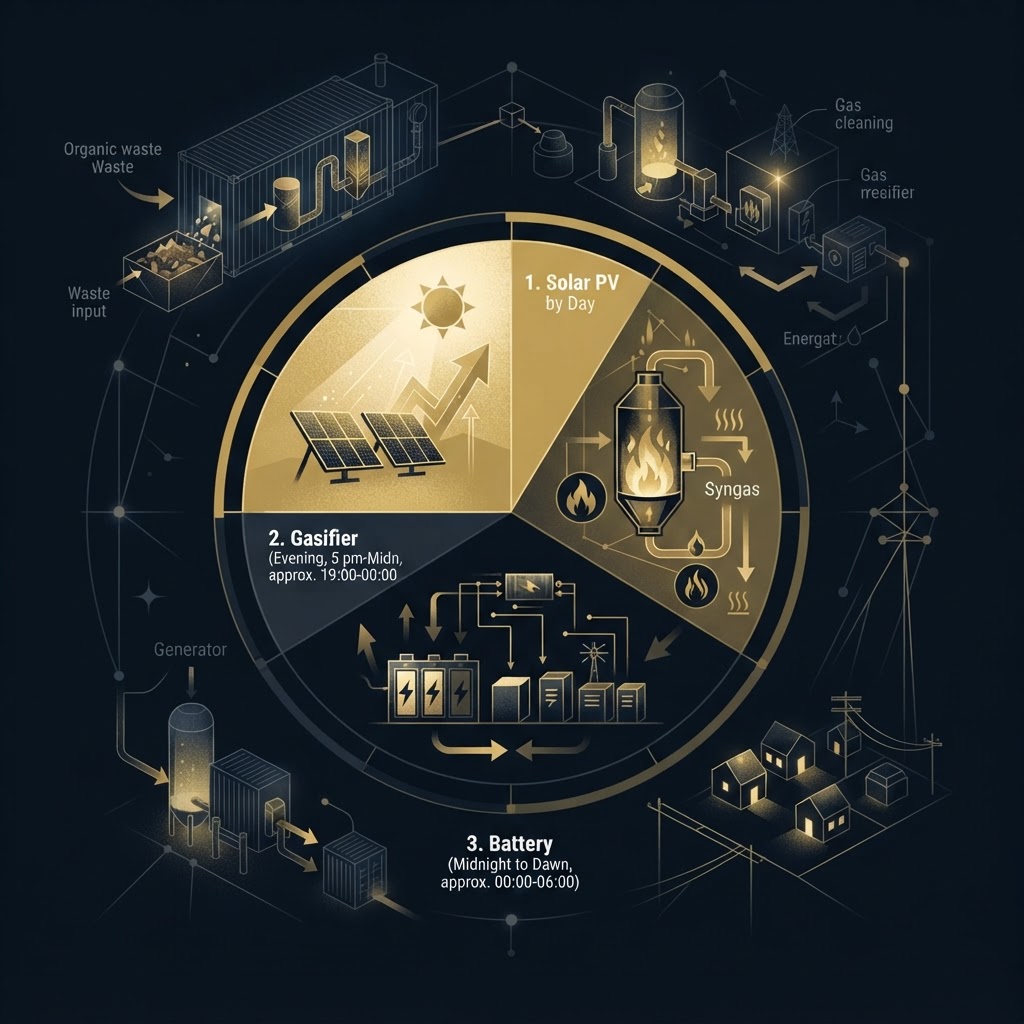
A hybrid solar biomass gasification mini grid solves the one problem a solar mini-grid cannot solve cheaply: the evening. Panels deliver at noon, villages and resorts consume after sunset, and every kilowatt-hour you move from noon to 9 pm through a battery is expensive. A gasifier running on crop residue or sorted waste is a dispatchable generator whose fuel is already on site. The academic literature is full of case studies that report one optimum configuration each. What it does not give a developer is the sizing logic behind those optimums. This guide extracts it, with the numbers, and says plainly where the hybrid fails. We build containerized gasifiers, so we have a view; we also cite every figure so you can check it.
If you are still choosing between solar, diesel and waste power in general, start with our comparison of off grid power solutions. This article assumes you have already decided a hybrid is on the table and need to size one.
What a hybrid solar biomass gasification mini grid actually is
Four components share one distribution network: a PV array, a battery bank with inverters, a biomass gasifier feeding a gas engine generator, and a controller that decides which source carries the load at any moment. Some designs add a small diesel genset as a last-resort backup.
The best documented small example is Kibindu in Tanzania's Coast Region. It pairs a 20 kW (32 kVA) gasifier running on maize cobs with 20 kW of solar PV, serves more than 200 households, SMEs and institutions, and cost about USD 200,000 including the distribution grid. Grant money covered the capital cost; customers pay operating costs through pay-as-you-go bills. Until 2015 the village ran on diesel generators.
The developer behind Kibindu's gasifier side, Husk Power Systems, is the company that turned this design into a business model. Its CEO described the dispatch logic in a pv magazine interview: solar PV for daytime supply, biomass gasification from 5 pm to midnight, and a battery from midnight until dawn. A typical site carried 30 kW of PV and 30 kW of gasification and served 200 to 300 customers with 24/7 power.
Why hybridise: the evening peak problem
Solar alone has to buy the night
Rural demand is shaped like a hump after dark. The same Husk interview notes that night-time demand in villages is high compared to daytime demand, and that storage would need to fall a further 50% in price before it could carry those evening hours at a tariff customers can pay. A Colorado State University engineer who works with Husk put it more bluntly in a profile of the company: "It's still cheaper to provide power at night with gasification than with batteries." He adds the monsoon point: to build a solar battery system that survives weeks of cloud, you have to overbuild it, which "drives to an uneconomic system."
A gasifier alone wastes the day
The reverse is also true. Husk started as a gasifier-only company, and its early plants produced about eight hours of electricity, mostly at night, because customers were farmers with little daytime demand. When customers started asking for 24/7 power and solar fell in price, the gasifier-only model was not enough. Running a gasifier at noon to cover a load the sun can carry for free burns feedstock you will want in the evening.
The cost data backs the split. A HOMER Pro study of mini-grids in rural Uttar Pradesh found standalone PV at about 0.20 USD/kWh and the PV plus biomass gasification hybrid below 0.17 USD/kWh, both roughly half the cost of diesel generation.
How to size it: a five-step method
None of the studies below publish this as a method. It is what their optimums have in common once you line them up.
Step 1: split the load into day, evening and night tail
Do not size from a single daily kWh figure. Plot an hourly profile for a typical dry-season day and a cloudy wet-season day, then cut it into three blocks:
- Day block, roughly sunrise to 5 pm: carried by PV.
- Evening block, roughly 5 pm to midnight: the peak, carried by the gasifier.
- Night tail, midnight to sunrise: low load, carried by the battery.
That is the Husk dispatch schedule, and it is the right starting assumption for residential and mixed loads. Agro-processing changes the shape: Husk's Water and Energy for Food profile describes the hybrid being used to extend agricultural operations beyond a single shift, which pushes the gasifier block into the day.
Step 2: size PV to the daytime block
PV covers daytime load plus whatever charge the battery needs for the night tail. Across the studies, PV carries a large share of annual energy: 44.8% in the Liberia case below, 38.3% in the Bangladesh case. If your model shows PV well above half, check that you have not quietly asked the battery to carry the evening.
Step 3: size the gasifier to the evening block, not the peak
This is where most designs go wrong. A gasifier is not a diesel genset. A 2024 sizing study for off-grid Ghana built its optimisation model specifically around gasification's long on and off times and restrictive ramping limits, and concluded that the gasifier works best as base load covering most of the local demand. You do not want it chasing a spiky peak, starting and stopping several times a day.
Two things follow. Size the gasifier to the steady evening load, and let the battery shave the peak above it. And do not oversize it. A Liberia HOMER study selected a 100 kW gasifier genset for a community with a 14.95 kW peak and 165.44 kWh of average daily load. It ran only 1,703 hours a year. Capital on a generator that sits idle is capital you are paying back through the tariff.
Nameplate also is not output. Husk's hybrids are rated at 60 kW of gasifier plus solar but operate at about 50 kW, and its gasifier-only plants built for 32 kW operate at 25 kW, according to the same company profile. Plan the evening block on the derated figure.
Step 4: size the battery to the night tail and the ramp gap
With the gasifier on the evening block, the battery has two jobs: carry the low-load hours after midnight, and bridge the minutes while the gasifier warms up or ramps. It does not carry the evening peak. That is what keeps it small.
The clearest evidence is a Bangladesh hybrid mini-grid study that modelled three configurations for the same load:
| Configuration | PV | Biomass | Diesel | Battery | Cost of energy |
|---|---|---|---|---|---|
| A: PV, biomass, battery | 111 kW | 65 kW | none | 290 kWh | 0.203 USD/kWh |
| B: PV, biomass, diesel | 106 kW | 55 kW | 40 kW | none | 0.21 USD/kWh |
| C: PV, biomass, battery, diesel | 103 kW | 60 kW | 40 kW | 60 kWh | 0.188 USD/kWh |
Removing the battery entirely (B) produced the most unmet load and more than 10% excess electricity. A large battery with no backup (A) worked but cost more. The winner (C) used a battery one fifth the size of A, with a small diesel unit covering rare shortfalls: it ran 1,267 hours a year and supplied 7.1% of energy, while the biomass generator ran 6,666 hours and supplied 54.6%. The lesson for a developer: a small backup genset that rarely runs is often cheaper than the last 200 kWh of storage.
Step 5: size the feedstock store to gasifier hours
The gasifier block sets the fuel bill. Husk's early gasifiers made 32 kW from 50 kg of rice husk per hour. Kibindu's village can supply about 40 tonnes of maize cobs per season. As arithmetic on those two published figures only (different feedstocks, so treat it as an order of magnitude): 40,000 kg at 50 kg/h is 800 hours at full output, or about 115 evenings of seven hours. If your residue arrives once a year at harvest, you need storage for a full year of evenings, kept dry, and probably a second residue for the off-season.
Moisture is the variable that breaks this step. Wet residue cuts gas quality and output; our planned guide to gasifier feedstock moisture content covers drying targets.
What the case studies say it costs
| Case | Configuration | Levelised cost of electricity |
|---|---|---|
| Seneso, Ghana | 30 kW PV + 24 kW gasifier | 0.30 USD/kWh private; 0.112 with capex subsidy |
| Savannah region, Ghana | PV-assisted gasification with heat and cooling | 0.287 USD/kWh |
| Grand Bassa, Liberia | 100 kW gasifier + 24.2 kW PV + lead-acid | 0.29 USD/kWh |
| Northern Bangladesh | 103 kW PV + 60 kW biomass + 40 kW diesel + 60 kWh | 0.188 USD/kWh |
| Rural Uttar Pradesh | PV + biomass gasification | below 0.17 USD/kWh |
Three things stand out. First, subsidy is decisive: the Seneso thesis found the project unprofitable at national tariffs under 100% private funding, and viable once an investment subsidy cut LCOE to 0.112 USD/kWh. Second, selling heat and cooling helps: the Savannah plant reached 62% combined efficiency against 18.2% electrical efficiency on peanut shells, and projected payback in just under 7 years. Third, fuel price matters more than you think. The Ghana sizing study found total project cost rose 33% when biomass went from free to 0.4 USD/kg, although gasifiers still cut project cost by 90% compared with diesel only. The Savannah authors flag the same two risks: cheap diesel and rising biomass costs.
Where hybrid gasifier mini grids fail
The INFORSE write-up of Kibindu is unusually honest about the weak points:
- Tar. Particulate matter and tar shorten engine life and force frequent maintenance. The usual fix, a gas filter, adds cost, needs frequent cleaning and often produces carcinogenic waste, especially with wet scrubbing.
- Feedstock. "Sometimes obtaining gasifier feedstock is a challenge," even in a maize-growing village.
- Batteries. Panels and gasifier last 15 to 20 years; the solar batteries last three to four. Budget for four or five battery replacements over the project life, which is another reason to keep the bank small.
- Skills. Skilled technicians are needed for the gasifier as well as the solar side.
The Uttar Pradesh study adds a design consequence: maintenance-heavy gasifiers must be oversized to hit near-zero shortfall. Reliability is therefore a sizing input, not an operating afterthought. A gasifier that clinkers every two weeks forces you to buy a bigger one, or a bigger battery, or both. Our deep dive on tar removal from syngas explains what separates a clean gas train from one that fouls engines.
Where a waste gasifier changes the maths
Every case above runs on clean agricultural residue. That is a constraint, not a law. Many of the sites that most need a firm evening supply, island resorts, agro-processors, peri-urban mini-grids in Nigeria, also pay to dispose of mixed waste, sludge or digestate. A gasifier that can run on that stream turns a disposal cost into fuel and removes the seasonal feedstock gap in Step 5.
That is the design brief for the X-150, a containerized 150 kg/h fixed-bed downdraft unit that has been validated on high-ash sludge, MSW and digestate, feedstocks clean-wood gasifiers cannot handle. On the reliability question that drives oversizing, the X-150 completed a 1,939-hour continuous campaign in Paris, 80 consecutive days on 16,382 kg of digestate pellets, with 99.98% tar conversion. Gas quality is handled by SyngaPure, our modular syngas cleaning system, which was selected for German BMWK go-inno support in December 2025.
Continuous operation is exactly the profile Step 3 asks for: a steady evening and night base load, with PV taking the day. If you want the engine side of that pairing explained, see our guide to the gasifier generator.
On capital, the Seneso result is the one to remember: subsidy turned an unviable hybrid into a viable one. In our target markets, public programmes fund 56% to 70% of project CAPEX, and our overview of waste to energy funding opportunities lists the routes. If your site currently runs diesel through the night, our planned guide to the best alternative to diesel generators off grid compares the options head to head.
FAQ
How many hours a day does the gasifier run in a solar hybrid mini grid?
It depends on the dispatch strategy. In Husk Power's model the gasifier runs as an evening block from about 5 pm to midnight, roughly seven hours. In the Bangladesh optimum it acted as base load and ran 6,666 hours a year, about 18 hours a day on average.
Can a hybrid solar biomass mini grid run without batteries?
It can, with a backup genset, but it performs worse. In the Bangladesh study the no-battery design had the most unmet load and more than 10% wasted surplus electricity. A small battery for the night tail and the gasifier ramp gap was cheaper overall.
What feedstock can a mini grid gasifier use?
Most operating hybrids run on dry agricultural residues: maize cobs, rice husks, coffee husks, cotton stalks and peanut shells. Mixed waste, sludge and digestate need a gasifier and gas cleaning built for high ash and tar.
Is a solar biomass hybrid cheaper than solar plus diesel?
In most published cases, yes. In Uttar Pradesh the PV plus gasifier hybrid was the cheapest design studied, and in Ghana gasifiers cut total project cost by 90% compared with diesel only. Cheap diesel and rising biomass prices are the two risks that can reverse it.
We use cookies to improve your experience on this site. By continuing, you agree to our Privacy Notice.