Syngas H2/CO Ratio: Targets by End Use and Gasifier
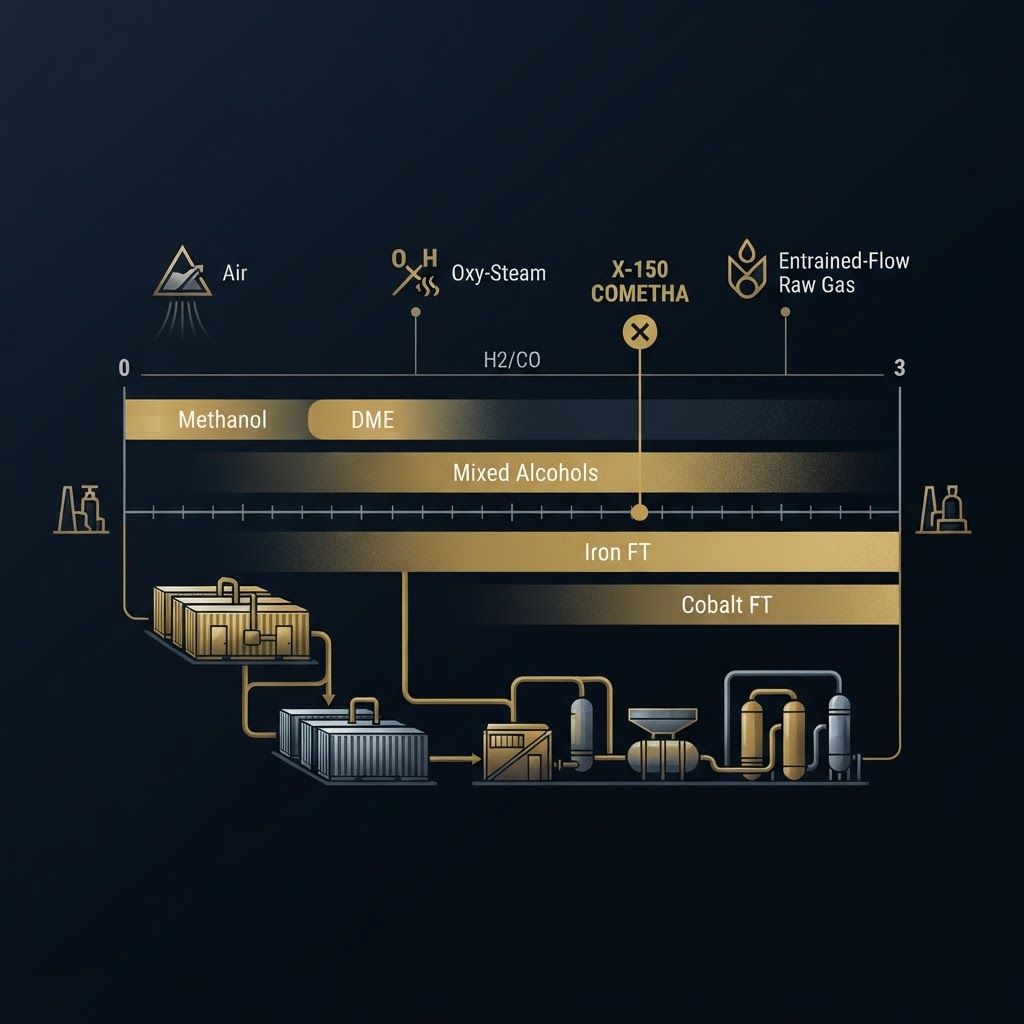
The syngas H2/CO ratio is the molar ratio of hydrogen to carbon monoxide in the gas leaving a gasifier, and it is the first number a catalyst supplier will ask you for. Get it wrong and a methanol or Fischer-Tropsch unit either starves for hydrogen or burns money shifting carbon monoxide into CO2. Get it right at the reactor and the whole downstream train gets smaller.
Most pages on the topic stop at "about 2:1". That is true for some routes and wrong for others, and it says nothing about where the number comes from. This guide does both halves: what each end use actually needs, and which knobs inside the gasifier move the ratio, with our own long-run figure from the X-150 as a reality check.
The target ratio by end use
The short version from the US National Energy Technology Laboratory: synthetic fuels need about 0.6 on iron catalysts and near 2.0 on cobalt, methanol about 2.0, hydrogen production "high", and boiler or turbine fuel gas does not care. The detail matters, so here is the full picture.
| End use | H2/CO target | Why |
|---|---|---|
| Engine, boiler, turbine | Unimportant | Heating value and cleanliness matter, ratio does not |
| Hydrogen | As high as possible | Every CO is shifted to H2 anyway |
| Methanol | About 2, set via the module (H2 minus CO2) over (CO plus CO2) | CO + 2H2 forms CH3OH |
| Fischer-Tropsch, cobalt | Slightly above 2 | Cobalt barely shifts on its own |
| Fischer-Tropsch, iron | 0.6 to 1.7 | Iron shifts internally |
| Mixed alcohols | 1 to 1.2 | Catalyst dependent |
| One-step DME | About 1 | Internal shift supplies the missing hydrogen |
| Syngas fermentation | Not sensitive | Microbes adapt; impurities matter more |
Methanol: watch the CO2 too
Methanol is the route where "2:1" is most often quoted and most often oversimplified. The stoichiometric number that really matters is (H2 minus CO2) divided by (CO plus CO2), which a UK NNFCC gasification review puts above 2 for gas-phase reactors on alumina-supported catalysts. The same review notes the catalyst needs tars with dew points below its operating temperature removed to tens of ppb. So a gas with a perfect 2:1 H2/CO but plenty of CO2 still falls short. Our planned guide to syngas to methanol goes deeper on the loop.
Fischer-Tropsch: the catalyst decides
For Fischer-Tropsch, the catalyst sets the target. Cobalt shows negligible water-gas shift activity, so it needs a ratio slightly above 2 to match what the reaction consumes, a ratio that is not always attainable in biomass gasification, as Lillebø and colleagues put it. Iron has intrinsic shift activity, which is why the NNFCC review gives it the much wider 0.6 to 1.7 window. If your gasifier makes hydrogen-poor gas, iron forgives it; cobalt does not. We cover catalyst and reactor choice in Fischer-Tropsch syngas.
DME and the low-ratio routes
One-step dimethyl ether synthesis runs the other way. Work for the US Department of Energy found the optimal H2:CO ratio for the liquid-phase DME reactor is around 1 to 1, because the shift reaction inside the reactor makes the hydrogen it needs. For CO-rich gas, injecting water into the reactor solves the mismatch. That makes DME one of the few chemical routes where a low-ratio gasifier is an advantage rather than a handicap.
What the gasifier produces before any conditioning
Raw gas rarely lands on target by itself. IEA Bioenergy Task 33 states that methanol needs a molar H2:CO ratio of 2, while clean raw syngas is usually closer to 1 to 1.5. Four things decide where in that range you land.
Reactor type
A reference text on Fischer-Tropsch refining classifies gasifiers by outlet temperature: moving beds at 425 to 650 °C give ratios from above 2:1 to below 1:1, fluidized beds at 900 to 1050 °C give less than 1:1, and entrained flow units at 1250 to 1600 °C give CO-rich gas around 1:2. NETL makes the same point for coal: slagging gasifiers give 0.3 to 1. Hotter, drier reactors favour CO. Our overview of syngas composition shows the full gas analysis behind these numbers.
Gasifying agent
The agent is the biggest single lever. In a 200 kWth pilot that gasified the same residues with every agent combination, Cerone and Zimbardi measured the H2/CO ratio at 0.34 to 0.66 with air, rising to 0.80 to 2.08 once steam was added. A process model of eleven municipal solid waste types reached a blunter conclusion: pure air gasification cannot produce syngas meeting the Fischer-Tropsch requirement of H2/CO of at least 2.15, and air also loads the gas with nitrogen. That is why synthesis routes and oxy-steam gasification go together.
Steam to biomass ratio and temperature
Steam drives the water-gas and shift reactions, so more steam means more hydrogen, up to a point. In a steam gasification study at the University of Castilla-La Mancha, the ratio reached 2.4, the value targeted there for methanol, at a steam to biomass mass ratio of 0.9 and 900 °C. The same work found the ratio fell as temperature rose, because the Boudouard reaction made CO faster than the water-gas reaction made hydrogen.
Temperature is a trade, not a dial. The MSW model above put its optimum, a ratio of at least 2.15 at maximum efficiency, at a steam to biomass ratio of 0.66 to 1.22 and only 679 to 763 °C, and found that above 1000 °C the H2/CO ratio drops while tar and NOx rise. Low temperature helps the ratio and hurts tar cracking. Fixed-bed designs live with that tension every day, which is why gas cleaning is never optional on a synthesis route.
CO2 as a fine trim
Adding CO2 pushes the ratio down through the Boudouard reaction. With steam at 900 °C, going from 0 to 5% CO2 let Butterman and Castaldi set the H2/CO ratio anywhere from 5.5 down to 0.25. Small additions, large effect. For a plant that has overshot its target, or that wants the low ratio a DME reactor prefers, recycled CO2 is the cheapest knob available.
Closing the gap downstream: what a shift reactor costs
When the gasifier cannot reach the target, the standard fix is the water-gas shift: CO + H2O gives H2 + CO2. IEA Task 33 is clear about the bill: the shift produces extra hydrogen but also extra CO2, and the shifted gas generally contains too much CO2 for optimal synthesis, so CO2 removal is usually required. NETL lists shift, acid gas removal and hydrogen separation as the standard conditioning steps.
Three costs follow every point of ratio you buy downstream:
- Carbon. Each mole of CO you shift leaves the process as CO2, not as product.
- Equipment. A shift reactor, steam supply and a CO2 removal step, each of which a small plant has to pay for at small scale.
- Complexity. More units between the gasifier and the catalyst means more places for trace contaminants to break through.
For hydrogen production, the shift is the point: you want every CO converted, which is the route our planned guide to syngas to hydrogen follows. For methanol and cobalt Fischer-Tropsch, every unit of ratio you make inside the gasifier is a unit of carbon you keep.
Our measured number: 1.95:1 over 1,939 hours
Literature ratios mostly come from short tests on clean wood. Waste behaves differently, so here is what our X-150 fixed-bed downdraft gasifier produced in a long campaign. In an 80 day, 1,939 hour continuous run in Paris within the COMETHA project, the unit processed 16,382 kg of digestate pellets in oxy-steam mode and recorded an H2/CO ratio of 1.95:1, 33% hydrogen, zero nitrogen ballast and 99.98% tar conversion.
What that number means against the table:
- Methanol. 1.95 sits right at the 2:1 window, so the remaining check is the CO2 term in the stoichiometric module, not a large shift step.
- Cobalt Fischer-Tropsch. It needs slightly above 2, so a small trim remains. That is a polishing step, not a whole shift train.
- Hydrogen. A third of the gas is already hydrogen before any shift.
- DME. The gas is richer in hydrogen than a one-step DME reactor wants, so CO2 recycle, not shift, would be the knob.
The zero nitrogen figure matters as much as the ratio. Air-blown gas can have a good ratio on paper and still be useless for synthesis, because the nitrogen dilutes every downstream unit. Ratio and cleanliness travel together: our modular gas cleaning system SyngaPure, built to sense tar, H2S and NH3 in real time, was selected for support under the German BMWK go-inno programme. What the economics look like at 150 kg/h is a per-site model, not something one ratio settles. Our ranking of syngas applications puts each route in that context.
How to specify the ratio for your project
Before you compare two gasifier quotes, run these checks:
- Start from the catalyst, not the gasifier. Cobalt FT, iron FT, methanol and DME want different numbers. Write the target down first.
- Ask for the basis. A ratio quoted on a dry, nitrogen-free basis is the useful one; ask how it was measured and over how many hours.
- Ask for the CO2 too. For methanol, H2/CO alone does not tell you whether the stoichiometric module is met.
- Ask which agent and steam ratio produced it. A ratio reached with oxygen and steam will not be reproduced in air mode.
- Ask for long-run data on your feedstock. A short test on clean wood says little about digestate, sludge or MSW.
FAQ
What is a good H2/CO ratio for syngas?
There is no single good value. It depends on the end use: about 2 for methanol, slightly above 2 for cobalt Fischer-Tropsch, 0.6 to 1.7 for iron catalysts, about 1 for one-step DME, and it is unimportant for engine or boiler fuel.
How do you increase the H2/CO ratio of syngas?
Inside the gasifier, add steam or switch from air to oxygen plus steam; downstream, run a water-gas shift reactor, which converts CO and water into hydrogen and CO2 and usually requires CO2 removal afterwards.
How do you lower the H2/CO ratio?
Raise the gasification temperature or add CO2 to the gasifying agent. Both favour the Boudouard reaction, which makes CO from char; small CO2 additions can move the ratio a long way.
Why does air gasification struggle to reach synthesis-grade ratios?
Air brings nitrogen and no extra hydrogen, so the gas is diluted and hydrogen poor. Modelling of municipal solid waste found pure air gasification cannot meet the 2.15 ratio Fischer-Tropsch needs.
We use cookies to improve your experience on this site. By continuing, you agree to our Privacy Notice.