Syngas Heating Value: LHV by Agent, Feedstock and Use
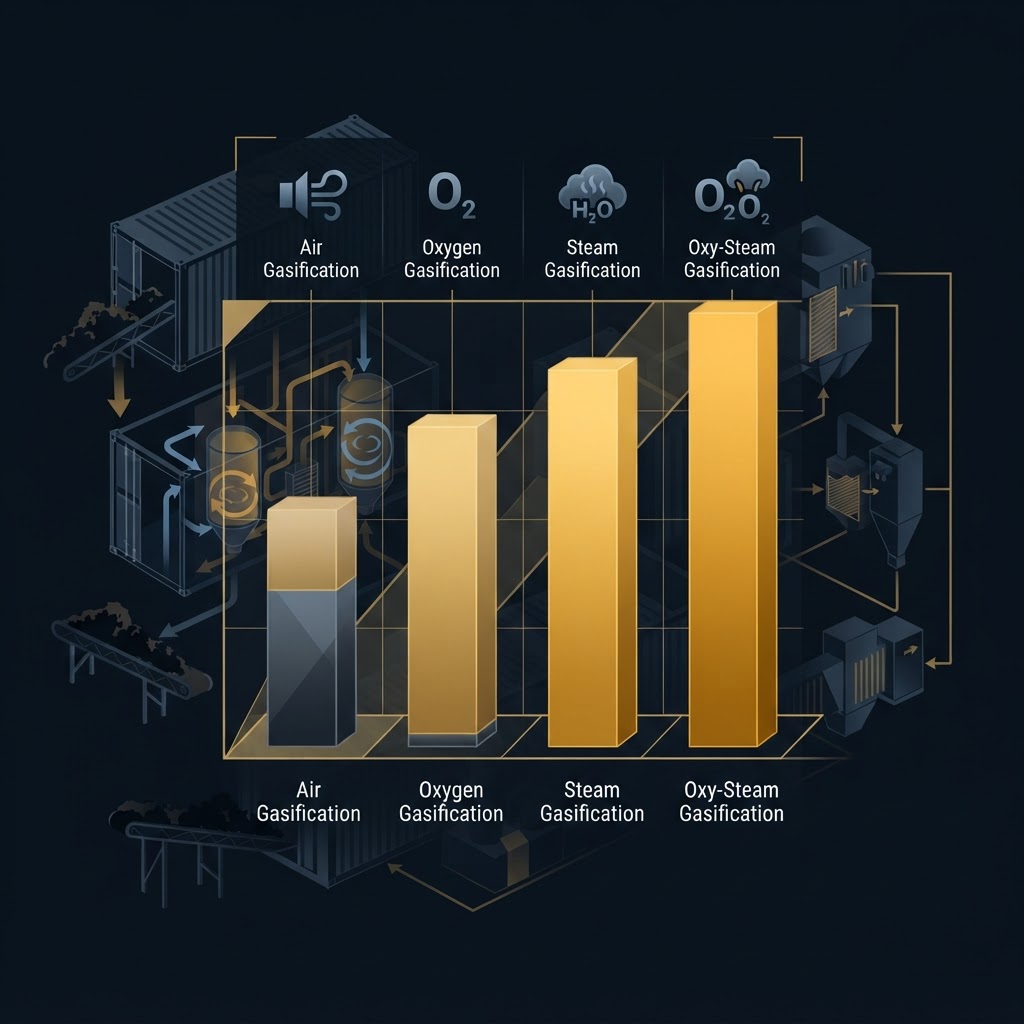
Syngas heating value is the energy released when a normal cubic metre of the gas burns, and for gasification syngas it lands anywhere between about 3 and 18 MJ/Nm3. That spread is the whole story. The same gasifier can produce weak fuel or strong syngas depending on one choice, what you blow into it, and a second, what you feed it.
Most pages on this topic are academic reviews with one number buried in a long table. This one is a working reference: the constants, the formula, a worked example, the typical values by gasifying agent and feedstock, and the minimum each application needs. At the end we explain why, after running our X-150 for 1,939 hours, we stopped treating a big MJ number as the goal.
What syngas heating value means
Syngas is a mix of burnable gases (hydrogen, carbon monoxide, methane, a few light hydrocarbons) diluted by gases that do not burn (nitrogen, carbon dioxide, water vapour). Its heating value is simply the weighted sum of what the burnable part can release. If you want the full breakdown of what is in the gas, start with our guide to syngas composition.
LHV vs HHV
Every combustible gas has two heating values. The higher heating value (HHV) assumes the water formed in combustion condenses and gives back its latent heat. The lower heating value (LHV) assumes it leaves as vapour, which is what happens in an engine, turbine or burner. The gap only matters for gases that contain hydrogen: in the IEA Bioenergy Task 33 survey of gasification labs and companies, hydrogen is about 12.75 MJ/Nm3 HHV against 10.78 LHV, while carbon monoxide is 12.63 for both, because burning CO makes no water.
Gasification people report LHV almost by default. If a supplier quotes HHV, the number will look better than the gas really is.
Why MJ/Nm3 and not MJ/kg
Gas is metered by volume, so heating value is given per normal cubic metre: dry gas at 0 C and 1013 mbar, the reference several Task 33 participants state explicitly. A per-kilogram figure flatters hydrogen-rich gas because hydrogen is so light, which is why you rarely see it for syngas.
How to calculate syngas LHV from a gas analysis
You do not need a calorimeter. If you have a gas chromatograph reading in volume percent, you can calculate the LHV yourself.
The component constants
The values the industry converges on, from the same Task 33 comparison, are:
| Component | LHV, MJ/Nm3 | HHV, MJ/Nm3 |
|---|---|---|
| Hydrogen (H2) | 10.78 | 12.75 |
| Carbon monoxide (CO) | 12.63 | 12.63 |
| Methane (CH4) | 35.88 | 39.82 |
| Ethylene (C2H4) | 59.46 | 63.41 |
| Ethane (C2H6) | 64.35 | 70.29 |
| Nitrogen, CO2, water | 0 | 0 |
The formula is then one line, the one used across the literature, for example in this review of syngas fuel properties:
LHV = (10.78 x H2 + 12.63 x CO + 35.88 x CH4 + higher hydrocarbons) / 100
with each gas in volume percent of the dry gas.
Worked example
Take a typical air-blown producer gas: 10% H2, 16% CO, 4% CH4, 53% N2 and 17% CO2. Plug it in:
- Hydrogen: 0.10 x 10.78 = 1.08 MJ/Nm3
- Carbon monoxide: 0.16 x 12.63 = 2.02 MJ/Nm3
- Methane: 0.04 x 35.88 = 1.44 MJ/Nm3
- Nitrogen and CO2: 0
Total: about 4.5 MJ/Nm3, the same 4.508 MJ/Nm3 reported for this composition in an engine study. Two lessons come out of the arithmetic. Methane punches far above its share: 4% of the volume gives a third of the energy. And 70% of this gas does nothing at all.
Typical syngas heating value by gasifying agent
The gasifying agent is the single biggest lever. Air brings roughly four volumes of nitrogen for every volume of oxygen, and all of it ends up in your gas.
| Gasifying agent | Typical H2, vol% | Typical N2, vol% | LHV, MJ/Nm3 |
|---|---|---|---|
| Air | 8 to 18 | 45 to 55 | 4 to 7 |
| Oxygen | 20 to 30 | 0 to 3 | 10 to 12 |
| Steam | 40 to 55 | 0 to 3 | 12 to 14 |
| Oxygen and steam | 30 to 45 | 0 to 3 | 10 to 14 |
Ranges from the combustion modelling review by Copa Rey and colleagues. Other sources broadly agree. A widely cited overview in Energy and Environmental Science puts air gasification at 4 to 7 MJ/Nm3 and pure oxygen at up to 12 to 28. One benchmarking study sorts gas into low (4 to 6), medium (12 to 18) and high (around 40 MJ/Nm3) bands. A review of syngas production parameters gives 10 to 18 MJ/Nm3 for steam gasification.
Real reactors sit below the textbook ranges more often than above them. In small two-stage downdraft units:
- In that same review, a downdraft reactor fed oxygen plus saturated steam made gas of 7.13 to 8.35 MJ/m3, nearly double the air case.
- A pilot study at UCLouvain replaced secondary air with oxygen and steam and lifted LHV by 55%, from 4.4 to 6.8 MJ/Nm3. Oxygen alone did better, but steam was needed as a thermal damper against excessive temperatures.
- An ENEA updraft pilot reached 10.9 MJ/m3 in oxy-steam mode, its best result of the ten conditions tested, with an H2/CO ratio of 2.08.
The jump from air to oxygen and steam is less about making more fuel and more about removing the nitrogen that dilutes it. Our syngas vs producer gas comparison covers that distinction in depth.
Syngas heating value by feedstock
Feedstock moves the number almost as much as the agent. From the feedstock tables in the Khlifi et al. review cited above, and others:
| Feedstock | Process | LHV, MJ/Nm3 |
|---|---|---|
| Medical waste | Pyrolysis, 600 C | 16.25 |
| Corn stalk briquettes | Air, ER 0.31 | 11.68 |
| Olive kernel | Air downdraft, ER 0.21 | 10.5 |
| Sewage sludge | Pyrolysis, 600 C | 6.72 |
| Spruce wood pellets | Gasification | 5.78 |
| Beech wood | Air fluidized bed | 4.82 to 5.0 |
| Rice husks | Air cyclone | 3.63 to 4.23 |
| Wheat straw | Pyrolysis | 3.45 to 3.79 |
For waste, a Slovak team gasifying refuse-derived fuel pellets reached a maximum of 11.9 MJ/Nm3 with a catalyst, against 9.9 without. The US DOE's biomass gasification benchmark lists 4 to 13 MJ/m3 across bubbling fluidized bed units and 4 to 7.5 across circulating ones, with the indirectly heated, nitrogen-free FERCO process at 18.0.
Read feedstock tables with care. The high figures above are often pyrolysis gas, rich in methane, not gasification syngas. Comparing them with an air-blown downdraft is comparing a different process.
What drags heating value down
Nitrogen
Covered above, and it is the dominant factor. Every percent of nitrogen is a percent of zero-value gas you pay to move, clean and compress.
Equivalence ratio
The equivalence ratio (ER) is how much oxygen you supply relative to full combustion. Push it up and you burn your own product. In one study cited by Khlifi, raising ER from 0.2 to 0.5 cut H2 from 16.7% to 3.17% and dropped LHV from 5.97 to 1.30 MJ/Nm3.
Moisture and ash
Wet feedstock shifts the gas toward hydrogen and CO2 and away from CO and methane, the most energy-dense component. Ash matters too: across published data, LHV falls by about 0.09 MJ/Nm3 for every extra percent of ash, which is one reason high-ash sludge gas is weaker than medical waste gas in the table above. Temperature cuts both ways: in a fluidized bed comparison on wood sawdust, LHV rose with temperature under steam and oxygen but fell under air. Torrefied sawdust with oxygen gave the best result, 9.31 MJ/Nm3.
How much heating value does your application need
This is the question that should drive your design, and the answer is less than most people think for power, and irrelevant for chemicals.
- Gas turbines: need at least 3.5 MJ/Nm3 to stay lit, per the RDF study above, plus very clean gas.
- Gas engines: run on 4 to 6 MJ/Nm3 producer gas. The power loss is smaller than the heating value suggests, because what the engine sees is the energy density of the air and fuel mixture, so the engine study above found the derating penalty very small. See our syngas CHP guide for the engine side.
- Boilers: the DOE benchmark lists a high heating value as desirable for fuel gas, while H2/CO ratio and CO2 barely matter.
- Hydrogen, methanol and synthetic fuels: the same DOE table marks heating value as unimportant. What matters is a low nitrogen content, the right H2/CO ratio and contaminants below 1 ppm sulfur.
So if you are buying a gasifier for electricity, a 5 MJ/Nm3 gas is fine and the money goes into tar removal. If you want hydrogen, chasing MJ/Nm3 is the wrong target.
Why we chase nitrogen-free gas, not a bigger MJ number
At Zero-X we design for hydrogen and chemical-grade syngas, so heating value is a side effect, not the spec. In our 1,939-hour continuous X-150 campaign in Paris, 80 days on 16,382 kg of digestate pellets, the gas held 33% hydrogen at an H2/CO ratio of 1.95:1 in oxy-steam mode, with zero nitrogen ballast and 99.98% tar conversion.
Run our own numbers through the formula: 33% H2 and about 17% CO (from the 1.95 ratio) contribute 3.56 plus 2.13, roughly 5.7 MJ/Nm3 before any methane. That is not a headline figure next to a 12 MJ/Nm3 lab result on clean wood. But it comes from digestate, a feedstock most wood gasifiers cannot handle, and every cubic metre of it is gas you can shift, separate and sell as hydrogen. A 6 MJ/Nm3 air-blown gas carrying 50% nitrogen cannot be upgraded at all without first paying to remove that nitrogen.
That is the practical rule. Calculate LHV to size your burners and engines. But judge syngas for hydrogen or fuels by its nitrogen content and H2/CO ratio. Our oxy-steam gasification guide explains how the mode works, and if you are sizing a plant, start with how much syngas a gasifier produces per kilogram of feed.
FAQ
Is syngas heating value higher than natural gas?
No. Natural gas is mostly methane, at about 35.9 MJ/Nm3 LHV. Even the best nitrogen-free syngas reaches roughly half of that, and air-blown gas only a sixth, because hydrogen and CO carry about a third of methane's energy per cubic metre.
What is the heating value of syngas in Btu/scf?
The US DOE reported coal syngas at the Wabash River plant at about 254 to 284 Btu/scf HHV over four years of operation. Biomass syngas from air gasification sits well below that.
Does higher gasification temperature always raise LHV?
No. With steam or oxygen, higher temperature generally raises LHV because more H2 and CO form. With air, the same wood sawdust study saw LHV fall as temperature rose.
We use cookies to improve your experience on this site. By continuing, you agree to our Privacy Notice.