Syngas CHP: Gas Engines, Derating and Gas Quality Limits
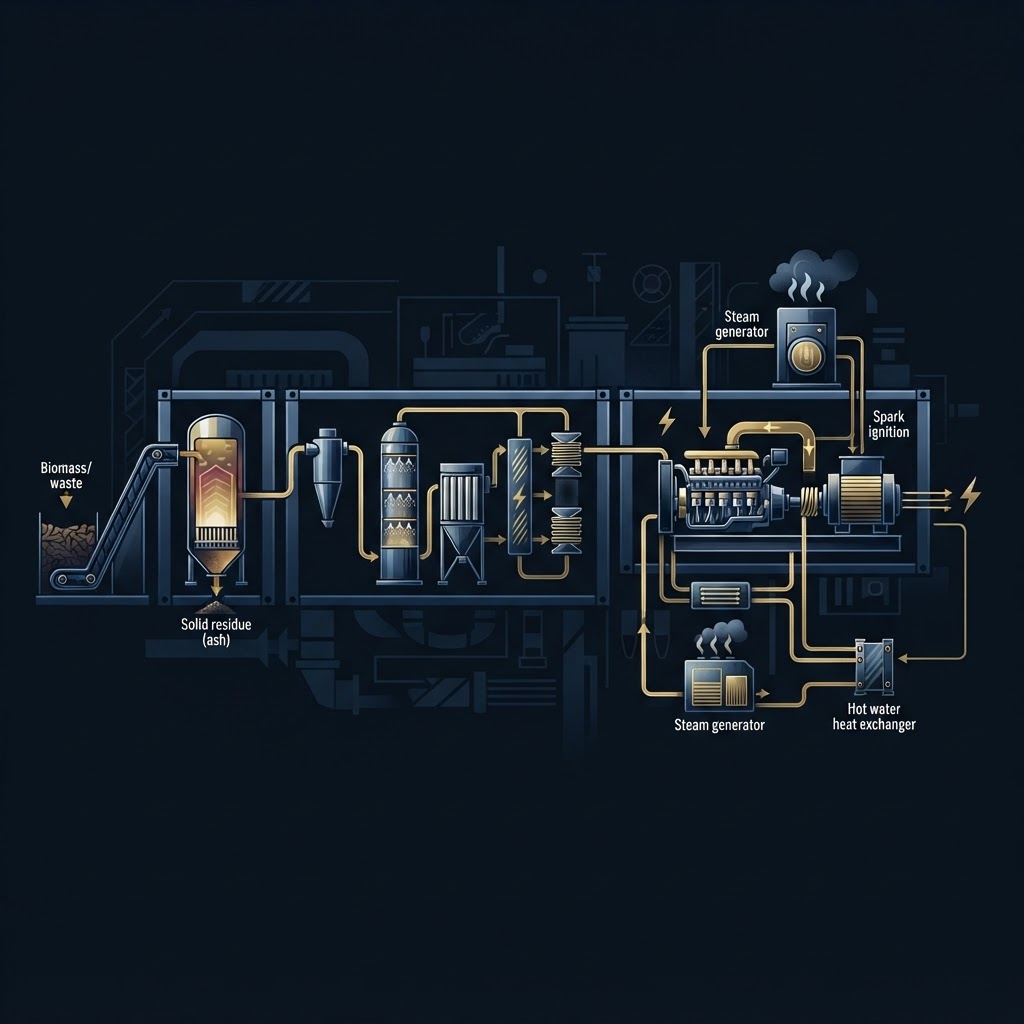
Syngas CHP sounds simple. Gasify a solid fuel, burn the gas in an engine, sell the electricity and use the heat. Engine makers will tell you their machines can do it, and they are right. What they rarely put on the same page is the list of conditions: how clean the gas has to be, how much of the engine's nameplate you lose, and what happens when the feedstock is waste instead of clean wood chips.
This guide walks through that list in the order an engineer would check it. Gas quality first, then derating, then the hydrogen question, then the hard public numbers on waste. If you are sizing a syngas combined heat and power plant, these are the four things that decide whether it runs.
What a syngas CHP plant is
A syngas CHP plant has four blocks: a gasifier that turns solid fuel into a combustible gas, a cleaning train that cools and scrubs it, a spark ignition gas engine driving a generator, and heat exchangers on the engine jacket and exhaust. It is the industrial big brother of the packaged gasifier generator, built to run continuously and to sell both products.
At small scale the engine is almost always the right prime mover. A Swedish Energy Agency inventory of small gasifier plants put net electrical efficiency at 13 to 28% for gas engines, 10 to 20% for steam turbines and 15 to 25% for gas turbines, noted that steam turbines need to be larger than 2 MWel to be efficient, and found that engines lose very little efficiency at part load. The same report gives the reason CHP exists at all: a plant making only electricity runs at 25 to 35% overall, while one that uses its heat reaches 70 to 90%.
Power and heat are the first rung of the syngas applications ladder. They are also the most forgiving one, which is why most small gasification projects start here.
Gas quality limits: what the engine will accept
Forgiving is not the same as tolerant of anything. An engine is a precision machine that breathes whatever the gasifier sends it.
Tar and particulates
A 2024 review of syngas requirements in Frontiers in Energy Research summarises the literature for internal combustion engines: particulates at or below 50 mg/Nm3 and tars at a maximum of about 100 mg/Nm3, with its own reference table using 50 mg/Nm3. Tar condenses in piping and on valves. Dust grinds moving parts.
Now compare that with what comes out of a gasifier. Small fixed bed gasifiers produce 50 to 500 mg/Nm3 of particles and 50 to 1,000 mg/Nm3 of heavy tar in the raw gas. In the worst case that is ten times the engine limit on both counts. The gap between raw gas and engine inlet is the whole job of syngas cleaning, and tar is the hardest part of it (our guide to tar removal from syngas covers the methods).
Sulphur, ammonia and chlorine
The same Frontiers review lists the trace limits that cause corrosion and emissions trouble: ammonia below 78 ppmv, because it burns to NOx, hydrogen chloride below 330 ppmv, and H2S up to 812 ppmv. Clean wood is easy here. The Swedish report measured H2S at 30 to 150 vppm on woody biomass and up to 500 vppm on peat. Waste is a different animal: sludge carries nitrogen and sulphur, plastics carry chlorine. MWM distributor Edina says it bluntly: with waste feedstocks gas clean-up is essential.
Why cleaning is a third of the plant
Researchers at Vrije Universiteit Brussel found that the cooling and scrubbing steps account for one third of gasification facility costs and involve a great amount of maintenance. That is why the cleaning train, not the engine, is usually where syngas CHP projects succeed or stall.
It is also where Zero-X put its engineering effort. SyngaPure, our modular cleaning system, removes 99% of tar compounds and monitors tar, H2S, ammonia and particulates in real time with AI control. In December 2025 it was selected for support under the German BMWK go-inno program.
Derating: why a 1 MW engine makes 600 kW
Clean gas gets the engine running. It does not get you the nameplate.
Low heating value and nitrogen
Air-blown gasification pulls nitrogen in with the air. UK gasifier maker Refgas publishes its air-fed syngas at about 5 MJ/Nm3 with 45 to 54% nitrogen, 12 to 17% hydrogen and 17 to 21% carbon monoxide, and says an engine rated at 1 MWe on natural gas gives about 600 kWe on that gas. Half the cylinder volume is filled with a gas that does not burn. See syngas composition for how the mix shifts with the gasifying agent.
A modelling study of a commercial micro CHP unit adds a second cause: the cleaning train creates a pressure drop that cuts the engine's volumetric efficiency, so direct syngas use generally implies a power derating of about 30%.
Hydrogen, knock and methane number
Hydrogen burns much faster than methane. Clarke Energy, the Jenbacher distributor, explains that without countermeasures this leads to pre-ignition, knock and backfiring, so syngas engines get modified combustion control and dedicated safety systems. The result: output typically falls to 50 to 70% of the natural gas rating, so an engine rated at 1,063 kW on natural gas delivers about 730 kW on syngas.
The industry measures knock resistance with the methane number. In the CIMAC gas quality guideline, methane scores 100 and hydrogen 0, and standard Western European engines are optimised for a methane number of 70 to 80. Below that range, engines need derating or hardware changes such as lower compression ratios. Syngas sits well below it. The full engine side of this story belongs in our upcoming guide to the syngas engine.
What derating means for sizing
Size on derated kilowatts, never on catalogue kilowatts. If your site needs 500 kWe, you are buying an engine rated somewhere between 700 kW and 1 MW on natural gas, and paying for that iron. Ask the engine maker for a derating curve against your actual gas analysis, not a generic syngas figure.
Air-blown versus oxy-steam syngas for CHP
The nitrogen problem has a direct fix: do not let nitrogen in. Gasifying with oxygen and steam instead of air produces a gas with no nitrogen ballast and far more hydrogen.
Our numbers from the field: in an 80-day, 1,939-hour continuous X-150 campaign in Paris, running in oxy-steam mode on 16,382 kg of digestate pellets, the syngas held 33% hydrogen at an H2/CO ratio of 1.95:1 with zero nitrogen ballast and 99.98% tar conversion. Compare that with the 12 to 17% hydrogen in air-blown gas above.
We will be straight about the trade-off. More hydrogen and no nitrogen mean a richer gas per cubic metre (more on that in syngas heating value). They also mean a lower methane number, so the engine has to be specified and approved for a hydrogen-rich fuel from the start. That is also why hydrogen-rich syngas is worth more as a feedstock for hydrogen or chemicals than as engine fuel. For a CHP project, the honest question is which product pays best per tonne of waste.
Waste feedstock: what the public data shows
Most published syngas CHP data comes from clean wood. One of the few public tests on mixed waste is Enerkem's project funded by Natural Resources Canada. Shredded mixed waste was gasified in a bubbling fluidised bed to a clean syngas of under 6 MJ/Nm3 and burned in a GE Jenbacher engine for 355 hours. The coupling worked. The engine lost 30 to 40% of its nominal output.
The economics were sobering. The 422 kW demonstration cost $12M, a scaled 1 MW system was estimated at $15M, and a 1 MW plant would need about 8,000 tonnes of dry biomass and waste a year. The project concluded that remote communities might not have enough local feedstock.
Two lessons for anyone planning waste-to-CHP. First, feedstock logistics dominate, so lock in your supply before you lock in your engine. Second, capital is the hurdle, which is why grants matter. In Zero-X's target markets, governments fund 56 to 70% of project CAPEX, and the X-150 has been validated on high-ash sludge, MSW and digestate at COMETHA, Fraunhofer IKTS and Hochschule Zittau/Goerlitz.
Where the heat goes
The "H" in CHP only counts if something absorbs it. Engine heat can be recovered as 90 C hot water, raised to steam, or turned into chilled water through absorption cooling driven by waste heat, as Refgas describes for its plants. Typical uses are district heating, process heat, and drying the plant's own feedstock, which matters a lot for wet wastes like sludge and digestate. If there is no year-round heat sink, you are building a power plant at 25 to 35% efficiency, not a CHP plant at 70 to 90%.
Syngas CHP checklist before you buy
- Gas analysis at the engine inlet. Tar, particulates, H2S, NH3 and HCl measured on your feedstock, after cleaning, not a brochure value for wood.
- Engine approval for your gas. Written confirmation from the engine maker that your hydrogen content and methane number are inside its operating envelope.
- Derated output. Contract on kWe at your gas quality. Expect 50 to 70% of the natural gas rating.
- Cleaning train availability. Who services the scrubbers and filters, how often, and what happens to the condensate.
- Continuous hours on waste. Ask for logged continuous run hours on a feedstock like yours, not total hours on clean pellets.
- A real heat sink. Name the user of every kilowatt of heat, by month.
- Funding route. Grants or subsidies identified before engineering starts.
FAQ
Can a natural gas engine run on syngas?
Yes, if it is configured for it. Syngas engines use adapted combustion control and safety systems to manage hydrogen's fast flame speed. Expect output of roughly 50 to 70% of the natural gas rating.
How clean does syngas need to be for a gas engine?
Published guidance puts particulates at or below 50 mg/Nm3, tar at 50 to 100 mg/Nm3, ammonia under 78 ppmv and HCl under 330 ppmv. Engine makers set their own limits, so get the specification for the exact engine you plan to buy.
Is a gas engine or a gas turbine better for syngas CHP?
At small scale, a gas engine. It has higher electrical efficiency at small sizes and holds efficiency at part load. Turbines also need much cleaner gas: the Frontiers review lists a tar limit of 5 mg/Nm3 for gas turbines against 50 for engines.
What is the efficiency of a syngas CHP plant?
Net electrical efficiency for small gasifier engine plants runs about 13 to 28%. Using the engine's heat lifts overall efficiency from 25 to 35% for power only to 70 to 90%.
We use cookies to improve your experience on this site. By continuing, you agree to our Privacy Notice.