Syngas vs Producer Gas: The Difference That Matters
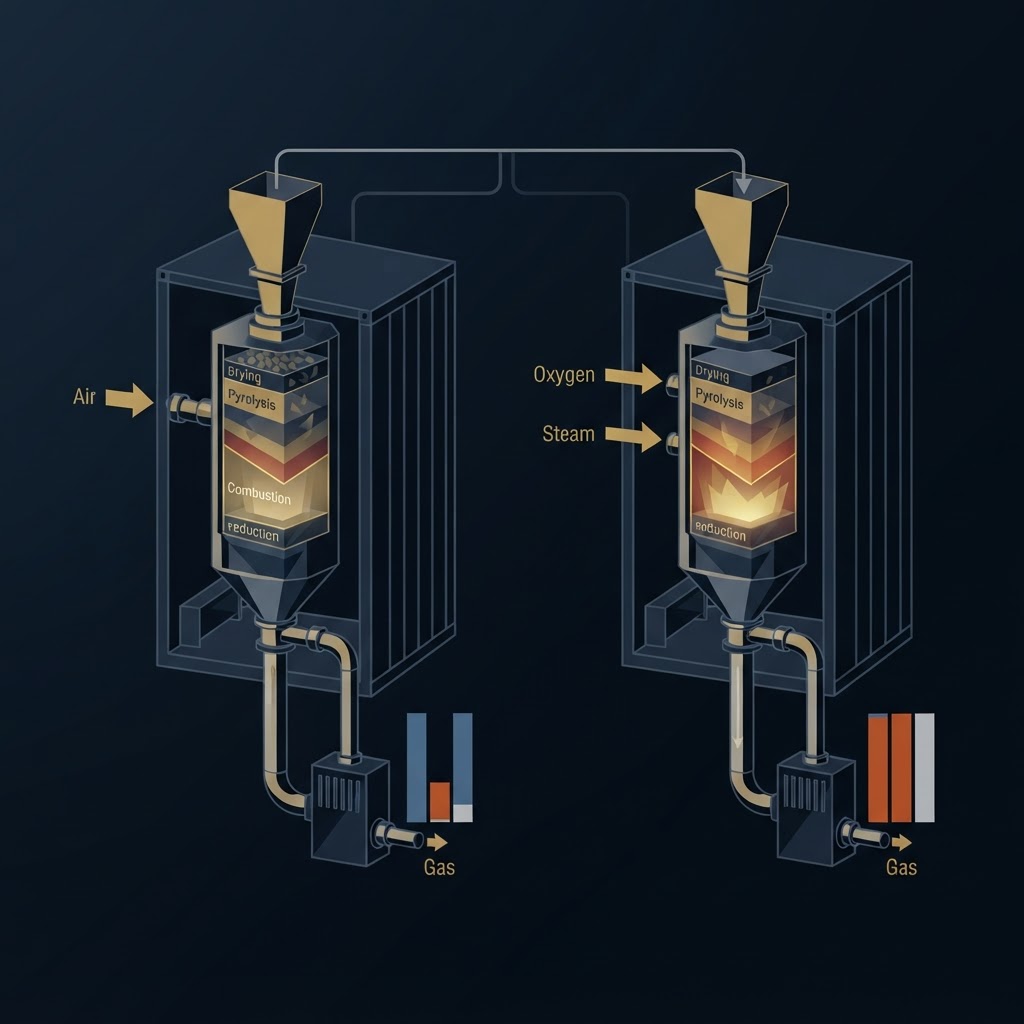
The syngas vs producer gas question has a one-line answer that most pages bury: it comes down to what you blow into the gasifier. Blow in air and the gas leaves carrying the nitrogen from that air. Blow in oxygen, steam or a mix of the two and it does not. The chemistry inside the reactor is mostly the same. The gas that comes out is not, and that difference decides whether you can only burn it or can also build hydrogen and chemicals from it.
The cleanest line in the literature is drawn by nitrogen. A review of biomass gasification thermochemistry defines producer gas as gas from air that is diluted with more than 45 vol% nitrogen, while nitrogen-free agents give syngas with 5 vol% or less. If you want the full component breakdown, H2, CO, CO2 and CH4 by gasifying agent, we keep that in our guide to syngas composition. This page is about the names, what each gas can actually do, and how you end up with one or the other.
Why the two names get mixed up
If you have read three sources on this and come away with three answers, the sources are not wrong. They are using the words differently.
The US and UK use producer gas differently
The US patent office's classification notes spell out the split. In the USA, producer gas is a generic term covering wood gas, town gas, synthesis gas, syngas and raw gas; in the UK it means a specific fuel gas made by passing air over red-hot fuel, diluted by the nitrogen in that air. So an American spec sheet may call oxygen-blown gas "producer gas", and a British engineer would say that is a contradiction.
Syngas as a catch-all
The opposite habit also exists. A review of syngas in engines notes that syngas is a general name for any gasification product, and that town gas, water gas, producer gas and blast furnace gas were earlier names for specific products. The same paper then uses the tighter definition in practice: air gives "producer gas" at 4 to 7 MJ/Nm3, steam or oxygen gives medium calorific syngas at 10 to 28 MJ/Nm3.
Our working rule, and the one the modern gasification literature converges on: if the gas carries roughly half its volume as nitrogen from air, call it producer gas. If the nitrogen is a few percent, call it syngas. That definition is useful because it predicts what the gas can be used for.
Syngas vs producer gas side by side
| Producer gas | Syngas | |
|---|---|---|
| Gasifying agent | Air | Oxygen, steam, or oxy-steam |
| Nitrogen in the gas | Above 45 vol% | 5 vol% or less |
| Heating value | 4 to 7 MJ/Nm3 | 10 to 28 MJ/Nm3 (medium calorific) |
| Pipeline transport | Not practical | Possible |
| Typical use | Boilers, engines, CHP on site | Hydrogen, methanol, Fischer-Tropsch fuels, also power |
| Cost to make | Lowest, air is free | Needs an oxygen or steam supply |
Nitrogen and heating value follow the sources above. The Arkansas extension fact sheet on gasification puts it in US units: air-blown gas carries 142 to 209 Btu/ft3 and cannot be moved through pipelines, while oxygen-blown gas reaches about 321 to 563 Btu/ft3 and can be, at the price of needing a nearby oxygen source that raises capital and operating costs. For scale, a University of California extension deck puts natural gas at about 1,000 Btu/ft3 against roughly 100 to 200 for producer gas.
What each gas can and cannot do
Producer gas: burn it close to where it is made
Producer gas is a fine fuel as long as you burn it right away. The same fact sheet lists its uses as heat in a boiler, electricity from a gas engine, or combined heat and power. Our gasifier generator guide covers that setup in detail.
The limit is the nitrogen. Every cubic metre of it is inert volume that takes up space in the engine cylinder. The engine review cited above found that power and torque losses were most pronounced with the lower calorific producer gases, mainly because of a volumetric efficiency penalty: the fuel displaces air the engine would otherwise use. You can make power from producer gas. You simply get less of it per litre of engine.
Syngas: a chemical feedstock
Take the nitrogen out and the gas becomes something chemists can use. The thermochemistry review quoted in the introduction lists the routes open to low-nitrogen syngas: enhanced hydrogen production through the water-gas shift reaction, and synthesis of methanol, dimethyl ether and Fischer-Tropsch liquids and waxes. Wikipedia's syngas entry sums up the mainstream industrial use as making ammonia or methanol.
You can still burn syngas for power, and it does that better than producer gas. But the reason to pay for oxygen or steam is to unlock the chemistry, which is where the syngas applications with the highest value per tonne of waste sit.
The key point for project developers: you cannot fix producer gas into syngas downstream at reasonable cost. Nitrogen does not react and is not trapped by a scrubber. Once air is in the reactor, the gas is producer gas, and every piece of equipment after it is sized for that ballast.
Why most small gasifiers make producer gas
If syngas is so much more useful, why is almost every small gasifier on the market air-blown? Cost and simplicity. The UC deck states plainly that small systems are generally air-blown downdraft or updraft units, and a review of syngas production from biomass notes that air is widely used because of its low cost, even though its nitrogen lowers the calorific value.
Here is what that looks like in a measured run. A conference test on an air-blown biomass unit reported 50.71% nitrogen and a heating value of 5.2 MJ per cubic metre, with about 40% of the gas combustible. The same authors note that oxygen gasification can reach 14 to 18 MJ per cubic metre. That is the gap between producer gas and syngas in a single experiment.
So the honest answer for a classic downdraft gasifier running on air is: it makes producer gas, it makes it well, and the gas belongs in an engine or a burner next to the reactor.
Getting syngas from a small fixed-bed unit
The assumption that only large oxygen-blown plants make real syngas is out of date. The ACS Omega review cited above also describes a two-stage downdraft reactor fed with oxygen plus steam that produced 27.4 to 35.9% hydrogen, nearly twice the concentration from air or air plus steam.
This is the side of the line the Zero-X X-150 was built for. In our COMETHA campaign in Paris, the X-150 ran 1,939 hours continuously on 16,382 kg of digestate pellets, producing syngas with 33% hydrogen, an H2/CO ratio of 1.95:1 and zero nitrogen ballast in oxy-steam mode, with 99.98% tar conversion. Same fixed-bed downdraft family as the air-blown units above, different agent, different gas. A ratio close to 2:1 is what methanol and Fischer-Tropsch synthesis want, which is why we treat the agent choice as the first design decision rather than a tuning parameter.
Removing nitrogen is half the job. A chemical-grade gas also has to be clean, which is why the X-150 is paired with SyngaPure, our syngas cleaning system that removes 99% of tar compounds so the gas can go to hydrogen rather than only to a burner. More on that step in tar removal from syngas.
Water gas, wood gas and town gas
These older names still turn up in search, in spec sheets and in old engineering texts. Here is where they fit:
- Water gas: CO and H2 made by passing steam over hot coke. Wikipedia describes the steam step as producing water gas in older terminology, with air blasts in between producing producer gas. It is a historical form of syngas.
- Wood gas: producer gas made from wood in an air-blown gasifier, the gas that ran cars in wartime Europe.
- Town gas (or city gas): any manufactured gas sold to households for light and heat. Wikipedia's producer gas page lists water gas, coal gas, coke oven gas and town gas as members of the same family, and notes that syngas can describe any of them but usually means modern industrial processes.
FAQ
Is syngas the same as water gas?
Not exactly. Water gas is a historical form of syngas: carbon monoxide and hydrogen made by blowing steam through hot coke. Syngas today is the broader term and also covers oxygen and oxy-steam gas made from biomass and waste.
Can producer gas be turned into syngas after the gasifier?
Not economically in practice. The nitrogen arrives with the air, does not react and is not removed by normal gas cleaning. The practical way to get syngas is to change the gasifying agent at the reactor inlet to oxygen, steam or both.
Can producer gas be sent through a pipeline?
Generally no. Its low energy content per cubic metre makes moving it any distance uneconomic, so it is burned on site. Medium energy syngas from oxygen gasification can be piped.
Is wood gas producer gas?
Yes. Wood gas is producer gas made from wood in an air-blown gasifier. In US usage the terms are often treated as interchangeable.
We use cookies to improve your experience on this site. By continuing, you agree to our Privacy Notice.